Unit 8 · Topic 8.1 · about 30 minutes · 7 parts · 11 scored checks, 1 of them multiple choice, plus 2 from earlier lessons
AP Chemistry 8.1: Introduction to Acids and Bases
Unit 8: 11 to 15% of the multiple-choice section
What you'll be able to do
- Calculate pH and pOH for neutral water from Kw and the concentrations of H₃O⁺ and OH⁻, including at temperatures other than 25 °C.
Key vocabulary
| Term | What it means | The exam trap |
|---|---|---|
| pH | The negative base-10 logarithm of the hydronium ion concentration, pH = −log[H₃O⁺]. | Count the significant figures in the concentration before you decide how many decimal places the pH keeps. |
| pOH | The negative base-10 logarithm of the hydroxide ion concentration, pOH = −log[OH⁻]. | Check whether a question asks for pH or pOH, because the two are different numbers for the same solution. |
| Hydronium ion | H₃O⁺(aq), the ion that forms when an H⁺ attaches to a water molecule; H⁺(aq) is often written for the same ion. | Treat H⁺(aq) and H₃O⁺(aq) as the same ion unless a question says otherwise. |
| Autoionization of water | The reaction in which two water molecules form one H₃O⁺ ion and one OH⁻ ion, 2 H₂O ⇌ H₃O⁺ + OH⁻. | Remember that this equilibrium is always present, so a question about water alone is still a question about ions. |
| Kw | The ion-product constant of water, Kw = [H₃O⁺][OH⁻], which equals 1.0 × 10⁻¹⁴ at 25 °C. | Look at the temperature a question gives before you choose a value for Kw. |
| Neutral solution | A solution in which pH equals pOH, so [H₃O⁺] equals [OH⁻]. | Read what the question gives you about both ions before you call a solution neutral. |
 Tap to open the picture full size
Part 1 Think first Heating pure water
Commit to a guess first. Being wrong now makes the right idea stick better.
Predict first
A chemist has a flask of pure water: distilled, with nothing dissolved in it. A calibrated pH meter reads 7.00 at 25 °C. She warms the flask to 60 °C, stirs, and reads the meter again. What does she most likely see?
In short. pH is the negative logarithm of the hydronium ion concentration, and water ionizes a little, so [H₃O⁺] times [OH⁻] always equals Kw.
- pH = −log[H₃O⁺] and pOH = −log[OH⁻]; at 25 °C, Kw = 1.0 × 10⁻¹⁴ and pH + pOH = 14.00.
- Pure water is neutral because [H₃O⁺] equals [OH⁻], which means pH equals pOH.
- Kw depends on temperature, so neutral water has a pH of 7.00 only at 25 °C.
Part 2 Learn it From concentration to pH
2a. pH and pOH
Chemists report the concentration of hydronium ion, H₃O⁺, and hydroxide ion, OH⁻, as a pH and a pOH, because these concentrations cover many powers of ten.
pH = −log[H₃O⁺]
pOH = −log[OH⁻]
The square brackets mean molar concentration, in mol/L. The terms hydrogen ion and hydronium ion are often used interchangeably, and H⁺(aq) means the same ion as H₃O⁺(aq). This course writes H₃O⁺, and H⁺(aq) is also accepted on the AP Exam.
A smaller concentration gives a larger pH, and every tenfold change in concentration changes the pH by exactly 1. For example, [H₃O⁺] = 1.0 × 10⁻³ M gives pH 3.00.
Logarithms use significant figures differently from other math. The digits after the decimal point in a pH equal the significant figures in the concentration. So [H₃O⁺] = 2.5 × 10⁻⁴ M, which has two significant figures, gives pH 3.60, with two decimal places.
Quick check · Calculate
The hydronium ion concentration of a sample of rainwater is 3.2 × 10⁻⁵ M. What is its pH? Give the number of decimal places that two significant figures in the concentration allow.
2b. Water ionizes a little
Pure water is not only H₂O molecules. A tiny fraction of them react with one another, in a process called autoionization:
2 H₂O(l) ⇌ H₃O⁺(aq) + OH⁻(aq)
This is an equilibrium, and its equilibrium constant is the ion-product constant of water, Kw:
Kw = [H₃O⁺][OH⁻] = 1.0 × 10⁻¹⁴ at 25 °C
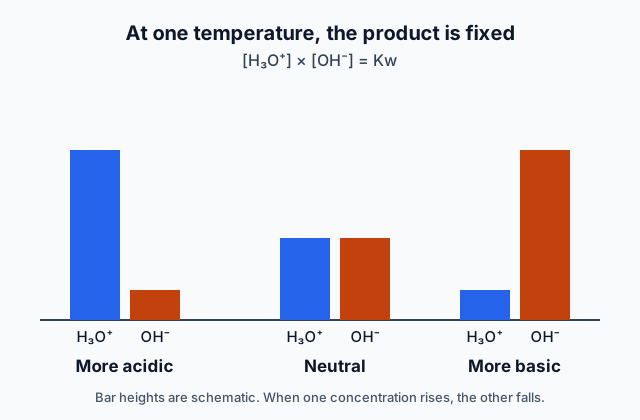
The product is fixed, so when one concentration rises the other falls. Taking −log of both sides gives the same rule for the p-values:
pH + pOH = pKw = 14.00 at 25 °C
The rule holds for any water solution at that temperature, so one concentration always gives you the other. Example: if [H₃O⁺] = 1.0 × 10⁻³ M at 25 °C, then [OH⁻] = (1.0 × 10⁻¹⁴) / (1.0 × 10⁻³) = 1.0 × 10⁻¹¹ M. Then pH = 3.00 and pOH = 11.00, and they add to 14.00.
Quick check · Decide and justify
Pure water has nothing dissolved in it. Does a sample of pure water contain any hydronium ions and hydroxide ions?
Which reason supports your decision?
2c. Neutral water and temperature
Comparing [H₃O⁺] with [OH⁻] sorts every water solution. A solution is acidic when [H₃O⁺] is greater than [OH⁻], which means pH is less than pOH. It is basic when [OH⁻] is greater than [H₃O⁺], which means pH is greater than pOH.
A neutral solution has equal amounts of acidic and basic ions. In pure water every autoionization makes one H₃O⁺ and one OH⁻, so [H₃O⁺] = [OH⁻], and that means pH = pOH.
At 25 °C, [H₃O⁺] = √Kw = √(1.0 × 10⁻¹⁴) = 1.0 × 10⁻⁷ M, so pH = pOH = 7.00. But 7.00 is not what makes a solution neutral. Kw changes with temperature, so pKw changes too, and so does the pH of neutral water. Neutral always means pH = pOH; the number is whatever the temperature makes it.
For neutral water at any temperature:
- [H₃O⁺] = √Kw
- pH = −log[H₃O⁺]
- pOH = pH
Example: where Kw = 4.0 × 10⁻¹⁴, [H₃O⁺] = 2.0 × 10⁻⁷ M, so pH = pOH = 6.70. The water is still neutral, and pH + pOH = 13.40, the pKw at that temperature.
Quick check · Calculate
At 50 °C, Kw for water is 5.5 × 10⁻¹⁴. What is the pH of pure water at 50 °C? Give two decimal places.
Part 3 Watch it done Pure water at 40 °C
Predict first, then watch each step, then finish the calculation yourself.
At 40 °C, Kw for water is 2.9 × 10⁻¹⁴. Find the pH of pure water at this temperature, to two decimal places.
Predict first
Before you open the first step, predict: will the pH of pure water at 40 °C be above 7, equal to 7, or below 7?
Step 1 · Write the equilibrium expression
Kw = [H₃O⁺][OH⁻] = 2.9 × 10⁻¹⁴. Water is the only source of both ions, so [H₃O⁺] = [OH⁻].
Why this step?
Why are [H₃O⁺] and [OH⁻] equal in pure water?
Each autoionization makes one H₃O⁺ and one OH⁻ together, and nothing else adds or removes either ion, so the two concentrations stay equal.
Step 2 · Solve for the hydronium ion concentration
Kw = [H₃O⁺]², so [H₃O⁺] = √(2.9 × 10⁻¹⁴) = 1.7029 × 10⁻⁷ M. Keep the unrounded value for the next step.
Your step · Calculate
Finish it. With [H₃O⁺] = 1.7029 × 10⁻⁷ M, what is the pH of pure water at 40 °C? Give two decimal places.
The pH is below 7.00, but [OH⁻] equals [H₃O⁺], so the pOH is also 6.77. The two add to 13.54, which is pKw at 40 °C. The water is exactly as neutral as it is at 25 °C.
Part 4 Try it Reading and ranking solutions
Both questions use solutions at 25 °C. These numbers are a teaching example.
Try it · Calculate
A sample of lake water at 25 °C has [OH⁻] = 2.5 × 10⁻⁹ M. What is its [H₃O⁺], in units of 10⁻⁶ M? Give two significant figures. For example, 3.5 × 10⁻⁶ M is typed 3.5.
Try it · Rank it
Four solutions at 25 °C have these hydronium ion concentrations: A, 5.0 × 10⁻⁹ M; B, 2.0 × 10⁻⁴ M; C, 3.0 × 10⁻⁹ M; D, 4.0 × 10⁻⁴ M. Rank the solutions by pH.
Lowest pH first
Give each one a place, 1 for first. Give two the same place if they are equal.
Your ranking: none yet
Part 5 Explain it Pure water at 80 °C
On the exam this is handwritten, so answer on paper first. Nothing you type here leaves this page. Then check your answer against the model and each scoring point.
Free response is 50% of the exam score. This one is shaped like a short-answer question, which is worth 4 points.
Free-response practice · Short-answer style
At 80 °C, Kw for water is 2.5 × 10⁻¹³. A student has a sample of pure water at 80 °C.
(a) Calculate the hydronium ion concentration of the sample.
(b) Calculate the pH of the sample.
(c) Determine the pOH of the sample.
(d) A classmate says the water is acidic because its pH is below 7.00. Justify whether the classmate is correct.
Model answer
(a) In pure water [H₃O⁺] = [OH⁻], so Kw = [H₃O⁺]² and [H₃O⁺] = √(2.5 × 10⁻¹³) = 5.0 × 10⁻⁷ M.
(b) pH = −log(5.0 × 10⁻⁷) = 6.30.
(c) Because [OH⁻] = [H₃O⁺], pOH = pH = 6.30. As a check, the sum 12.60 is pKw at 80 °C.
(d) The classmate is not correct. Acidic means [H₃O⁺] is greater than [OH⁻], and in pure water the two are equal at every temperature, so the water is neutral (pH = pOH). The value 7.00 is the neutral pH only at 25 °C, where Kw = 1.0 × 10⁻¹⁴. At 80 °C, Kw is larger, so the neutral pH is lower.
Score your own answer. This is a self-check, not a grade. Tick each point your answer makes.
Part 6 Check yourself Kw at four temperatures
All three case questions use the table.
A student looks up the ion-product constant of water at four temperatures. Each value is for pure water with nothing dissolved in it. These values are rounded for teaching.
| Temperature (°C) | Kw |
|---|---|
| 0 | 1.1 × 10⁻¹⁵ |
| 10 | 2.9 × 10⁻¹⁵ |
| 25 | 1.0 × 10⁻¹⁴ |
| 100 | 5.5 × 10⁻¹³ |
Case question 1 · Calculate
Using the table: what is the pH of pure water at 100 °C? Give two decimal places.
Case question 2 · Multiple choice
Using the table: which statement describes pure water at 0 °C?
Case question 3 · Select all
Using the table: which two statements are true? Select two.
Select 2 answers, then check.
The rest stand on their own and do not use the case.
Check yourself · Spot the error
A student studies pure water at 60 °C, where Kw = 9.6 × 10⁻¹⁴. Tap the line with the mistake.
Check yourself · Sort it
Each card describes a solution at 25 °C. Tap a card, then the bin that says whether the solution is acidic, neutral or basic.
Acidic
Neutral
Basic
Part 7 Keep it Bring back earlier ideas
This lesson leans on two earlier ideas: concentration in mol/L, and giving an answer the right number of significant figures. Pulling them back up is what makes them last.
From 3.7 Solutions and Mixtures · Calculate
A student dissolves 29.2 g of sodium chloride, NaCl (molar mass 58.44 g/mol), in water and adds water to make 250.0 mL of solution. What is the molarity of the solution? Give your answer to three significant figures.
From 6.4 Heat Capacity and Calorimetry · Calculate
How much heat, in joules, does it take to warm 50.0 g of water from 22.0 °C to 34.5 °C? The specific heat capacity of water is 4.18 J/(g·°C). Give your answer to three significant figures.
In three lines
- pH = −log[H₃O⁺] and pOH = −log[OH⁻], and the decimal places in a pH match the significant figures in the concentration.
- Water autoionizes, so Kw = [H₃O⁺][OH⁻] = 1.0 × 10⁻¹⁴ and pH + pOH = 14.00 at 25 °C.
- Neutral means pH = pOH, and because Kw depends on temperature, neutral water has a pH of 7.00 only at 25 °C.
Exam strategy for this topic
- Section I, Multiple Choice: 60 questions in 90 minutes.
- Section II, Free Response: 7 questions in 105 minutes.
- A scientific or graphing calculator is recommended for use on both sections of the exam.
Write the relationship you are using, pH = −log[H₃O⁺] or Kw = [H₃O⁺][OH⁻], before you substitute, and give a pH with the decimal places the concentration allows. Call a solution neutral when pH equals pOH, and read the temperature before you pick a value for Kw.
Questions students ask
How do you calculate pH from the concentration of hydronium ions?
Take the base-10 logarithm of [H₃O⁺] in mol/L and change its sign: pH = −log[H₃O⁺]. The decimal places in the pH match the significant figures in the concentration.
What is Kw?
Kw is the equilibrium constant for the autoionization of water, Kw = [H₃O⁺][OH⁻]. It equals 1.0 × 10⁻¹⁴ at 25 °C and changes with temperature.
Why is the pH of pure water 7.00 at 25 °C?
Pure water has [H₃O⁺] = [OH⁻], so each equals √(1.0 × 10⁻¹⁴) = 1.0 × 10⁻⁷ M, and −log of that is 7.00.
Is water with a pH below 7 always acidic?
No. Acidic means [H₃O⁺] is greater than [OH⁻]. Pure water at a temperature above 25 °C has a pH below 7.00 but is still neutral, because the two concentrations are equal.
How are pH and pOH related?
They add to pKw. At 25 °C, pKw is 14.00, so pH + pOH = 14.00. At other temperatures pKw has a different value.
Course alignment, for teachers
AP Chemistry topic 8.1, Unit 8: Acids and Bases.
- Skill 5.B: Identify an appropriate theory, definition, or mathematical relationship to solve a problem.
This lesson maps all 4 essential knowledge statements of the topic to the part that teaches each one: 4 are checked by a scored question. The map is in the lesson file.