Unit 7 · Topic 7.12 · about 30 minutes · 7 parts · 11 scored checks, 1 of them multiple choice, plus 2 from earlier lessons
AP Chemistry 7.12: Common-Ion Effect
Unit 7: 7 to 9% of the multiple-choice section
What you'll be able to do
- Find the solubility of a salt, or the Ksp of a salt, from the concentration of a common ion already present in the solution.
Key vocabulary
| Term | What it means | The exam trap |
|---|---|---|
| Common ion | An ion that a salt shares with another substance already in the solution. | Look at the ions each formula gives in water rather than at the formulas as written, and decide from those. |
| Common-ion effect | The reduction in the solubility of a salt when it is dissolved in a solution that already contains one of its ions. | A question may name the solution by the salt that supplies the ion, so work out which ions it holds and at what concentrations. |
| Molar solubility (s) | The number of moles of a salt that dissolve per liter of solution, in mol/L. | Quote a molar solubility with its unit and the salt it is for, because moles of salt per liter is not the same as the concentration of one ion. |
| Approximation check | A comparison of s with the common ion's starting concentration, made after solving, to confirm that s was small enough to drop. | Say what you compared and what the result means, so that a reader can see why the approximation was fair. |
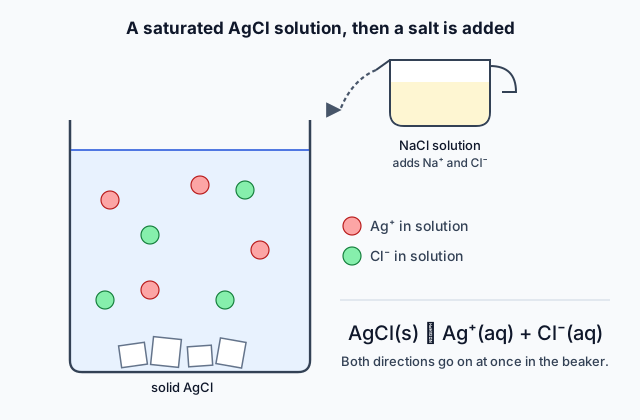 Tap to open the picture full size
Part 1 Think first A salt that makes a solid appear
Commit to a guess first. Being wrong now makes the right idea stick better.
Predict first
A technician stirs white silver chloride, AgCl, into pure water. A little dissolves, and the rest settles as white solid at the bottom. She then stirs in a spoonful of table salt, NaCl, which dissolves easily and contains no silver. The pile of white solid at the bottom grows, and less silver chloride is left in the solution. Why does adding a salt that dissolves easily make more solid appear?
In short. A salt is less soluble in a solution that already contains one of its ions, because that common ion pushes the dissolving equilibrium back toward the solid.
- The extra ion makes Q greater than Ksp, so some salt comes out of solution until Q equals Ksp again.
- To find the new solubility, put the common ion's starting concentration into the Ksp expression with the amount that dissolves, and drop s from the sum when it is tiny.
- Ksp itself does not change, because the temperature has not changed; the more common ion there is, the less of the salt dissolves.
Part 2 Learn it The common-ion effect
2a. Why a common ion lowers solubility
A saturated solution of AgCl is at equilibrium:
AgCl(s) ⇌ Ag⁺(aq) + Cl⁻(aq), with Ksp = [Ag⁺][Cl⁻]
Now add a salt that dissolves easily, such as NaCl. It brings Cl⁻ into the solution. Cl⁻ is a common ion: an ion the salt and the added substance share.
The extra Cl⁻ is a disturbance. It raises [Cl⁻], so Q = [Ag⁺][Cl⁻] becomes greater than Ksp. The reverse reaction is favored, and Ag⁺ and Cl⁻ combine into solid AgCl until Q equals Ksp again. In terms of Le Chatelier's principle, the system shifts to use up the ion that was added.
The result is the common-ion effect: the solubility of a salt is reduced when it is dissolved in a solution that already contains one of its ions. Ksp is unchanged, since the temperature is the same. What changes is how much of the salt can dissolve before the ion concentrations fit Ksp.
The ion must be one the salt contains. NaCl shares Cl⁻ with AgCl, and AgNO₃ shares Ag⁺. KNO₃ shares neither ion with AgCl, so it has no common-ion effect on it.
Quick check · Sort it
Solid silver chloride, AgCl, is shaken with each solution below until it is saturated. Tap a card, then the bin that says whether the solution has a common-ion effect on AgCl.
Common-ion effect: less AgCl dissolves
No common-ion effect
2b. Calculating the solubility with a common ion
Ksp lets you calculate how much dissolves. Treat the common ion's starting concentration as already there.
Example, a teaching example with Ksp = 1.8 × 10⁻¹⁰ for AgCl: find the molar solubility, s, in 0.10 M NaCl. NaCl supplies 0.10 M Cl⁻, and s mol/L of AgCl dissolves:
[Ag⁺] = s and [Cl⁻] = 0.10 + s
Ksp = (s)(0.10 + s) = 1.8 × 10⁻¹⁰
AgCl is so slightly soluble that s is tiny next to 0.10. In pure water s is only 1.3 × 10⁻⁵ M, and a common ion makes it smaller still. So 0.10 + s ≈ 0.10, and the expression becomes Ksp ≈ (s)(0.10), which gives s = (1.8 × 10⁻¹⁰) / 0.10 = 1.8 × 10⁻⁹ M.
Check the approximation afterward. Here s = 1.8 × 10⁻⁹ M, a tiny fraction of 0.10 M and far under 5% of it, so dropping s was fair. If s is not small next to the common ion's concentration, the approximation fails.
The coefficients still become exponents. For CaF₂ in NaF, [F⁻] = 0.010 + 2s ≈ 0.010 when s is tiny, so Ksp ≈ (s)(0.010)².
Quick check · Calculate
Calcium fluoride has Ksp = 3.2 × 10⁻¹¹, a teaching example. What is its molar solubility in 0.010 M NaF? Assume s is tiny next to 0.010 M. Give your answer to two significant figures, as a number times 10⁻⁷ M (type 3.5 for 3.5 × 10⁻⁷ M).
2c. More common ion, less solubility
What matters is the concentration of the common ion, not the amount of the salt that supplies it. For a salt MX dissolving in a solution that already holds X⁻, s ≈ Ksp / [X⁻]. The larger the concentration of the common ion, the smaller the solubility.
Two things to watch:
- Count the ions the source supplies. A 0.10 M solution of NaCl supplies 0.10 M Cl⁻, but a 0.10 M solution of CaCl₂ supplies 0.20 M Cl⁻, because each formula unit has two chloride ions. A source that supplies no ion of the salt supplies no common ion.
- Ksp does not change. The temperature is the same, so Ksp has the same value as in pure water. Only the concentrations that must fit it change.
Because Ksp stays the same, the calculation also runs backward. If a measurement gives the molar solubility of a salt in a solution with a known concentration of a common ion, multiply s by the common ion's concentration to get Ksp (for MX, Ksp = s × [X⁻]). The Ksp found is the same as one found from a measurement in pure water.
Quick check · Rank it
Silver chloride has Ksp = 1.8 × 10⁻¹⁰, a teaching example. Rank the molar solubility of AgCl in these four solutions. If two give the same molar solubility, give them the same place.
Greatest molar solubility first
Give each one a place, 1 for first. Give two the same place if they are equal.
Your ranking: none yet
Part 3 Watch it done Silver chromate in sodium chromate
Predict first, then watch each step, then finish the calculation yourself.
At 25 °C, silver chromate, Ag₂CrO₄, has Ksp = 1.1 × 10⁻¹² and a molar solubility of 6.5 × 10⁻⁵ M in pure water. These values are a teaching example. What is its molar solubility in 0.0100 M sodium chromate, Na₂CrO₄, a soluble salt?
Predict first
Before you open the first step, predict: compared with pure water, will Ag₂CrO₄ dissolve to a larger, a smaller or about the same extent in 0.0100 M Na₂CrO₄?
Step 1 · Write the equation and the expression
Ag₂CrO₄(s) ⇌ 2 Ag⁺(aq) + CrO₄²⁻(aq), so Ksp = [Ag⁺]²[CrO₄²⁻] = 1.1 × 10⁻¹².
Step 2 · Write each concentration, counting the common ion
Let s be the moles of Ag₂CrO₄ that dissolve per liter. [Ag⁺] = 2s. Chromate comes from two sources: 0.0100 M from the Na₂CrO₄, which supplies one CrO₄²⁻ per formula unit, and s from the dissolving, so [CrO₄²⁻] = 0.0100 + s.
Why this step?
Why can 0.0100 + s be replaced by 0.0100?
In pure water only 6.5 × 10⁻⁵ M dissolves, and the chromate already present pushes the solubility lower still. So s is tiny next to 0.0100 M, and adding it changes the sum by well under 1%. The check at the end confirms it.
Step 3 · Substitute and simplify
Ksp ≈ (2s)²(0.0100) = 4s²(0.0100) = 0.0400 s², so 0.0400 s² = 1.1 × 10⁻¹².
Your step · Calculate
Finish it. Solve 0.0400 s² = 1.1 × 10⁻¹² for the molar solubility of Ag₂CrO₄ in 0.0100 M Na₂CrO₄. Give your answer to two significant figures, as a number times 10⁻⁶ M (type 3.5 for 3.5 × 10⁻⁶ M).
× 10⁻⁶ M
Check the approximation: s = 5.2 × 10⁻⁶ M is about 0.05% of 0.0100 M, far under 5%, so dropping s from 0.0100 + s was fair. The solubility fell from 6.5 × 10⁻⁵ M to 5.2 × 10⁻⁶ M, about twelve times lower. Ksp is still 1.1 × 10⁻¹²; only the concentrations changed.
Part 4 Try it Rinsing a precipitate
A chemist collects solid barium sulfate, BaSO₄, on a filter and rinses it. Rinsing dissolves a little of the product and wastes it. BaSO₄ has Ksp = 1.1 × 10⁻¹⁰, a teaching example. The chemist compares rinsing with pure water and with 0.010 M Na₂SO₄ solution.
Try it · Calculate
By what factor is the molar solubility of BaSO₄ in 0.010 M Na₂SO₄ smaller than in pure water? Assume s is tiny next to 0.010 M. Give your answer to two significant figures.
Try it · Select all
Which two of these rinse solutions would dissolve less BaSO₄ than pure water does? Select two.
Select 2 answers, then check.
Part 5 Explain it Lead(II) chloride in salt water
On the exam this is handwritten, so answer on paper first. Nothing you type here leaves this page. Then check your answer against the model and each scoring point.
Free response is 50% of the exam score. This one is shaped like a short-answer question, which is worth 4 points.
Free-response practice · Short-answer style
Lead(II) chloride, PbCl₂, has Ksp = 1.7 × 10⁻⁵ at 25 °C. This value is a teaching example.
(a) Calculate the molar solubility of PbCl₂ in pure water.
(b) Calculate the molar solubility of PbCl₂ in 0.50 M NaCl, and justify any approximation you make.
(c) Explain, using Le Chatelier's principle or Q and Ksp, why the molar solubility in 0.50 M NaCl is less than in pure water.
(d) Identify whether the value of Ksp for PbCl₂ is different in the NaCl solution, and give a reason.
Model answer
(a) PbCl₂(s) ⇌ Pb²⁺(aq) + 2 Cl⁻(aq), so Ksp = [Pb²⁺][Cl⁻]² = (s)(2s)² = 4s³ = 1.7 × 10⁻⁵. Then s³ = 4.25 × 10⁻⁶ and s = 1.6 × 10⁻² M.
(b) [Pb²⁺] = s and [Cl⁻] = 0.50 + 2s ≈ 0.50 M. Ksp ≈ (s)(0.50)² = 1.7 × 10⁻⁵, so s = (1.7 × 10⁻⁵) / 0.25 = 6.8 × 10⁻⁵ M. The approximation is fair because 2s = 1.4 × 10⁻⁴ M is a tiny fraction of 0.50 M, far under 5%.
(c) NaCl supplies Cl⁻, a common ion. The extra Cl⁻ raises [Cl⁻], so Q = [Pb²⁺][Cl⁻]² becomes greater than Ksp. The reverse reaction is favored, so some PbCl₂ solid forms until Q equals Ksp again, and less PbCl₂ stays dissolved.
(d) No. Ksp has the same value, because the temperature is the same. Only the concentrations change, and they still satisfy the same Ksp.
Score your own answer. This is a self-check, not a grade. Tick each point your answer makes.
Part 6 Check yourself Silver bromide in four solutions
All three case questions use the table.
A student measures the molar solubility of silver bromide, AgBr, in four solutions at 25 °C. The values are a teaching example.
| Solution | Molar solubility of AgBr (mol/L) |
|---|---|
| Pure water | 7.35 × 10⁻⁷ |
| 0.00100 M NaBr | 5.40 × 10⁻¹⁰ |
| 0.0100 M NaBr | 5.40 × 10⁻¹¹ |
| 0.100 M AgNO₃ | 5.40 × 10⁻¹² |
Case question 1 · Calculate
Using the table: what is Ksp for AgBr, found from the 0.0100 M NaBr row? Assume s is tiny next to 0.0100 M. Give your answer to three significant figures, as a number times 10⁻¹³ (type 3.50 for 3.50 × 10⁻¹³).
Case question 2 · Multiple choice
Using the table: which explanation fits the 0.100 M AgNO₃ row?
Case question 3 · Decide and justify
Using the table: a fifth solution is 0.0500 M NaBr. Where does the molar solubility of AgBr in it fall?
Which reason supports your decision?
The rest stand on their own and do not use the case.
Check yourself · Spot the error
A student finds how much silver chloride dissolves in 0.20 M NaCl, where Ksp = 1.8 × 10⁻¹⁰ for AgCl, and then explains the result. Tap the line with the mistake.
Check yourself · Put it in order
A student finds the molar solubility of a salt in a solution that already holds one of its ions. Put the steps in order.
Part 7 Keep it Bring back earlier ideas
This lesson leans on two earlier ideas: finding a molar solubility from Ksp, and comparing Q with K to see which way a reaction goes. Pulling them back up is what makes them last.
From 7.11 Introduction to Solubility Equilibria · Calculate
Calcium fluoride has Ksp = 3.2 × 10⁻¹¹ at 25 °C, a teaching example. What is its molar solubility? Give your answer to two significant figures, as a number times 10⁻⁴ M (type 3.5 for 3.5 × 10⁻⁴ M).
From 7.10 Reaction Quotient and Le Châtelier’s Principle · Sort it
Kc for 2 NO₂ ⇌ N₂O₄ is 170 at this temperature. Each card gives Q for a mixture right after a disturbance. Tap a card, then the bin for what the mixture does next.
Forward reaction favored
Reverse reaction favored
No net change
In three lines
- A salt is less soluble in a solution that already contains one of its ions, because the common ion makes Q greater than Ksp and some salt comes out of solution.
- To calculate the solubility, put the common ion's starting concentration into the Ksp expression, drop s from the sum when it is tiny, solve for s, and check the approximation.
- Ksp stays the same, because the temperature does; the more common ion there is, the less of the salt dissolves.
Exam strategy for this topic
- Section I, Multiple Choice: 60 questions in 90 minutes.
- Section II, Free Response: 7 questions in 105 minutes.
- A scientific or graphing calculator is recommended for use on both sections of the exam.
When a question gives a solution that already holds one of the salt's ions, write the common ion's starting concentration into the Ksp expression, say that s is small next to it and simplify, and then check the assumption with the answer. Say in words that Q is greater than Ksp, or that the equilibrium shifts toward the solid, to explain why less dissolves.
Questions students ask
What is the common-ion effect?
The solubility of a salt is lower in a solution that already contains one of its ions than in pure water. The extra ion shifts the dissolving equilibrium back toward the solid.
How do I calculate solubility with a common ion?
Write the Ksp expression with the common ion's starting concentration plus the amount that dissolves. If s is tiny next to the starting concentration, drop it from the sum and solve for s, then check the approximation.
Does a common ion change Ksp?
No. Ksp depends on temperature, and the temperature has not changed. The concentrations change, and they still fit the same Ksp.
Can the common ion be the positive ion?
Yes. Either ion of the salt can be the common ion: AgNO₃ shares Ag⁺ with AgCl, and NaCl shares Cl⁻.
How can I explain the effect in words?
The added ion raises Q above Ksp, or by Le Chatelier's principle shifts the equilibrium toward the solid, so some salt comes out of solution and less dissolves.
Course alignment, for teachers
AP Chemistry topic 7.12, Unit 7: Equilibrium.
- Skill 2.F: Explain how modifications to an experimental procedure will alter results.
This lesson maps the one essential knowledge statement of the topic to the part that teaches each one: 1 is checked by a scored question. The map is in the lesson file.