Unit 8 · Topic 8.10 · about 30 minutes · 7 parts · 13 scored checks, 4 of them multiple choice
AP Chemistry 8.10: Buffer Capacity
Unit 8: 11 to 15% of the multiple-choice section
What you'll be able to do
- Explain how the buffer capacity of a solution depends on the amounts of its conjugate acid and conjugate base, and on which of the two there is more of.
Key vocabulary
| Term | What it means | The exam trap |
|---|---|---|
| Buffer capacity | The amount of added strong acid or strong base a buffer can neutralize before its pH changes substantially. | Capacity is an amount of acid or base absorbed, so read each question for how much a buffer can take up rather than for what pH it holds. |
| Conjugate base (A⁻) | The partner of a buffer that reacts with added acid, formed when the weak acid HA gives up H⁺. | Both partners are present at once, so name which one a given addition reacts with before you compare amounts. |
| Conjugate acid (HA) | The partner of a buffer that reacts with added base, left when the conjugate base picks up H⁺. | In a weak base buffer the conjugate acid is the ion, such as NH₄⁺, so check which species gives up the H⁺. |
| Buffer | A solution that holds a large concentration of both members of a conjugate acid-base pair and so resists changes in pH when a little acid or base is added. | A buffer is a pair of partners in one solution, so a solution of only a weak acid does not count. |
| Neutralize | To react with an added acid or base so that it no longer changes the pH of the solution. | An amount of acid or base can be neutralized only while some reacting partner remains, so look for which one runs out first. |
 Tap to open the picture full size
Part 1 Think first Blood under stress
Commit to a guess first. Being wrong now makes the right idea stick better.
Predict first
Your blood is a buffer. It holds a pH near 7.4 even though your cells keep releasing acids. In a medical emergency such as uncontrolled diabetes, very large amounts of acid pour into the blood, and the pH can fall to a dangerous level. What does that tell you about how a buffer works?
In short. Buffer capacity is the amount of added acid or base a buffer can neutralize before its pH changes substantially, and it depends on how much of each conjugate partner the buffer holds.
- Making a buffer more concentrated while keeping the ratio of its partners the same leaves the pH unchanged and increases the capacity.
- Added acid is neutralized by the conjugate base, so more conjugate base means more capacity for acid.
- Added base is neutralized by the conjugate acid, so more conjugate acid means more capacity for base.
Part 2 Learn it What sets how much a buffer can take
2a. Capacity depends on how much is there
A buffer holds a weak acid, HA, and its conjugate base, A⁻. Added strong acid reacts with A⁻, and added strong base reacts with HA. Each reaction uses up a little of one partner, so a buffer can work only for so long. Buffer capacity is how much added acid or base a buffer can neutralize before its pH changes substantially.
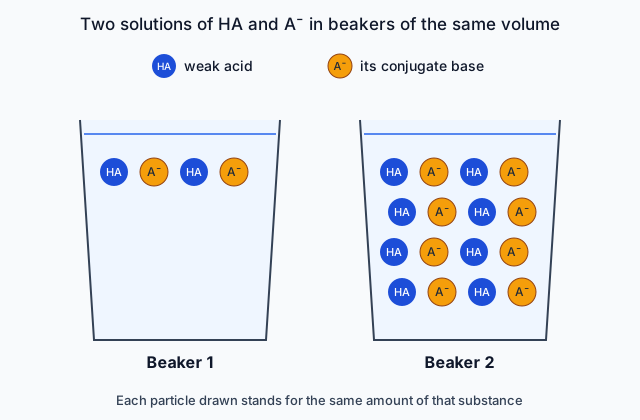
Capacity depends on how much of each partner is in the solution, not on the pH alone. Take two acetic acid and acetate buffers of equal volume:
- Buffer 1: 0.10 M HC₂H₃O₂ and 0.10 M C₂H₃O₂⁻.
- Buffer 2: 0.50 M HC₂H₃O₂ and 0.50 M C₂H₃O₂⁻.
The pH of a buffer is set by the ratio of its two partners (and the acid's pKa), as the Henderson-Hasselbalch equation says. The ratio of C₂H₃O₂⁻ to HC₂H₃O₂ is 1 to 1 in both, so both buffers have the same pH. But buffer 2 holds five times as many moles of each partner in the same volume. It has five times as much C₂H₃O₂⁻ to react with added acid and five times as much HC₂H₃O₂ to react with added base.
So increasing the concentrations of the partners while keeping their ratio constant leaves the pH the same and increases the capacity.
Quick check · Multiple choice
Buffer P is 0.050 M HF and 0.050 M NaF. Buffer Q has the same volume and is 0.40 M HF and 0.40 M NaF. Which statement compares them correctly?
2b. Which partner reacts with what
Each partner has a job:
- Added acid reacts with the conjugate base: A⁻ + H₃O⁺ → HA + H₂O
- Added base reacts with the conjugate acid: HA + OH⁻ → A⁻ + H₂O
So the capacity of a buffer for added acid is set by how much conjugate base it holds, and its capacity for added base is set by how much conjugate acid it holds. When a buffer has more conjugate acid than conjugate base, it has a greater capacity for added base than for added acid. When it has more conjugate base than conjugate acid, it has a greater capacity for added acid than for added base.
To compare, turn each concentration into an amount by multiplying by the volume. With the volume in mL, mol/L times mL gives millimoles (mmol), a thousandth of a mole, which keeps the numbers handy. Teaching example: 100.0 mL of a buffer that is 0.300 M HC₂H₃O₂ and 0.100 M C₂H₃O₂⁻ holds 30.0 mmol of HC₂H₃O₂ and 10.0 mmol of C₂H₃O₂⁻. The most strong base it can neutralize is 30.0 mmol, and the most strong acid is 10.0 mmol, before the partner that reacts runs out.
Quick check · Calculate
A 250.0 mL buffer is 0.400 M NH₄⁺ and 0.100 M NH₃. Added strong base reacts with NH₄⁺ to form NH₃. At most how many millimoles of NaOH can this buffer neutralize before its NH₄⁺ is used up? Give your answer to three significant figures.
2c. When a partner runs out
A buffer holds its pH nearly steady while both partners are present. Every mole of strong acid added turns one mole of A⁻ into HA. If the acid added is small next to the A⁻ available, plenty of A⁻ is left and the pH barely moves.
If the acid added is more than the A⁻ available, the A⁻ is gone and the extra acid has nothing to react with. It stays in solution as H₃O⁺, and the pH falls sharply. Base works the same way with HA. This is what it means to exceed the capacity of a buffer.
The two directions are not equal. A buffer rich in A⁻ but poor in HA takes up acid well, but a small amount of base can use up its HA. The partner that is scarce is the one that sets the limit for the addition it reacts with.
Quick check · Decide and justify
A 100.0 mL sample of a buffer holds 100. mmol of HC₂H₃O₂ and 100. mmol of C₂H₃O₂⁻. A student adds 200. mmol of HCl to it. What happens to the pH?
Which reason supports your decision?
Part 3 Watch it done Which buffer takes the acid?
Predict first, then watch each step, then finish the calculation yourself.
A reaction will release 10.00 mmol of strong acid into a buffer. Two buffers are on the shelf, each 150.0 mL. Buffer P is 0.100 M HC₂H₃O₂ and 0.100 M NaC₂H₃O₂. Buffer Q is 0.500 M HC₂H₃O₂ and 0.0500 M NaC₂H₃O₂. These are teaching examples. Which buffer can take up all of the acid, and by how many moles does the other fall short?
Predict first
Before you open the first step, predict: which buffer is better able to take up the added acid?
Step 1 · Decide which partner reacts
Added strong acid is H₃O⁺. It reacts with the conjugate base: C₂H₃O₂⁻ + H₃O⁺ → HC₂H₃O₂ + H₂O. So the capacity for acid is set by the moles of C₂H₃O₂⁻ in each buffer.
Step 2 · Find the moles of C₂H₃O₂⁻ in each buffer
Buffer P: (0.100 mol/L)(150.0 mL) = 15.0 mmol. Buffer Q: (0.0500 mol/L)(150.0 mL) = 7.50 mmol. Keep these unrounded for the next step.
Why this step?
Buffer Q holds 75.0 mmol of HC₂H₃O₂, much more than buffer P. Why does that not help it take up acid?
Acid reacts with the conjugate base, not with the conjugate acid. The HC₂H₃O₂ in Q has nothing to give an added acid to react with, so only its small amount of C₂H₃O₂⁻ counts.
Step 3 · Compare each with the acid added
Buffer P has 15.0 mmol of C₂H₃O₂⁻ for 10.00 mmol of acid, so it neutralizes all of it and still has 5.00 mmol of C₂H₃O₂⁻ left. Buffer Q has only 7.50 mmol of C₂H₃O₂⁻, which is less than 10.00 mmol, so its C₂H₃O₂⁻ runs out.
Your step · Calculate
Finish it. Buffer Q holds 7.50 mmol of C₂H₃O₂⁻, and 10.00 mmol of strong acid is added. How many millimoles of the acid are left over with no C₂H₃O₂⁻ to react with? Give your answer to three significant figures.
mmol
Buffer Q has the greater total concentration, 0.550 M against 0.200 M for P, yet it is the worse protection against acid. What counts is the amount of the partner that reacts. Buffer Q would be the better choice if base were being added, because it holds 75.0 mmol of HC₂H₃O₂ against 15.0 mmol in P.
Part 4 Try it Choose and rank buffers
Now use the same reasoning on new buffers. Four buffers, each 200.0 mL, are made from the same weak acid HA and its conjugate base A⁻. These are teaching examples.
| Buffer | [HA] (M) | [A⁻] (M) |
|---|---|---|
| Buffer A | 0.100 | 0.100 |
| Buffer B | 0.300 | 0.100 |
| Buffer C | 0.200 | 0.400 |
| Buffer D | 0.0500 | 0.0500 |
Try it · Rank it
Using the table: rank the four buffers by the number of millimoles of NaOH each can neutralize before its conjugate acid is used up.
Most NaOH first
Give each one a place, 1 for first. Give two the same place if they are equal.
Your ranking: none yet
Try it · Decide and justify
A student measures how much strong acid a buffer can take. The plan is to mix 50.0 mL of 0.200 M HC₂H₃O₂ with 50.0 mL of 0.200 M NaC₂H₃O₂ and add 0.100 M HCl from a buret until the pH has fallen by one unit. By mistake the student uses 0.0200 M NaC₂H₃O₂ instead. How does this mistake change the volume of HCl needed to lower the pH by one unit?
Which reason supports your decision?
Part 5 Explain it Compare two acetate buffers
On the exam this is handwritten, so answer on paper first. Nothing you type here leaves this page. Then check your answer against the model and each scoring point.
Free response is 50% of the exam score. This one is shaped like a short-answer question, which is worth 4 points.
Free-response practice · Short-answer style
A student prepares three acetate buffers. Buffer 1 is made by mixing 50.0 mL of 0.100 M HC₂H₃O₂ with 50.0 mL of 0.100 M NaC₂H₃O₂. Buffer 2 is made by mixing 50.0 mL of 0.500 M HC₂H₃O₂ with 50.0 mL of 0.500 M NaC₂H₃O₂. Buffer 3 is made by mixing 50.0 mL of 0.500 M HC₂H₃O₂ with 50.0 mL of 0.100 M NaC₂H₃O₂.
(a) Explain why buffer 1 and buffer 2 have the same pH.
(b) Calculate the largest amount of strong acid, in millimoles, that buffer 2 can neutralize before its conjugate base is used up.
(c) Determine whether buffer 3 has the greater capacity for added acid or for added base, and justify your answer.
(d) The student measures the 0.500 M NaC₂H₃O₂ for buffer 2 in a graduated cylinder that was rinsed with water and not dried. Explain how this error affects the capacity of buffer 2 for added acid compared with the value in part (b).
Model answer
(a) The pH of a buffer depends on the ratio of the conjugate base to the conjugate acid. In both buffers the ratio of C₂H₃O₂⁻ to HC₂H₃O₂ is 1 to 1, so the pH is the same even though buffer 2 is five times as concentrated.
(b) Added acid reacts with the conjugate base. Moles of C₂H₃O₂⁻ = (50.0 mL)(0.500 mol/L) = 25.0 mmol, so buffer 2 can neutralize at most 25.0 mmol of strong acid.
(c) Buffer 3 has the greater capacity for added base. It holds 25.0 mmol of conjugate acid, HC₂H₃O₂, and only 5.00 mmol of conjugate base, C₂H₃O₂⁻. Added base reacts with the conjugate acid, and there is more of it than of the conjugate base that reacts with added acid.
(d) The capacity for added acid is lower than calculated. The water left in the cylinder dilutes the NaC₂H₃O₂ solution, so the buffer receives fewer moles of C₂H₃O₂⁻, the partner that reacts with acid.
Score your own answer. This is a self-check, not a grade. Tick each point your answer makes.
Part 6 Check yourself Four acetate buffers
All three case questions use the table.
A student makes four acetic acid and sodium acetate buffers, W to Z, each with a volume of 250.0 mL. These numbers are a teaching example.
| Buffer | [HC₂H₃O₂] (M) | [C₂H₃O₂⁻] (M) |
|---|---|---|
| W | 0.100 | 0.100 |
| X | 0.500 | 0.500 |
| Y | 0.400 | 0.0800 |
| Z | 0.0800 | 0.400 |
Case question 1 · Multiple choice
Using the table: which statement about the pH of the buffers is correct?
Case question 2 · Calculate
Using the table: at most how many millimoles of strong acid can buffer Y neutralize before it runs out of the partner that reacts with acid? Give your answer to three significant figures.
Case question 3 · Multiple choice
Using the table: which buffer can neutralize the most added strong base?
The rest stand on their own and do not use the case.
Check yourself · Match
Match each situation to what it means for a buffer.
Check yourself · Spot the error
A student compares 100.0 mL of buffer A, 0.10 M HF and 0.10 M NaF, with 100.0 mL of buffer B, 1.0 M HF and 1.0 M NaF. Tap the line with the mistake.
Part 7 Keep it Bring back earlier ideas
This lesson leans on two earlier ideas: what makes a buffer, and how the ratio of its partners sets the pH. Pulling them back up is what makes them last.
Bring it back · Multiple choice
Which of these solutions is a buffer?
Bring it back · Calculate
An acetate buffer has [HC₂H₃O₂] = 0.10 M and [C₂H₃O₂⁻] = 0.50 M. The pKa of acetic acid is 4.74. What is the pH of the buffer? Give your answer to two decimal places.
In three lines
- Buffer capacity is the amount of added strong acid or base a buffer can neutralize; raising both concentrations in the same ratio keeps the pH and raises the capacity.
- Added acid reacts with the conjugate base and added base reacts with the conjugate acid, so each partner sets the capacity for one kind of addition.
- A buffer with more conjugate base than acid handles added acid better, one with more conjugate acid handles added base better, and a used-up partner means a sharp pH change.
Exam strategy for this topic
- Section I, Multiple Choice: 60 questions in 90 minutes.
- Section II, Free Response: 7 questions in 105 minutes.
- A scientific or graphing calculator is recommended for use on both sections of the exam.
When a question compares buffers, convert each concentration to moles with the volume, then ask which partner reacts with what is being added. Say the direction in words, such as "more conjugate base, so more capacity for added acid", and give amounts to the significant figures the data allow.
Questions students ask
What is buffer capacity?
It is how much strong acid or strong base a buffer can neutralize before its pH changes substantially. It depends on how much of each conjugate partner the buffer holds.
Does a more concentrated buffer have a different pH?
Not if the ratio of the conjugate base to the conjugate acid stays the same. The pH stays the same and the capacity goes up, because there is more of each partner to react.
Which part of a buffer reacts with added acid?
The conjugate base. Added acid reacts with it to form the conjugate acid, so the more conjugate base a buffer holds, the more acid it can neutralize.
Which part of a buffer reacts with added base?
The conjugate acid. Added base reacts with it to form the conjugate base, so the more conjugate acid a buffer holds, the more base it can neutralize.
What happens when the capacity of a buffer is exceeded?
The partner that reacts is used up, and the extra acid or base has nothing to react with. The pH then changes sharply.
Course alignment, for teachers
AP Chemistry topic 8.10, Unit 8: Acids and Bases.
- Skill 6.G: Explain how potential sources of experimental error may affect the experimental results.
This lesson maps all 2 essential knowledge statements of the topic to the part that teaches each one: 2 are checked by a scored question. The map is in the lesson file.