Unit 8 · Topic 8.9 · about 30 minutes · 7 parts · 11 scored checks, 1 of them multiple choice, plus 2 from earlier lessons
AP Chemistry 8.9: Henderson-Hasselbalch Equation
Unit 8: 11 to 15% of the multiple-choice section
What you'll be able to do
- Find the pH of a buffer from the identity and concentrations of its conjugate acid-base pair, and explain why a small addition of acid or base changes the pH so little.
Key vocabulary
| Term | What it means | The exam trap |
|---|---|---|
| Henderson-Hasselbalch equation | The relationship pH = pKa + log([A⁻]/[HA]), which gives the pH of a buffer from the weak acid's pKa and the concentrations of the conjugate pair. | The equation uses the base-10 logarithm and puts the conjugate base on top, so check both before you accept a number. |
| Concentration ratio | The concentration of the conjugate base divided by the concentration of the weak acid, [A⁻]/[HA]; it is the quantity that sets how far the pH sits from the pKa. | Two buffers with different amounts can have the same ratio, so compare ratios, not amounts. |
| pKa | The negative logarithm of the acid's Ka, pKa = −log Ka. | A weak base buffer is described by the pKa of its conjugate acid, so find that value before you start. |
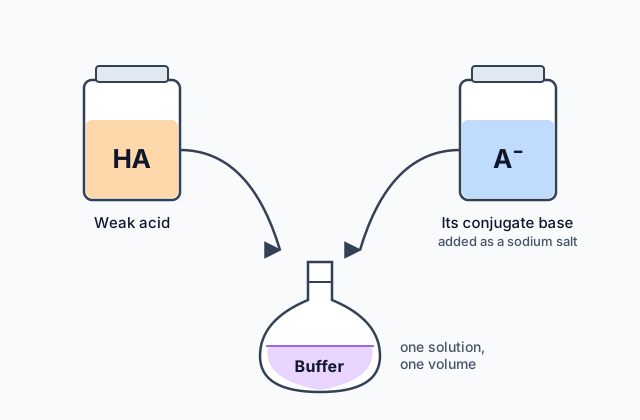
| Buffer | A solution holding large concentrations of both members of a conjugate acid-base pair, so its pH changes only slightly when a small amount of acid or base is added. | A pH given for a buffer does not tell you the amounts, so look at the ratio of the two members. |
 Tap to open the picture full size
Part 1 Think first Doubling the base in a buffer
Commit to a guess first. Being wrong now makes the right idea stick better.
Predict first
A lab technician mixes 1.00 mol of acetic acid with 1.00 mol of sodium acetate in 1.00 L of solution. The pH meter reads 4.76. She then adds another 1.00 mol of sodium acetate and stirs. The acid is unchanged and the base has doubled. What do you expect the pH to do?
In short. The pH of a buffer is the pKa of its weak acid plus the logarithm of the ratio of the conjugate base's concentration to the acid's: pH = pKa + log([A⁻]/[HA]).
- Equal concentrations give pH = pKa, more base than acid puts the pH above the pKa, and more acid than base puts it below.
- For a buffer made from a weak base, use the pKa of its conjugate acid and put the base on top of the ratio.
- A small addition of acid or base changes the ratio only slightly, so the pH changes much less than it would without the buffer.
Part 2 Learn it The pH of a buffer
2a. The Henderson-Hasselbalch equation
The pH of a buffer comes from the pKa of its weak acid and the concentrations of the two members. The relationship is the Henderson-Hasselbalch equation:
pH = pKa + log([A⁻]/[HA])
- pKa is the weak acid's, pKa = −log Ka.
- [A⁻] is the concentration of the conjugate base, and [HA] is the concentration of the weak acid.
- log is the base-10 logarithm.
The equation is a consequence of the equilibrium expression for the weak acid's dissociation, Ka = [H₃O⁺][A⁻]/[HA]. It gives the pH when both members are present in sizable amounts, as they are in a buffer.
Both members are in the same solution, so they share one volume. The ratio of their moles equals the ratio of their concentrations, and you can use either.
Example: a buffer holds 0.100 M CH₃COOH and 0.400 M CH₃COO⁻, and the pKa is 4.76. The ratio is 0.400/0.100 = 4.00, and log 4.00 = 0.602. So pH = 4.76 + 0.602 = 5.36.
Give the pH with as many decimal places as the pKa has.
Quick check · Calculate
A buffer is made from 0.300 M acetic acid, CH₃COOH, and 0.150 M acetate ion, CH₃COO⁻. The pKa of acetic acid is 4.76. What is the pH of the buffer? Give your answer to two decimal places.
2b. What the ratio tells you before you calculate
The log term shows where the pH sits relative to the pKa, so you can predict a result before you calculate:
- [A⁻] = [HA]: the ratio is 1, log 1 = 0, and pH = pKa.
- [A⁻] > [HA]: the ratio is above 1, the log is positive, and pH > pKa.
- [A⁻] < [HA]: the ratio is below 1, the log is negative, and pH < pKa.
This is the same rule as for indicators: a pH above the pKa means the base form has the higher concentration.
Only the ratio matters, not the amounts. A buffer with 0.10 M of each member and one with 0.50 M of each both have a ratio of 1, and both have a pH equal to the pKa.
A buffer made from a weak base works the same way. Use the pKa of the conjugate acid, and put the base on top: pH = pKa + log([B]/[BH⁺]). For NH₃ and NH₄⁺ the pKa is 9.25, found from 14.00 − 4.75, the pKb of ammonia.
Quick check · Rank it
Four buffers are made from acetic acid and sodium acetate. Rank them by pH. Buffer A holds 0.10 M CH₃COOH and 0.10 M CH₃COO⁻. Buffer B holds 0.50 M CH₃COOH and 0.50 M CH₃COO⁻. Buffer C holds 0.20 M CH₃COOH and 0.050 M CH₃COO⁻. Buffer D holds 0.050 M CH₃COOH and 0.20 M CH₃COO⁻.
Highest pH first
Give each one a place, 1 for first. Give two the same place if they are equal.
Your ranking: none yet
2c. Why a small addition barely changes the pH
A buffer holds large amounts of both members. When a small amount of strong acid is added, A⁻ reacts with it and forms HA, so a little A⁻ is lost and a little HA is gained. A small amount of strong base does the reverse. Either way, each member changes by only a small fraction of what is there, so the ratio [A⁻]/[HA] changes only slightly.
The pH follows the logarithm of that ratio, so a small change in the ratio is a small change in the pH. A buffer whose ratio moves from 1.00 to 0.98 has hardly moved at all.
Without a buffer, nothing absorbs the addition. The same small amount of strong acid, 0.0010 mol, in 1.0 L of pure water changes the pH from 7.00 to 3.00, a change of 4 units. So the change in pH on adding acid or base to a buffer is much less than it would have been without the buffer.
Quick check · Decide and justify
A buffer holds 0.20 M HA and 0.20 M A⁻, so [A⁻]/[HA] is 1.00. A small amount of strong acid is added, 0.0020 mol per liter, and the ratio becomes 0.98. How does the pH of the buffer change?
Which reason supports your decision?
Part 3 Watch it done The pH of an ammonia buffer
Predict first, then watch each step, then finish the calculation yourself.
A student mixes 0.250 mol of ammonia, NH₃, with 0.400 mol of ammonium chloride, NH₄Cl, in water to make a buffer. Ammonia has a pKb of 4.75. What is the pH of the buffer?
Predict first
Before you open the first step, predict: will the pH of this buffer be above, below or equal to the pKa of NH₄⁺?
Step 1 · Find the pKa to use
The pair is NH₃, the base, and NH₄⁺, its conjugate acid, so use the pKa of NH₄⁺: pKa = 14.00 − pKb = 14.00 − 4.75 = 9.25.
Step 2 · Write the ratio with the base on top
[NH₃]/[NH₄⁺] = 0.250/0.400 = 0.625. Both are in the same solution, so the moles can stand for the concentrations.
Why this step?
Why can the moles be used in place of the concentrations?
Both substances are in the same volume of solution. Dividing each amount by that same volume gives the concentrations, and the volume cancels in the ratio.
Step 3 · Take the logarithm
log(0.625) = −0.2041. It is negative because the ratio is below 1, so the pH will be below the pKa.
Your step · Calculate
Finish it. With a pKa of 9.25 for NH₄⁺ and log([NH₃]/[NH₄⁺]) = −0.2041, what is the pH of the buffer? Give your answer to two decimal places.
The answer lies below the pKa of 9.25, as the ratio said it would. Predicting the side first is a quick check on the sign you get from the logarithm.
Part 4 Try it A fluoride buffer and a target pH
Now apply the equation to a buffer you have not seen, and then use it in reverse: choose the pair that gives a target pH.
Try it · Calculate
A buffer holds 0.200 mol of hydrofluoric acid, HF, and 0.300 mol of sodium fluoride, NaF, in 1.00 L of solution. The pKa of HF is 3.17. What is the pH of the buffer? Give your answer to two decimal places.
Try it · Multiple choice
A chemist wants a buffer with a pH close to 9.2, made from equal concentrations of a weak acid and its conjugate base. Which pair should the chemist use?
Part 5 Explain it A formic acid buffer
On the exam this is handwritten, so answer on paper first. Nothing you type here leaves this page. Then check your answer against the model and each scoring point.
Free response is 50% of the exam score. This one is shaped like a short-answer question, which is worth 4 points.
Free-response practice · Short-answer style
A student makes a buffer from 0.300 M formic acid, HCOOH, and 0.600 M sodium formate, HCOONa. The pKa of formic acid is 3.75.
(a) Predict whether the pH of the buffer is greater than, less than or equal to 3.75, and justify your prediction with the concentrations.
(b) Calculate the pH of the buffer.
(c) A small amount of HCl is added to the buffer. Explain, using the ratio of the two concentrations, why the pH changes only slightly.
(d) Identify whether the pH would change by more or by less if the same amount of HCl were added to pure water.
Model answer
(a) Greater than 3.75. The concentration of the conjugate base, HCOO⁻ (0.600 M), is greater than that of the acid, HCOOH (0.300 M), so the ratio is above 1, its logarithm is positive, and the pH is above the pKa.
(b) pH = pKa + log([HCOO⁻]/[HCOOH]) = 3.75 + log(0.600/0.300) = 3.75 + 0.301 = 4.05.
(c) The added acid reacts with HCOO⁻ and forms HCOOH, so a little of the base is lost and a little of the acid is gained. Both are present in large amounts, so the ratio [HCOO⁻]/[HCOOH] changes only slightly. The pH depends on the logarithm of the ratio, so it changes only slightly too.
(d) The pH would change by much more in pure water, because water holds no conjugate pair to react with the added acid.
Score your own answer. This is a self-check, not a grade. Tick each point your answer makes.
Part 6 Check yourself Three buffers
The first three questions use the table.
A student prepares three buffers. Each one is a single solution, with the concentrations in the table. These numbers are a teaching example.
| Buffer | Acid member and its pKa | Concentration of acid member | Concentration of base member |
|---|---|---|---|
| 1 | HCOOH, pKa 3.75 | 0.200 M HCOOH | 0.200 M HCOO⁻ |
| 2 | HCOOH, pKa 3.75 | 0.400 M HCOOH | 0.100 M HCOO⁻ |
| 3 | NH₄⁺, pKa 9.25 | 0.300 M NH₄⁺ | 0.100 M NH₃ |
Case question 1 · Calculate
Using the table: what is the pH of buffer 2? Give your answer to two decimal places.
Case question 2 · Select all
Using the table: which two statements about the buffers are true? Select two.
Select 2 answers, then check.
Case question 3 · Calculate
Using the table: what is the pH of buffer 3? Give your answer to two decimal places.
The rest stand on their own and do not use the case.
Check yourself · Spot the error
A student finds the pH of a buffer made from 0.10 M HCOOH and 0.30 M HCOO⁻, with a pKa of 3.75. Tap the line with the mistake.
Check yourself · Fill the statement
Complete the statement of the Henderson-Hasselbalch equation for a buffer made from a weak acid, HA, and its conjugate base, A⁻.
The pH of the buffer equals the of the weak acid plus the of the ratio of the concentration of the to the concentration of the .
Part 7 Keep it Bring back earlier ideas
This lesson leans on how a buffer answers added acid, and on turning a pKb into the pKa of its conjugate acid. Pulling them back up makes them last.
From 8.8 Properties of Buffers · Decide and justify
The same small amount of HCl is added to 1.0 L of pure water and to 1.0 L of a buffer made of acetic acid and acetate ion. In which solution does the pH change less?
Which reason supports your decision?
From 8.7 pH and pKa · Calculate
Methylamine, CH₃NH₂, is a weak base with a pKb of 3.36. What is the pKa of its conjugate acid, CH₃NH₃⁺? Use pKa + pKb = 14.00, and give your answer to two decimal places.
In three lines
- For a buffer, pH = pKa + log([A⁻]/[HA]): the pKa of the weak acid plus the logarithm of the base-to-acid ratio, with the base on top.
- A ratio of 1 gives pH = pKa, more base than acid puts the pH above the pKa, and more acid than base puts it below. For a weak base, use the pKa of its conjugate acid.
- A small addition of acid or base changes the ratio only slightly, so the pH changes much less than it would without the buffer.
Exam strategy for this topic
- Section I, Multiple Choice: 60 questions in 90 minutes.
- Section II, Free Response: 7 questions in 105 minutes.
- A scientific or graphing calculator is recommended for use on both sections of the exam.
Write the equation first, then set up the ratio with the base on top and the acid on the bottom. Predict whether the pH should be above or below the pKa before you calculate, and give the pH to as many decimal places as the pKa has. To explain a small change in pH, name the ratio: the added acid or base barely changes it, so the pH barely moves.
Questions students ask
What is the Henderson-Hasselbalch equation?
It is pH = pKa + log([A⁻]/[HA]), which gives the pH of a buffer from the pKa of the weak acid and the concentrations of the conjugate base and the acid.
What is the pH of a buffer when the acid and base concentrations are equal?
The ratio is 1, its logarithm is 0, and the pH equals the pKa of the acid.
Which goes on top of the ratio, the acid or the base?
The conjugate base. The ratio is [A⁻]/[HA], so more base than acid puts the pH above the pKa.
How do you find the pH of a buffer made from a weak base?
Use the pKa of the conjugate acid, which is 14.00 − pKb at 25 °C, and put the base on top: pH = pKa + log([B]/[BH⁺]).
Why does the pH of a buffer change so little when a little acid or base is added?
The addition changes the amounts of the two members only slightly, so the ratio [A⁻]/[HA] barely changes, and the pH depends on the logarithm of that ratio.
Beyond the AP Exam
College Board sets these limits on what the AP Exam asks about this topic. Anything past them is not on the exam.
Computation of the change in pH resulting from the addition of an acid or a base to a buffer will not be assessed on the AP Exam.
Derivation of the Henderson-Hasselbalch equation will not be assessed on the AP Exam.
Course alignment, for teachers
AP Chemistry topic 8.9, Unit 8: Acids and Bases.
- Skill 5.F: Calculate, estimate, or predict an unknown quantity from known quantities by selecting and following a logical computational pathway and attending to precision (e.g., performing dimensional analysis and attending to significant figures).
This lesson maps the one essential knowledge statement of the topic to the part that teaches each one: 1 is checked by a scored question. The map is in the lesson file.