Unit 8 · Topic 8.11 · about 30 minutes · 7 parts · 13 scored checks, 5 of them multiple choice
AP Chemistry 8.11: pH and Solubility
Unit 8: 11 to 15% of the multiple-choice section
What you'll be able to do
- Identify the qualitative effect of a change in pH on the solubility of a salt, using the ions of the salt and Le Châtelier's principle.
Key vocabulary
| Term | What it means | The exam trap |
|---|---|---|
| Solubility | The amount of a substance that dissolves in a given amount of solution at equilibrium. | Read what a question varies, because the same salt has a different solubility in solutions of different pH. |
| Saturated solution | A solution in which dissolving and precipitating go on at equal rates, so it holds as much dissolved salt as it can. | Equal rates are not zero rates, so the solid can still be present and still take part in the equilibrium. |
| Le Châtelier's principle | When a change is made to a system at equilibrium, the system shifts in the direction that partly undoes the change. | Name the species that is added or removed first, because the direction of the shift depends on it. |
| Conjugate base of a weak acid | An anion, such as F⁻ or CO₃²⁻, that has a real attraction for H⁺ and so reacts with H₃O⁺. | The charge on an anion does not tell you whether it reacts with acid, so check the strength of the acid it came from. |
| Common ion | An ion that is already in a solution and is also one of the ions a salt releases when it dissolves. | Only an ion the salt itself contains counts as a common ion, so check the formula before you apply the idea. |
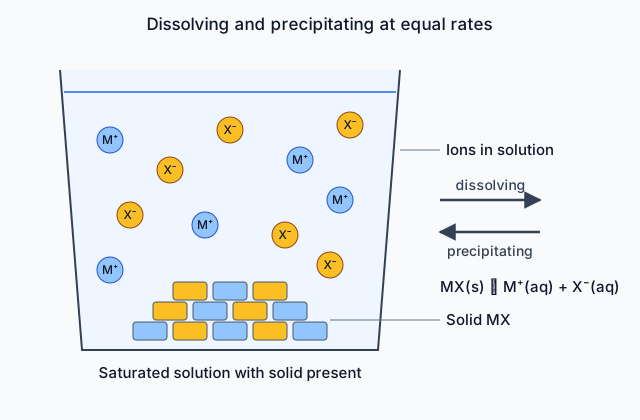 Tap to open the picture full size
Part 1 Think first The blurring statue
Commit to a guess first. Being wrong now makes the right idea stick better.
Predict first
Marble and limestone statues are mostly calcium carbonate, CaCO₃, a salt that barely dissolves in pure water. In cities where the rain is acidic, the carved details on these statues blur away much faster than in places with ordinary rain. What best explains the faster loss?
In short. The solubility of a salt depends on pH when one of its ions is a weak acid, a weak base or the hydroxide ion, because that ion reacts with H₃O⁺ or OH⁻ and shifts the dissolving equilibrium.
- An anion that is the conjugate base of a weak acid, such as F⁻ or CO₃²⁻, is removed by H₃O⁺, so lowering the pH makes its salt more soluble.
- Hydroxide salts also dissolve more as the pH falls, and dissolve less when more OH⁻ is added.
- Salts whose ions neither take H⁺ nor give it up, such as AgBr, are not affected by pH.
Part 2 Learn it How pH changes what dissolves
2a. Which salts care about pH
When a salt dissolves, its ions meet the H₃O⁺ and OH⁻ in the water. If an ion reacts with either one, a change in pH changes how much of the salt dissolves. The solubility of a salt is pH sensitive when one of its ions is a weak acid, a weak base or the hydroxide ion.
Check each ion of the salt:
- The anion of a weak acid is a weak base. F⁻, CO₃²⁻, PO₄³⁻ and C₂H₃O₂⁻ take H⁺ from H₃O⁺, becoming HF, HCO₃⁻, HPO₄²⁻ and HC₂H₃O₂. So CaF₂ and BaCO₃ are pH sensitive.
- Hydroxide, OH⁻, reacts with H₃O⁺ directly. So a metal hydroxide such as Mg(OH)₂ is pH sensitive.
- A cation that is a weak acid, such as NH₄⁺, gives up H⁺ to OH⁻.
- The anion of a strong acid (Cl⁻, Br⁻, I⁻, NO₃⁻) does not take H⁺ from H₃O⁺, and neither do the metal ions Na⁺, K⁺, Ca²⁺ and Ba²⁺, or Ag⁺ and Pb²⁺ at these pH values. A salt made only of such ions, like AgBr or PbI₂, is not pH sensitive.
A salt is pH sensitive if at least one of its ions qualifies. The question to ask of every anion is which acid it came from, and whether that acid is weak.
Quick check · Sort it
Each card names one ion that could be part of a salt. Tap a card, then the bin it belongs in.
A salt with this ion can be pH sensitive
This ion does not make a salt pH sensitive
2b. Why acid dissolves more of the salt
Take CaF₂, a salt that dissolves only slightly. Its dissolving equilibrium is:
CaF₂(s) ⇌ Ca²⁺(aq) + 2 F⁻(aq)
Now add a strong acid, so the pH falls. The extra H₃O⁺ reacts with F⁻, the conjugate base of the weak acid HF:
F⁻(aq) + H₃O⁺(aq) → HF(aq) + H₂O(l)
That reaction removes F⁻ from the solution. By Le Châtelier's principle, the equilibrium shifts in the direction that makes up for the loss. It shifts toward the products, so more CaF₂ dissolves. The solubility of CaF₂ is higher in acid than in water.
The same chain works for any salt with a weak base for an anion: lower the pH, the anion is removed, the equilibrium shifts toward dissolving, and the solubility increases.
Quick check · Put it in order
Limestone, CaCO₃, is a salt of the weak-base anion CO₃²⁻. Put these steps in order to explain why acid rain dissolves more of it.
2c. Hydroxides, and raising the pH
A metal hydroxide has the anion OH⁻ built in. For Mg(OH)₂:
Mg(OH)₂(s) ⇌ Mg²⁺(aq) + 2 OH⁻(aq)
Lower the pH. H₃O⁺ + OH⁻ → 2 H₂O removes OH⁻, so the equilibrium shifts toward dissolving and more Mg(OH)₂ dissolves. This is how antacid tablets and milk of magnesia work in stomach acid.
Raise the pH. Adding OH⁻, for example from NaOH, adds an ion the salt itself releases. This is a common ion, so the equilibrium shifts toward the solid and less Mg(OH)₂ dissolves.
Raising the pH also matters for the other kinds of salt. With less H₃O⁺ in the water, an anion such as F⁻ stays as F⁻, so CaF₂ dissolves less than it does in acid. A salt whose cation is a weak acid goes the other way: OH⁻ reacts with NH₄⁺ to form NH₃ and water, which removes NH₄⁺ and makes such a salt dissolve more as the pH rises.
Quick check · Multiple choice
A saturated solution of Mg(OH)₂ has solid at the bottom. Which change would make less Mg(OH)₂ dissolve?
Part 3 Watch it done Strontium fluoride in nitric acid
Predict first, then watch each step, then finish the prediction yourself.
Solid strontium fluoride, SrF₂, is stirred in water until the solution is saturated and some solid remains at the bottom. A student then adds nitric acid, HNO₃, a strong acid, and stirs again. What happens to the amount of undissolved SrF₂?
Predict first
Before you open the first step, predict: after the nitric acid is added, what do you expect about the solid at the bottom?
Step 1 · Write the dissolving equilibrium
SrF₂(s) ⇌ Sr²⁺(aq) + 2 F⁻(aq). The ions are Sr²⁺ and F⁻.
Step 2 · Find the ion that reacts with the acid
F⁻ is the conjugate base of the weak acid HF, so it takes H⁺ from H₃O⁺: F⁻(aq) + H₃O⁺(aq) → HF(aq) + H₂O(l). Sr²⁺ does not react with H₃O⁺.
Why this step?
The acid also brings nitrate ions, NO₃⁻, into the solution. Why do they not change the answer?
NO₃⁻ is not one of the ions of SrF₂, so it is not a common ion. It is also the conjugate base of the strong acid HNO₃, so it does not react with H₃O⁺. It is a spectator.
Step 3 · Say what the reaction does to the equilibrium
The reaction removes F⁻ from the solution, so [F⁻] falls. Le Châtelier's principle says the equilibrium shifts in the direction that makes up for the loss of F⁻. The last step is to name that direction and what it does to the solid.
Your step · Fill the statement
Finish it. Complete the prediction for the undissolved SrF₂.
After the nitric acid is added, the amount of undissolved SrF₂ , because the dissolving equilibrium shifts to the .
The strategy is the same for any salt: write the equilibrium, find the ion that reacts with H₃O⁺ or OH⁻, say whether the change adds it or removes it, and shift the equilibrium. Notice that the spectator ions from the acid, here NO₃⁻, never entered the argument.
Part 4 Try it Predict the shift
Try it · Select all
A little nitric acid, HNO₃, is added to a saturated solution of each salt below, each with solid present. Which two salts become more soluble? Select two.
Select 2 answers, then check.
Try it · Decide and justify
A saturated solution of Mg(OH)₂ has solid at the bottom. A student stirs in some solid ammonium chloride, NH₄Cl. NH₄⁺ is a weak acid, and Cl⁻ is the conjugate base of a strong acid. What happens to the amount of undissolved Mg(OH)₂?
Which reason supports your decision?
Part 5 Explain it Magnesium hydroxide in three beakers
On the exam this is handwritten, so answer on paper first. Nothing you type here leaves this page. Then check your answer against the model and each scoring point.
Free response is 50% of the exam score. This one is shaped like a short-answer question, which is worth 4 points.
Free-response practice · Short-answer style
A student adds 1.00 g of solid Mg(OH)₂ to each of three beakers holding 100. mL of a different solution: beaker 1, pure water; beaker 2, 1.0 M nitric acid, HNO₃(aq); beaker 3, sodium hydroxide, NaOH(aq), at pH 12. Each mixture is stirred until nothing more changes. The dissolving equilibrium is Mg(OH)₂(s) ⇌ Mg²⁺(aq) + 2 OH⁻(aq).
(a) Predict which beaker will have the least solid left and which will have the most.
(b) Explain, using the equilibrium, why beaker 2 differs from beaker 1.
(c) Explain, using the equilibrium, why beaker 3 differs from beaker 1.
(d) The student repeats beaker 2 with solid AgBr in place of Mg(OH)₂. Predict whether the amount of solid left will differ much from AgBr in pure water, and justify your prediction.
Model answer
(a) Beaker 2 will have the least solid left, and beaker 3 will have the most.
(b) In beaker 2, H₃O⁺ from the acid reacts with OH⁻ to form water, which lowers the concentration of OH⁻. The equilibrium shifts toward the products to make up for it, so more Mg(OH)₂ dissolves than in water.
(c) In beaker 3, the NaOH adds OH⁻, an ion that Mg(OH)₂ releases. The equilibrium shifts toward the solid, so less Mg(OH)₂ dissolves than in water.
(d) The amount of solid left will not differ much. Br⁻ is the conjugate base of the strong acid HBr, so it does not react with H₃O⁺, and Ag⁺ does not either. With no ion removed or added, the equilibrium does not shift.
Score your own answer. This is a self-check, not a grade. Tick each point your answer makes.
Part 6 Check yourself Five solids at two pH values
All three case questions use the table.
A student stirs 1.00 g of each of five solids in its own 100. mL of water at pH 7, and again in its own 100. mL of 1.0 M nitric acid, which holds 100. mmol of H₃O⁺. After stirring until nothing changes, the student filters, dries and weighs the solid that is left. The balance reads to 0.01 g. These numbers are a teaching example.
| Solid | Water (pH 7) | 1.0 M HNO₃ |
|---|---|---|
| CaF₂ | 1.00 | 0.91 |
| AgBr | 1.00 | 1.00 |
| Mg(OH)₂ | 1.00 | 0.00 |
| AgI | 1.00 | 1.00 |
| BaCO₃ | 1.00 | 0.31 |
Case question 1 · Select all
Using the table: which two solids are not pH sensitive? Select two.
Select 2 answers, then check.
Case question 2 · Multiple choice
Using the table: which statement best explains why less BaCO₃ is left in the acid than in water?
Case question 3 · Multiple choice
Using the table: the student repeats the test with Mg(OH)₂ in sodium hydroxide at pH 12. How will the solubility of Mg(OH)₂ at pH 12 compare with its solubility at pH 7?
The rest stand on their own and do not use the case.
Check yourself · Spot the error
A student explains why CaF₂ is more soluble in acid than in water. Tap the line with the mistake.
Check yourself · Match
Match each salt to the ion that decides how its solubility responds to pH.
Part 7 Keep it Bring back earlier ideas
This lesson leans on two earlier ideas: the common-ion effect, and which form of a weak acid is present at a given pH. Pulling them back up is what makes them last.
Bring it back · Multiple choice
A saturated solution of PbI₂ has solid PbI₂ at the bottom. Which addition would decrease the solubility of PbI₂?
Bring it back · Multiple choice
The weak acid HF has a pKa of 3.17. In a solution at pH 2.0, which form of the acid is present in the greater amount?
In three lines
- The solubility of a salt depends on pH when one of its ions is a weak acid, a weak base or hydroxide, because that ion reacts with H₃O⁺ or OH⁻.
- Lowering the pH removes an anion that is the conjugate base of a weak acid or hydroxide, so Le Châtelier's principle shifts the equilibrium toward dissolving.
- Extra OH⁻ makes a hydroxide less soluble, and a salt such as AgBr, with ions that do not react, is not affected by pH.
Exam strategy for this topic
- Section I, Multiple Choice: 60 questions in 90 minutes.
- Section II, Free Response: 7 questions in 105 minutes.
- A scientific or graphing calculator is recommended for use on both sections of the exam.
To predict the effect of pH on a salt, write the dissolving equilibrium, find the ion that reacts with H₃O⁺ or OH⁻, say whether the change adds or removes it, and then say which way the equilibrium shifts and what that does to the solubility. Use the words "shifts toward dissolving" or "shifts toward the solid" so the direction is explicit.
Questions students ask
How does pH affect the solubility of a salt?
It does when one of the salt's ions is a weak acid, a weak base or hydroxide. Changing the pH adds or removes that ion, and the dissolving equilibrium shifts to partly undo the change.
Why does a carbonate dissolve more in acid?
The carbonate ion reacts with H₃O⁺, which lowers its concentration. By Le Châtelier's principle the equilibrium shifts toward dissolving to replace it, so more of the salt dissolves.
Does a lower pH always make a salt more soluble?
No. It makes a salt more soluble only if one of its ions reacts with H₃O⁺. A salt such as AgBr, whose ions do not react, is not affected.
Why does a high pH make a hydroxide less soluble?
A high pH means extra OH⁻ in solution. OH⁻ is an ion the hydroxide salt releases, so the equilibrium shifts toward the solid and less dissolves.
How can I tell which ions react with acid?
Ask what acid the ion came from. A conjugate base of a weak acid, such as F⁻, reacts with H₃O⁺. A conjugate base of a strong acid, such as Br⁻, does not.
Beyond the AP Exam
College Board sets this limit on what the AP Exam asks about this topic. Anything past it is not on the exam.
Computations of solubility as a function of pH will not be assessed on the AP Exam.
Course alignment, for teachers
AP Chemistry topic 8.11, Unit 8: Acids and Bases.
- Skill 2.D: Make observations or collect data from representations of laboratory setups or results, while attending to precision where appropriate.
This lesson maps the one essential knowledge statement of the topic to the part that teaches each one: 1 is checked by a scored question. The map is in the lesson file.