Unit 9 · Topic 9.1 · about 30 minutes · 7 parts · 11 scored checks, 1 of them multiple choice, plus 2 from earlier lessons
AP Chemistry 9.1: Introduction to Entropy
Unit 9: 7 to 9% of the multiple-choice section
What you'll be able to do
- Identify the sign and relative magnitude of the entropy change associated with chemical or physical processes.
Key vocabulary
| Term | What it means | The exam trap |
|---|---|---|
| Entropy (S) | A measure of how dispersed the matter and the energy of a system are. | Ask what became more spread out, the matter, the energy or both, before you decide anything about a sign. |
| Change in entropy (ΔS) | The final entropy of a system minus its initial entropy: positive when the system becomes more dispersed, negative when it becomes less dispersed. | A change and its reverse have opposite signs, so settle the direction of the change before you write the sign. |
| Dispersal of matter | The spreading of particles into more space or into freer motion, as in a phase change or a gas expanding. | Only particles that move freely through the container count, so check the state label of each species. |
| Distribution of kinetic energy | How the kinetic energies of the particles in a sample are spread over a range of values; it broadens as the temperature increases. | Temperature is a second way to disperse a system, so check it even when nothing else about the sample changes. |
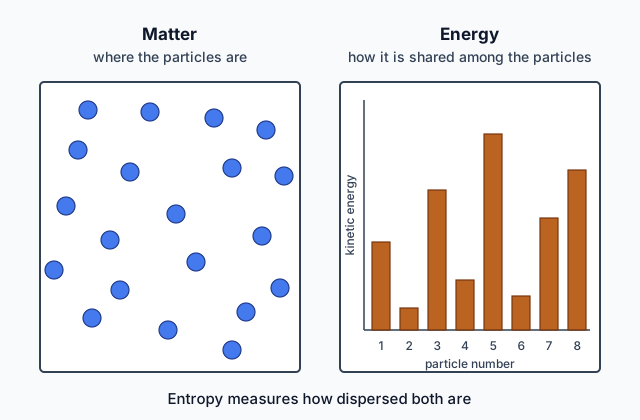 Tap to open the picture full size
Part 1 Think first A drop of dye
Commit to a guess first. Being wrong now makes the right idea stick better.
Predict first
A drop of food coloring is placed gently at the top of a glass of still water. Nobody stirs it. Within an hour the color has spread evenly through the whole glass, and it never gathers back into a drop. Why does spreading out happen, and the reverse does not?
In short. Entropy is a measure of how dispersed the matter and the energy of a system are, and it increases when either one becomes more dispersed.
- Matter becomes more dispersed when a solid melts, a liquid boils, a gas expands, or a reaction makes more moles of gas than it uses, and each of these has a positive ΔS.
- Energy becomes more dispersed when a sample is heated, because the kinetic energies of its particles spread over a broader range of values.
- The reverse changes gather matter or energy, so their ΔS is negative, and the more dispersal a change causes, the larger the size of its ΔS.
Part 2 Learn it Matter and energy spreading out
2a. Matter spreading out
Entropy (S) measures how dispersed the matter and the energy of a system are. Particles move at random, and a dispersed arrangement can happen in far more ways than a gathered one, so changes that disperse matter or energy are the ones that tend to occur. A change in entropy is ΔS, the final entropy minus the initial entropy. If entropy rises, ΔS is positive. If it falls, ΔS is negative.
Matter becomes more dispersed in these ways:
- A phase change from solid to liquid, or from liquid to gas. The particles become freer to move and generally take up a larger volume, so melting and boiling have ΔS > 0. Freezing and condensation are the reverse, so they have ΔS < 0. Boiling spreads the particles much farther apart than melting does, so its change is the larger one.
- A gas expanding into a larger volume at constant temperature. The molecules can move within a larger space, so an expansion has ΔS > 0 and a compression has ΔS < 0.
Quick check · Rank it
Each sample is 1.0 mol of water. Rank the samples by their entropy.
Highest entropy first
Give each one a place, 1 for first. Give two the same place if they are equal.
Your ranking: none yet
2b. Moles of gas in a reaction
In a reaction, most of the change in dispersal comes from the gases, because a gas's particles are spread through the whole container while the particles of a solid or a liquid are packed together. So count the moles of gas on each side of the equation. Count only species labeled (g), and use the coefficients.
- If the products have more moles of gas than the reactants, the entropy generally increases: ΔS > 0.
- If the products have fewer moles of gas, the entropy generally decreases: ΔS < 0.
For CaCO₃(s) → CaO(s) + CO₂(g), the reaction makes 1 mol of gas from none, so ΔS > 0. For N₂(g) + 3H₂(g) → 2NH₃(g), the reaction goes from 4 mol of gas to 2 mol, so ΔS < 0. The bigger the change in the moles of gas, the larger the size of ΔS.
Quick check · Sort it
Each card is a reaction at constant temperature. Tap a card, then the bin for the sign of its ΔS.
ΔS > 0
ΔS < 0
2c. Energy spreading out
Energy can be dispersed too. The particles of a gas do not all have the same kinetic energy. At any moment their kinetic energies are spread over a range of values, which kinetic molecular theory describes as a distribution.
When the temperature rises, the average kinetic energy rises and the distribution broadens: the energies are spread over a wider range of values. The energy of the system is more dispersed, so entropy increases as temperature increases. This is true even when the volume does not change. Cooling a sample narrows the distribution and lowers its entropy.
So a mole of a gas has more entropy at 400 K than at 250 K, in the same flask. Matter and energy are the two things to check whenever you predict the sign of ΔS.
Quick check · Decide and justify
A rigid, sealed flask holds 1.0 mol of helium gas at 300 K. It is heated to 600 K. Does the entropy of the helium increase, decrease or stay the same?
Which reason supports your decision?
Part 3 Watch it done Combustion of ethane
Predict first, then watch each step, then finish the calculation yourself.
Ethane burns in oxygen: 2C₂H₆(g) + 7O₂(g) → 4CO₂(g) + 6H₂O(l). Predict whether the entropy of the system increases or decreases, using the moles of gas.
Predict first
Before you open the first step, predict: does burning ethane this way make the matter more dispersed or less dispersed?
Step 1 · Find which species are gases
The reactants are C₂H₆(g) and O₂(g), both gases. Among the products, CO₂(g) is a gas, but H₂O(l) is a liquid.
Why this step?
Why is the liquid water left out of the count?
Entropy depends on how dispersed the matter is. A liquid's particles are packed together, not spread through the whole container, so liquid water is not counted as gas. Only species labeled (g) are counted.
Step 2 · Count the moles of gas in the reactants
The reactants have 2 mol of C₂H₆ and 7 mol of O₂, which is 2 + 7 = 9 mol of gas.
Your step · Calculate
Finish it. The products have 4 mol of CO₂(g) and 6 mol of H₂O(l). What is the change in the moles of gas, products minus reactants?
mol
Fewer moles of gas means the matter is less dispersed, so ΔS < 0 for this reaction. It is a large decrease, because five moles of gas disappear. Notice that the answer needed no table of data: counting the gas was enough.
Part 4 Try it An airbag in 30 milliseconds
A car's airbag inflates when sodium azide decomposes: 2NaN₃(s) → 2Na(s) + 3N₂(g). A solid is turned into enough nitrogen gas to fill the bag in a few hundredths of a second.
Try it · Fill the statement
Complete the argument about the sign of ΔS for the airbag reaction.
The reactants contain mol of gas and the products contain mol of gas. The matter becomes dispersed, so ΔS is .
Now four changes of 1.0 mol of water, each at its normal temperature of change.
Try it · Rank it
Rank the four changes by ΔS. Remember that a negative ΔS is lower than a positive one.
Largest ΔS (most positive) first
Give each one a place, 1 for first. Give two the same place if they are equal.
Your ranking: none yet
Part 5 Explain it Gas reaction, expansion and heating
On the exam this is handwritten, so answer on paper first. Nothing you type here leaves this page. Then check your answer against the model and each scoring point.
Free response is 50% of the exam score. This one is shaped like a short-answer question, which is worth 4 points.
Free-response practice · Short-answer style
Dinitrogen tetroxide gas decomposes into nitrogen dioxide gas: N₂O₄(g) → 2NO₂(g).
(a) Identify the change in the number of moles of gas when the reaction occurs as written.
(b) Predict the sign of ΔS for the reaction, and justify your prediction in terms of how dispersed the matter is.
A separate 1.0 mol sample of helium gas, at constant temperature, expands from 1.0 L to 3.0 L.
(c) Predict the sign of the entropy change of the helium and explain it.
The helium is then sealed in a rigid container and heated from 300 K to 500 K.
(d) Predict the sign of its entropy change and explain it in terms of the distribution of kinetic energy.
Model answer
(a) The reaction goes from 1 mol of gas to 2 mol of gas, a change of +1 mol.
(b) ΔS is positive. The products have more moles of gas than the reactants, so there are more gas particles, and the matter is spread more widely through the container.
(c) The entropy change is positive. The helium atoms can move within a larger space, so the matter is more dispersed.
(d) The entropy change is positive. As the temperature rises, the distribution of the atoms' kinetic energies broadens, so the energy is more dispersed.
Score your own answer. This is a self-check, not a grade. Tick each point your answer makes.
Part 6 Check yourself Four reactions at one temperature
All three case questions use the table.
A student plans four reactions, all run at the same temperature. These equations are a teaching example.
| Reaction | Equation |
|---|---|
| A | 2KClO₃(s) → 2KCl(s) + 3O₂(g) |
| B | 2SO₂(g) + O₂(g) → 2SO₃(g) |
| C | C₃H₈(g) + 5O₂(g) → 3CO₂(g) + 4H₂O(g) |
| D | 2Mg(s) + O₂(g) → 2MgO(s) |
Case question 1 · Multiple choice
Using the table: which reaction has the largest positive ΔS?
Case question 2 · Calculate
Using the table: what is the change in the moles of gas for reaction C, products minus reactants?
Case question 3 · Decide and justify
Using the table: is ΔS for reaction D positive or negative?
Which reason supports your decision?
The rest stand on their own and do not use the case.
Check yourself · Spot the error
A student predicts the sign of ΔS when a rigid flask of neon gas is cooled from 400 K to 300 K. Tap the line with the mistake.
Check yourself · Select all
Which two changes of 1.0 mol of a substance have ΔS < 0? Select two.
Select 2 answers, then check.
Part 7 Keep it Bring back earlier ideas
Entropy leans on two earlier ideas: how a gas fills the space it is given, and how its kinetic energies are spread out. Pulling them back up is what makes them last.
From 3.5 Kinetic Molecular Theory · Select all
A sealed flask of oxygen is warmed from 300 K to 400 K. Which two statements describe how the Maxwell-Boltzmann distribution of the molecules’ speeds changes? Select two.
Select 2 answers, then check.
Two everyday situations to explain with particles: air squeezed in a syringe, and honey that pours faster when it is warm.
From 3.3 Solids, Liquids, and Gases · Decide and justify
A student seals the tip of a syringe full of air and pushes the plunger in until the air takes up half its starting volume. The student says each gas particle has been squeezed to half its size. Is the student right?
Which reason supports your decision?
In three lines
- Entropy measures how dispersed matter and energy are; ΔS is positive when either becomes more dispersed and negative when either is gathered.
- Matter disperses in melting, boiling, gas expansion and reactions that make more moles of gas; count only the species labeled (g).
- Heating broadens the distribution of kinetic energies, so entropy rises with temperature even at constant volume.
Exam strategy for this topic
- Section I, Multiple Choice: 60 questions in 90 minutes.
- Section II, Free Response: 7 questions in 105 minutes.
- A scientific or graphing calculator is recommended for use on both sections of the exam.
To predict the sign of ΔS, ask two questions in order: did the matter become more or less dispersed (phase, gas volume, moles of gas), and did the energy become more or less dispersed (temperature)? Write the answer as a comparison, such as "more moles of gas in the products, so ΔS is positive", because the question asks for a reason as well as a sign.
Questions students ask
What is entropy?
Entropy is a measure of how dispersed the matter and the energy of a system are. It increases when matter or energy becomes more dispersed.
When is ΔS positive?
ΔS is positive when matter or energy becomes more dispersed: a solid melting, a liquid boiling, a gas expanding, a reaction making more moles of gas, or a sample being heated.
How do you predict the sign of ΔS for a reaction?
Count the moles of gas on each side of the balanced equation. If the products have more moles of gas, ΔS is generally positive, and if they have fewer, it is generally negative.
Does entropy change when a gas is heated at constant volume?
Yes. The distribution of the particles' kinetic energies broadens as the temperature rises, so the energy is more dispersed and the entropy increases.
Is entropy the same thing as disorder?
Disorder is a rough picture. This course uses dispersal of matter and energy, which you can check in each case by looking at phases, gas volume, moles of gas and temperature.
Course alignment, for teachers
AP Chemistry topic 9.1, Unit 9: Thermodynamics and Electrochemistry.
- Skill 6.C: Support a claim with evidence from representations or models at the particulate level, such as the structure of atoms and/or molecules.
This lesson maps all 2 essential knowledge statements of the topic to the part that teaches each one: 2 are checked by a scored question. The map is in the lesson file.