Unit 8 · Topic 8.7 · about 30 minutes · 7 parts · 12 scored checks, 2 of them multiple choice, plus 2 from earlier lessons
AP Chemistry 8.7: pH and pKa
Unit 8: 11 to 15% of the multiple-choice section
What you'll be able to do
- Explain which form of a weak acid or base has the higher concentration at a given pH by comparing the pH with the pKa, and use that to read and choose indicators.
Key vocabulary
| Term | What it means | The exam trap |
|---|---|---|
| pKa | The negative logarithm of an acid's Ka, pKa = −log Ka; a smaller pKa means a stronger acid. | A problem may give a pKb for a base, so check which constant you have before you compare anything with a pH. |
| Conjugate acid-base pair | Two species that differ by one proton, such as HA and A⁻, or NH₄⁺ and NH₃. | Each constant belongs to one member of a pair, so be sure which member the number describes. |
| Acid-base indicator | A weak acid whose acid form and base form differ in a property such as color, so that property responds to the pH of the solution. | Colors differ from one indicator to the next, so read which color goes with which form in the data you are given. |
| Equivalence point | The point in a titration where the moles of titrant added equal the moles of analyte that were originally present. | The pH at this point depends on what is left in the flask, so work that out before you think about any indicator. |
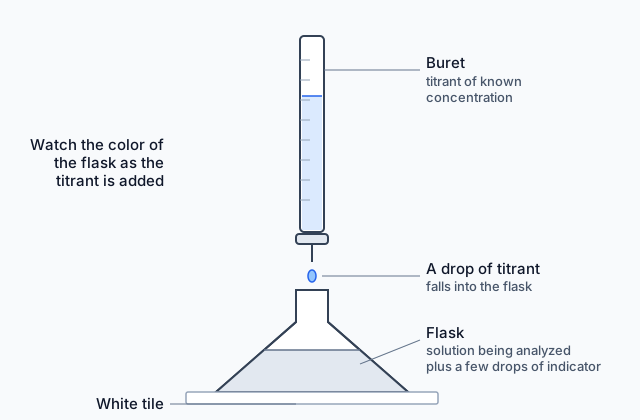 Tap to open the picture full size
Part 1 Think first Red cabbage juice
Commit to a guess first. Being wrong now makes the right idea stick better.
Predict first
Red cabbage juice is purple. A cook stirs a spoonful of it into vinegar and it turns red, then stirs another spoonful into a baking soda solution and it turns green. The same juice shows three colors. What best explains this?
In short. A weak acid is mostly its acid form, HA, when the pH of the solution is below its pKa, and mostly its base form, A⁻, when the pH is above it.
- An indicator is a weak acid whose two forms have different colors, so its color shows which form has the higher concentration.
- For a weak base, compare the pH with the pKa of its conjugate acid, which is 14.00 − pKb at 25 °C.
- To mark the equivalence point of a titration, choose an indicator whose pKa is close to the pH at that point.
Part 2 Learn it Reading a solution's pH against a pKa
2a. Which form is there more of?
A weak acid, HA, reacts only partly with water, so a solution of it holds two forms of the same substance: the acid form, HA, and its conjugate base, A⁻. Which one is present in the greater amount depends on the pH of the solution.
The acid's strength is often reported as its pKa, where pKa = −log Ka. Compare the pH with the pKa:
- pH < pKa: the acid form, HA, has the higher concentration.
- pH > pKa: the base form, A⁻, has the higher concentration.
- pH = pKa: the two forms have equal concentrations.
Le Châtelier's principle explains the rule. In HA + H₂O ⇌ A⁻ + H₃O⁺, a solution with a low pH already holds a lot of H₃O⁺, which pushes the equilibrium toward HA. A solution with a high pH holds very little H₃O⁺, so the equilibrium shifts toward A⁻.
Example: acetic acid has a pKa of 4.76. In vinegar, at about pH 2.4, it is mostly CH₃COOH. In blood, at about pH 7.4, it would be mostly CH₃COO⁻.
Quick check · Sort it
Acetic acid has a pKa of 4.76. Each card gives the pH of a solution of acetic acid. Tap a card, then the bin for the form that is present in the greater amount.
Acid form, CH₃COOH
Base form, CH₃COO⁻
2b. Bases use the conjugate acid's pKa
A weak base, B, and its conjugate acid, BH⁺, are a pair just like A⁻ and HA. The rule is the same, but the pKa that goes with the pair is the pKa of the conjugate acid, BH⁺.
A base's strength is usually reported as its pKb. For a conjugate pair at 25 °C, pKa + pKb = 14.00, so
pKa of BH⁺ = 14.00 − pKb of B
Then compare the pH with that pKa:
- pH < pKa of BH⁺: the acid form, BH⁺, has the higher concentration.
- pH > pKa of BH⁺: the base form, B, has the higher concentration.
Example: ammonia, NH₃, has a pKb of 4.75, so the pKa of NH₄⁺ is 14.00 − 4.75 = 9.25. In a solution at pH 11.5, which is above 9.25, ammonia is mostly NH₃.
Never compare a pH directly with a pKb. The pKb describes the base reacting with water; the pH-versus-pKa rule needs the constant of the acid form.
Quick check · Decide and justify
Pyridine, C₅H₅N, is a weak base with a pKb of 8.77. Its conjugate acid is the pyridinium ion, C₅H₅NH⁺. A solution of pyridine is held at pH 7.0. Which form is present in the greater amount?
Which reason supports your decision?
2c. An indicator is a weak acid with two colors
An acid-base indicator is a weak acid whose acid form, HIn, and base form, In⁻, have different properties, usually different colors. The pH of the solution decides which form is present in the greater amount, so the color shows which side of the indicator's pKa the pH is on.
Read the colors from the table, one form per column. Near the pKa both forms are present in noticeable amounts, so the color is a blend of the two.
| Indicator | pKa | Acid form, HIn | Base form, In⁻ |
|---|---|---|---|
| Methyl orange | 3.5 | red | yellow |
| Methyl red | 5.0 | red | yellow |
| Bromothymol blue | 7.1 | yellow | blue |
| Phenolphthalein | 9.4 | colorless | pink |
Example: bromothymol blue has a pKa of 7.1. At pH 6.0, below its pKa, HIn has the higher concentration and the solution is yellow. At pH 8.5, above its pKa, In⁻ has the higher concentration and the solution is blue.
Quick check · Match
Bromothymol blue has a pKa of 7.1, a yellow acid form and a blue base form. Methyl red has a pKa of 5.0, a red acid form and a yellow base form. Phenolphthalein has a pKa of 9.4, a colorless acid form and a pink base form. Match each indicator in its solution to the color it shows.
2d. Choosing an indicator for a titration
In a titration, you add titrant until you reach the equivalence point, where the moles of titrant added equal the moles of analyte that were in the flask. An indicator lets you see that point, because its color changes as the pH passes its pKa. So the rule is:
Choose an indicator whose pKa is close to the pH at the equivalence point.
For example, if the equivalence point is at pH 8.0, an indicator with a pKa near 8 changes color right where the titration should stop. One with a pKa near 4 changes color far from the equivalence point, so the student would stop at the wrong volume.
The pH at the equivalence point is not always 7. It depends on what is left in the flask:
- a strong acid with a strong base leaves a neutral solution, at pH 7;
- a weak acid with a strong base leaves the conjugate base of the acid, which is a weak base, so the pH is above 7;
- a weak base with a strong acid leaves the conjugate acid of the base, which is a weak acid, so the pH is below 7.
Find that pH first, then look for the closest pKa.
Quick check · Multiple choice
A student titrates 0.100 M acetic acid, a weak acid with a pKa of 4.76, with 0.100 M sodium hydroxide. The pH at the equivalence point is 8.73. Which indicator is the best choice to mark the equivalence point?
Part 3 Watch it done Which indicator for ammonia and acid?
Predict first, then watch each step, then finish the choice yourself.
A student titrates 25.00 mL of 0.100 M ammonia, NH₃, with 0.100 M hydrochloric acid. Ammonia has a pKb of 4.75. At the equivalence point the flask holds only NH₄⁺, at 0.0500 M. The student has four indicators: methyl orange (pKa 3.5), methyl red (pKa 5.0), bromothymol blue (pKa 7.1) and phenolphthalein (pKa 9.4). Which indicator should the student use?
Predict first
Before you open the first step, predict: will the pH at the equivalence point be above 7, exactly 7 or below 7?
Step 1 · Find what is left at the equivalence point
All of the NH₃ has reacted with the acid and become NH₄⁺, its conjugate acid. NH₄⁺ is a weak acid, so it adds H₃O⁺ to the solution and the pH at the equivalence point is below 7.
Step 2 · Find the pH
The pKa of NH₄⁺ is 14.00 − 4.75 = 9.25, so Ka = 5.6 × 10⁻¹⁰. For 0.0500 M NH₄⁺, [H₃O⁺] = √(Ka × 0.0500) = 5.3 × 10⁻⁶ M, and the pH is 5.28.
Why this step?
Why not pick the indicator with a pKa near 7, since a titration is supposed to reach a neutral solution?
Only the equivalence point of a strong acid with a strong base is neutral. Here NH₄⁺ is left in the flask, so the pH at the equivalence point is 5.28, and the indicator has to change color there, not at 7.
Step 3 · Set the rule
The best indicator is the one whose pKa is closest to the pH at the equivalence point, 5.28. Compare each of the four pKa values with that number.
Your step · Decide and justify
Finish it. The pH at the equivalence point of the titration of ammonia with hydrochloric acid is 5.28. Which indicator should the student use?
Which reason supports your decision?
Methyl red changes color around pH 5, so its color change tells the student when the equivalence point is reached. Bromothymol blue, the choice for a neutral endpoint, changes color around pH 7.1. In this titration the pH falls through 7.1 before the equivalence point, so the student would stop too early.
Part 4 Try it Two new situations
Use the same comparison in two settings you have not seen: a juice and a different titration.
Try it · Spot the error
A student explains the color of bromothymol blue (pKa 7.1, yellow acid form, blue base form) in lemon juice at pH 2.3. Tap the line with the mistake.
Try it · Rank it
A student titrates hydrochloric acid with sodium hydroxide, so the pH at the equivalence point is 7.00. Rank these indicators from the best choice to the worst, by how close the indicator's pKa is to that pH: methyl orange (pKa 3.5), methyl red (pKa 5.0), bromothymol blue (pKa 7.1), phenolphthalein (pKa 9.4).
Best choice first
Give each one a place, 1 for first. Give two the same place if they are equal.
Your ranking: none yet
Part 5 Explain it Choose an indicator for a weak acid
On the exam this is handwritten, so answer on paper first. Nothing you type here leaves this page. Then check your answer against the model and each scoring point.
Free response is 50% of the exam score. This one is shaped like a short-answer question, which is worth 4 points.
Free-response practice · Short-answer style
A student titrates 25.00 mL of 0.100 M propanoic acid, CH₃CH₂COOH, with 0.100 M sodium hydroxide. The Ka of propanoic acid is 1.3 × 10⁻⁵. The pH of the acid solution before any base is added is 2.95, and the pH at the equivalence point is 8.79. The student has two indicators. Bromothymol blue has a pKa of 7.1, a yellow acid form and a blue base form. Phenolphthalein has a pKa of 9.4, a colorless acid form and a pink base form.
(a) Identify the form of bromothymol blue present in the greater amount before any base is added, and the color the solution shows.
(b) Identify which indicator is the better choice for this titration, and justify your choice using the pKa values and the pH at the equivalence point.
(c) Predict the color of the solution with phenolphthalein in it when the pH is 10.5, and explain your prediction with the pH and the pKa.
(d) Explain the error in the student's result if bromothymol blue is used instead.
Model answer
(a) The pH, 2.95, is below the pKa of bromothymol blue, 7.1, so the acid form, HIn, has the higher concentration. The solution is yellow.
(b) Phenolphthalein. The pH at the equivalence point is 8.79. The pKa of phenolphthalein, 9.4, is 0.6 pH units from that, and the pKa of bromothymol blue, 7.1, is 1.7 away. The better indicator has the pKa closest to the pH at the equivalence point.
(c) Pink. The pH, 10.5, is above the pKa, 9.4, so the base form, In⁻, has the higher concentration, and the base form is pink.
(d) Bromothymol blue turns blue when the pH rises past 7.1, which happens before the equivalence point at pH 8.79. The student would stop adding base too soon, use too little sodium hydroxide, and calculate a concentration for the acid that is too low.
Score your own answer. This is a self-check, not a grade. Tick each point your answer makes.
Part 6 Check yourself Four indicators, one unknown
The first three questions use the table.
A student adds a few drops of four different indicators to four separate samples of one unknown solution and records the colors. The table gives each indicator's pKa and the color of each of its forms. These numbers are a teaching example.
| Indicator | pKa | Acid form, HIn | Base form, In⁻ | Color in the unknown |
|---|---|---|---|---|
| Methyl orange | 3.5 | red | yellow | yellow |
| Methyl red | 5.0 | red | yellow | red |
| Bromothymol blue | 7.1 | yellow | blue | yellow |
| Phenolphthalein | 9.4 | colorless | pink | colorless |
Case question 1 · Multiple choice
Using the table: which statement about the pH of the unknown solution is supported by the colors?
Case question 2 · Select all
Using the table: which two statements about the forms of the indicators in the unknown solution are true? Select two.
Select 2 answers, then check.
Case question 3 · Decide and justify
Using the table: another student will titrate a weak base with a strong acid, and the pH at the equivalence point is 4.6. Which indicator in the table should the student use?
Which reason supports your decision?
The rest stand on their own and do not use the case.
Check yourself · Calculate
Methylamine, CH₃NH₂, is a weak base with a pKb of 3.36. What is the pKa of its conjugate acid, CH₃NH₃⁺? Use pKa + pKb = 14.00, and give your answer to two decimal places.
Check yourself · Put it in order
A student wants to choose an indicator for a titration. Put the steps in order.
Part 7 Keep it Bring back earlier ideas
Titrations rely on molarity, and every pH comparison starts from a pH or a pKa found with the right units. Pulling them back up makes them last.
From 3.7 Solutions and Mixtures · Calculate
A student dissolves 29.2 g of sodium chloride, NaCl (molar mass 58.44 g/mol), in water and adds water to make 250.0 mL of solution. What is the molarity of the solution? Give your answer to three significant figures.
From 8.3 Weak Acid and Base Equilibria · Calculate
A weak acid HA has pKa = 4.40. What is the pH of a 0.200 M solution of HA at 25 °C? Treat [HA] at equilibrium as 0.200 M. Give two decimal places.
In three lines
- Below a weak acid's pKa the acid form, HA, has the higher concentration; above it the base form, A⁻, does. For a base, use the pKa of its conjugate acid, 14.00 − pKb.
- An indicator is a weak acid whose two forms have different colors, so its color shows which form has the higher concentration at that pH.
- Choose an indicator whose pKa is close to the pH at the equivalence point, which is not always 7.
Exam strategy for this topic
- Section I, Multiple Choice: 60 questions in 90 minutes.
- Section II, Free Response: 7 questions in 105 minutes.
- A scientific or graphing calculator is recommended for use on both sections of the exam.
Write down which constant you are given, turn a pKb into the pKa of the conjugate acid, and only then compare it with the pH. For a titration, find the pH at the equivalence point from what is left in the flask before you look at any indicator, and say in words which form has the higher concentration.
Questions students ask
How do you tell whether HA or A⁻ is present in the greater amount?
Compare the solution's pH with the pKa of the acid. Below the pKa the acid form, HA, has the higher concentration; above it the base form, A⁻, does.
What happens when the pH equals the pKa?
The acid form and the base form are present in equal concentrations.
How do you use a pKb to compare with a pH?
Turn it into the pKa of the conjugate acid with pKa = 14.00 − pKb at 25 °C, then compare that pKa with the pH.
Why does an indicator change color?
It is a weak acid whose acid form and base form have different colors. As the pH passes its pKa, the form with the higher concentration changes, and so does the color.
How do you choose an indicator for a titration?
Find the pH at the equivalence point, then choose the indicator whose pKa is closest to that pH.
Course alignment, for teachers
AP Chemistry topic 8.7, Unit 8: Acids and Bases.
- Skill 2.D: Make observations or collect data from representations of laboratory setups or results, while attending to precision where appropriate.
This lesson maps all 3 essential knowledge statements of the topic to the part that teaches each one: 3 are checked by a scored question. The map is in the lesson file.