Unit 8 · Topic 8.8 · about 30 minutes · 7 parts · 11 scored checks, 2 of them multiple choice, plus 2 from earlier lessons
AP Chemistry 8.8: Properties of Buffers
Unit 8: 11 to 15% of the multiple-choice section
What you'll be able to do
- Explain how the two members of a buffer's conjugate pair react with added acid and added base, and why those reactions keep the pH steady.
Key vocabulary
| Term | What it means | The exam trap |
|---|---|---|
| Buffer | A solution that contains a large concentration of both members of a conjugate acid-base pair and keeps its pH nearly steady when a small amount of acid or base is added. | A weak acid on its own does not form a buffer, so check what else is in the solution before you call it one. |
| Conjugate acid | The species formed when a base gains a proton, such as NH₄⁺ from NH₃; in a buffer it reacts with added base. | Decide whether the species in a pair is the acid or the base before you decide what it reacts with. |
| Conjugate base | The species formed when an acid loses a proton, such as CH₃COO⁻ from CH₃COOH; in a buffer it reacts with added acid. | A spectator ion from a salt may look like a base, so check that it really differs from the acid by one proton. |
| Net ionic equation | An equation that shows only the species that react, leaving out spectator ions such as Na⁺ and Cl⁻. | Charge and atoms must balance on both sides, so check them before you accept an equation. |
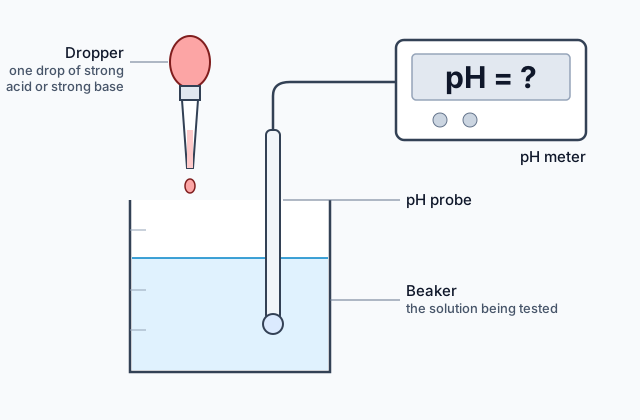 Tap to open the picture full size
Part 1 Think first Exercise and your blood
Commit to a guess first. Being wrong now makes the right idea stick better.
Predict first
Hard exercise sends lactic acid into your blood, and the carbon dioxide your cells make forms an acid in water all day long. Yet the pH of blood stays between about 7.35 and 7.45, and a pH below about 6.8 or above about 7.8 is not compatible with life. What do you think keeps the pH of blood so steady when acid is added?
In short. A buffer is a solution with a large concentration of both members of a conjugate acid-base pair, and it keeps its pH nearly steady when a small amount of acid or base is added.
- Added acid reacts with the conjugate base of the pair, and added base reacts with the conjugate acid.
- Each reaction turns a strong acid or base into a weak one, so little H₃O⁺ or OH⁻ is left over.
- A buffer limits the change in pH but does not stop it, and a weak acid alone is not a buffer.
Part 2 Learn it How a buffer works
2a. What makes a buffer
A buffer is a solution whose pH stays nearly steady when small amounts of acid or base are added. What it holds is the key: a large concentration of both members of a conjugate acid-base pair, a weak acid, HA, and its conjugate base, A⁻, or a weak base and its conjugate acid.
Common buffers:
- acetic acid and acetate ion, CH₃COOH and CH₃COO⁻, made by dissolving sodium acetate in acetic acid;
- ammonia and ammonium ion, NH₃ and NH₄⁺, made by dissolving ammonium chloride in ammonia;
- carbonic acid and hydrogen carbonate ion, H₂CO₃ and HCO₃⁻, which buffer blood.
Some mixtures look like buffers but are not:
- A weak acid alone holds almost none of its conjugate base.
- A strong acid with its salt, such as HCl with NaCl, holds no HA at all, because a strong acid ionizes completely.
- A weak acid with the salt of a different acid, such as acetic acid with NaCl, has no conjugate base. Cl⁻ is not the conjugate base of acetic acid.
The two members must be a true pair, differing by one H⁺, and both must be present in large amounts.
Quick check · Sort it
Each card names two substances dissolved together in water, each at 0.50 M. Tap a card, then the bin it belongs in.
Buffer
Not a buffer
2b. How the pair answers added acid or base
The two members of the pair do opposite jobs, and an acid reacts with a base while a base reacts with an acid:
- Added acid (H₃O⁺) is taken up by the conjugate base, A⁻: A⁻ + H₃O⁺ → HA + H₂O
- Added base (OH⁻) is taken up by the conjugate acid, HA: HA + OH⁻ → A⁻ + H₂O
In the acetic acid buffer, these are CH₃COO⁻ + H₃O⁺ → CH₃COOH + H₂O and CH₃COOH + OH⁻ → CH₃COO⁻ + H₂O.
The roles follow the chemistry, not the label of acid or base on the solution. In an ammonia buffer, NH₃ is the base, so it takes up added acid: NH₃ + H₃O⁺ → NH₄⁺ + H₂O. NH₄⁺ is the acid, so it takes up added base: NH₄⁺ + OH⁻ → NH₃ + H₂O.
Added acid has nothing to react with in the acid member of the pair, since both are acids. Match each addition with the member that is its opposite.
Quick check · Match
One buffer holds acetic acid, CH₃COOH, and acetate ion, CH₃COO⁻. Another holds ammonia, NH₃, and ammonium ion, NH₄⁺. Match each addition to what happens in the buffer.
2c. Why the pH barely moves
The reactions in the last chunk do the work. When a strong acid or base is added to a buffer, it does not stay behind as free H₃O⁺ or OH⁻. It is converted into a member of the pair, and a weak acid or base puts far less H₃O⁺ or OH⁻ into the solution than a strong one does. Because the buffer holds large amounts of both members, there is plenty of each to react.
The table shows the same small addition of acid to two solutions. These numbers are a teaching example.
| Solution | pH before | pH after |
|---|---|---|
| Pure water | 7.00 | 2.00 |
| Buffer of 0.10 M NH₃ and 0.10 M NH₄⁺ | 9.25 | 9.16 |
In pure water nothing reacts with the added H₃O⁺, so all of it stays and the pH falls by 5 units. In the buffer, NH₃ takes up almost all of it, and the pH moves only a little.
A buffer does not freeze the pH. It makes the pH change much less than it would have without the pair.
Quick check · Decide and justify
The same small amount of HCl is added to 1.0 L of pure water and to 1.0 L of a buffer made of acetic acid and acetate ion. In which solution does the pH change less?
Which reason supports your decision?
Part 3 Watch it done Hydrochloric acid in an ammonia buffer
Predict first, then watch each step, then finish the equation yourself.
An ammonia buffer holds 0.20 M NH₃ and 0.20 M NH₄Cl. A student adds a few drops of hydrochloric acid, HCl. Show what happens to the added acid.
Predict first
Before you open the first step, predict: which member of the buffer reacts with the added acid?
Step 1 · Name the pair
NH₄⁺ is the conjugate acid and NH₃ is the conjugate base. They differ by one H⁺, and each is present at 0.20 M, which is a large amount.
Step 2 · Say what is added
HCl is a strong acid. It ionizes completely, so the added acid is H₃O⁺ and Cl⁻. Cl⁻ is a spectator and does nothing to the pH.
Why this step?
Why must NH₃ react with the H₃O⁺, and not NH₄⁺?
An acid reacts with a base. NH₃ is a base and can accept a proton from H₃O⁺. NH₄⁺ already carries the extra proton and is an acid itself, so it has nothing to do with added acid.
Step 3 · Say what moves
A proton moves from H₃O⁺ to NH₃. Each H₃O⁺ added uses up one NH₃ and makes one NH₄⁺, so the strong acid is replaced by a weak one.
Your step · Fill the statement
Finish it. Complete the net ionic equation for the reaction of the ammonia buffer with the added H₃O⁺.
NH₃ + H₃O⁺ → +
The strong acid you added is gone, and a little of the weak acid NH₄⁺ has taken its place. NH₄⁺ releases much less H₃O⁺ than HCl would have, which is why the pH of the buffer barely moves.
Part 4 Try it Acid and base added to acetic acid buffers
Now follow the amounts and the reactions in an acetic acid buffer. The numbers are a teaching example.
Try it · Calculate
A 1.00 L buffer holds 0.500 mol of acetic acid, CH₃COOH, and 0.500 mol of acetate ion, CH₃COO⁻. A student adds 0.100 mol of HCl, which reacts completely with the buffer. How many moles of acetic acid are in the solution afterward? Give your answer to three significant figures.
Try it · Spot the error
A student explains what happens when sodium hydroxide is added to an acetic acid and acetate buffer. Tap the line with the mistake.
Part 5 Explain it Write the buffer reactions
On the exam this is handwritten, so answer on paper first. Nothing you type here leaves this page. Then check your answer against the model and each scoring point.
Free response is 50% of the exam score. This one is shaped like a short-answer question, which is worth 4 points.
Free-response practice · Short-answer style
A student makes a buffer by dissolving sodium fluoride, NaF, in hydrofluoric acid, HF, so that the solution holds 0.50 M HF and 0.50 M F⁻.
(a) Identify the conjugate acid and the conjugate base in this buffer.
(b) Represent, with a net ionic equation, the reaction that happens when a small amount of HCl is added.
(c) Represent, with a net ionic equation, the reaction that happens when a small amount of NaOH is added.
(d) Explain why the pH of the buffer changes much less than the pH of pure water does when the same small amount of HCl is added.
Model answer
(a) The conjugate acid is HF and the conjugate base is F⁻.
(b) F⁻ + H₃O⁺ → HF + H₂O. The conjugate base takes up the added acid.
(c) HF + OH⁻ → F⁻ + H₂O. The conjugate acid takes up the added base.
(d) In the buffer, the added H₃O⁺ is taken up by F⁻, which is present in a large amount, and forms HF. HF is a weak acid, so it puts little H₃O⁺ back into the solution and the pH changes only a little. Pure water has nothing that reacts with the added H₃O⁺, so all of it stays and the pH falls much more.
Score your own answer. This is a self-check, not a grade. Tick each point your answer makes.
Part 6 Check yourself Four solutions and one small addition of acid
The first three questions use the table.
A student measures the pH of four 100.0 mL solutions, adds 1.0 mL of 1.0 M HCl to each, and measures the pH again. The HCl adds 0.0010 mol of H₃O⁺ to each solution. These numbers are a teaching example.
| Solution | Contents | pH before | pH after |
|---|---|---|---|
| A | Pure water | 7.00 | 2.00 |
| B | 0.10 M CH₃COOH and 0.10 M CH₃COO⁻ | 4.76 | 4.67 |
| C | 0.10 M NaCl | 7.00 | 2.00 |
| D | 0.10 M CH₃COOH only | 2.88 | 2.00 |
Case question 1 · Multiple choice
Using the table: solution C is 0.10 M NaCl. Which statement describes what the table shows for C, and explains it?
Case question 2 · Decide and justify
Using the table: is solution D, which holds only acetic acid, a buffer?
Which reason supports your decision?
Case question 3 · Multiple choice
Using the table: which reaction mainly accounts for the small change in the pH of solution B when the HCl is added?
The rest stand on their own and do not use the case.
Check yourself · Select all
Which two statements about a buffer are true? Select two.
Select 2 answers, then check.
Check yourself · Put it in order
A small amount of HCl is added to a buffer of ammonia and ammonium ion. Put what happens in order.
Part 7 Keep it Bring back earlier ideas
This lesson leans on which form of an acid has the higher concentration at a given pH, and on the mole concept. Pulling them back up makes them last.
From 8.7 pH and pKa · Decide and justify
Pyridine, C₅H₅N, is a weak base with a pKb of 8.77. Its conjugate acid is the pyridinium ion, C₅H₅NH⁺. A solution of pyridine is held at pH 7.0. Which form is present in the greater amount?
Which reason supports your decision?
From 3.7 Solutions and Mixtures · Calculate
A student dissolves 29.2 g of sodium chloride, NaCl (molar mass 58.44 g/mol), in water and adds water to make 250.0 mL of solution. What is the molarity of the solution? Give your answer to three significant figures.
In three lines
- A buffer holds large concentrations of both members of a conjugate acid-base pair, a weak acid and its conjugate base, or a weak base and its conjugate acid.
- Added acid is taken up by the conjugate base, and added base is taken up by the conjugate acid, so each strong addition becomes a weak one.
- Those reactions are why the pH of a buffer changes much less than the pH of water does, but they do not hold the pH perfectly still.
Exam strategy for this topic
- Section I, Multiple Choice: 60 questions in 90 minutes.
- Section II, Free Response: 7 questions in 105 minutes.
- A scientific or graphing calculator is recommended for use on both sections of the exam.
When a question adds acid or base to a buffer, name the conjugate pair first, then match the addition with the opposite member and write that reaction as a net ionic equation. Explain the pH in words: a strong acid or base is replaced by a weak one, so little H₃O⁺ or OH⁻ is left, and the pH changes much less than in water.
Questions students ask
What is a buffer?
A solution that holds a large concentration of both members of a conjugate acid-base pair, so it keeps its pH nearly steady when small amounts of acid or base are added.
What reacts with added acid in a buffer?
The conjugate base of the pair accepts a proton from the added H₃O⁺ and becomes the conjugate acid, for example A⁻ + H₃O⁺ → HA + H₂O.
What reacts with added base in a buffer?
The conjugate acid of the pair donates a proton to the added OH⁻ and becomes the conjugate base, for example HA + OH⁻ → A⁻ + H₂O.
Is a weak acid solution a buffer?
No. A weak acid alone holds almost none of its conjugate base, so nothing in it can take up added acid. A buffer needs a large amount of both members.
Does a buffer keep the pH from changing at all?
No. A buffer makes the pH change much less than it would have without the pair, but it does not hold the pH perfectly constant.
Course alignment, for teachers
AP Chemistry topic 8.8, Unit 8: Acids and Bases.
- Skill 6.D: Provide reasoning to justify a claim using chemical principles or laws, or using mathematical justification.
This lesson maps the one essential knowledge statement of the topic to the part that teaches each one: 1 is checked by a scored question. The map is in the lesson file.