Unit 9 · Topic 9.11 · about 30 minutes · 7 parts · 12 scored checks, 1 of them multiple choice, plus 2 from earlier lessons
AP Chemistry 9.11: Electrolysis and Faraday’s Law
Unit 9: 7 to 9% of the multiple-choice section
What you'll be able to do
- Calculate the charge that flows in an electrochemical cell from the amounts of reactants and products that change, and the amounts from the charge, current and time.
Key vocabulary
| Term | What it means | The exam trap |
|---|---|---|
| Current (I) | The rate at which charge flows, in amperes; one ampere is one coulomb per second, so I = q/t. | A time given in minutes or hours has to become seconds before you use it with amperes. |
| Coulomb (C) | The unit of electric charge; the charge carried by one mole of electrons is 96,485 C. | Charge and moles of electrons are different quantities, so check which one a number refers to. |
| Faraday's constant (F) | The charge of one mole of electrons, 96,485 C/mol e⁻. | Read the unit first, because it tells you whether to multiply or divide by F. |
| Electrolysis | Using an outside source of current to drive a reaction that would not run on its own. | Do not let the name make you look for a spontaneous reaction; the source of current supplies the energy. |
| Electroplating | Electrolysis that deposits a layer of metal on an object by reducing metal ions at that object. | Find which species gains electrons before you count them, and read the electron count from the half-reaction. |
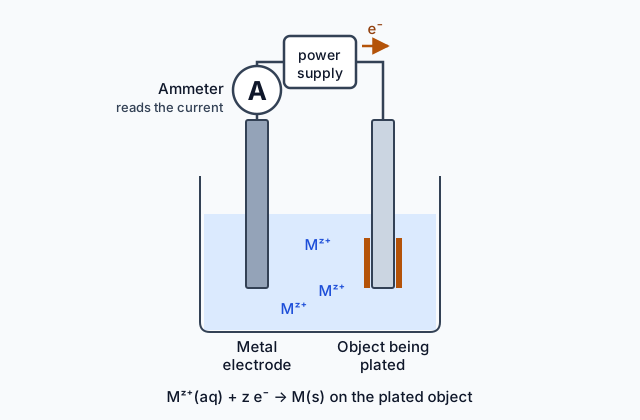 Tap to open the picture full size
Part 1 Think first A jeweler's silver bath
Commit to a guess first. Being wrong now makes the right idea stick better.
Predict first
A jeweler silver-plates ring blanks. She hangs them in a bath of silver nitrate solution and runs a steady current through it from a power supply. Ten minutes gives a thin, even coat. She wants a coat twice as heavy. What should she change?
In short. Faraday's laws tie the charge that flows through a cell to the amount of material deposited or removed at an electrode, through the current, the time, the moles of electrons and the charge on the ion.
- Charge in coulombs equals current in amperes times time in seconds, q = It, because one ampere is one coulomb per second.
- One mole of electrons carries 96,485 C, so moles of electrons equal the charge divided by 96,485 C/mol e⁻.
- The charge on the ion is the number of electrons per metal atom, so the same charge deposits different moles and masses of different metals.
Part 2 Learn it From charge to mass
2a. Charge, current and time
A current is charge moving. Current, I, is the rate: the charge that passes a point each second. One ampere (A) is one coulomb (C) per second. In symbols:
I = q/t, so q = It
with q in coulombs, I in amperes and t in seconds. Times are often given in minutes or hours, so convert before you multiply. A current of 3.00 A for 10.0 min is 600 s, so q = (3.00 C/s)(600 s) = 1800 C, or 1.80 × 10³ C.
A bigger current moves more charge each second, and a longer time gives it more seconds. Either one raises the total charge.
In electrolysis an outside power source forces a current through a cell and drives a reaction that would not run on its own. In electroplating, metal ions from the solution are reduced at the object being plated and deposit on it as a layer of metal.
Quick check · Calculate
A plating cell carries a steady current of 2.50 A for 30.0 min. How much charge flows through it, in kilocoulombs (1 kC = 1000 C)? Give your answer to three significant figures.
2b. Charge to moles of electrons
Charge comes in electrons. One mole of electrons carries 96,485 C, a quantity called Faraday's constant, F = 96,485 C/mol e⁻. So the moles of electrons that flowed are
moles of e⁻ = q / F
The 1800 C from the last chunk is 1800 C ÷ 96,485 C/mol e⁻ = 0.01866 mol e⁻, or 0.0187 mol e⁻ to three significant figures.
Next, the half-reaction says how many electrons it takes to make one metal atom. For a metal ion with charge z, the half-reaction is Mᶻ⁺ + z e⁻ → M(s), so z moles of electrons deposit 1 mole of metal:
- Ag⁺ + e⁻ → Ag(s): 1 mol e⁻ per mol Ag
- Cu²⁺ + 2 e⁻ → Cu(s): 2 mol e⁻ per mol Cu
- Al³⁺ + 3 e⁻ → Al(s): 3 mol e⁻ per mol Al
The charge on the ion is the link between moles of electrons and moles of metal. The same charge makes more moles of a metal whose ion has a small charge.
Quick check · Rank it
Each metal is deposited from its ion: Ag⁺, Cu²⁺, Zn²⁺ and Al³⁺. Rank them by the charge needed to deposit 1.00 mol of each metal.
Most charge first
Give each one a place, 1 for first. Give two the same place if they are equal.
Your ranking: none yet
2c. From current and time to mass
Put the pieces in a chain. Each arrow is a conversion with its own factor:
current and time → charge → moles of electrons → moles of metal → mass
- q = It, with the time in seconds.
- Moles of e⁻ = q ÷ 96,485 C/mol e⁻.
- Moles of metal = moles of e⁻ ÷ z, where z is the number of electrons in the half-reaction.
- Mass = moles of metal × molar mass.
Example: 2.00 A runs for 25.0 min through a bath of Ag⁺(aq). The charge is (2.00 A)(1500 s) = 3000 C. The electrons are 3000 C ÷ 96,485 C/mol e⁻ = 0.03109 mol. One electron deposits one Ag atom, so that is 0.03109 mol Ag. The mass is 0.03109 mol × 107.87 g/mol = 3.35 g. Keep unrounded numbers between steps and round once at the end.
Quick check · Put it in order
A bath contains Cu²⁺(aq), and you know the current, the time in minutes and the half-reaction. Put the steps for finding the mass of copper deposited in order.
2d. Working backward from a mass
The chain runs in reverse just as well. Start from the mass of metal that deposited or dissolved:
mass → moles of metal → moles of electrons → charge → time or current
- Moles of metal = mass ÷ molar mass.
- Moles of e⁻ = moles of metal × z.
- q = moles of e⁻ × 96,485 C/mol e⁻.
- Then t = q ÷ I, or I = q ÷ t.
Example: how long does 2.00 A take to plate 1.00 g of nickel from Ni²⁺(aq), Ni²⁺ + 2 e⁻ → Ni(s)? Moles of Ni = 1.00 g ÷ 58.69 g/mol = 0.01704 mol. Electrons = 2 × 0.01704 = 0.03408 mol. Charge = 0.03408 mol × 96,485 C/mol = 3288 C. Time = 3288 C ÷ 2.00 A = 1640 s, which is 27.4 min.
The same arithmetic works for any species that gains or loses electrons at an electrode. A metal anode that dissolves, such as Cu(s) → Cu²⁺ + 2 e⁻, loses the moles that the charge says it should.
Quick check · Spot the error
A student finds how long a 2.00 A current must run to plate 1.27 g of copper from Cu²⁺(aq), using Cu²⁺ + 2 e⁻ → Cu(s) and a molar mass of 63.55 g/mol. Tap the line with the mistake.
Part 3 Watch it done Chromium plating
Predict first, then watch each step, then finish the calculation yourself.
A bath contains Cr³⁺(aq). A steady current of 5.00 A runs for 45.0 min, and chromium deposits by Cr³⁺ + 3 e⁻ → Cr(s). The molar mass of chromium is 52.00 g/mol. What mass of chromium plates out? These numbers are a teaching example.
Predict first
Before you open the first step, predict: compared with a silver bath carrying the same charge, will this bath deposit more moles of metal, fewer, or the same number?
Step 1 · Find the charge
The time is 45.0 min × 60 s/min = 2700 s. q = It = (5.00 A)(2700 s) = 13500 C, or 1.35 × 10⁴ C.
Step 2 · Find the moles of electrons
Moles of e⁻ = 13500 C ÷ 96,485 C/mol e⁻ = 0.139918 mol. Keep the unrounded value for the next step.
Why this step?
Why divide the charge by 96,485 C/mol e⁻ rather than use the coulombs directly?
The half-reaction counts electrons in moles, and 96,485 C/mol e⁻ is the conversion between coulombs and moles of electrons. Without it the charge has the wrong unit to compare with the half-reaction.
Step 3 · Find the moles of chromium
The half-reaction uses 3 mol e⁻ for each mol Cr, so moles of Cr = 0.139918 ÷ 3 = 0.046639 mol.
Your step · Calculate
Finish it. With 0.046639 mol of chromium and a molar mass of 52.00 g/mol, what mass of chromium plates out, in grams? Give your answer to three significant figures.
g
Three electrons for every chromium atom means each mole of chromium needs three times the charge that a mole of silver needs, and only a third as many moles of chromium as moles of electrons are deposited. The ion's charge is what turns charge into moles of metal.
Part 4 Try it Plating a ring
A jeweler silver-plates a ring in a bath of Ag⁺(aq), where Ag⁺ + e⁻ → Ag(s) and silver's molar mass is 107.87 g/mol. The current is 0.750 A for 12.0 min. These numbers are a teaching example.
Try it · Calculate
What mass of silver plates onto the ring, in grams? Give your answer to three significant figures.
Try it · Decide and justify
The same current runs for the same time through three cells in series, so equal charge passes through each. One cell has Ag⁺(aq), one has Cu²⁺(aq) and one has Al³⁺(aq), and each metal plates onto its own electrode. The molar masses are Ag 107.87 g/mol, Cu 63.55 g/mol and Al 26.98 g/mol. Which electrode gains the most mass?
Which reason supports your decision?
Part 5 Explain it Nickel first, then silver
On the exam this is handwritten, so answer on paper first. Nothing you type here leaves this page. Then check your answer against the model and each scoring point.
Free response is 50% of the exam score. This one is shaped like a short-answer question, which is worth 4 points.
Free-response practice · Short-answer style
A part is nickel-plated in a bath of Ni²⁺(aq), where Ni²⁺ + 2 e⁻ → Ni(s). A steady current of 4.00 A runs for 30.0 min. Use F = 96,485 C/mol e⁻, and molar masses of 58.69 g/mol for nickel and 107.87 g/mol for silver.
(a) Calculate the charge that flows, in coulombs.
(b) Calculate the moles of electrons that flow.
(c) Calculate the mass of nickel deposited.
(d) The same charge is then passed through a bath of Ag⁺(aq), where Ag⁺ + e⁻ → Ag(s). Determine the mass of silver deposited, and explain why it is greater than the mass of nickel.
Model answer
(a) t = 30.0 min × 60 s/min = 1800 s, so q = It = (4.00 A)(1800 s) = 7200 C, or 7.20 × 10³ C.
(b) Moles of e⁻ = 7200 C ÷ 96,485 C/mol e⁻ = 0.0746 mol.
(c) Each Ni²⁺ takes 2 electrons, so moles of Ni = 0.07462 ÷ 2 = 0.03731 mol, and the mass is 0.03731 mol × 58.69 g/mol = 2.19 g.
(d) Each Ag⁺ takes 1 electron, so moles of Ag = 0.07462 mol, and the mass is 0.07462 mol × 107.87 g/mol = 8.05 g. The same charge deposits twice as many moles of silver as of nickel, because silver needs 1 electron per atom and nickel needs 2, and a mole of silver also has the larger mass.
Score your own answer. This is a self-check, not a grade. Tick each point your answer makes.
Part 6 Check yourself Three plating runs
All three case questions use the table.
A shop plates three parts, one in each bath, with a steady current. In each bath the metal deposits as M(s) from its ion. The molar masses are Cu 63.55, Ni 58.69 and Cr 52.00 g/mol. These numbers are a teaching example.
| Run | Ion in the bath | Current (A) | Time (min) |
|---|---|---|---|
| 1 | Cu²⁺ | 3.00 | 20.0 |
| 2 | Ni²⁺ | 3.00 | 20.0 |
| 3 | Cr³⁺ | 1.50 | 40.0 |
Case question 1 · Calculate
Using the table: how many moles of electrons flow in run 3? Give your answer to three significant figures.
Case question 2 · Calculate
Using the table: what mass of chromium is deposited in run 3, in grams? Give your answer to three significant figures.
Case question 3 · Multiple choice
Using the table: runs 1 and 2 use the same current for the same time. Which statement compares the metal deposited?
The rest stand on their own and do not use the case.
Check yourself · Sort it
A copper bath plates Cu²⁺ + 2 e⁻ → Cu(s). Each card is a change to the run. Tap a card, then the bin that says what it does to the mass of copper deposited.
Changes the mass deposited
Leaves the mass deposited unchanged
Check yourself · Fill the statement
Complete the pathway from a mass of metal to the charge that was needed.
Moles of metal = mass ÷ . Moles of electrons = moles of metal × . Charge = moles of electrons × .
Part 7 Keep it Bring back earlier ideas
This lesson leans on two earlier ideas: how to turn a mass into moles, and how to reason about which way electrons flow in a cell. Pulling them back up is what makes them last.
From 1.1 Moles and Molar Mass · Calculate
How many moles of sodium chloride, NaCl, are in 10.0 g of it? The molar mass of NaCl is 58.44 g/mol. Give your answer to three significant figures.
From 9.10 Cell Potential Under Nonstandard Conditions · Decide and justify
A concentration cell has two silver electrodes. One half-cell holds 0.010 M Ag⁺ and the other holds 1.0 M Ag⁺. The half-cells are joined by a wire and a salt bridge. In which direction do electrons flow through the wire?
Which reason supports your decision?
In three lines
- Charge in coulombs is current in amperes times time in seconds, q = It, and moles of electrons are the charge divided by 96,485 C/mol e⁻.
- The ion's charge, z, links moles of electrons to moles of metal, and the molar mass links moles of metal to grams.
- The chain runs both ways, from current and time to mass or from mass back to charge, time or current.
Exam strategy for this topic
- Section I, Multiple Choice: 60 questions in 90 minutes.
- Section II, Free Response: 7 questions in 105 minutes.
- A scientific or graphing calculator is recommended for use on both sections of the exam.
Write the chain in units: amperes and seconds give coulombs, coulombs over C/mol e⁻ give moles of electrons, the half-reaction gives moles of metal, and the molar mass gives grams. Convert the time to seconds first, keep unrounded numbers between steps, and give the answer to the figures the data allow.
Questions students ask
How do you find the charge that flows in electrolysis?
Multiply the current in amperes by the time in seconds, q = It. One ampere is one coulomb per second, so the answer is in coulombs.
What is Faraday's constant?
It is the charge of one mole of electrons, 96,485 C/mol e⁻. Divide a charge in coulombs by it to get moles of electrons.
How do you find the mass of metal deposited in electroplating?
Find the charge, divide by 96,485 to get moles of electrons, divide by the electrons in the half-reaction to get moles of metal, and multiply by the molar mass.
Why does the same charge deposit different masses of different metals?
Each metal needs a different number of electrons per atom and has a different molar mass. Silver takes 1 electron per atom, copper 2 and aluminum 3.
What is the difference between electrolysis and a galvanic cell?
A galvanic cell runs a favored reaction and produces current. Electrolysis uses an outside current to drive a reaction that is not favored.
Course alignment, for teachers
AP Chemistry topic 9.11, Unit 9: Thermodynamics and Electrochemistry.
- Skill 5.B: Identify an appropriate theory, definition, or mathematical relationship to solve a problem.
This lesson maps the one essential knowledge statement of the topic to the part that teaches each one: 1 is checked by a scored question. The map is in the lesson file.