Unit 9 · Topic 9.10 · about 30 minutes · 7 parts · 14 scored checks, 4 of them multiple choice
AP Chemistry 9.10: Cell Potential Under Nonstandard Conditions
Unit 9: 7 to 9% of the multiple-choice section
What you'll be able to do
- Explain how a cell's potential changes when its concentrations move away from standard conditions, using the reaction quotient Q and the distance of the cell from equilibrium.
Key vocabulary
| Term | What it means | The exam trap |
|---|---|---|
| Cell potential (E) | The voltage of an electrochemical cell under the conditions it is actually in, measured in volts. | A question may give E or E°, so read which one it names before you decide what can change. |
| Standard cell potential (E°) | The cell potential when every species is at standard conditions, which means Q = 1. | Check whether a question asks about E or about E° before you decide whether a change matters. |
| Reaction quotient (Q) | The ratio of product to reactant concentrations at any moment, each raised to its coefficient, with solids and pure liquids left out. | Write the expression from the balanced cell reaction before using any numbers, and watch which species sit on top. |
| Nonstandard conditions | Any conditions other than 1 M for dissolved species and 1 atm for gases. Q can still equal 1 when the concentrations balance. | Compare a cell with standard conditions through Q, not by looking at one concentration alone. |
| Concentration cell | A galvanic cell whose two half-cells have the same half-reaction and differ only in concentration. | Compare the two half-cells before choosing a direction, and do not treat them as two different metals. |
| Nernst equation | E = E° − (RT/nF) ln Q, which gives the cell potential from the standard potential and the reaction quotient. | Read the sign of the ln Q term before you decide whether E is above or below E°. |
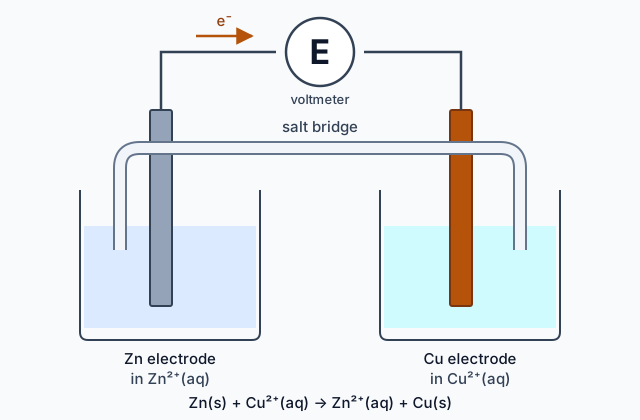 Tap to open the picture full size
Part 1 Think first A bike light that fades
Commit to a guess first. Being wrong now makes the right idea stick better.
Predict first
Dana's bike light runs on a battery that gets its voltage from a spontaneous chemical reaction. On the first night the light is bright. After many hours of riding it is dim, and then it goes out, though the battery looks unchanged and nothing leaked. What happened inside the battery?
In short. Away from standard conditions, a cell's potential depends on the reaction quotient Q: it equals E° when Q = 1, rises above E° when Q is smaller, falls as Q grows toward K, and is zero at equilibrium.
- Cell potential is a driving force toward equilibrium, so the farther a cell is from equilibrium, the larger its potential.
- Concentrations that make Q less than 1 raise the potential above E°, and concentrations that make Q greater than 1 lower it, down to zero at Q = K.
- A running cell is not at equilibrium, so Le Châtelier's principle does not apply; reason from Q instead.
Part 2 Learn it Cell potential away from standard conditions
2a. Cell potential is a driving force
The potential of a cell, E, measures how hard its reaction pushes electrons through the wire. Think of it as a driving force toward equilibrium. A fresh cell is far from equilibrium, so its potential is large. As the reaction runs, reactants are used up and products build up, the cell gets closer to equilibrium, and the magnitude of its potential shrinks. At equilibrium the potential is zero. Nothing pushes electrons any more, and the battery is dead.
The standard cell potential, E°, is the potential when every species is at standard conditions: 1 M for dissolved species and 1 atm for gases. Real cells seldom sit there. When the concentrations differ, the potential differs from E°. E° belongs to the cell reaction at a given temperature; E is what you would read on a voltmeter right now.
In this lesson every cell has a positive E° as written, so its K is greater than 1, except the concentration cell later in this lesson, whose E° is zero. Every cell is at 298 K unless a question says otherwise.
Quick check · Multiple choice
A galvanic cell reads 1.10 V when new. After it has run a small motor for several hours, a voltmeter reads 0.72 V. Which statement describes the cell now? These numbers are a teaching example.
2b. Compare Q with 1 and with K
The reaction quotient, Q, compares the concentrations in the cell at any moment. For Zn(s) + Cu²⁺(aq) → Zn²⁺(aq) + Cu(s), Q = [Zn²⁺]/[Cu²⁺]. Solids are left out. At standard conditions Q = 1, and that is where E = E°. At equilibrium Q equals the equilibrium constant K, which is greater than 1 for a cell with a positive E° as written.
The Nernst equation says how E depends on Q:
E = E° − (RT/nF) ln Q
R, T, n and F are all positive, so the sign of ln Q decides everything. You will read this equation, not calculate with it:
- Q < 1: ln Q is negative, so E is greater than E°. The cell is farther from equilibrium than at standard conditions.
- Q = 1: ln Q = 0, so E = E°.
- 1 < Q < K: ln Q is positive, so E is less than E° but still positive. The cell is closer to equilibrium.
- Q = K: E = 0.
So concentrations that make Q smaller raise E, and concentrations that make Q larger lower it.
Quick check · Rank it
Four Zn/Cu cells have the same E° and the same temperature. Cell A has [Zn²⁺] = 1.0 M and [Cu²⁺] = 1.0 M. Cell B has [Zn²⁺] = 0.040 M and [Cu²⁺] = 1.6 M. Cell C has [Zn²⁺] = 1.6 M and [Cu²⁺] = 0.040 M. Cell D has been left to run until it is at equilibrium. Rank the cells by the size of their cell potential.
Largest cell potential first
Give each one a place, 1 for first. Give two the same place if they are equal.
Your ranking: none yet
2c. Concentration cells
A concentration cell has the same half-reaction on both sides and differs only in concentration. Picture two copper electrodes, one in 0.010 M Cu²⁺ and one in 1.0 M Cu²⁺, joined by a wire and a salt bridge. Both half-cells have the same standard reduction potential, so E° = 0. Any potential the cell shows comes entirely from Q being different from 1.
To find the direction of electron flow, ask which way the cell must go to reach equilibrium. Here equilibrium is the state where the two concentrations are equal. So the concentrated half-cell must lose Cu²⁺ and the dilute one must gain it:
- In the concentrated half-cell, Cu²⁺ is reduced to Cu(s), and the solution gets more dilute.
- In the dilute half-cell, Cu(s) is oxidized to Cu²⁺, and the solution gets more concentrated.
Electrons therefore flow through the wire from the dilute half-cell toward the concentrated one. As the cell runs, the two concentrations move toward each other and the potential falls toward zero, reaching it when they are equal.
Quick check · Decide and justify
A concentration cell has two silver electrodes. One half-cell holds 0.010 M Ag⁺ and the other holds 1.0 M Ag⁺. The half-cells are joined by a wire and a salt bridge. In which direction do electrons flow through the wire?
Which reason supports your decision?
2d. Why Le Châtelier does not apply
Earlier in the course you used Le Châtelier's principle: a system at equilibrium that is disturbed shifts to oppose the change. It is tempting to say that adding Cu²⁺ to a Zn/Cu cell makes the system "shift right", so the potential goes up. Do not argue that way.
A cell that produces a potential is not at equilibrium. A cell at equilibrium has a potential of zero. Equilibrium arguments need a system at equilibrium, so they do not apply to an electrochemical cell that is running.
Use Q instead. Adding Cu²⁺ raises the denominator of Q = [Zn²⁺]/[Cu²⁺], so Q gets smaller, and a smaller Q makes E larger. The conclusion happens to match what a "shift" would suggest, but the reasoning is what earns the point.
A good argument about a cell names Q, compares it with 1 or with K, and says what that does to the distance from equilibrium. Changing a concentration changes E. It does not change E°.
Quick check · Spot the error
A Zn/Cu cell is running with [Zn²⁺] = 1.0 M and [Cu²⁺] = 1.0 M. A student adds more Cu²⁺ and explains why the cell potential changes. Tap the line with the mistake.
Part 3 Watch it done Zinc-rich, copper-poor
Predict first, then watch each step, then finish the reasoning yourself.
A Zn/Cu cell has E° = 1.10 V at 298 K. It is built with [Zn²⁺] = 2.0 M and [Cu²⁺] = 0.050 M. Is the cell potential greater than, equal to or less than 1.10 V? These concentrations are a teaching example.
Predict first
Before you open the first step, predict: with much more Zn²⁺ than Cu²⁺ in the cell, is it closer to or farther from equilibrium than a standard cell?
Step 1 · Write the cell reaction and Q
The cell reaction is Zn(s) + Cu²⁺(aq) → Zn²⁺(aq) + Cu(s). Solids are left out of Q, so Q = [Zn²⁺]/[Cu²⁺].
Step 2 · Calculate Q
Q = (2.0 M)/(0.050 M) = 40, or 40. to two significant figures. It has no unit.
Why this step?
Why compare Q with 1 and with K, instead of asking which way the cell would shift?
Q = 1 marks standard conditions, where E = E°, and Q = K marks equilibrium, where E = 0. Where Q sits between them says how far the cell is from equilibrium. The cell is not at equilibrium, so a shift argument does not apply.
Step 3 · Place Q on the scale
Q = 40 is greater than 1, so the cell is not at standard conditions. It is still far below K, which for this cell is enormous, so the cell has not reached equilibrium.
Your step · Fill the statement
Finish it. Complete the conclusion about the cell with Q = 40.
Because Q is 1 but less than K, the cell is equilibrium than a standard cell, so its potential is than 1.10 V and still positive.
Only the numbers in Q moved. E° stayed at 1.10 V, and no shift was needed to reach the conclusion. If this cell kept running until Q reached K, its potential would fall to zero.
Part 4 Try it Four test cells
A student builds Zn/Cu cells at 298 K with different concentrations. For each one, the cell reaction is Zn(s) + Cu²⁺(aq) → Zn²⁺(aq) + Cu(s), and E° = 1.10 V. These concentrations are a teaching example.
Try it · Calculate
A cell has [Zn²⁺] = 2.5 M and [Cu²⁺] = 0.050 M. What is Q? Give your answer to two significant figures.
Try it · Sort it
Each card gives the conditions in a Zn/Cu cell with E° = 1.10 V. Tap a card, then the bin that describes its cell potential, E.
E greater than 1.10 V
E equal to 1.10 V
E less than 1.10 V but above zero
E equal to zero
Part 5 Explain it Predict the potential of a copper and silver cell
On the exam this is handwritten, so answer on paper first. Nothing you type here leaves this page. Then check your answer against the model and each scoring point.
Free response is 50% of the exam score. This one is shaped like a short-answer question, which is worth 4 points.
Free-response practice · Short-answer style
A galvanic cell has a copper electrode in Cu²⁺(aq) and a silver electrode in Ag⁺(aq). The cell reaction is Cu(s) + 2 Ag⁺(aq) → Cu²⁺(aq) + 2 Ag(s), and E° = 0.46 V at 298 K. The cell is set up with [Cu²⁺] = 0.10 M and [Ag⁺] = 0.010 M.
(a) Calculate Q for the cell.
(b) Predict whether the cell potential is greater than, equal to or less than 0.46 V.
(c) Justify your prediction in terms of Q and the distance of the cell from equilibrium.
(d) A classmate says adding more Ag⁺ "shifts the reaction right by Le Châtelier's principle" and so raises the potential. Explain why that argument does not apply to this cell, and give the argument that does.
Model answer
(a) Solids are left out, so Q = [Cu²⁺]/[Ag⁺]² = (0.10)/(0.010)² = 1.0 × 10³.
(b) Less than 0.46 V.
(c) Q is far greater than 1 but still below K (K is very large for this cell). At standard conditions Q = 1, so this cell is closer to equilibrium than a standard cell. The driving force is smaller, so the magnitude of the potential is smaller than E°.
(d) A cell that is producing a potential is not at equilibrium (a cell at equilibrium has a potential of zero), so Le Châtelier's principle, which is an equilibrium argument, does not apply. The valid argument: adding Ag⁺ raises the denominator of Q, so Q falls, the cell moves farther from equilibrium, and the potential rises.
Score your own answer. This is a self-check, not a grade. Tick each point your answer makes.
Part 6 Check yourself Four cells, one reaction
All three case questions use the table.
A student builds four galvanic cells that all run Zn(s) + Cu²⁺(aq) → Zn²⁺(aq) + Cu(s) at 298 K, and reads the potential of each. These numbers are a teaching example.
| Cell | [Zn²⁺] (M) | [Cu²⁺] (M) | Cell potential (V) |
|---|---|---|---|
| A | 1.00 | 1.00 | 1.10 |
| B | 0.0100 | 1.00 | 1.16 |
| C | 1.00 | 0.0100 | 1.04 |
| D | 0.250 | 0.0500 | 1.08 |
Case question 1 · Calculate
Using the table: what is Q for cell D? Give your answer to three significant figures.
Case question 2 · Multiple choice
Using the table: cell B reads above 1.10 V. Which explanation do its concentrations support?
Case question 3 · Select all
Using the table: select the two statements the data support.
Select 2 answers, then check.
The rest stand on their own and do not use the case.
Check yourself · Match
Match each value of Q to what it means for the cell potential, E, compared with E°. Every cell has a positive E° as written, so K is greater than 1.
Check yourself · Decide and justify
A concentration cell has nickel electrodes in 0.010 M Ni²⁺ and 1.0 M Ni²⁺. It is left connected for a long time. What is its cell potential at the end?
Which reason supports your decision?
Part 7 Keep it Bring back earlier ideas
This lesson leans on two earlier ideas: how to write a reaction quotient, and what the sign of E° tells you about a cell reaction. Pulling them back up is what makes them last.
Bring it back · Multiple choice
Which is the reaction quotient for Cu(s) + 2 Ag⁺(aq) → Cu²⁺(aq) + 2 Ag(s)?
Bring it back · Multiple choice
A galvanic cell has a positive standard cell potential. What does that say about its cell reaction at standard conditions?
In three lines
- A cell's potential is a driving force toward equilibrium: it shrinks as products build up, and it is zero at equilibrium.
- Compare Q with 1 and K: Q below 1 puts E above E°, Q above 1 puts E below E°, and Q = K gives E = 0.
- A running cell is not at equilibrium, so argue from Q, not from Le Châtelier's principle.
Exam strategy for this topic
- Section I, Multiple Choice: 60 questions in 90 minutes.
- Section II, Free Response: 7 questions in 105 minutes.
- A scientific or graphing calculator is recommended for use on both sections of the exam.
Argue from Q. Write the reaction quotient, say whether it is below 1, above 1 or equal to K, then state how the cell potential compares with E° and why. Do not use Le Châtelier's principle for a cell that is producing a potential, and keep the Nernst equation for reading, not for long calculations.
Questions students ask
What is cell potential under nonstandard conditions?
It is the potential of a cell when the concentrations are not all 1 M, so Q is not 1. It depends on Q through E = E° − (RT/nF) ln Q.
Why does a battery's voltage fall to zero?
As the cell reaction runs, reactants are used up and products build up, so Q moves toward K. The driving force shrinks, and at equilibrium the potential is zero.
Does Le Châtelier's principle work for galvanic cells?
No. A cell that is producing a potential is not at equilibrium, so equilibrium arguments do not apply. Compare Q with 1 and with K instead.
What does a Q smaller than 1 do to the cell potential?
It makes ln Q negative, so E is greater than E°. The cell is farther from equilibrium than at standard conditions, with a larger driving force.
What is a concentration cell?
It is a cell with the same half-reaction on both sides and different concentrations. E° is zero, the potential comes from Q, and it falls to zero as the concentrations become equal.
Course alignment, for teachers
AP Chemistry topic 9.10, Unit 9: Thermodynamics and Electrochemistry.
- Skill 6.D: Provide reasoning to justify a claim using chemical principles or laws, or using mathematical justification.
This lesson maps all 4 essential knowledge statements of the topic to the part that teaches each one: 4 are checked by a scored question. The map is in the lesson file.