Unit 1 · Topic 1.5 · about 30 minutes · 7 parts · 12 scored checks, 3 of them multiple choice, plus 2 from earlier lessons
AP Human Geography 1.5: Human–Environmental Interaction
Unit 1: 8 to 10% of the multiple-choice section
What you'll be able to do
- Explain how the concepts of natural resources, land use and sustainability, and the move from environmental determinism to possibilism, describe the relationship between people and the physical environment in a place.
Key vocabulary
| Term | What it means | The exam trap |
|---|---|---|
| Natural resources | Materials and energy from the physical environment that people use to meet their needs, such as water, soil, timber, minerals, fuels and sunlight. | Whether something counts as a resource depends on people having a use and a way to get it, so the same rock can become a resource when technology changes. |
| Land use | What people do with an area of land, such as farming, grazing, logging, mining, building homes and factories, or protecting it. | Land use describes what people do on the land, not what the land is made of, so one forest could be timberland, a park or a future housing tract. |
| Sustainability | Using resources and land in ways that meet people's needs now without leaving future generations less to meet theirs. | The idea applies to one resource, a piece of land or a whole economy, so check which of these a question asks about. |
| Environmental determinism | The theory that the physical environment, especially climate and landforms, decides how a society lives and develops, and even the character of its people. | Read what a claim says caused the outcome before you label it. |
| Possibilism | The theory that the physical environment sets limits and offers possibilities, while people's culture, technology and choices decide which possibilities a society takes up. | Students often misstate how much room the theory leaves the environment; read the definition's two halves. |
 Tap to open the picture full size
Part 1 Think first Two islands, one environment
Commit to a guess first. Being wrong now makes the right idea stick better.
Predict first
Two hypothetical islands sit side by side in the same sea. They have the same climate, the same rainfall, the same hilly soil and the same fish offshore. Two different peoples settle them at about the same time. Three hundred years later, how alike do you predict their ways of making a living will be?
In short. Human-environmental interaction is the two-way relationship between people and the physical environment: people use natural resources and land, sustainability asks whether that use can last, and geographers' theories of the relationship moved from environmental determinism to possibilism.
- Natural resources are what people take from the environment to meet their needs; renewable ones are replaced by nature, nonrenewable ones are not, and a renewable one can still run out where people use it faster than it renews.
- Land use is what people do with an area of land, and a use is sustainable when it can go on without using up the resources it depends on: compare the rate of use with the rate of renewal.
- Environmental determinism held that the environment decides how a society lives; possibilism, which replaced it, holds that the environment sets limits and offers options, and people's culture, technology and choices decide among them.
Part 2 Learn it People and the environment
2a. Natural resources
A natural resource is anything from the physical environment that people use to meet their needs: water, soil, forests, fish, minerals, fuels, sunlight and wind. Something becomes a resource when people have a use for it and a way to get it. A metal deposit that nobody can extract is only rock until a technology arrives that can mine it.
Geographers sort resources by how nature replaces them.
- A renewable resource is replaced by natural processes within a human lifetime or faster. Sunlight and wind arrive every day, forests regrow, fish and animals breed, and rain refills rivers and many aquifers, though some underground water built up over thousands of years and is replaced far more slowly than people use it.
- A nonrenewable resource formed over millions of years, or only once, so the supply in the ground is all there is on any time scale people plan for. Fossil fuels such as oil, coal and natural gas are nonrenewable, and so are metal ores such as iron.
Renewable does not mean endless. A renewable resource can still run out in a place if people use it faster than nature replaces it. And the label says nothing about how clean or dirty a resource is to use: it is only about whether nature makes more.
Quick check · Sort it
Each card is a natural resource used in a hypothetical country. Tap a card, then the kind of resource it is.
Renewable
Nonrenewable
2b. Land use and sustainability
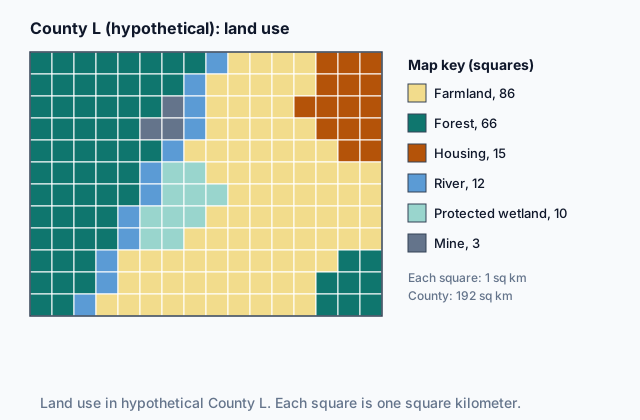
Land use is what people do with an area of land: grow crops, graze animals, cut timber, mine, build homes and factories, or protect it as a park or wetland. A land-use map shows the pattern, as the map of hypothetical County L at the top of this page does. Every use depends on natural resources such as soil, water or ore.
Sustainability means using resources and land in ways that meet people's needs now without leaving future generations less to meet theirs. For a renewable resource the test compares two rates: how fast people use it and how fast nature replaces it. Use at or below the rate of renewal can go on indefinitely. Use above it draws down the supply every year until it is gone, however large the supply looks at the start.
Take a hypothetical grassland whose grass regrows enough each year to feed 2,000 sheep. Herders who keep 1,800 sheep can graze it year after year. Herders who keep 3,000 strip the grass faster than it grows back, and the bare soil blows or washes away: a land use that destroys what it depends on.
For a nonrenewable resource any use draws it down, so sustainability means using it carefully, recycling it, and building other sources before it runs out.
Quick check · Calculate
A hypothetical lake holds about 900 tons of one kind of fish. Each year breeding and growth add about 50 tons of fish, and the villages around the lake catch 80 tons. If both amounts stay the same every year, in how many years will the fish be gone?
2c. Environmental determinism
Human-environmental interaction runs both ways: the environment shapes what people can do, and people change the environment through how they use it. Geographers' theories of how much the environment shapes people changed over time.
The older theory is environmental determinism: the idea that the physical environment, especially climate and landforms, decides how a society lives, how far it develops, and even the character of its people. A determinist might write that a hot climate makes people lazy or that mountain peoples are independent by nature. In this view people respond to their surroundings but do not really choose.
Determinism was widely held among geographers in the late 1800s and early 1900s, and then fell from favor for two reasons. The evidence did not fit it: places with very similar climates and landforms hold societies that live in very different ways, and one place's people change their way of life over time while the land stays the same. And it was used to rank peoples as superior or inferior by their climate and to excuse ruling over them, which made it a cover for prejudice.
To spot a determinist claim, ask what it says caused the outcome. If the answer is the environment alone, with no room for culture, technology or choice, the claim is determinist.
Quick check · Multiple choice
Which claim about hypothetical Country T is an example of environmental determinism?
2d. Possibilism
Geographers replaced environmental determinism with possibilism: the physical environment sets limits and offers a range of possibilities, and people's culture, technology and choices decide which of those possibilities they take up.
The environment still matters. A desert limits farming without a water source, a short growing season rules out some crops, and a coast offers a harbor that an inland town lacks. But within those limits different societies choose differently, and the same society chooses differently as its knowledge and technology change.
Take hypothetical Valley N, cold and dry. One group herds animals across its grasslands. A later group digs canals and farms the valley floor. Today some families also grow vegetables in greenhouses, and a ski resort makes money from the winter snow. The environment is the same through all three; what changed is what people knew, wanted and could build. A possibilist explains each way of life with both halves: what the place offers or rules out, and what the people chose.
The move from determinism to possibilism changed how geographers study a place. Instead of reading a society off its climate, they ask how people and the environment act on each other, including how people reshape the environment through their land use.
Quick check · Fill the statement
Two geographers explain the farming of hypothetical Valley M, which has a short, cool growing season. Complete the passage.
Geographer 1 writes that the cool climate decided the valley's whole way of life, down to its people's patient character. That claim is . Geographer 2 writes that the climate rules out some crops, but the farmers chose which of the others to grow and later added greenhouses. That claim is . In the history of geography, the view of Geographer came first.
Part 3 Watch it done Can a town keep pumping?
Watch each step, then do the last one yourself.
Hypothetical Town W pumps 15 million cubic meters of water a year from an aquifer, a layer of rock that holds water underground. Rain refills the aquifer by about 12 million cubic meters a year, and the aquifer holds about 300 million cubic meters. Is the town's water use sustainable, and if not, by what percent must it cut its yearly pumping?
Predict first
Before the steps, about how big a cut do you expect Town W needs?
Step 1 · Name the test
Water that rain puts back into an aquifer is a renewable resource. Using it is sustainable when the town pumps no more than the rain puts back: here, no more than 12 million cubic meters a year.
Step 2 · Compare the two rates
The town pumps 15 million cubic meters a year and the rain puts back only 12 million, so each year the town takes more than the refill, and the difference comes out of the water stored underground. The use is not sustainable.
Why this step?
Why compare the pumping with the yearly refill instead of with the 300 million cubic meters the aquifer holds?
The store only says how long the overuse can last before the aquifer runs dry. Sustainability asks whether the use can go on indefinitely, and only pumping within the refill can, however large the store is.
Your step · Calculate
Finish it. Town W pumps 15 million cubic meters of water a year, and rain refills its aquifer by 12 million cubic meters a year. By what percent must the town cut its yearly pumping so that it takes no more than the refill?
percent
Part 4 Try it Read a county's land and its plans
Try it · Match
Match each idea about people and the environment to the observation from a hypothetical region that shows it.
Try it · Decide and justify
Hypothetical County P farms 50 square km of steep hillside covered by about 600 mm of soil, where new soil forms at about 1 mm a year (all figures here are invented). Under Plan A, farmers cut terraces into the slopes and keep growing row crops, which earn more per square km than fruit, and rain washes away about 1.5 mm of soil a year. Under Plan B, they plant orchards with grass between the rows, which cuts soil loss to about 0.5 mm a year. Which plan is the more sustainable land use?
Which reason supports your answer?
Part 5 Explain it Explain a region's forest and its past
Nothing you type leaves this page. Check your answer against the model and each scoring point.
Free response is 50% of the exam score. This one is shaped like Question 3, from free-response II.
Free-response practice · Question 3 style
Stimulus 1, hypothetical data for Region H's forest: forest area was 500 square km in 2005 and 350 square km in 2025. Each year loggers cut about 12,000 cubic meters of timber, and the forest regrows about 8,000 cubic meters.
Stimulus 2, two hypothetical descriptions of Region H: a report written in 1910 says, "The thin soil and steep hills of Region H will keep its people poor forever." A 2025 description says Region H's hills now carry sheep farms, a wool-processing industry and hiking resorts.
(A) Identify the natural resource shown in Stimulus 1, and state whether it is renewable or nonrenewable.
(B) Using Stimulus 1, describe whether Region H's timber harvest is sustainable.
(C) Explain one change in land use or policy that could make Region H's timber harvest sustainable.
(D) Identify the theory of human-environmental interaction that the 1910 report in Stimulus 2 reflects.
(E) Using Stimulus 2, explain how the 2025 description challenges the 1910 report.
(F) Describe how a possibilist would explain Region H's economy in 2025.
(G) Explain one reason, other than the evidence in Stimulus 2, why geographers moved away from environmental determinism.
Model answer
(A) Timber from the forest. It is renewable, because the forest regrows.
(B) The harvest is not sustainable. Loggers cut about 12,000 cubic meters a year while the forest regrows only about 8,000, so the forest loses about 4,000 cubic meters more than it gains each year. The forest area shows the same thing: it fell from 500 to 350 square km, a loss of 30 percent in 20 years.
(C) The region could cap the yearly cut at the regrowth, about 8,000 cubic meters, so the forest stops shrinking. Replanting cut areas would also add regrowth, raising the amount that can be cut each year without shrinking the forest.
(D) Environmental determinism.
(E) The 1910 report claimed the soil and hills decided that the people would stay poor. By 2025 the people of the same hills earn a living from sheep, wool processing and tourism. The environment did not change; the people found new uses for it, so the environment did not decide their future.
(F) A possibilist would say the thin soil and steep slopes set limits, ruling out most crop farming, but also offered options: grass for sheep and scenery for hikers. The people's skills, technology and choices decided which options to take, and they chose grazing, a wool industry and tourism.
(G) Environmental determinism was used to rank peoples as superior or inferior by their climate and to excuse ruling over them, so geographers came to see it as a cover for prejudice rather than an explanation.
Score your own answer. This is a self-check, not a grade. Tick each point your answer makes.
Part 6 Check yourself The land and water of Valley R
The case questions use the table. The others mix the ideas from the whole lesson.
Hypothetical Valley R is dry, with hot summers and little rain. In 1900 a hypothetical travel writer called the valley fit only for grazing and predicted that its people would always be herders. Today the valley's government publishes figures on its land and water. The valley's farms and homes draw water from an aquifer that holds about 900 million cubic meters, and rain refills it by about 20 million cubic meters a year.
| Measure | 2000 | 2025 |
|---|---|---|
| Forest (square km) | 120 | 90 |
| Farmland, mostly irrigated orchards (square km) | 200 | 180 |
| Housing (square km) | 30 | 80 |
| Protected wetland (square km) | 50 | 50 |
| Water pumped from the aquifer (million cubic meters a year) | 16 | 26 |
Case question 1 · Calculate
By what percent did Valley R's forest area fall between 2000 and 2025?
Case question 2 · Multiple choice
Which conclusion about Valley R's water use do the figures best support?
Case question 3 · Multiple choice
The 1900 travel writer expected Valley R's people to stay herders, but most of its farmland is now irrigated orchards. Which explanation of the change would a possibilist give?
The rest stand on their own and do not use the case.
Check yourself · Spot the error
A student explains how geographers' ideas about people and the environment changed. Which line is the first to go wrong?
Check yourself · Rank it
Four hypothetical forests are logged at steady rates, and each regrows by a steady amount a year. Rank them by how long their timber will last at these rates.
Lasts longest first
Give each one a place, 1 for first. Give two the same place if they are equal.
Your ranking: none yet
Part 7 Keep it Bring back earlier ideas
This lesson stands on spatial concepts from Topic 1.4 and on geographic data from Topic 1.3.
From 1.4 Spatial Concepts · Multiple choice
A travel writer is describing hypothetical Millbrook, a small river town. Which sentence describes Millbrook as a place?
From 1.3 The Power of Geographic Data · Put it in order
A hypothetical supermarket company uses census data to choose a site for a new store. Put the events in the order they happen, from the data to the last effect.
In three lines
- Natural resources: renewable ones are replaced by nature and nonrenewable ones are not, but a renewable resource used faster than it renews still runs out.
- Land use and sustainability: a use is sustainable when it can go on without using up what it depends on, so compare the rate of use with the rate of renewal.
- Environmental determinism said the environment decides how people live; possibilism replaced it, with the environment setting limits and people choosing among the options.
Exam strategy for this topic
- Section I, Multiple Choice: 60 questions in 60 minutes.
- Section II, Free Response: 3 questions in 75 minutes.
When a question asks whether a use of a resource is sustainable, compare two rates, the yearly use and the yearly renewal, and quote both numbers. When it asks which theory a claim reflects, ask who decides the outcome in the claim: the environment alone, or people choosing within the environment's limits.
Questions students ask
Is environmental determinism still accepted?
No. Geographers moved away from it in the early 1900s because similar environments hold very different societies, and because it was used to justify prejudice and colonial rule. It is studied as the theory that possibilism replaced.
Does possibilism mean people can live any way they like anywhere?
No. The environment still sets limits: a desert without a water source cannot grow rice, and a short growing season rules out some crops. Possibilism says people choose among the options the environment leaves, and that technology can widen those options.
If a resource is renewable, is using it always sustainable?
No. A renewable resource is sustainable to use only when people use it no faster than nature replaces it. Fish, forests and the water in an aquifer that rain refills are all renewable, and all can be used up in a place.
What does land use have to do with human-environmental interaction?
Land use is where the interaction shows on a map. The environment shapes which uses make sense in a place, and each use in turn changes the environment, for good or ill, by drawing on its soil, water and other resources.
Are the places and numbers in this lesson real?
No. Every country, county, valley, lake, island, town and forest here is hypothetical, and every number was invented to show an idea clearly.
Course alignment, for teachers
AP Human Geography topic 1.5, Unit 1: Thinking Geographically.
- Skill 1.B: Explain geographic concepts, processes, models, and theories.
This lesson maps all 2 essential knowledge statements of the topic to the part that teaches each one: 2 are checked by a scored question. The map is in the lesson file.