Unit 2 · Topic 2.10 · about 30 minutes · 7 parts · 14 scored checks, 3 of them multiple choice
AP Human Geography 2.10: Causes of Migration
Unit 2: 12 to 17% of the multiple-choice section
What you'll be able to do
- Explain how push factors, pull factors, intervening obstacles and intervening opportunities, each cultural, demographic, economic, environmental or political, encourage or hold back migration, and use them to read a migrant's move.
Key vocabulary
| Term | What it means | The exam trap |
|---|---|---|
| Push factor | A condition at the place a person lives that drives them to leave, such as a lack of jobs, a drought or persecution. | A push factor can be political, cultural or environmental, not only a lack of jobs. |
| Pull factor | A condition at a destination that draws people to move there, such as jobs, safety or relatives already living there. | A pull factor works on what migrants believe about a place, which can differ from what they find. |
| Intervening obstacle | Something along the route or at the destination's border that makes a move harder or stops it, such as distance, a desert, a cost or a closed border. | It can sit at the destination's border as well as along the route. |
| Intervening opportunity | A place nearer than the planned destination that offers what a migrant is looking for, so the migrant may stop there. | It can be any of the five kinds, not only a place with jobs. |
| Migration | A move from one place to another to live there for a long time or for good, within a country or across a border. | A daily trip to work is not migration; a move of where someone lives is. |
 Tap to open the picture full size
Part 1 Think first Why did they leave?
Commit to a guess first. Being wrong now makes the right idea stick better.
Predict first
Two things happen in the same year. A drought ruins the harvest in hypothetical Region K, a farming region, and a new factory opens in hypothetical City T, 400 km away, and starts hiring. That year, many young adults leave Region K for City T. What best explains their move?
In short. People migrate when conditions at home push them away and conditions somewhere else pull them in, and what lies between the two places, intervening obstacles and intervening opportunities, decides whether and where the move happens.
- A push factor is a condition at the place a person leaves that drives them away; a pull factor is a condition at a destination that draws them in. Most moves have both.
- An intervening obstacle makes a move harder, such as distance, a desert, a cost or a closed border; an intervening opportunity is a nearer place that offers what the migrant wants, so the move stops there.
- Every one of these can be cultural, demographic, economic, environmental or political. Economic reasons are the most common, but far from the only ones.
Part 2 Learn it What makes people move, and what stands in the way
2a. Push factors and pull factors
Geographers split the causes of a move into two groups. A push factor is a condition at the place someone leaves that drives them away: no work, a failed harvest, fighting, a government that jails its critics. A pull factor is a condition at a destination that draws people to it: jobs, higher pay, good schools, safety, relatives who already live there.
Most moves have both. In Think first, the drought pushed and the factory pulled, and either one alone might not have been enough.
Push and pull depend on where you stand, so the same kind of fact can be either one. Cheap rent in a small town is a pull factor for a family thinking of moving there. Expensive rent in a big city is a push factor for a family that lives in it. To label a factor, ask one question: is this a condition at the place being left, or at the place being chosen?
People move on what they believe about a place, much of it from friends and relatives who went before. A pull factor can be a promise that turns out to be wrong when the migrant arrives.
Quick check · Sort it
A hypothetical bookkeeper lives in Town A and is thinking about moving to City B. Tap each card, then the kind of factor it is for this move.
Push factor
Pull factor
2b. Five kinds of factor
Push and pull factors, and the obstacles and opportunities later in this lesson, come in five kinds.
- Economic: jobs, wages, land to farm, the cost of living.
- Environmental: drought, floods, poor soil, rising seas, or a mild climate and fertile land.
- Political: war, persecution, unfair laws, or the safety and freedom another place offers.
- Cultural: religion, language, ethnicity and education, such as a place where people share your faith, or one where people of your faith are mistreated.
- Demographic: the size and makeup of the population itself, such as a young, fast-growing population with too little land to go around, or an aging country short of young workers.
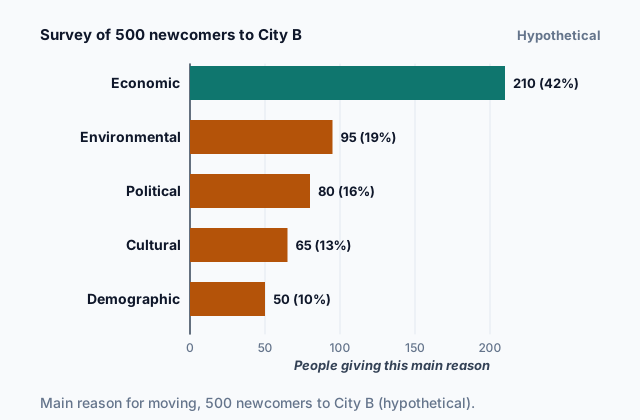
The chart at the top of the page shows a survey of 500 newcomers to hypothetical City B. Economic reasons lead, at 42 percent, but 58 percent of the newcomers named another kind of reason.
To classify a factor, ask what it is about: money and work, land and climate, government and safety, beliefs and identity, or the number and ages of the people.
Quick check · Match
Match each kind of factor to the hypothetical place that shows it.
2c. Intervening obstacles
Wanting to move is not the same as moving. Between the origin and the destination, things get in the way. An intervening obstacle is anything along the route, or at the destination's border, that makes a move harder or stops it.
Obstacles come in the same five kinds:
- Environmental: a desert, a mountain range or a sea on the route.
- Economic: the cost of the trip, or a fee for a work permit.
- Political: a closed border, or a rule about who may enter.
- Cultural: a route or a destination where no one speaks the migrant's language.
- Demographic: a destination so crowded with recent newcomers that housing is already full.
Name the kind by what the obstacle is: a cost is economic even when a government charges it, and a rule about who may enter is political. Distance is the one obstacle every move faces, since every kilometer adds cost, time and risk.
An obstacle is neither a push nor a pull factor. It does not make anyone want to leave or want to arrive; it makes getting there harder. It does not always stop a move, either: some migrants find a way around it.
Quick check · Fill the statement
A hypothetical welder plans to move from Country Q to Country R for work. Name the kind of intervening obstacle each one is.
The only road from Country Q to Country R crosses a wide desert: . Country R charges a work-permit fee equal to a year of the welder's wages: . Then Country R closes its border to all workers from Country Q: .
2d. Intervening opportunities
Something along the way can pull as well. An intervening opportunity is a place nearer than the planned destination that offers what a migrant is looking for, so the migrant stops there and never goes on.
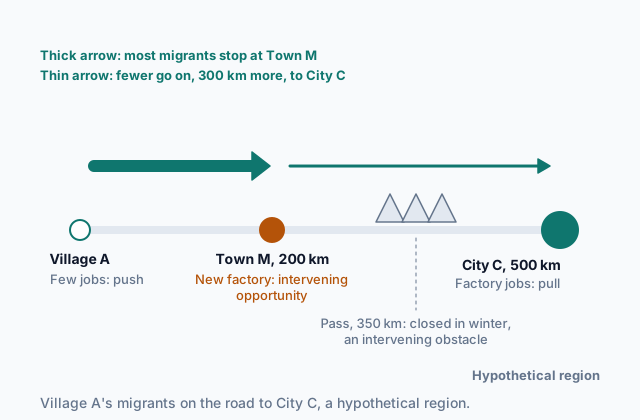
The map shows hypothetical Village A, whose young people have long gone to City C, 500 km away, for factory jobs. Then a factory opens in Town M, 200 km from the village on the same road. Town M offers the same kind of work, closer to home and before the mountain pass, which is closed in winter. Many of the village's migrants now stop at Town M, and fewer reach City C, though City C itself has not changed.
This is why the largest or richest place does not always draw the most migrants. A move happens when the push and pull factors outweigh the obstacles, and it often ends at the first place that offers what the migrant wanted.
Opportunities come in the five kinds, too. Town M's factory is economic. A city on the way where the migrant's language is spoken would be cultural.
 Tap to open the picture full size
Quick check · Decide and justify
A hypothetical nurse in Town F plans to move to the capital, 900 km away, where hospitals are short of nurses. Before she leaves, she learns that a new hospital in City G, 300 km from Town F on the way to the capital, is hiring nurses at the same pay as the capital's hospitals. What is she most likely to do?
Which reason supports your answer?
Part 3 Watch it done Read one migrant's move
Watch each step, then do the last one yourself.
A hypothetical carpenter lives in Valley V, where two dry years have left the farms short of water and building work has dried up. Her cousin in Port P, 600 km away, writes that the port's new shipyard needs carpenters. Sort the facts of her move into push factors, pull factors, intervening obstacles and intervening opportunities, and name each one's kind.
Step 1 · Start at the place she would leave
Two facts are about Valley V. The dry years are an environmental push factor. The lack of building work is an economic push factor. Both make staying harder.
Step 2 · Then the place she is choosing
The shipyard's demand for carpenters is an economic pull factor at Port P. Her cousin there adds a second pull: a relative who can help her settle, and who has told her the jobs are real.
Why this step?
Why look at the trip itself, and not only at Valley V and Port P?
Because a move can stall between the two places. Something on the route can make the trip harder, or offer a nearer place to stop, and either one can change whether she moves and where she ends up.
Your step · Sort it
Finish it. Sort five more facts the carpenter learns about her move.
Push factor
Pull factor
Intervening obstacle
Intervening opportunity
Part 4 Try it Help a region keep its young people
Try it · Spot the error
A student explains why many people leave hypothetical Island J for hypothetical Country R. Which line is the first to go wrong?
Try it · Select all
Hypothetical Region K loses many young adults to the capital every year. Its leaders want to slow this by reducing the push factors in Region K itself. Which two plans do that? Select two.
Select 2 answers, then check.
Part 5 Explain it Explain why people leave, and where they go
Nothing you type leaves this page. Check your answer against the model and each scoring point.
Free response is 50% of the exam score. This one is shaped like Question 1, from free-response II.
Free-response practice · Question 1 style
Hypothetical Country Q's northern provinces are dry farmland with few jobs outside farming. Its southern coast has fast-growing port cities. Neighboring Country R, on the far side of a high mountain range, is wealthier and short of workers.
(A) Define a push factor.
(B) Describe one economic pull factor that could draw people from the northern provinces to the port cities.
(C) Describe one environmental push factor in the northern provinces.
(D) Explain how the mountain range acts as an intervening obstacle to migration from Country Q to Country R.
(E) Explain how the growth of Country Q's port cities could act as an intervening opportunity for people who would otherwise move to Country R.
(F) Explain how a political change in Country R could increase or decrease migration from Country Q.
(G) Explain how the departure of many young adults could change the age structure of the northern provinces.
Model answer
(A) A push factor is a condition at the place a person lives that drives them to leave.
(B) Jobs in the port cities' docks, factories and shops pay more than farm work in the north, so the chance of a better income draws people south.
(C) Drought: the dry farmland gives poor harvests in years with little rain, which leaves farm families without enough food or income.
(D) A migrant has to cross the mountains to reach Country R. The crossing takes time, costs money and carries risk, so fewer people make the move than would if the land were open.
(E) A northern migrant looking for better-paid work can find it in the port cities, which are inside Country Q, closer and with no border to cross. Many stop there and never go on to Country R.
(F) If Country R opens a program that grants work visas to Country Q's workers, a political obstacle shrinks and more people move. If it closes its border, a political obstacle grows and fewer move.
(G) The people who leave are mostly young adults, so the share of older people left behind rises. Fewer young adults also means fewer children born there, so the provinces' population ages faster.
Score your own answer. This is a self-check, not a grade. Tick each point your answer makes.
Part 6 Check yourself Leaving District K
The case questions use the table. The others mix the ideas from the whole lesson.
Hypothetical Country Q's statistics office compares District K, a farming district that many people leave, with hypothetical Country R, where many of them go. A worker from Country Q needs a work permit to take a job in Country R, and the permit costs 1,620 credits, three months of farm wages there.
| Measure | District K, Country Q | Country R |
|---|---|---|
| Share of adults without work | 24% | 6% |
| Rainfall over the last two years | 40% below normal | Normal |
| Days of river flooding last year | 0 | 15 |
| Average monthly wage for farm work | 120 credits | 540 credits |
| Neighborhoods where most people speak District K's language | All of them | Three, in the capital |
Case question 1 · Multiple choice
Which row of the table shows an environmental push factor for people in District K?
Case question 2 · Fill the statement
Complete the description of a worker's move from District K to Country R.
For a worker in District K, Country R's higher wages are a factor, and District K's lack of work is a factor. The 1,620-credit work permit is an intervening .
Case question 3 · Multiple choice
Country R cuts the work permit's cost from 1,620 credits to 100 credits. If nothing else changes, which result is most likely?
The rest stand on their own and do not use the case.
Check yourself · Match
Each item is an intervening obstacle or opportunity on a hypothetical migrant's route. Match each kind to its example.
Check yourself · Decide and justify
A hypothetical family lives in City B, where rents have doubled in five years. They are thinking about moving to Town S, where rents are low. For this family, what kind of factor are City B's high rents?
Which reason supports your answer?
Part 7 Keep it Bring back earlier ideas
This lesson stands on aging populations from Topic 2.9 and population policies from Topic 2.7.
Bring it back · Multiple choice
For 40 years, hypothetical Country Z's birth rate has fallen and its life expectancy has risen. Few people move in or out. What has most likely happened to its population?
Bring it back · Sort it
Each card is a policy of a hypothetical government. Tap a card, then the type of policy it is.
Pronatalist
Antinatalist
Immigration
In three lines
- Push factors are conditions at the place being left; pull factors are conditions at the place being chosen. Most moves have both.
- Intervening obstacles make a move harder, and intervening opportunities are nearer places that offer what the migrant wants, so a move can stop partway.
- Each factor, obstacle and opportunity is cultural, demographic, economic, environmental or political; ask what it is about to name its kind.
Exam strategy for this topic
- Section I, Multiple Choice: 60 questions in 60 minutes.
- Section II, Free Response: 3 questions in 75 minutes.
When a question asks for a push or pull factor, name the place it belongs to and its kind, such as an economic push factor in the origin. When it asks about an obstacle or an opportunity, say what lies between the two places and how it changes the move.
Questions students ask
Can one fact be both a push factor and a pull factor?
The same kind of fact can be either, depending on the place. Low wages at home push, and high wages at a destination pull. For any one move, a condition at the origin pushes and a condition at the destination pulls.
Is distance an intervening obstacle?
Yes. Every kilometer adds cost, time and risk, so distance is the one obstacle every move faces, though faster travel and cheaper communication have made it smaller.
What is the difference between an intervening opportunity and a pull factor?
A pull factor is a condition at the destination a migrant has in mind. An intervening opportunity is a different, nearer place that offers what the migrant wants, so the move ends there instead.
Which kind of factor causes the most migration?
Economic factors, jobs and wages above all, drive most voluntary moves. Environmental, political, cultural and demographic factors still cause many moves, and most moves have more than one cause.
Are the places and people in this lesson real?
No. Every country, region, town, survey and person here is hypothetical, with details chosen to show each idea clearly. Real moves usually mix several factors at once.
Course alignment, for teachers
AP Human Geography topic 2.10, Unit 2: Population and Migration Patterns and Processes.
- Skill 2.B: Explain spatial relationships in a specified context or region of the world, using geographic concepts, processes, models, or theories.
This lesson maps all 2 essential knowledge statements of the topic to the part that teaches each one: 2 are checked by a scored question. The map is in the lesson file.