Unit 2 · Topic 2.11 · about 30 minutes · 7 parts · 14 scored checks, 3 of them multiple choice
AP Human Geography 2.11: Forced and Voluntary Migration
Unit 2: 12 to 17% of the multiple-choice section
What you'll be able to do
- Describe the types of forced migration, including slavery and the events that produce refugees, internally displaced persons and asylum seekers, and the types of voluntary migration: transnational, transhumance, internal, chain, step, guest worker and rural-to-urban.
Key vocabulary
| Term | What it means | The exam trap |
|---|---|---|
| Forced migration | A move people are made to make, because they are captured, as in slavery, or must flee danger such as war, persecution or disaster. | Disasters can force people out as well as war and persecution. |
| Refugee | A person who has fled their country across an international border because of persecution or violence; this course uses the word once another country has recognized that they need protection. | Check whether another country has decided the person's case before you choose a name. |
| Internally displaced person | A person forced to flee their home who is still inside their own country. | The term covers people forced out by disasters as well as by fighting. |
| Asylum seeker | A person who has reached another country and asked it for protection, and is waiting for its decision. | A person can ask for asylum at a border, at an airport or after arriving. |
| Chain migration | Migration in which people follow relatives or neighbors who moved before them to the same destination. | The people who went first need not be close family; neighbors from the same village count. |
| Step migration | Migration made in stages, each to a larger or more distant place. | The stages need not stay in one country; the last step can cross a border. |
| Guest worker | A person who works in another country on a permit for a set time and is expected to return home. | Many guest workers stay longer than planned, so the label describes the permit, not where the worker ends up. |
| Transhumance | The seasonal movement of herders and their animals between pastures, such as up mountains in summer and down in winter. | It follows pastures and seasons, not jobs in cities. |
 Tap to open the picture full size
Part 1 Think first Is the herder a migrant?
Commit to a guess first. Being wrong now makes the right idea stick better.
Predict first
Every spring, a hypothetical herder drives his family's sheep from the dry lowlands of Valley D up to mountain pastures, and every fall he brings them back down. His family has done this for generations. Is he a migrant?
In short. Migration is forced when people are made to move or must flee danger, and voluntary when they choose to move, and each side has named types that describe who moves, where they go and how.
- Forced migration includes slavery and flight from war, persecution or disaster. Those who flee are refugees once recognized in another country, asylum seekers while they wait for that decision, and internally displaced persons if they never cross a border.
- Voluntary migration is named by where it goes: internal (within one country), rural-to-urban, transnational (across a border, with strong ties kept to both countries) and transhumance (herders moving with the seasons).
- It is also named by how it happens: chain migration follows relatives who went before, step migration moves in stages, and guest workers take jobs abroad for a set time.
Part 2 Learn it Forced and voluntary moves, and their types
2a. Forced or voluntary?
The first question about any move is who chose it. In voluntary migration, people decide to move, weighing push and pull factors like the ones in Topic 2.10. In forced migration, people are made to move, by other people or by danger, and have no real choice about leaving.
Slavery is forced migration in its plainest form. People are captured, taken from their homes against their will, sold, and made to work for others. The Atlantic slave trade, which carried enslaved Africans across the ocean to the Americas, is the largest long-distance forced migration in history, and it shaped where people live and which cultures are found across the Americas today.
Other forced migrations come from events: a war, the persecution of a religious or ethnic group, a government that expels people, a disaster that destroys a town. People who flee may have some say in where they go, but not in whether they leave.
Voluntary does not mean easy. A family that leaves because wages at home are low has made a hard choice, but a choice. The test is whether the people could have stayed in safety.
Quick check · Sort it
Each card describes a move. Tap a card, then the kind of migration it is.
Forced
Voluntary
2b. Refugees, internally displaced persons and asylum seekers
People who flee war or persecution are named by where they end up and what protection they have been given.
- A refugee has fled their country, crossing an international border, because of persecution or violence. In this course, a person is called a refugee once another country has recognized that they need protection.
- An internally displaced person (IDP) has fled for the same kinds of reasons but is still inside their own country.
- An asylum seeker has reached another country and asked to be protected there, and is waiting for that country's decision.
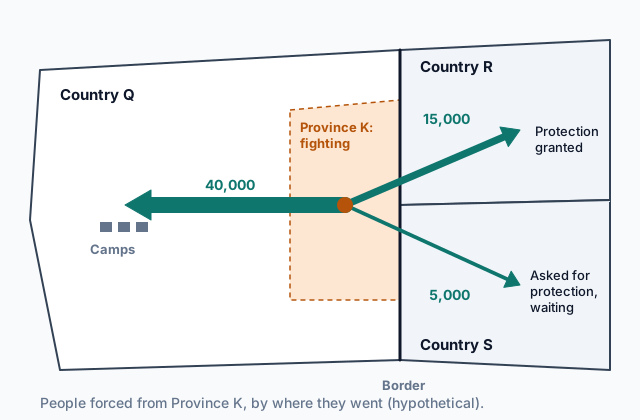
The map at the top shows all three. Of 60,000 people driven from Province K, the 40,000 in camps in western Country Q are internally displaced: they never crossed a border. The 15,000 that Country R has granted protection are refugees. The 5,000 waiting in Country S are asylum seekers.
The names matter. Refugees, and asylum seekers while their cases are decided, have rights under international law, such as not being sent back into danger. Internally displaced persons remain under their own government, sometimes the very government they fled, which can make outside help hard to bring in.
Quick check · Decide and justify
A hypothetical family flees bombing in its city in Country Q. They travel 600 km to their cousins' town in a peaceful part of Country Q and stay there. What are they?
Which reason supports your answer?
2c. Voluntary moves, named by where they go
Voluntary moves have names for where people go.
- Internal migration stays inside one country: from one region to another, such as from a farming region to a coastal one.
- Rural-to-urban migration goes from the countryside to cities. It is usually internal, and it is the largest flow in a country that is industrializing, as factory and office jobs gather in its cities.
- Transnational migration crosses an international border, and the migrant keeps strong ties to both countries: sending money home, visiting often, owning property or voting in the home country, and staying part of both communities.
- Transhumance is the seasonal move of herders and their animals between pastures, often up into mountains in summer and down to valleys in winter, as the herder in Think first does.
One move can carry more than one name. A woman who leaves a village for her own country's capital is an internal migrant and a rural-to-urban migrant at once. Use every name that fits, and check each one against its definition.
Quick check · Fill the statement
Three hypothetical relatives grow up in a farm village in Country Q. Name each move.
The sister moves from the village to a fishing village on Country Q's coast, in another province: migration. Their uncle drives his cattle to hill pastures every summer and back every fall: migration. The brother moves to Country R, sends money home every month and comes back for every holiday: migration.
2d. Voluntary moves, named by how they happen
Other names describe how a move happens.
- Chain migration: people follow relatives or neighbors who moved before them to the same destination. The first migrants send news, money for the trip and a place to stay, so emigrants from one village often cluster in one neighborhood of one city.
- Step migration: a move made in stages, each to a larger or more distant place, such as from a village to a market town, later to a regional city, and finally to the capital.
- Guest worker migration: workers go to another country on a permit for a set time, to fill jobs there, and are expected to go home when it ends. Many stay longer than planned, and some bring their families.
Chain migration is about who came before. Step migration is about the stops along the way. One person can be both: a woman who moves to a town and then to the capital, where her sister found her a job, is a step migrant and part of a chain.
Quick check · Match
Match each type of voluntary migration to the hypothetical move that shows it.
Part 3 Watch it done Name each move in one life
Watch each step, then do the last one yourself.
A hypothetical worker grows up in a farm village in Country Q. At 18 she moves to the nearby market town for a job in a shop. At 23 she moves to Country Q's capital, where a factory pays more. At 30 she takes a three-year permit to work in a hotel in Country R and plans to go home when it ends. Name each move.
Step 1 · The first move
Village to market town goes from the countryside to an urban place inside Country Q, so it is rural-to-urban and internal. She chose it for a job, so it is voluntary.
Step 2 · Village, town, capital
She reached the capital in stages, each to a larger place. That path is step migration. The move to the capital is also internal, since she stays in Country Q.
Why this step?
Why is the move to the capital step migration, when the capital could be reached from the village directly?
Step migration is named by the path a migrant takes, not by the path she could have taken. She went village, then town, then capital, stopping and settling at each, which is what step migration describes.
Step 3 · The permit abroad
A permit for a set time in another country, with a return home planned, makes her a guest worker.
Your step · Select all
Finish it. Later, two of her cousins take the bus from the village to the capital and stay in her apartment while they look for work. Which two names fit the cousins' move? Select two.
Select 2 answers, then check.
Part 4 Try it Name the people in a crisis
Try it · Sort it
Fighting breaks out in hypothetical Province K of Country Q. Tap each person, then the name that fits them now.
Refugee
Internally displaced person
Asylum seeker
Try it · Spot the error
A student describes a farm labor program in hypothetical Country R. Which line is the first to go wrong?
Part 5 Explain it Describe forced and voluntary moves
Nothing you type leaves this page. Check your answer against the model and each scoring point.
Free response is 50% of the exam score. This one is shaped like Question 1, from free-response II.
Free-response practice · Question 1 style
In hypothetical Country Q, fighting has broken out in Province K. Some families flee to camps in a peaceful province, and others cross into neighboring Country R and ask for protection. Meanwhile, young people from the farm villages of Province L, far from the fighting, move to the market towns and then to the capital, and some take two-year work permits in Country R's factories.
(A) Define forced migration, using the families who flee Province K.
(B) Describe the difference between the families in the camps and the families who cross into Country R once they are granted protection.
(C) Describe the situation of a family from Province K that has asked Country R for protection and is waiting.
(D) Describe the step migration of Province L's young people.
(E) Explain how chain migration could lead young people from one village in Province L to cluster in one neighborhood of the capital.
(F) Describe one difference between the workers on two-year permits and transnational migrants.
(G) Explain why the move from Province L's villages to the capital is both rural-to-urban and internal migration.
Model answer
(A) Forced migration is a move people are made to make, because they are captured, as in slavery, or must flee danger. The families of Province K leave because staying in the fighting is unsafe.
(B) Both have fled the fighting. The families in the camps are internally displaced persons, still inside Country Q. The families granted protection in Country R have crossed an international border and are refugees.
(C) The family is an asylum seeker: it has reached Country R and asked for protection, and is waiting for Country R to decide its case.
(D) The young people move in stages, first from their villages to a market town, and later from the town to the capital, each step to a larger place.
(E) The first migrants from the village send home news about jobs, money for the trip and offers of a place to stay. Relatives and neighbors follow them to the same neighborhood, where they have help and people they know, and each new arrival helps the next.
(F) A guest worker takes a job abroad on a permit for a set time and is expected to go home, while a transnational migrant may settle abroad for good but keeps strong ties to both countries.
(G) The move goes from farm villages to a city, so it is rural-to-urban, and the capital is inside Country Q, so the move never crosses a border and is internal.
Score your own answer. This is a self-check, not a grade. Tick each point your answer makes.
Part 6 Check yourself Country R's migration records
The case questions use the table. The others mix the ideas from the whole lesson.
Hypothetical Country R's government keeps records of four groups of people who arrived in the last three years.
| Group | People | What the records say |
|---|---|---|
| 1 | 12,000 | Crossed from Country Q after their villages were attacked; protection granted |
| 2 | 8,000 | Crossed from Country Q after their villages were attacked; applications not yet decided |
| 3 | 6,000 | Hold two-year permits to work in Country R's mines, and must leave when the permits end |
| 4 | 3,000 | Came from one town in Country S, each helped by relatives already living in Country R |
Case question 1 · Multiple choice
Which statement about Group 2 is accurate?
Case question 2 · Fill the statement
Complete the description of three groups in the table.
Group 1 are . Group 3 are . Group 4's move is migration.
Case question 3 · Multiple choice
Which prediction about future migration from Group 4's home town is best supported by the table?
The rest stand on their own and do not use the case.
Check yourself · Put it in order
A hypothetical engineer flees fighting in her home province. Put the stages of her journey in order, from first to last.
Check yourself · Decide and justify
A hypothetical farming family leaves its village after three years of low crop prices, for a city where the father has a job offer. Is the move forced or voluntary?
Which reason supports your answer?
Part 7 Keep it Bring back earlier ideas
This lesson stands on the causes of migration from Topic 2.10 and women and demographic change from Topic 2.8.
Bring it back · Sort it
A hypothetical fisher plans to move from Island J to a factory job in City B. Tap each card, then what it is for this move.
Intervening obstacle
Intervening opportunity
Bring it back · Multiple choice
Over 25 years, the share of girls finishing secondary school in hypothetical Country V rose from 30 percent to 85 percent, and clinics began offering contraception in every district. What change in Country V is most likely?
In three lines
- Forced migration happens when people are captured, as in slavery, or must flee danger; voluntary migration happens when people choose to move.
- Refugees have crossed a border and been granted protection, asylum seekers are waiting for a decision, and internally displaced persons never left their country.
- Voluntary types name where a move goes (internal, rural-to-urban, transnational, transhumance) and how it happens (chain, step, guest worker).
Exam strategy for this topic
- Section I, Multiple Choice: 60 questions in 60 minutes.
- Section II, Free Response: 3 questions in 75 minutes.
When a question names a type of migration, give its definition and then tie it to the scenario: say which border was or was not crossed, what status was granted, or which people or stops the migrant followed.
Questions students ask
What is the difference between a refugee and an asylum seeker?
Both have fled their country and asked another for protection. An asylum seeker is still waiting for that country's decision; a refugee has been recognized as needing protection.
Is someone who leaves because of poverty a forced migrant?
Usually not. Poverty pushes people hard, but if they could stay in safety, the move is voluntary. A move is forced when people are captured or must flee danger such as war, persecution or disaster.
Can one move be more than one type?
Yes. A move from a village to the capital is internal and rural-to-urban, and if the migrant follows a cousin there, it is chain migration too.
How is transnational migration different from any other move abroad?
A transnational migrant keeps strong ties to both countries, such as sending money home, visiting often, owning property or voting there, and stays part of both communities.
Are the places and people in this lesson real?
No. Every country, province, town and person in the examples and questions is hypothetical, with details chosen to show each type clearly. The one real history named, the Atlantic slave trade, is described without figures.
Course alignment, for teachers
AP Human Geography topic 2.11, Unit 2: Population and Migration Patterns and Processes.
- Skill 1.D: Describe a relevant geographic concept, process, model, or theory in a specified context.
This lesson maps all 2 essential knowledge statements of the topic to the part that teaches each one: 2 are checked by a scored question. The map is in the lesson file.