Unit 2 · Topic 2.12 · about 30 minutes · 7 parts · 14 scored checks, 3 of them multiple choice
AP Human Geography 2.12: Effects of Migration
Unit 2: 12 to 17% of the multiple-choice section
What you'll be able to do
- Explain the historical and contemporary economic, cultural and political effects of migration on the places migrants leave and the places they reach, and use data such as remittances to describe them.
Key vocabulary
| Term | What it means | The exam trap |
|---|---|---|
| Remittances | Money that migrants send to family or others in their home country. | They are usually counted per year, so check the time period before you compare two figures. |
| Brain drain | The loss of educated or skilled workers, such as doctors and engineers, when they emigrate. | It is a loss of skill, so it is not measured by the number of people who leave alone. |
| Ethnic enclave | A district where most residents, shops and places of worship come from one ethnic or migrant group. | Enclaves change over time as migrants' children move to other districts. |
| Quota | A limit, set by law, on how many people may enter a country, often in a year or from a given country. | It is a rule about entry, so it is not the same as the number of migrants who actually arrive. |
| Cultural diffusion | The spread of culture, such as food, language, music or religion, from one place or group to others. | Diffusion names the spread itself; what spreads can be a food, a word or a belief. |
 Tap to open the picture full size
Part 1 Think first Is the country losing?
Commit to a guess first. Being wrong now makes the right idea stick better.
Predict first
Hypothetical Country M trains 1,000 new doctors a year at public expense, and 400 of them take jobs abroad within five years. A government minister says: "Every doctor who leaves is a pure loss for Country M." Is the minister right?
In short. Migration changes both the places people leave and the places they reach, with economic effects such as remittances and brain drain, cultural effects such as the spread of foods, languages and religions, and political effects such as new laws, voters and debates.
- Economic: the origin loses workers, often young and skilled (brain drain), and gains remittances, the money migrants send home; the destination gains workers, taxpayers and businesses.
- Cultural: migrants carry their language, religion, food and music, which spread in the destination and can form ethnic enclaves, and some effects last for centuries, as the African music, foods and faiths the Atlantic slave trade carried to the Americas show.
- Political: destinations debate and set immigration laws and quotas, migrants who become citizens change who is elected, and origin governments court their citizens abroad.
Part 2 Learn it What migration does to places
2a. Economic effects
Migration moves workers, and workers move money.
The place migrants leave loses workers, often its youngest and most skilled. When doctors, nurses, engineers or teachers leave, the loss is called brain drain. The country paid to train them, and their skills now serve somewhere else. In return, migrants send remittances, money sent home to family. Remittances pay for food, school fees, new houses and small businesses, and in some countries they are a large part of the economy. Migrants who return bring savings and new skills.
The place migrants reach gains workers, often for jobs it cannot fill, such as when its own population is aging. Migrants pay taxes, rent homes, buy goods and start businesses. Some local workers face more competition for the same jobs.
To compare how much countries depend on remittances, divide the remittances by the size of the economy, its gross domestic product (GDP), and multiply by 100. Hypothetical Country M receives 2 billion dollars in remittances a year and has a GDP of 40 billion dollars: 2 ÷ 40 × 100 = 5 percent.
Quick check · Calculate
Hypothetical Country L has a GDP of 60 billion dollars a year, and its citizens working abroad send home 9 billion dollars a year. Remittances equal what percent of Country L's GDP?
2b. Cultural effects
Migrants carry their culture with them: language, religion, food, music, clothing and holidays.
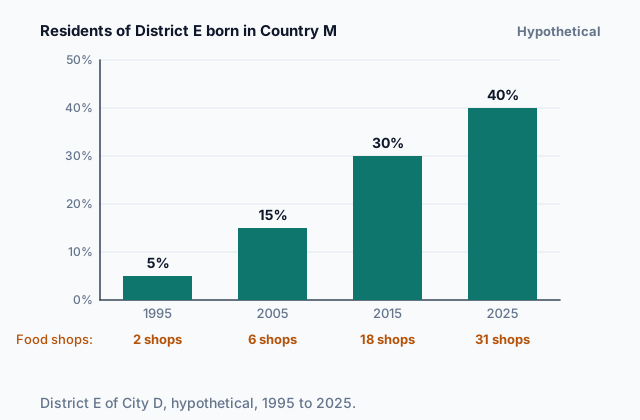
In the destination, chain migration often brings people from one origin to the same district. The chart at the top shows District E of hypothetical City D. In 30 years, the share of its residents born in hypothetical Country M rose from 5 percent to 40 percent, and shops selling Country M's foods rose from 2 to 31. When most of a district's residents, shops and places of worship come from one migrant group, the district is an ethnic enclave.
Culture also spreads outward. Residents across City D start eating Country M's foods, words from Country M's language enter local slang, and its holidays become city festivals. That spread is cultural diffusion. Migrants, and especially their children, take up the destination's language and customs too.
Cultural effects last for centuries. The Atlantic slave trade, the forced migration from Topic 2.11, carried African music, foods and religious practices to the Americas, where they still shape the region's music and cooking today.
The flow runs both ways. Migrants who visit or return home bring new music, ideas and habits back with them, so the origin changes as well.
Quick check · Fill the statement
Complete the description of District E and Country M.
So many migrants from Country M settle in District E that its shops, signs and places of worship reflect Country M's culture, making District E . Families across City D now cook Country M's dishes at home, an example of cultural . Migrants returning to Country M bring City D's music and slang with them, so culture moves .
2c. Political effects
Migration changes who governs and what governments argue about.
In the destination, immigration becomes a political question: how many people to admit, from where, and with what rights. Governments answer with laws, visas, border controls and quotas, limits on how many people may enter each year. Parties campaign for and against immigration, and the debate can bring tension, sometimes hostility toward newcomers. Migrants who become citizens vote and run for office, and a district where many of them live may elect leaders who share their background or speak for their concerns.
In the origin, governments court their citizens abroad, because those citizens send money and keep ties. Some let them vote from abroad, open offices to serve them, or press destination countries for fairer visa rules. Emigration can also change politics at home: when people who wanted change leave, fewer remain to push for it, while some organize from abroad.
Refugee flows are political too. A sudden arrival of asylum seekers can strain relations between neighboring countries, or draw aid from countries farther away.
Quick check · Sort it
Each card is an effect of migration. Tap a card, then the kind of effect it is.
Economic
Cultural
Political
2d. Both ends of the move
Every move has two ends, and its effects show up at both, often as mirror images.
When nurses leave hypothetical Country M for Country N, Country M's clinics lose staff while Country N's hospitals fill posts. Money flows back the other way, as remittances. Culture flows both ways. Politics changes in both places: Country N debates its visa rules, and Country M's government courts the nurses abroad.
The effects also land differently on different people. A nurse's family in Country M gains income while a village loses its only clinic. A hospital in Country N gains staff while a local worker faces new competition. Whether an effect counts as a gain or a loss depends on who you ask.
When a question asks for an effect of migration, say which place it is in, origin or destination, and which kind it is: economic, cultural or political.
Quick check · Select all
Many young doctors and nurses leave hypothetical Country M to work in Country N. Which two are effects in Country M, the origin? Select two.
Select 2 answers, then check.
Part 3 Watch it done How much does a village depend on money from abroad?
Watch each step, then do the last one yourself.
Hypothetical Village V, in Country M, has 800 households. 200 of them have a member working abroad, and each of those households receives about 3,000 dollars a year from that member. Together, the village's households earn 4,800,000 dollars a year from all other sources. What percent of the village's total household income comes from remittances?
Step 1 · Total the remittances
200 households × 3,000 dollars = 600,000 dollars a year.
Step 2 · Decide what the share is a share of
The question asks for a share of all the village's household income. Remittances are part of that income, so the total you divide by must include them as well as the other income.
Why this step?
Why does the total have to include the remittances?
A share is a part over the whole it belongs to. Remittances are part of the village's income, so leaving them out of the whole makes the share come out too large.
Your step · Calculate
Finish it. Work out the village's total household income, then the percent of it that comes from remittances. Round to one decimal place.
%
Part 4 Try it Follow the effects across a border
Try it · Decide and justify
Remittances from workers in hypothetical Country N equal 20 percent of hypothetical Country M's GDP. Country N proposes a new tax on all money sent abroad. Is Country M's government likely to object?
Which reason supports your answer?
Try it · Spot the error
A student explains the effects of migration from hypothetical Country M to Country N. Which line is the first to go wrong?
Part 5 Explain it Explain the effects of migration
Nothing you type leaves this page. Check your answer against the model and each scoring point.
Free response is 50% of the exam score. This one is shaped like Question 1, from free-response II.
Free-response practice · Question 1 style
Over 30 years, many young adults from hypothetical Country M have moved to work in hypothetical Country N, a wealthier country with an aging population.
(A) Define remittances.
(B) Describe one economic effect of this migration on Country M.
(C) Explain one economic effect of this migration on Country N.
(D) Describe one cultural effect of this migration on Country N.
(E) Describe one effect of a migration from long ago that can still be seen in a place today.
(F) Explain one political effect of this migration in Country N.
(G) Explain why Country M's government might act to keep ties with its citizens in Country N.
Model answer
(A) Remittances are money that migrants send to family or others in their home country.
(B) Country M loses many young workers, and when the skilled ones such as nurses or engineers leave, it suffers brain drain: the skills it paid to train now serve Country N.
(C) Country N's aging population leaves jobs unfilled. Young migrants fill them, and they pay taxes that help support Country N's older residents.
(D) Migrants from Country M cluster in some districts of Country N's cities, forming ethnic enclaves with their own shops and places of worship, and their foods spread across those cities.
(E) The Atlantic slave trade forced enslaved Africans to the Americas centuries ago. The music, foods and religious practices they carried still shape music, cooking and worship across the Americas today.
(F) Immigration becomes a political debate in Country N. Parties argue over how many migrants to admit, and the government may set quotas or change its visa rules.
(G) Remittances from Country N support many of Country M's families and its economy, so the government may let citizens abroad vote or open offices to serve them, to keep the money and the ties flowing.
Score your own answer. This is a self-check, not a grade. Tick each point your answer makes.
Part 6 Check yourself A decade of emigration from Country M
The case questions use the table. The others mix the ideas from the whole lesson.
Hypothetical Country M's statistics office compares two years. In 2023, between them, Country M's government opened an office to serve citizens living abroad and gave them the right to vote from abroad in national elections.
| Measure | 2015 | 2025 |
|---|---|---|
| Citizens working abroad | 200,000 | 800,000 |
| Remittances received per year | $0.5 billion | $2.0 billion |
| GDP | $20 billion | $25 billion |
| Share of doctors trained in Country M who work abroad | 10% | 35% |
Case question 1 · Multiple choice
Which conclusion is best supported by the table?
Case question 2 · Calculate
Remittances equaled what percent of Country M's GDP in 2025?
Case question 3 · Multiple choice
The 2023 changes, an office for citizens abroad and voting from abroad, are best described as which effect of migration?
The rest stand on their own and do not use the case.
Check yourself · Rank it
Rank these hypothetical countries by how much their economies depend on remittances. Work out each country's share of GDP before you rank.
Most dependent first
Give each one a place, 1 for first. Give two the same place if they are equal.
Your ranking: none yet
Check yourself · Match
Match each term to the hypothetical example that shows it.
Part 7 Keep it Bring back earlier ideas
This lesson stands on forced and voluntary migration from Topic 2.11 and the demographic transition model from Topic 2.5.
Bring it back · Fill the statement
Two hypothetical workers moved in different ways. Name each type of migration.
A mechanic moves from a village to a market town, later to a regional city, and finally to the capital: migration. A cook takes a two-year permit to work in another country and must go home when it ends: migration.
Bring it back · Multiple choice
In Stage 2 of the demographic transition model, what happens to a country's population, and why?
In three lines
- Economic effects: the origin loses workers (brain drain) and gains remittances; the destination gains workers, taxpayers and businesses.
- Cultural effects: migrants' foods, languages and religions spread and can form ethnic enclaves, returning migrants carry new ideas home, and some effects last for centuries.
- Political effects: destinations debate and set immigration laws and quotas, new citizens change who is elected, and origin governments court citizens abroad.
Exam strategy for this topic
- Section I, Multiple Choice: 60 questions in 60 minutes.
- Section II, Free Response: 3 questions in 75 minutes.
When a question asks for an effect of migration, name the kind (economic, cultural or political) and the place (origin or destination), then give the cause and the effect in one sentence, such as: emigrating nurses leave Country M's clinics short of staff.
Questions students ask
Is migration good or bad for the country people leave?
Both, and it depends on who you ask. The origin loses workers and skills but gains remittances, returning migrants' savings and skills, and ties abroad.
How do I measure how much a country depends on remittances?
Divide its remittances by its GDP and multiply by 100. A large total can still be a small share of a large economy.
What is the difference between an ethnic enclave and an ethnic neighborhood?
The words overlap. This lesson uses ethnic enclave for a district where one group's residents, shops and places of worship dominate.
Does migration affect politics in the country people leave?
Yes. Origin governments court citizens abroad, for example by letting them vote from abroad, and emigration can change who stays home to take part in politics.
Are the places and people in this lesson real?
No. Every country, city, district, village and person here is hypothetical, with numbers chosen to show each effect clearly. Real migration mixes many effects at once.
Course alignment, for teachers
AP Human Geography topic 2.12, Unit 2: Population and Migration Patterns and Processes.
- Skill 2.B: Explain spatial relationships in a specified context or region of the world, using geographic concepts, processes, models, or theories.
This lesson maps the one essential knowledge statement of the topic to the part that teaches each one: 1 is checked by a scored question. The map is in the lesson file.