Unit 3 · Topic 3.1 · about 30 minutes · 7 parts · 14 scored checks, 3 of them multiple choice
AP Human Geography 3.1: Introduction to Culture
Unit 3: 12 to 17% of the multiple-choice section
What you'll be able to do
- Define culture, name culture traits such as food preferences, architecture and land use, and tell ethnocentrism apart from cultural relativism as attitudes geographers meet when they study culture.
Key vocabulary
| Term | What it means | The exam trap |
|---|---|---|
| Culture | The shared practices, technologies, attitudes and behaviors that a society passes on to its members. | Geographers use the word for everyday ways of life, so do not limit it to the arts. |
| Culture trait | A single element of a culture, such as a food preference, a style of architecture or a way of using land. | An observation can mention food or land without being that kind of trait, so read what it is really about. |
| Ethnocentrism | The attitude of judging another culture by the standards of your own, with your own way treated as the normal or best way. | It can hide in a polite or mild remark, so read every remark for the standard it uses. |
| Cultural relativism | The attitude of understanding a culture's practices within that culture's own context and values. | It is an attitude a person holds toward other cultures, not a trait a landscape shows. |
 Tap to open the picture full size
Part 1 Think first Two villages, one valley
Commit to a guess first. Being wrong now makes the right idea stick better.
Predict first
Hypothetical Village R and Village S face each other across a river. They have the same climate and the same kind of soil. Farmers in Village R flood their fields and grow rice. Farmers in Village S keep their land as pasture and raise goats. What best explains the difference?
In short. Culture is the set of shared practices, technologies, attitudes and behaviors that a society passes on to its members; geographers read it in culture traits on the landscape and watch for two attitudes people take toward cultures unlike their own.
- Culture belongs to a group and is learned from other people. One person's habit, or something nobody teaches, is not culture.
- Culture traits are single elements of a culture, such as food preferences, architecture and land use. Sort each one by what the observation is about.
- Ethnocentrism judges another culture by the standards of your own. Cultural relativism tries to understand a culture within its own context and values.
Part 2 Learn it Culture, its traits and two attitudes
2a. What culture is
Geographers use culture for the shared practices, technologies, attitudes and behaviors that a society passes on to its members. Two ideas in that definition do most of the work.
Shared. Culture belongs to a group. In hypothetical fishing Town F, nearly every family dries fish on wooden racks by the harbor. That is part of the town's culture. One fisher who dyes his nets green, when no one else does, has a personal habit.
Passed on. Culture is learned from other people, not inborn. Children in Town F learn to dry fish by working beside their parents, and new families pick it up from neighbors. The harbor's tides and a baby's need for sleep are not culture: nobody teaches them.
The definition reaches well past art and music. It takes in what people do (practices and behaviors), the tools and methods they use (technologies) and what they hold to be right or rude (attitudes). The design of Town F's drying racks is a technology. Its shared belief that fishing on a festival day brings bad luck is an attitude.
Culture also changes. A practice that spreads through a group and is passed on becomes part of that group's culture, wherever it first came from.
Quick check · Sort it
A geographer records these observations in hypothetical Town F, a fishing town. Tap a card, then the bin it belongs in.
Part of the town's culture
Not part of its culture
2b. Culture traits
A culture trait is a single element of a culture that a group shares. Geographers can read three kinds straight off a landscape.
Food preferences are what a group chooses to eat and how it prepares food. Architecture is the form of buildings: their shape, materials and layout. Land use is what people do with the land: farm it, graze it, terrace it or leave it as forest.
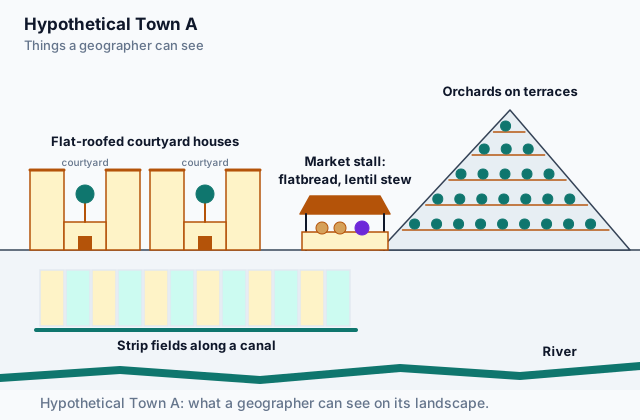
Look at the picture at the top of the page, hypothetical Town A. The flat-roofed courtyard houses are architecture. The flatbread and lentil stew at the market stall are food preferences. The orchards on terraces and the strip fields along the canal are land use. The river is not a culture trait; nobody built or planted it.
Sort a trait by what the observation is about, not by a word in it. Apricot trees planted on terraces are land use, even though apricots are food. Dried apricots served to every guest are a food preference. A house is architecture, even though it stands on land. Because traits are shared and passed on, the same roofs or the same fields repeat across a town.
 Tap to open the picture full size
Quick check · Fill the statement
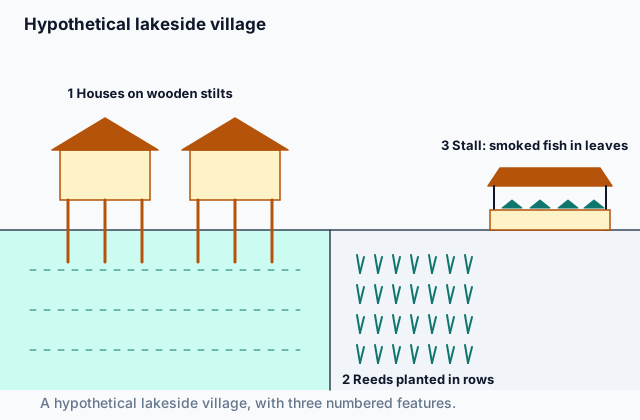
A sketch of a hypothetical lakeside village shows three numbered features: (1) houses built on wooden stilts over the water, (2) reeds planted in rows along the shore, and (3) a stall selling smoked fish wrapped in leaves. Complete the geographer's notes on the sketch.
Feature 1, the stilt houses, is a trait of . Feature 2, the rows of reeds, is a trait of . Feature 3, the smoked fish, is a trait of .
2c. Ethnocentrism
Geographers also study how people react to cultures unlike their own. Ethnocentrism is judging another culture by the standards of your own, with your own way treated as the normal or best way.
Take Rosa, from hypothetical Country G, visiting hypothetical Country H. In Country H, shops close for three hours at midday while families eat together. If Rosa writes "Country H's shops close at midday, and Country G's stay open," she has described a difference. If she writes "Country H's people are lazy and should keep their shops open the way we do," she has judged Country H by Country G's habits. That second remark is ethnocentrism.
The test is the yardstick. Ask what standard a remark measures by. If the standard is the speaker's own culture, laid over someone else's, the remark is ethnocentric, however polite it sounds. Noticing and comparing differences is not ethnocentric; geographers do it all the time.
Ethnocentrism matters to a geographer because it bends what an observer records and how a place gets explained.
Quick check · Spot the error
Ben, from hypothetical Country J, visits hypothetical Country K. A student analyzes his journal. Which line is the first to go wrong?
2d. Cultural relativism
Cultural relativism is the attitude of understanding a culture's practices within that culture's own context and values, rather than measuring them against yours.
Go back to Rosa. A relativist asks why Country H's shops close at midday. She might learn that the midday meal is the main family meal of the day, that the afternoon heat makes outdoor work hard, and that shops reopen until late evening. Now the custom makes sense on Country H's own terms, and her report explains it instead of grading it.
Geographers try to bring this attitude to fieldwork, because it gives a truer picture of why places differ. It is a way of studying, not a vote of approval. You can see why a practice fits its setting without taking it up, and you can still prefer your own food or your own shop hours.
So the two attitudes differ in their yardstick. Ethnocentrism uses your own culture to judge another. Cultural relativism uses the other culture's own setting to understand it. Both are attitudes people hold toward cultural difference, not traits you can see on a landscape.
Quick check · Sort it
Visitors to hypothetical countries wrote these remarks. Tap a remark, then the attitude it shows.
Ethnocentrism
Cultural relativism
Part 3 Watch it done Read a geographer's field notes
Watch each step, then do the last one yourself.
A geographer's field notes from hypothetical Town H list seven observations. Decide which ones are culture traits, and what kind each one is.
- Most households eat rice porridge with pickled radish for breakfast.
- Houses have steep tiled roofs that curve up at the corners.
- One woman has painted her gate purple; no other gate in town is purple.
- Tea bushes are planted in rows along the hill slopes.
- It rained for three days in a row last week.
- Families farm the flat valley floor and build their houses on the higher ground beside it.
- Families serve tea and sweet bean cakes to every guest.
Predict first
Before the steps, how many of the seven notes do you expect to be culture traits?
Step 1 · Keep only what the town shares and passes on
Note 3 is one woman's choice; nobody else shares it. Note 5 is weather, which nobody practices or teaches. Both drop out. The other five notes describe what most households do, so they are culture traits.
Step 2 · Name the kind of trait for note 1
Rice porridge with pickled radish is about what the town chooses to eat, and how. Note 1 is a food preference.
Why this step?
Why leave out the purple gate, when a person made it and it changes how the street looks?
Culture is shared by a group and passed on. One person's gate is a personal choice. If most of the town painted its gates purple and taught their children to, it would become a trait.
Your step · Sort it
Finish it. Sort the four notes left from hypothetical Town H by the kind of culture trait each one shows.
Food preference
Architecture
Land use
Part 4 Try it Read a town, then plan a report
Try it · Match
A geographer took four photographs in hypothetical Town Z, a mountain town. Match each label to the photograph it fits.
Try it · Decide and justify
Leo grew up in hypothetical Country P, where people eat three small meals a day. He is writing a report on hypothetical Village Q, where, during planting season, families eat one large meal in the late afternoon after the day's work in the fields. Which approach should Leo take in his report?
Which reason supports your answer?
Part 5 Explain it Explain a town's culture and how others see it
Nothing you type leaves this page. Check your answer against the model and each scoring point.
Free response is 50% of the exam score. This one is shaped like Question 1, from free-response II.
Free-response practice · Question 1 style
In hypothetical Country T, the families of Hill Town build stone houses with thick walls, grow barley on terraces cut into the slopes, and eat barley porridge every morning, as their grandparents did. Many young adults from Hill Town have moved to a large lowland city in the same country. A newspaper columnist in the city writes that barley porridge is "peasant food" that the newcomers should give up for a proper city breakfast.
(A) Identify one culture trait of Hill Town that is a land use.
(B) Identify one culture trait of Hill Town that is architecture.
(C) Explain why a geographer would treat the barley porridge as part of Hill Town's culture rather than one family's habit.
(D) Identify the attitude toward cultural difference that the columnist shows.
(E) Explain how a geographer using cultural relativism would describe the barley porridge differently from the columnist.
(F) Explain one pull factor that could draw young adults from Hill Town to the lowland city.
(G) Explain one cultural effect the newcomers from Hill Town could have on the lowland city.
Model answer
(A) Growing barley on terraces cut into the slopes.
(B) Stone houses with thick walls.
(C) The porridge is eaten by the families of Hill Town, not by one household, so it is shared, and children learn to eat it from their parents, as their parents did from theirs, so it is passed on. Shared practices passed on through a society are culture.
(D) Ethnocentrism.
(E) The columnist judges the porridge by the city's own idea of a proper breakfast. A geographer using cultural relativism would explain it within Hill Town's own setting: barley is the grain the town grows on its terraces, and a filling porridge is a long-standing way to start a day of farm work. The geographer would describe why it makes sense there instead of ranking it.
(F) Jobs. The lowland city offers more kinds of paid work than a farming town, which draws young adults who want wages or careers that Hill Town cannot offer.
(G) The newcomers could bring their food preferences with them. Cafes or shops selling barley porridge could open, and city residents could start eating it too, so a Hill Town trait becomes part of the city's culture.
Score your own answer. This is a self-check, not a grade. Tick each point your answer makes.
Part 6 Check yourself Thirty years in Town M
The case questions use the table. The others mix the ideas from the whole lesson.
A geographer surveyed the households of hypothetical Town M twice, thirty years apart. Around the time of the first survey, families from a hypothetical farming region to the east began settling in the town. They brought a noodle dish with them, which in their home region is a quick meal eaten between shifts in the fields. The figures are invented for this lesson.
| Household practice | Thirty years ago | Today |
|---|---|---|
| Bake bread at home each morning | 85% | 80% |
| Live in a courtyard house | 70% | 68% |
| Farm a plot of olive trees on terraces | 60% | 35% |
| Eat the noodle dish at least once a week | 5% | 65% |
Case question 1 · Multiple choice
Which statement about land use in Town M does the table support?
Case question 2 · Decide and justify
A student reads the table and says the noodle dish is not part of Town M's culture, because newcomers brought it. Is the student right?
Which evidence supports your answer?
Case question 3 · Multiple choice
Members of Town M's council comment on the noodle dish in the table. Which remark shows cultural relativism?
The rest stand on their own and do not use the case.
Check yourself · Spot the error
Lena, from hypothetical Country V, visits hypothetical Country W. A student analyzes her reaction. Which line is the first to go wrong?
Check yourself · Select all
Hypothetical Port L is known for one way of building boats. Which two facts would best show that this boat design is part of the port's culture, not one builder's habit? Select two.
Select 2 answers, then check.
Part 7 Keep it Bring back earlier ideas
This lesson stands on the effects of migration from Topic 2.12 and the causes of migration from Topic 2.10: people who move carry their culture with them.
Bring it back · Multiple choice
Many workers from hypothetical Country M move to hypothetical Country N. Over the following decades, families across Country N begin cooking Country M's dishes at home and celebrating one of Country M's festivals. Which does this change show?
Bring it back · Fill the statement
A family leaves hypothetical Country R after a drought ruins its farm and moves to hypothetical Country S, where a factory is hiring.
For this family, the drought is a factor of the kind, and the factory jobs are a factor of the kind.
In three lines
- Culture is the shared practices, technologies, attitudes and behaviors a society passes on; one person's habit, biology and weather are not culture.
- Culture traits are single elements of a culture, such as food preferences, architecture and land use; sort each by what it is about.
- Ethnocentrism judges another culture by your own standards; cultural relativism understands a culture within its own context.
Exam strategy for this topic
- Section I, Multiple Choice: 60 questions in 60 minutes.
- Section II, Free Response: 3 questions in 75 minutes.
When a question asks which attitude a remark shows, find the standard the remark measures by. When it asks what kind of culture trait something is, name what the observation is about, not a word it happens to mention.
Questions students ask
Is culture the same as a country?
No. A culture belongs to a group of people who share and pass on ways of life. One country can hold many cultures, and one culture can spread across several countries.
What is the difference between a culture trait and culture?
A culture trait is one element, such as a dish, a style of roof or a way of farming. Culture is the whole set of shared practices, technologies, attitudes and behaviors a group passes on.
Does cultural relativism mean every practice is fine?
In this course it is an attitude for studying a culture: you try to understand a practice within that culture's own context before you judge it. Understanding a practice is not the same as adopting it.
Is it ethnocentric to like my own culture's food best?
Preferring your own food is a personal taste. It becomes ethnocentrism when you judge another culture's food as wrong or lesser because it is not like yours.
Are the places in this lesson real?
No. Every town, village and country here is hypothetical, and the survey figures for Town M are invented to show each idea clearly.
Course alignment, for teachers
AP Human Geography topic 3.1, Unit 3: Cultural Patterns and Processes.
- Skill 4.A: Identify the different types of information presented in visual sources.
This lesson maps all 3 essential knowledge statements of the topic to the part that teaches each one: 3 are checked by a scored question. The map is in the lesson file.