Unit 2 · Topic 2.2 · about 30 minutes · 7 parts · 14 scored checks, 3 of them multiple choice
AP Human Geography 2.2: Consequences of Population Distribution
Unit 2: 12 to 17% of the multiple-choice section
What you'll be able to do
- Explain how population distribution and density affect political, economic and social processes, including the provision of services such as medical care, and how they affect the environment and natural resources through carrying capacity.
Key vocabulary
| Term | What it means | The exam trap |
|---|---|---|
| Population density | The number of people living on each unit of land, such as people per square kilometer. | Density is an average for a whole area, so it does not say how the people are spread within it. |
| Population distribution | The pattern of where people live across an area. | Two places with the same population can have very different distributions. |
| Carrying capacity | The largest population an area can support over time without damaging its environment. | Tie it to what the land and its resources can support, not to how many people already live there. |
| Natural resources | Materials from the environment that people use, such as water, soil, forests and minerals. | Some, like soil and fish, renew only at their own pace, so ask how fast a resource comes back as well as how much there is. |
| Provision of services | Supplying people with services such as medical care, schools and transit. | A service can fall short in more than one way, so say which way you mean. |
 Tap to open the picture full size
Part 1 Think first One hospital for each region
Commit to a guess first. Being wrong now makes the right idea stick better.
Predict first
Hypothetical Regions East and West each have 100,000 people. In Region East, nearly everyone lives in one city of 200 square kilometers. In Region West, people live in 40 villages spread over 20,000 square kilometers. Each region gets the money to build and staff one hospital. In which region will people find it harder to get emergency care?
In short. Where people live and how densely they live shape what a society can provide and what it does to its land: the cost and reach of services such as medical care, political representation and jobs, and the pressure on the environment that carrying capacity measures.
- Dense places can support hospitals, transit and specialized services close to most people but face crowding; sparse places cost more per person to serve and leave people traveling far for care.
- Where people cluster shapes politics and the economy: legislative seats follow population, and companies that need many workers and customers locate where people are dense.
- Carrying capacity is the largest population an area can support without damaging its environment, and it changes with technology and with how people use the land.
Part 2 Learn it What distribution and density do
2a. Services follow people
A hospital, a high school or a bus line needs enough people nearby to be worth running. Where people live densely, many of them sit close to one site, so a city can support large hospitals, specialist doctors and frequent transit, and most residents reach them quickly.
Where people are spread thin, each service has to cover a large area. Fewer people live near any one clinic, so it costs more per resident to build and staff, and many places end up with no doctor at all. Residents drive long distances for care, wait longer for an ambulance and may skip checkups. Governments fill the gap with smaller clinics, mobile clinics that visit on a schedule, flying doctors or telehealth.
Density brings its own problems for services. A crowded city's emergency rooms can be overloaded, schools can run out of seats, and heavy traffic can slow an ambulance even when the hospital is close. Neither pattern is simply better; each makes some services easier and others harder to provide.
Quick check · Sort it
Each card is a problem a hypothetical country's health and school officials report. Tap a card, then the kind of place where it is more likely.
A densely settled area
A sparsely settled area
2b. Politics and the economy
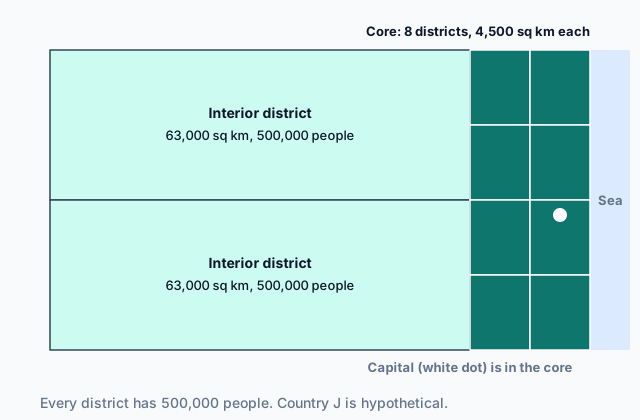
Distribution shapes political processes. In many countries, seats in the legislature are drawn so each district holds about the same number of people. The map at the top of the page shows hypothetical Country J: eight small districts in the dense coastal core and two huge ones in the empty interior, each with 500,000 people. The core elects most of the legislature, so its voters' concerns, such as transit and housing, can outweigh the interior's, such as rural roads and farm prices. When people move from the interior to the capital, the interior can lose seats after the next census.
Distribution shapes economic processes too. A company that needs thousands of workers, or millions of customers, locates where people are dense, which draws more people there in turn. Roads, power lines and water pipes cost less per person where many people share them, so dense places get them first, and sparse areas pay more for each kilometer of road per resident.
And it shapes social processes. Dense places mix many groups and support specialized clubs, places of worship and services; sparse places can leave people isolated, with long trips to see family or reach a school.
Quick check · Match
Match each effect of population distribution to the observation from hypothetical Country J that shows it.
2c. Pressure on the land
Distribution and density also affect the environment and natural resources. A dense, growing city draws heavily on the water, land and energy around it. It may pump groundwater faster than rain refills it, pave over farmland at its edge for housing, and send sewage, trash and exhaust into the air, rivers and soil nearby.
Sparse settlement is not free of damage. Where few people farm or herd over a large area, each family may need a lot of land: grazing herds can strip grass from dry hillsides, and clearing forest for new fields spreads across a wide area.
Low density inside a city has a cost too: low-density suburbs use more land and more fuel per person than the same people living closer together.
So the question is never only how many people live in a place. It is how many people, how densely they live, and how they use the land and its resources.
Quick check · Select all
Hypothetical City K's population has doubled in twenty years, and most of the new residents live at high density. Which two are effects on the environment and natural resources? Select two.
Select 2 answers, then check.
2d. Carrying capacity
Carrying capacity is the largest population an area can support over time without damaging its environment. Think of a dry valley where families herd cattle. Each year the grass grows back by a certain amount. If the herds eat no more than the regrowth, the land stays healthy year after year. If more families bring more cattle than the regrowth can feed, the grass thins, bare soil washes or blows away, and the valley can feed fewer cattle than before.
Carrying capacity is not a fixed number stamped on the land. It depends on the resources and on how people use them. Irrigation, better seed, terraced fields, fertilizer or food brought in by trade can raise it. Overgrazing, soil erosion, a falling water table or a drying climate can lower it.
A place passes its carrying capacity when its population, at its current way of living, uses resources faster than they are replaced. That can happen in a sparse place as easily as in a dense one: a dry valley with a few hundred herders can be past its limit while a crowded, well-watered plain is not.
Quick check · Fill the statement
Complete the description of carrying capacity in a hypothetical farming valley.
The valley's carrying capacity is the population it can support over time without damaging its land and water. When farmers dig canals to irrigate dry fields, the carrying capacity . When too many goats strip the hillsides and the soil washes away, it .
Part 3 Watch it done How many herders can the valley hold?
Watch each step, then do the last one yourself.
Hypothetical Valley V has 600 square kilometers of pasture. Each year the grass regrows enough to feed 10 cattle on each square kilometer without stripping the land. Each herding family needs 20 cattle to live. What is the valley's carrying capacity, in herding families?
Step 1 · Find how many cattle the land can feed
600 square kilometers × 10 cattle per square kilometer = 6,000 cattle that the valley can feed year after year.
Why this step?
Why use the grass that regrows each year, and not all the grass standing in the valley today?
Carrying capacity is what the land can support over time without damage. Herds that eat more than the regrowth eat into the grass itself, and the land feeds fewer animals each year after.
Step 2 · Set up the last step
Each family needs 20 cattle, so the number of families is the cattle the valley can feed divided by the cattle each family needs.
Your step · Calculate
Finish it. Valley V's pasture can feed 6,000 cattle a year without damage, and each herding family needs 20 cattle. How many herding families can the valley support without damaging its land?
families
Part 4 Try it Plan for a sparse district and a crowded valley
Try it · Decide and justify
Hypothetical District G has 30,000 people living in 60 small villages spread over 15,000 square kilometers, and no hospital. The health ministry can pay for one of two plans. Which will reach more of District G's residents with regular care?
Which reason supports your answer?
Try it · Rank it
Four hypothetical herding villages each know their population and their carrying capacity, the most people their land can support without damage. Rank them by how much pressure their population puts on the land, measured as population divided by carrying capacity.
Most pressure first
Give each one a place, 1 for first. Give two the same place if they are equal.
Your ranking: none yet
Part 5 Explain it Explain what a country's population pattern does
Nothing you type leaves this page. Check your answer against the model and each scoring point.
Free response is 50% of the exam score. This one is shaped like Question 1, from free-response II.
Free-response practice · Question 1 style
In hypothetical Country J, most people live at high density in a coastal region around the capital. The dry interior covers most of the land but holds few people, who raise cattle and goats on open pasture.
(A) Describe one way the sparse population makes medical care harder to provide in the interior.
(B) Explain one way high density can strain medical care in the capital region.
(C) Explain one political effect of so many of Country J's people living in the capital region.
(D) Explain one economic reason companies choose to locate in the capital region.
(E) Define carrying capacity.
(F) Explain one way the capital region's density affects the environment or natural resources.
(G) Explain how herders in the interior could exceed the land's carrying capacity even though few people live there.
Model answer
(A) With few people spread over a large area, a hospital or clinic serves a huge territory, so many families live hours from care and the cost per person of staffing a clinic is high.
(B) So many people live within reach of each hospital that emergency rooms are overloaded and waits are long, and traffic can slow ambulances.
(C) If legislative districts hold equal populations, the capital region holds most of the districts, so it elects most of the legislature and its concerns can outweigh the interior's.
(D) Companies need workers and customers, and the capital region has the most of both close together.
(E) Carrying capacity is the largest population an area can support over time without damaging its environment.
(F) The dense population needs a great deal of water, so wells can be pumped faster than rain refills them; or growth paves over farmland at the region's edge.
(G) Dry pasture regrows slowly, so each family's herd needs a large area. If the herds eat more grass than grows back each year, the land is stripped and the soil erodes, which is past the carrying capacity even at a low density of people.
Score your own answer. This is a self-check, not a grade. Tick each point your answer makes.
Part 6 Check yourself Doctors in Province E
The case questions use the table. The others mix the ideas from the whole lesson.
Hypothetical Province E has three districts: a city, a farming district and a mountain district. The province's health office lists each district's people, land and doctors.
| District | Population | Land area | Doctors |
|---|---|---|---|
| 1: City | 600,000 | 300 square km | 400 |
| 2: Farming | 150,000 | 3,000 square km | 30 |
| 3: Mountain | 50,000 | 5,000 square km | 5 |
Case question 1 · Multiple choice
Which statement best describes how density and medical care are related in Province E?
Case question 2 · Calculate
How many people does each doctor in District 3, the mountain district, serve on average?
Case question 3 · Multiple choice
To save money, the province closes District 2's only hospital and sends its patients to the hospital in District 1. Which outcome is most likely for District 2's residents?
The rest stand on their own and do not use the case.
Check yourself · Spot the error
A student works out the carrying capacity of hypothetical Valley Q. Which line is the first to go wrong?
Check yourself · Fill the statement
A supermarket needs about 20,000 regular customers to stay open. Complete the comparison of two hypothetical districts.
In a district with 5 people per square kilometer, the supermarket has to draw its customers from area than in a district with 500 people per square kilometer. So residents of the sparse district usually travel to buy groceries.
Part 7 Keep it Bring back earlier ideas
This lesson stands on scales of analysis from Topic 1.6 and population density from Topic 2.1.
Bring it back · Multiple choice
Hypothetical Country J's census gives a national average age of 35. Mapped by district, the same census shows rural districts averaging 55 and the capital averaging 28. What does this show?
Bring it back · Calculate
Hypothetical Country Q has 18,000,000 people, 240,000 square kilometers of land, 30,000 square kilometers of arable land and 3,000,000 farmers. What is its physiological density, in people per square kilometer of arable land?
In three lines
- Dense places reach most people with services but face crowding; sparse places cost more per person to serve and leave people far from care.
- Population distribution shapes politics and the economy: seats follow people, and employers and infrastructure go where people are dense.
- Carrying capacity is the largest population an area can support without damaging its environment, and it changes with technology and land use.
Exam strategy for this topic
- Section I, Multiple Choice: 60 questions in 60 minutes.
- Section II, Free Response: 3 questions in 75 minutes.
When a question asks for an effect of population distribution or density, name the kind of effect (political, economic, social or environmental) and connect it to where the people are, not only to how many there are.
Questions students ask
Is a dense population always worse for the environment?
No. A dense city draws heavily on the water and land around it, but it can use less land and fuel per person than the same people spread out. A sparse population can still overuse fragile land, as overgrazing shows.
Can carrying capacity change?
Yes. Irrigation, new seeds, terracing and trade can raise it; soil erosion, falling water tables and drought can lower it. It describes what the land can support with the way people live there now.
Why does medical care cost more per person in sparse areas?
A clinic needs a building, staff and equipment however many people use it. Where few people live nearby, those costs are split among fewer patients, and the patients travel farther to reach it.
How does population distribution affect politics?
Where seats in a legislature are drawn to hold equal populations, places where many people live elect more members. When people move, seats move with them after the next count.
Are the places in this lesson real?
No. Every country, province, district, valley and village here is hypothetical, with numbers chosen to show each idea clearly.
Course alignment, for teachers
AP Human Geography topic 2.2, Unit 2: Population and Migration Patterns and Processes.
- Skill 2.C: Explain a likely outcome in a geographic scenario using geographic concepts, processes, models, or theories.
This lesson maps all 2 essential knowledge statements of the topic to the part that teaches each one: 2 are checked by a scored question. The map is in the lesson file.