Unit 2 · Topic 2.6 · about 30 minutes · 7 parts · 14 scored checks, 3 of them multiple choice
AP Human Geography 2.6: Malthusian Theory
Unit 2: 12 to 17% of the multiple-choice section
What you'll be able to do
- Explain theories of population growth and decline: use Malthusian theory and its critiques to analyze how a population changes and what follows from that change in a particular place.
Key vocabulary
| Term | What it means | The exam trap |
|---|---|---|
| Malthusian theory | Thomas Malthus's theory, from 1798, that population grows faster than the food supply, so that hunger and other checks must hold population down. | It is a theory built on stated assumptions, so when you critique it, name the assumption you are attacking. |
| Geometric growth | Growth by a constant multiple each period, such as doubling: 1, 2, 4, 8. | It starts slowly, so its first few numbers can look no faster than steady growth. |
| Arithmetic growth | Growth by a constant amount each period: 1, 2, 3, 4. | The amount added stays the same, so the percent it adds shrinks each period. |
| Positive check | In Malthus's theory, an event or condition that holds population down by raising the death rate. | Positive here does not mean good, so do not judge a check by the word. |
| Preventive check | In Malthus's theory, a choice or custom that holds population down by lowering the birth rate. | The checks Malthus himself had in mind were mostly about marriage, so modern birth control is a later addition to the idea. |
| Neo-Malthusian | A thinker who revives Malthus's warning about population growth and extends it to resources and the environment. | The prefix means new: these thinkers wrote in the twentieth century and later, so do not place them in 1798. |
 Tap to open the picture full size
Part 1 Think first Why did the food keep up?
Commit to a guess first. Being wrong now makes the right idea stick better.
Predict first
Hypothetical Country R had 10 million people in 1850. A writer then warned that its food supply could never keep up with its growing population. By 2000 it had 80 million people, and the average person ate more than in 1850. Which explanation fits best?
In short. Malthusian theory holds that population grows faster than the food supply, so that hunger, disease and war, or later marriage, must hold population down; its critics argue that new technology, falling birth rates, trade and fairer distribution let food keep up.
- Malthus argued that population, left unchecked, grows geometrically (1, 2, 4, 8) while food grows arithmetically (1, 2, 3, 4), so population eventually outruns food.
- Positive checks, such as famine, disease and war, raise the death rate; preventive checks, such as putting off marriage, lower the birth rate.
- Critics point to farming technology, the fall in birth rates as countries develop, trade and the role of poverty in hunger; neo-Malthusians widen the warning to water, soil, energy and the environment.
Part 2 Learn it Malthus and his critics
2a. Malthus's argument
In 1798 the English economist Thomas Malthus published An Essay on the Principle of Population. He argued that population, when nothing holds it back, grows geometrically: it doubles in a set period, 1, 2, 4, 8, 16. The food supply, he argued, grows only arithmetically: it adds about the same amount each period, 1, 2, 3, 4, 5.
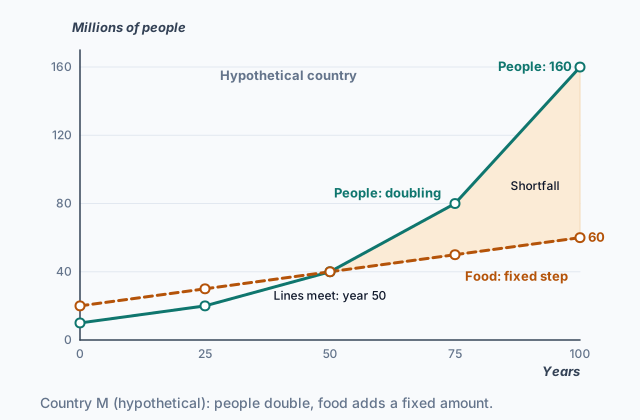
However much food a country starts with, a doubling population passes a food supply that adds a fixed amount. The picture at the top of the page shows hypothetical Country M. It starts with 10 million people and food for 20 million, and the two lines meet after 50 years. From then on the gap between people and food grows wider every period.
Malthus concluded that population would always press against the food supply, so that most people would live close to hunger. In his view this did not come from bad luck or bad government. It came from the two rates of growth.
Quick check · Calculate
Hypothetical Country N has 6 million people, and its population doubles every 30 years. If nothing holds that growth back, as Malthus assumed, how many million people will it have after 90 years?
2b. What holds population back
Malthus said two kinds of check bring population back in line with food.
Positive checks raise the death rate: famine, disease, war and the poverty that comes with too many people for the food.
Preventive checks lower the birth rate. Malthus meant mainly what he called moral restraint: putting off marriage until a couple could support a family, or not marrying at all. He opposed birth control.
If people did not use preventive checks, he argued, positive checks would do the work instead, through hunger and higher death rates. That is why his name is tied to grim predictions: a population that grows past its food supply is cut back by misery.
Notice two things Malthus assumed. He expected that people's wish to have children would stay about the same, and that farming could improve only slowly. Both assumptions are where his critics aim.
Quick check · Sort it
Each card describes an event in a hypothetical country in Malthus's time. Tap a card, then the kind of check it is in Malthus's theory.
Positive check
Preventive check
Not a check
2c. The critiques
Since Malthus wrote, the world's population has grown many times over, food output has grown faster still in most places, and famine has not followed the curve he drew. Malthus and his critics measure the result the same way, as food per person: the food supply divided by the population. Critics point to what his theory missed.
- Technology raises food output. Fertilizer, irrigation, machinery and new crop varieties multiplied what an acre can grow. The economist Ester Boserup went further: she argued that a growing population pushes farmers to work the land harder and find better methods.
- Birth rates fall. As countries urbanize and more children survive, families choose fewer children, as the demographic transition model shows. Growth slows without famine.
- Hunger is about poverty and distribution. Many famines have struck places where food existed but people could not afford it or could not reach it, often during wars.
- Trade moves food. A region can feed more people than its own fields support by buying food grown elsewhere.
Each critique attacks one of Malthus's assumptions: that farming improves slowly, that the wish for children stays the same, and that food grown is food eaten.
Quick check · Decide and justify
In hypothetical Region P the population doubled over 40 years. In the same years farmers terraced the hillsides, dug irrigation channels and began growing two crops a year, and food per person rose. Does Region P's history support Malthus or his critics?
Which reason supports your answer?
2d. Neo-Malthusians, and using the theory today
Malthus's ideas did not go away. Neo-Malthusians in the twentieth century revived them with a wider view: the danger is not only food but every resource a population uses, such as fresh water, soil, forests and energy, and the pollution it creates. They point to farmland lost to erosion and groundwater pumped out faster than rain refills it, and argue that growth can push a region past its carrying capacity.
Their critics answer much as Malthus's did: people find substitutes, use resources more efficiently and have fewer children as incomes rise.
Scale matters when you use the theory. A country may grow plenty of food overall while one dry region inside it outgrows its own water. A world with enough food can still hold a region where war has cut people off from it. Geographers use Malthusian theory and its critiques together, to ask which limit, if any, a particular place is close to.
Quick check · Fill the statement
Complete the argument about hypothetical Region Q.
Region Q's farmers pump groundwater faster than rain refills it, so a neo-Malthusian warns that the region is near its . Unlike Malthus, who wrote mainly about , this writer also warns about water, soil and energy. A critic replies that farmers will switch to drip irrigation, a new that grows the same crops with less water.
Part 3 Watch it done When does the food run short?
Watch each step, then do the last one yourself.
Hypothetical Country T has 12 million people and grows enough food for 18 million. Its population doubles every 30 years, and its food supply adds enough for 6 million more people every 30 years. Using Malthus's two rates, find when the population catches up with the food supply and how large the shortfall is at year 90.
Predict first
Before the steps, when do you expect Country T's population to catch up with its food supply?
Step 1 · Grow the population geometrically
12 million doubles to 24 million at year 30, then to 48 million at year 60.
Step 2 · Grow the food supply arithmetically
Food for 18 million adds 6 million each period: food for 24 million at year 30, and for 30 million at year 60. The population catches the food at year 30, and by year 60 there are 18 million more people than the food can feed.
Why this step?
Why does the population catch up by year 30, when the food supply started 6 million ahead?
In the first 30 years the population added 12 million, its own size, while the food added only its fixed 6 million. A doubling quantity adds more each period than the one before, so it erases any fixed head start.
Your step · Calculate
Finish it. At year 90, how many million more people does Country T have than its food supply can feed?
million people
Part 4 Try it Weigh the theory against the evidence
Try it · Match
Four people speak about the future of a hypothetical farming region. Match each view to the statement that expresses it.
Try it · Select all
Which two developments did Malthus's theory fail to foresee? Select two.
Select 2 answers, then check.
Part 5 Explain it Explain Malthus and his critics
Nothing you type leaves this page. Check your answer against the model and each scoring point.
Free response is 50% of the exam score. This one is shaped like Question 1, from free-response II.
Free-response practice · Question 1 style
Answer each part about Malthusian theory and its critiques.
(A) Describe Malthus's prediction about the relationship between population growth and the food supply.
(B) Identify one positive check that Malthus described.
(C) Explain the difference between a positive check and a preventive check.
(D) Explain one way technology has challenged Malthus's prediction.
(E) Explain how the demographic transition model challenges Malthus's assumption about birth rates.
(F) Describe one argument a neo-Malthusian would make about population growth today.
(G) Explain why Malthusian theory could describe one region better than the world as a whole.
Model answer
(A) Malthus predicted that population, growing geometrically, would outgrow the food supply, which grows arithmetically, so food per person would fall and most people would live close to hunger.
(B) Famine. (Disease and war are also positive checks.)
(C) A positive check raises the death rate, as a famine does. A preventive check lowers the birth rate, as putting off marriage does.
(D) Fertilizer, irrigation and new crop varieties raised the yield of each acre, so food output grew faster than population in many places, which Malthus thought farming could not do.
(E) Malthus assumed people's wish for children would stay the same. The demographic transition model shows birth rates falling in Stage 3, as countries urbanize and more children survive, so growth slows without famine.
(F) A neo-Malthusian would argue that growth is using up resources besides food, such as groundwater, soil and energy, and could push a region past its carrying capacity.
(G) A dry or isolated region can outgrow its own water or farmland, or be cut off from food by war or poverty, even while the world as a whole grows enough food.
Score your own answer. This is a self-check, not a grade. Tick each point your answer makes.
Part 6 Check yourself People and grain in Region K
The case questions use the table. The others mix the ideas from the whole lesson.
A geography student collects figures for hypothetical Region K, a farming region that buys and sells little food. One ton is 1,000 kilograms.
| Year | Population | Grain harvest (tons) |
|---|---|---|
| 1960 | 2,000,000 | 600,000 |
| 1980 | 3,000,000 | 1,050,000 |
| 2000 | 4,500,000 | 1,440,000 |
| 2020 | 6,000,000 | 1,500,000 |
Case question 1 · Multiple choice
Which statement best describes Region K from 1960 to 1980?
Case question 2 · Calculate
How many kilograms of grain per person did Region K harvest in 2020?
Case question 3 · Multiple choice
From 2000 to 2020, Region K's harvest barely grew while its population rose by a third. Which conclusion fits a critic of Malthus, rather than Malthus or a neo-Malthusian?
The rest stand on their own and do not use the case.
Check yourself · Spot the error
A student summarizes Malthus's theory. Which line is the first to go wrong?
Check yourself · Put it in order
Put Malthus's chain of reasoning in order, from the two rates of growth to the outcome he predicted.
Part 7 Keep it Bring back earlier ideas
This lesson stands on the demographic transition model from Topic 2.5 and population composition from Topic 2.3.
Bring it back · Multiple choice
In which stage of the demographic transition model does a country's death rate fall sharply while its birth rate stays high?
Bring it back · Calculate
A hypothetical mining town has 5,400 men and 4,500 women. What is its sex ratio, as the number of men per 100 women?
In three lines
- Malthus: population grows geometrically and food arithmetically, so population presses against food until checks hold it down.
- Positive checks (famine, disease, war) raise the death rate; preventive checks (later marriage) lower the birth rate.
- Critics point to technology, falling birth rates, trade and poverty; neo-Malthusians widen the warning to water, soil and energy, and scale decides which view fits a place.
Exam strategy for this topic
- Section I, Multiple Choice: 60 questions in 60 minutes.
- Section II, Free Response: 3 questions in 75 minutes.
When a question asks about Malthus, name both rates of growth and the kind of check. When it asks for a critique, tie it to one specific change, such as new farming technology, falling birth rates, trade or poverty, and say which of his assumptions it breaks.
Questions students ask
Was Malthus right?
Not about the world as a whole so far: food output has grown faster than he thought possible, and birth rates have fallen in most countries. But hunger, overused water and worn-out soil in some regions are why geographers still use his ideas, alongside the critiques, to analyze particular places.
What is the difference between Malthus and the neo-Malthusians?
Malthus wrote about food. Neo-Malthusians, writing from the twentieth century on, extend his warning to water, soil, energy, forests and pollution, and often to carrying capacity.
Who was Ester Boserup?
An economist who argued nearly the opposite of Malthus: that population growth pushes farmers to work land more intensively and adopt better methods, so a growing population can raise food output instead of being held down by it.
Does Malthusian theory work at every scale?
It can describe a region and not the world, or the world and not a region. A dry region can outgrow its own water while its country has plenty of food, so say which scale you are analyzing.
Are the countries and regions in this lesson real?
No. Every country, region and town here is hypothetical, with numbers chosen to show each idea clearly. Thomas Malthus, Ester Boserup and the neo-Malthusians are real.
Course alignment, for teachers
AP Human Geography topic 2.6, Unit 2: Population and Migration Patterns and Processes.
- Skill 2.B: Explain spatial relationships in a specified context or region of the world, using geographic concepts, processes, models, or theories.
This lesson maps the one essential knowledge statement of the topic to the part that teaches each one: 1 is checked by a scored question. The map is in the lesson file.