Unit 2 · Topic 2.7 · about 30 minutes · 7 parts · 14 scored checks, 3 of them multiple choice
AP Human Geography 2.7: Population Policies
Unit 2: 12 to 17% of the multiple-choice section
What you'll be able to do
- Explain what pronatalist, antinatalist and immigration policies are meant to do, and how each one changes the size and the makeup of a population, sometimes in ways its makers did not plan.
Key vocabulary
| Term | What it means | The exam trap |
|---|---|---|
| Population policy | A government's plan to change how fast its population grows or what it is made of. | A policy is judged by what it aims to change, so name its intent before you judge its effect. |
| Pronatalist policy | A policy that encourages people to have more children. | The word holds natal, meaning birth, so the policy is always about births. |
| Antinatalist policy | A policy that discourages births, from free family planning to legal limits on the number of children. | It includes voluntary measures, not only coercive limits. |
| Immigration policy | A country's rules on how many people may move in to live, which people, and on what terms. | It can be written to promote growth or to discourage it. |
| Replacement level | A total fertility rate of about 2.1 children per woman, the rate at which each generation just replaces the one before. | Read it as a total fertility rate, children per woman, not as a crude birth rate. |
| Population momentum | Growth or decline that continues because of a population's age structure, after its fertility rate has changed. | It can carry a population downward as well as upward. |
 Tap to open the picture full size
Part 1 Think first More workers, fast
Commit to a guess first. Being wrong now makes the right idea stick better.
Predict first
Hypothetical Country V has 20 million people. Its total fertility rate, the average number of children per woman, is 1.3, and many of its workers will retire in the next five years. Its leaders want more working-age adults within five years. Which plan would add them fastest?
In short. Governments try to change how fast their populations grow and what they are made of, mostly by encouraging births, discouraging births, or deciding who may move in.
- A pronatalist policy encourages births, with tools such as child payments, paid parental leave and cheap child care; countries with fertility below replacement level adopt them.
- An antinatalist policy discourages births, from free contraception and campaigns for small families to legal limits on family size; countries growing faster than they can build schools and clinics adopt them.
- An immigration policy can promote or discourage growth, and it works faster than any policy about births and changes a population's age and skill makeup at the same time.
Part 2 Learn it Three kinds of population policy
2a. Policies that encourage births
A population policy is a government's plan to change how fast its population grows or what it is made of. Most aim at births or at migration.
A pronatalist policy encourages people to have more children. Governments turn to one when the total fertility rate sits below replacement level, about 2.1 children per woman, the rate at which each generation just replaces the one before. Below it, and without migration, a population eventually shrinks and grows older, leaving fewer young workers and taxpayers to support each retiree.
Common tools:
- a payment for each birth, or a monthly allowance for each child
- paid parental leave, with the job held open
- free or cheap child care and preschool
- tax cuts or housing help for larger families
Most of these lower the cost of raising a child, either in money or in time away from paid work. A few pronatalist measures work the other way, by limiting choices instead of adding support: some governments have restricted contraception or abortion to raise the birth rate.
Quick check · Fill the statement
Complete the description of a hypothetical country's new policy.
Hypothetical Country K gives every new parent a year of paid leave and opens free day care centers. The kind of policy Country K is using: . Both measures work by lowering the of raising a child.
2b. Policies that discourage births
An antinatalist policy aims to lower the birth rate. A government adopts one when its population grows faster than it can build schools, clinics, housing and jobs. A very young population also means many children for each working adult to support.
Antinatalist policies run from voluntary to coercive:
- Voluntary: free family planning clinics and contraception, campaigns urging couples to wait and to stop at two, keeping girls in school longer, raising the legal age of marriage.
- Incentives and penalties: tax breaks, school places or housing priority for small families; fines or lost benefits for large ones.
- Coercive: a legal limit on the number of children, enforced with penalties.
The more a policy forces choices, the faster it can cut births and the more it costs in human rights. Coercive limits can also reshape a population in ways the government never planned, which the last section of this part returns to.
Quick check · Sort it
Each card is a policy in a hypothetical country. Tap a card, then the kind of population policy it is.
Pronatalist
Antinatalist
Immigration policy
2c. Immigration policies
An immigration policy decides how many people may move into a country to live, which people, and on what terms. Like a policy about births, it can promote growth or discourage it. To promote growth, a country raises yearly quotas, offers work visas or lets foreign students stay after they graduate. To discourage it, a country sets a low cap on new residents or tightens visa rules.
A population's yearly change has three parts:
population change = births minus deaths plus net migration
Net migration is the number of people who move in minus the number who move out. A country with more deaths than births shrinks unless net migration makes up the gap, and immigration does that far faster than births can: a newborn will not work for many years, but an adult admitted this year can start work right away.
Immigration policy also shapes composition, the makeup of a population by age, sex, skills and culture. Most migrants are young adults, so admitting many of them lowers the median age and raises the share of people of working age. A points system that rewards certain ages, skills or languages picks that composition on purpose.
Quick check · Match
Hypothetical Country G is choosing among immigration policies. Match each policy to the change it is most directly meant to make.
2d. Intent and effects
A policy's intent is what its makers want. Its effects are what actually happens, and the two often differ.
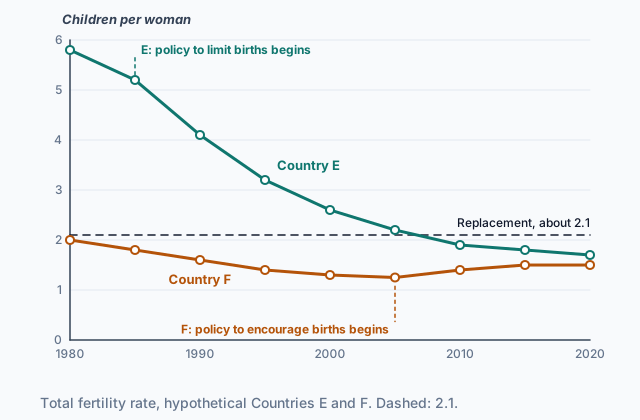
In the chart at the top of the page, Country E began limiting births in 1985, and its rate fell from 5.2 to below replacement by 2010. Country F began encouraging births in 2005, at 1.25, and its rate rose only to 1.5.
- Pronatalist policies usually raise fertility only a little. A payment rarely covers what a child costs, and the careers and values that lowered fertility do not change because of a bonus. Part of any rise is couples having planned children sooner, not having more.
- Antinatalist policies can overshoot. Once small families become normal, fertility can sink below replacement and stay there, and the country later reverses course.
- Growth continues after fertility falls. Population momentum keeps a young population growing for decades after it reaches replacement level, because the large groups born in the high-fertility years are still entering their childbearing years.
Where families prefer sons, a strict limit on children can also lead to sex-selective abortion and neglect of girls, leaving far more young men than young women.
Quick check · Select all
Hypothetical Country L enforced a strict one-child limit for 30 years, and many of its families prefer sons. Which two are likely effects of the policy? Select two.
Select 2 answers, then check.
Part 3 Watch it done How many newcomers hold a population steady?
Watch each step, then do the last one yourself.
Hypothetical Country W has 8,000,000 people. Each year it has 64,000 births and 96,000 deaths. Its government wants the population to stay the same size. How much net migration does it need each year?
Predict first
Before the steps: to keep its size, does Country W need more people moving in than out, more moving out than in, or neither?
Step 1 · Find the natural increase
Births minus deaths: 64,000 minus 96,000 is minus 32,000. Country W has a natural decrease of 32,000 people a year.
Step 2 · Find the net migration that balances it
Population change = births minus deaths plus net migration. For a change of zero, net migration must be plus 32,000: each year, 32,000 more people must move in than move out.
Why this step?
Why does the government need a net gain of 32,000, rather than simply 32,000 immigrants?
Emigrants count too. If 10,000 residents leave each year, Country W must admit 42,000 immigrants to reach a net gain of 32,000.
Your step · Calculate
Finish it. Country W also starts a pronatalist policy, and births rise to 76,000 a year while deaths stay at 96,000. How much net migration a year now keeps the population the same size?
people a year
Part 4 Try it Judge two policy debates
Try it · Decide and justify
Hypothetical Country X ran a voluntary antinatalist campaign for 25 years, and its total fertility rate fell from 4.8 to 2.1. Most of its people are under 30. Will its population stop growing in the year the rate reaches 2.1?
Which reason supports your answer?
Try it · Spot the error
A student analyzes the population policy of hypothetical Country Z. Which line is the first to go wrong?
Part 5 Explain it Explain two countries' population policies
Nothing you type leaves this page. Check your answer against the model and each scoring point.
Free response is 50% of the exam score. This one is shaped like Question 1, from free-response II.
Free-response practice · Question 1 style
Hypothetical Country M has a total fertility rate of 1.3, fewer young workers each year and more retirees. Its neighbor, hypothetical Country N, has a total fertility rate of 5.0, and its schools and clinics cannot keep up with the number of children.
(A) Identify the type of population policy Country N is most likely to adopt.
(B) Describe one policy Country M could use to encourage births, other than a cash payment.
(C) Explain why a policy that encourages births would do little to ease Country M's shortage of workers over the next ten years.
(D) Explain how an immigration policy could change both the size and the age composition of Country M's population.
(E) Describe one difference between a voluntary and a coercive policy to limit births.
(F) Explain one reason a policy to encourage births often raises fertility only a little.
(G) Explain why Country N's population would keep growing for years after its fertility rate fell to replacement level.
Model answer
(A) An antinatalist policy, one meant to lower the birth rate.
(B) Paid parental leave that keeps a parent's job open for a year, which lowers the wages a family gives up to have a child.
(C) A baby born now will not reach working age for 15 to 20 years, so more births add nothing to the workforce within ten years. They add children, who are dependents in that time.
(D) Admitting more immigrants adds people, so the population shrinks more slowly or grows. Most migrants are young adults, so the median age falls and the share of people of working age rises.
(E) A voluntary policy, such as free contraception or a campaign for smaller families, leaves the choice to couples. A coercive policy, such as a legal limit on the number of children with fines, forces the choice.
(F) A payment covers only a small part of what raising a child costs, and the reasons fertility fell, such as women's careers, the cost of housing and the value placed on small families, are still there.
(G) Population momentum. Country N's population is young, so a large group is entering the childbearing years. Even at about 2.1 children per woman, that group produces more births than the small older groups produce deaths, until the large groups age.
Score your own answer. This is a self-check, not a grade. Tick each point your answer makes.
Part 6 Check yourself Four countries, four policies
The case questions use the table. The others mix the ideas from the whole lesson.
A geography class compares four hypothetical countries of similar size. Each has a different population policy.
| Country | Main policy | Total fertility rate | Births a year | Deaths a year | Net migration a year |
|---|---|---|---|---|---|
| A | A payment to parents for each child born | 1.4 | 45,000 | 60,000 | +5,000 |
| B | Free contraception and a campaign for families of two | 3.4 | 210,000 | 70,000 | -20,000 |
| C | Work visas for skilled adults under 40 | 1.6 | 90,000 | 100,000 | +40,000 |
| D | No population policy | 1.9 | 50,000 | 55,000 | 0 |
Case question 1 · Multiple choice
Which statement correctly classifies two of the policies in the table?
Case question 2 · Calculate
By how many people does Country C's population change in a year? Give a fall as a negative number.
Case question 3 · Multiple choice
Country A's leaders want its population to stop shrinking within the next two years. Which change would most likely do that?
The rest stand on their own and do not use the case.
Check yourself · Rank it
Each hypothetical country wants its population to stay the same size. Rank them by how much net migration each needs a year. Work out births minus deaths for each before you rank.
Most net migration needed first
Give each one a place, 1 for first. Give two the same place if they are equal.
Your ranking: none yet
Check yourself · Fill the statement
Complete the prediction about a fast-growing hypothetical country.
Hypothetical Country Y has a total fertility rate of 5.5, and its schools hold twice as many pupils as they were built for. The kind of policy its government is most likely to adopt is , and one example is .
Part 7 Keep it Bring back earlier ideas
This lesson stands on Malthus from Topic 2.6 and growth rates from Topic 2.4.
Bring it back · Multiple choice
Which statement is a critique of Malthusian theory rather than a part of it?
Bring it back · Calculate
Hypothetical Country T's rate of natural increase is 1.4 percent a year. Using the rule of 70, about how many years will its population take to double?
In three lines
- Pronatalist policies encourage births, mostly by lowering the cost of a child; antinatalist policies discourage births, from voluntary family planning to coercive limits.
- Immigration policies promote or discourage growth through who may move in, and they change a population's age and skill makeup faster than any birth policy.
- Effects differ from intent: pronatalist policies raise fertility only a little, antinatalist ones can overshoot, and population momentum keeps young populations growing.
Exam strategy for this topic
- Section I, Multiple Choice: 60 questions in 60 minutes.
- Section II, Free Response: 3 questions in 75 minutes.
When a question names a population policy, say which of the three things it works through, births or migration, and whether it aims at growth or decline. Then say whether the effect matched the intent, using any data the question gives.
Questions students ask
Is an immigration policy a pronatalist policy if it adds people?
No. Pronatalist and antinatalist policies work through births. An immigration policy works through migration, even when it changes a population's size as much as a birth policy would.
Do pronatalist policies work?
Usually only a little. Payments and leave can raise fertility somewhat and help families, but they rarely bring a low rate back up to replacement level, because what a child costs and what people value change slowly.
Why is replacement level 2.1 and not 2.0?
Two children would replace two parents only if every child lived to adulthood and exactly half were girls. Some children die young and slightly more boys than girls are born, so the rate has to be a little above 2.
Can a population policy change composition as well as size?
Yes. Immigration policies that select by age or skill change composition directly, and strict limits on births change the age structure and, where families prefer sons, the balance of boys and girls.
Are the countries in this lesson real?
No. Every country here is hypothetical, with numbers chosen to show each idea clearly. Real countries' policies and results are messier.
Course alignment, for teachers
AP Human Geography topic 2.7, Unit 2: Population and Migration Patterns and Processes.
- Skill 2.C: Explain a likely outcome in a geographic scenario using geographic concepts, processes, models, or theories.
This lesson maps the one essential knowledge statement of the topic to the part that teaches each one: 1 is checked by a scored question. The map is in the lesson file.