Unit 3 · Topic 3.3 · about 30 minutes · 7 parts · 14 scored checks, 3 of them multiple choice
AP Human Geography 3.3: Cultural Patterns
Unit 3: 12 to 17% of the multiple-choice section
What you'll be able to do
- Explain the patterns and landscapes of language, religion, ethnicity and gender, and how regional patterns of language, religion and ethnicity give places meaning, shape the world's cultural landscape, and pull a state together or push it apart.
Key vocabulary
| Term | What it means | The exam trap |
|---|---|---|
| Sense of place | The feelings, meanings and memories people attach to a place. | Placemaking can strengthen it, but the two terms name different things. |
| Placemaking | People shaping a public space on purpose so that it reflects their community's identity and values. | Look for who shaped the space and why, not only for what stands there. |
| Global cultural landscape | The world-scale mosaic of culture regions, seen in what people build, write and celebrate where each language, religion and ethnic group lives. | It is read at the world scale, so name the scale when you use it. |
| Ethnicity | Identity with a group of people who share ancestry and cultural traditions. | Keep it apart from nationality, which is about the country a person belongs to. |
| Centripetal force | A force that unifies the people of a state and strengthens it. | The two force names sound alike; centripetal pulls toward the center. |
| Centrifugal force | A force that divides the people of a state and weakens it. | Name the trait and the place where it acts, not only the label. |
 Tap to open the picture full size
Part 1 Think first Guess the north's reaction
Commit to a guess first. Being wrong now makes the right idea stick better.
Predict first
Amara lives in the north of hypothetical Country H, where most people speak Language N at home. The rest of the country speaks Language S. The national government plans to make Language S the only language of schools, courts and government offices in every region, and says one language will unite the country. What is the most likely effect in the north?
In short. Language, religion and ethnicity cluster in regions whose patterns give places their meaning and shape the world's cultural landscape, and each of the three can pull a state together as a centripetal force or push it apart as a centrifugal force.
- Regions of language, religion and ethnicity often cross political borders and do not line up with one another, so trace each trait's boundary on a map.
- Sense of place is what a place means to people, placemaking is people shaping a public space to show their identity, and at the world scale the regional patterns form the global cultural landscape.
- A trait shared across a state unifies it. A different language, religion or ethnicity concentrated in one region, or a policy that shuts one out, can divide it.
Part 2 Learn it Where culture traits cluster, and what that does
2a. Regional patterns of language, religion and ethnicity
Language, religion and ethnicity are not spread evenly. Each one clusters into regions: an area where most people speak the same language, follow the same religion, or share the same ancestry and traditions.
To read any such map, ask where each trait's region begins and ends. Then ask whether the regions of different traits line up with one another, and whether they line up with political borders.
Often they do not. Take hypothetical Country M. Its coastal provinces speak one language and its inland provinces another, but one religion covers both. A map of language and a map of religion split the country in different places, so knowing someone's language does not tell you their religion. The inland language also keeps going past the border into the next country, because the people who speak it settled the area long before the border was drawn.
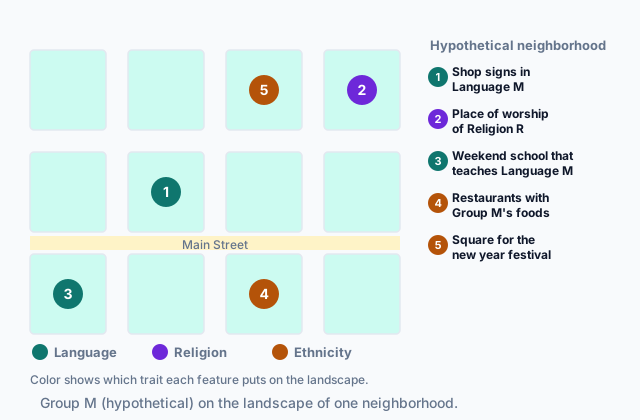
The same reading works at every scale: a world region, a country, or a few blocks of a city where one ethnic group has settled. The picture at the top of the page shows one such neighborhood, with its group's language, religion and ethnicity written on the landscape in signs, buildings, food and a festival.
Quick check · Fill the statement
A map of hypothetical Country J shows Language A in the north and Language B in the south, where it also continues across the border into hypothetical Country H. It shows Religion X in the west and Religion Y in the east. Complete what the map tells you.
Language B's region the political border. The language boundary and the religious boundary . In Country J, the language a person speaks tell you which religion they follow.
2b. Sense of place, placemaking and the global cultural landscape
Sense of place is the feelings, meanings and memories people attach to a place. Language, religion and ethnicity feed it: the language heard on the street, a holy site, the foods and festivals of a group. Two people can stand in the same square and feel very different attachments to it.
Placemaking is people shaping a public space on purpose so that it reflects their identity and values. A community puts up street signs in its own language, paints a mural of its history, or turns an empty lot into a square for its festival. Placemaking is an action. It often strengthens sense of place, but the two are different things.
At the world scale, regional patterns add up to the global cultural landscape: a mosaic of culture regions, each visible in what people build, write and celebrate. A religion that diffused to many world regions puts similar places of worship on several continents. A language spoken across a broad world region puts the same words on signs from country to country.
Gender leaves patterns on the landscape too, in who uses which spaces. Topic 3.2 looks at how attitudes toward gender shape the use of space.
Quick check · Sort it
Each card describes something in a hypothetical place. Tap a card, then the idea it shows best.
Sense of place
Placemaking
Global cultural landscape
2c. Forces that pull a state together or push it apart
A state holds people who may differ in language, religion and ethnicity. Geographers ask whether each trait pulls the state together or pushes it apart.
A centripetal force unifies a state's people and strengthens the state. A shared language lets people from every region work, trade and follow the same news. A shared religion gives them common holidays and values. A shared ethnic identity, or a national story that several groups tell together, makes people feel they belong to one country.
A centrifugal force divides a state's people and weakens the state. Two language groups that cannot easily understand each other may want separate schools, media and laws. A religious minority that feels its practice is limited may turn against the government. An ethnic group that feels the state favors another group may demand more control over its own region.
Other things, such as the economy, can pull a state either way too. This lesson looks at language, religion and ethnicity.
Quick check · Sort it
Each card describes a hypothetical country. Tap a card, then the kind of force it shows.
Centripetal force
Centrifugal force
2d. The same trait can unite or divide
No trait is centripetal or centrifugal by its nature. What decides it is how the trait is spread across the state and how the state treats it.
First, is the trait shared across the whole country, or is a different version concentrated in one region? A minority spread thinly through every city has no territory of its own. A minority that makes up most of one region, especially near a border its group also lives across, has a homeland to rally around and ties outside the state.
Second, how does the government treat it? An official language that most people already speak ties a country together. The same policy in a country where one region speaks another language can make that region feel shut out, and then language becomes a centrifugal force there.
Traits can also work against each other. In hypothetical Country E, two regions speak different languages but share one religion. Language divides them, and religion ties them back together. Read each trait on its own, then weigh them.
Quick check · Spot the error
A student compares how language works in two hypothetical countries. Which line is the first to go wrong?
Part 3 Watch it done Which traits hold Country R together?
Watch each step, then do the last one yourself.
Hypothetical Country R has two regions. In the Lowlands, where most people live, nearly everyone speaks Language C and belongs to ethnic Group 3. In the Uplands, along the northern border, most people speak Language D and belong to Group 4, which also lives across the border in hypothetical Country S. Nearly everyone in both regions follows Religion Z. Decide whether each trait acts as a centripetal or a centrifugal force for Country R.
Predict first
Before the steps, which trait do you expect to hold Country R together?
Step 1 · Map each trait
Language: C in the Lowlands, D in the Uplands. Ethnicity: Group 3 in the Lowlands, Group 4 in the Uplands and across the border. Religion: Z in both regions. Religion is the same everywhere; language and ethnicity are not.
Step 2 · Read the trait both regions share
Religion Z is followed in both regions, so Lowlanders and Uplanders share holidays, beliefs and places of worship even though they speak different languages. In Country R, religion acts as a centripetal force.
Why this step?
Why does it matter that Group 4 lives mostly in one region, and not only that it is a minority?
A minority spread thinly across the country has no region of its own. A minority that makes up most of one region has a territory it can call its own, a place where its language and traditions are the everyday ones and where it can organize.
Your step · Fill the statement
Finish it. Complete the conclusion about language and ethnicity in hypothetical Country R.
Language and ethnicity both split Country R along the same , so in Country R they act as forces. Group 4's ties to people across the border in Country S make that pull .
Part 4 Try it Read a valley and a country
Try it · Match
A hypothetical river valley holds many farming towns. Match each idea to the observation that shows it.
Try it · Decide and justify
Hypothetical Country T has three regions, each with its own language. Nearly everyone in all three follows the same religion, and that religion's main festival is the country's biggest national holiday, celebrated in every region. For Country T, does religion act mainly as a centripetal or a centrifugal force?
Which reason supports your answer?
Part 5 Explain it Explain a country's cultural patterns
Nothing you type leaves this page. Check your answer against the model and each scoring point.
Free response is 50% of the exam score. This one is shaped like Question 1, from free-response II.
Free-response practice · Question 1 style
Hypothetical Country D has three regions. In the Coast region, home to the capital and most of the population, most people speak Language P and follow Religion Q. In the Delta region, most people speak Language P and follow Religion V. In the Highland region, along the border, most people speak Language U, follow Religion V and belong to an ethnic group that also lives across the border in a neighboring country. In the Highland region's main town, residents recently painted murals of their group's history and put up street signs in Language U.
(A) Identify one trait the Coast and Delta regions share.
(B) Describe the regional pattern of religion in Country D.
(C) Describe how the murals and street signs in the Highland town are an example of placemaking.
(D) Explain how the murals and street signs could strengthen the residents' sense of place.
(E) Explain how religion could act as a centripetal force between the Delta and Highland regions.
(F) Explain why language is likely to act as a centrifugal force in the Highland region.
(G) Explain one way the national government's language policy could weaken the centrifugal force described in part (F).
Model answer
(A) Language P, which most people in both regions speak.
(B) Religion Q is followed in the Coast region, and Religion V in both the Delta and Highland regions, so the religious boundary does not follow the language boundary: Religion V crosses from the Language P region into the Language U region.
(C) Placemaking is people shaping a public space on purpose to reflect their identity. The residents chose to paint their group's history on walls and to write their own language on the streets, so the town's public spaces now show who lives there.
(D) The murals and signs put the residents' own history and language in the places they pass every day. That gives the town meanings and memories that are theirs, which deepens their attachment to it.
(E) People in the Delta and Highland regions follow the same religion, so they share holidays, beliefs and places of worship even though they speak different languages. That shared bond ties Highlanders to people in another part of the country and helps hold the state together.
(F) Language U sets the Highland region apart from the other two regions, and its speakers are concentrated in one region on the border, next to a country where their ethnic group also lives. A region with its own language and ties across the border can feel separate from the state and demand more control over its own affairs.
(G) The government could recognize Language U for use in Highland schools, courts and offices. Highlanders would then see their language given a place in national life, so they would have less reason to feel shut out of the state.
Score your own answer. This is a self-check, not a grade. Tick each point your answer makes.
Part 6 Check yourself The regions of Country K
The case questions use the map. The others mix the ideas from the whole lesson.
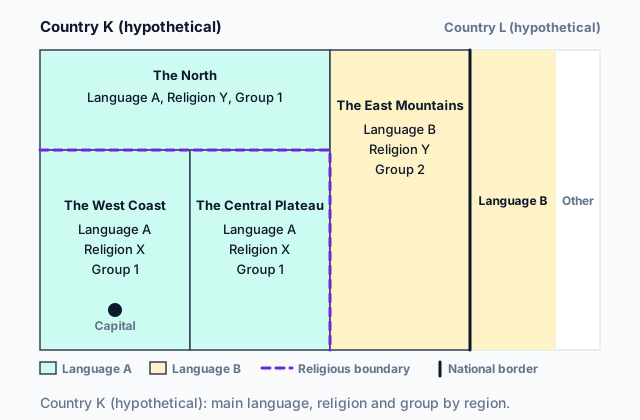
Hypothetical Country K has four regions. The map shows each region's main language, main religion and main ethnic group. The capital is on the West Coast, and hypothetical Country L lies to the east.
 Tap to open the picture full size
Case question 1 · Multiple choice
Based on the map, in which region of Country K are language and ethnicity most likely to act as centrifugal forces?
Case question 2 · Rank it
Compare each region's main language, main religion and main ethnic group with the West Coast's. Rank the other three regions of Country K by how many of those three traits they share with the West Coast.
Most traits shared with the West Coast first
Give each one a place, 1 for first. Give two the same place if they are equal.
Your ranking: none yet
Case question 3 · Multiple choice
Country K's government opens schools in the East Mountains that teach in both Language A and Language B, and makes the main festival of Religion Y a national holiday. Based on the map, which outcome is most likely?
The rest stand on their own and do not use the case.
Check yourself · Spot the error
A student writes about a neighborhood in a hypothetical city. Which line is the first to go wrong?
Check yourself · Select all
Which two statements about regional patterns of language, religion and ethnicity are accurate? Select two.
Select 2 answers, then check.
Part 7 Keep it Bring back earlier ideas
This lesson stands on cultural landscapes from Topic 3.2 and the effects of migration from Topic 2.12.
Bring it back · Multiple choice
In a hypothetical town, a place of worship stands on the stone foundations of an older place of worship built by a different group, and both are still visible. Which characteristic of a cultural landscape does this show?
Bring it back · Fill the statement
Workers from hypothetical Country F move to hypothetical Country G. Complete the description of the effects of their migration.
The money the workers send home to their families is one effect of the migration. The restaurants and places of worship they open in Country G are one effect. A new law in Country G that changes who may become a citizen is one effect.
In three lines
- Language, religion and ethnicity cluster in regions that often cross borders and do not line up with one another.
- Sense of place is what a place means to people; placemaking shapes a space to show identity; at the world scale the patterns form the global cultural landscape.
- A trait shared across a state pulls it together; one concentrated in a region that differs from the rest can push it apart.
Exam strategy for this topic
- Section I, Multiple Choice: 60 questions in 60 minutes.
- Section II, Free Response: 3 questions in 75 minutes.
When a question asks whether a trait is a centripetal or a centrifugal force, name the trait, say where it is shared or concentrated, and say which way that pushes the state. When it gives a map, trace each trait's boundary before you compare regions.
Questions students ask
Can the same language be a centripetal force in one country and a centrifugal force in another?
Yes. A language spoken across a whole country helps unify it. A different language concentrated in one region, especially one the government shuts out of schools and offices, can divide it.
What is the difference between sense of place and placemaking?
Sense of place is the feelings and meanings people attach to a place. Placemaking is what people do to a public space, such as murals, signs or a festival square, so it reflects their identity. Placemaking often strengthens sense of place.
What does the global cultural landscape mean?
It is the world-scale pattern that regional patterns of language, religion and ethnicity add up to: a mosaic of culture regions you can see in buildings, scripts and celebrations from one world region to the next.
The learning objective names gender. Where is it covered?
Gender also leaves patterns on the landscape, in who uses which spaces. Topic 3.2 covers how attitudes toward gender shape the use of space; this lesson concentrates on language, religion and ethnicity.
Are the countries and places in this lesson real?
No. Every country, region, language, religion and group here is hypothetical, chosen to show each idea clearly. Real countries mix these patterns in more complicated ways.
Course alignment, for teachers
AP Human Geography topic 3.3, Unit 3: Cultural Patterns and Processes.
- Skill 4.C: Explain patterns and trends in visual sources to draw conclusions.
This lesson maps all 2 essential knowledge statements of the topic to the part that teaches each one: 2 are checked by a scored question. The map is in the lesson file.