Unit 3 · Topic 3.4 · about 30 minutes · 7 parts · 14 scored checks, 3 of them multiple choice
AP Human Geography 3.4: Types of Diffusion
Unit 3: 12 to 17% of the multiple-choice section
What you'll be able to do
- Define relocation diffusion and expansion diffusion, including the contagious, hierarchical and stimulus kinds of expansion, and tell which type a spread shows from the evidence about it.
Key vocabulary
| Term | What it means | The exam trap |
|---|---|---|
| Diffusion | The spread of a culture trait or idea from its hearth to other people and places. | Read the evidence about the path a trait took before you name the type. |
| Hearth | The place where a culture trait or idea began. | A hearth is where a trait started, not wherever it is most common today. |
| Relocation diffusion | Diffusion in which people who move to a new place take a trait with them. | Decide it from who carried the trait, not from how far the trait traveled. |
| Expansion diffusion | Diffusion in which a trait spreads from its hearth to more and more people and places while it stays in the hearth. | Contagious, hierarchical and stimulus diffusion are all kinds of expansion, so name the kind when a question asks for it. |
| Contagious diffusion | Expansion diffusion in which a trait passes from person to person through direct contact, reaching places near the hearth first. | Check the order in which places got the trait before you use this term. |
| Hierarchical diffusion | Expansion diffusion in which a trait moves from the most important or largest people or places to less important or smaller ones. | The ladder can be one of people, such as leaders and celebrities, as well as one of places. |
| Stimulus diffusion | Expansion diffusion in which the idea behind a trait spreads, but the people who adopt it change the trait itself. | Ask what arrived: the exact trait, or only the idea behind it. |
 Tap to open the picture full size
Part 1 Think first One dance, how many paths?
Commit to a guess first. Being wrong now makes the right idea stick better.
Predict first
A new dance starts among young people in the capital of hypothetical Country D. Within a year it shows up in Country D's other large cities, hundreds of kilometers away, while small towns just outside the capital still have not seen it. Then, inside each of those cities, it spreads from one neighborhood to the next neighborhood over. How would you describe the way the dance spread?
In short. Diffusion is the spread of a culture trait from its hearth, either by relocation, when people move and take the trait with them, or by expansion, when the trait spreads to more people and places while it stays at its hearth.
- Relocation diffusion travels with migrants, so a trait can appear far away with nothing in between; expansion diffusion makes the area that has the trait grow.
- Contagious diffusion passes from person to person and reaches the nearest places first; hierarchical diffusion moves from the largest or most important places and people down to smaller ones, skipping small places nearby.
- In stimulus diffusion the idea spreads but the people who adopt it change the trait itself, and one trait can spread by different types at different stages.
Part 2 Learn it How a trait spreads from its hearth
2a. Relocation and expansion
Diffusion is the spread of a culture trait or idea from its hearth, the place where it began, to other people and places. Geographers split diffusion into two main types with one question: who moved?
In relocation diffusion, people move to a new place and take the trait with them. Suppose families from a hypothetical mountain valley cross the sea to a port city and keep baking their valley's flatbread there. The flatbread now exists in the port, but no town in between ever took it up. It traveled with the movers. Back home the trait may stay strong, or fade if most of its people leave. Either way it is relocation, because people carried it.
In expansion diffusion, the trait spreads from its hearth to more and more people and places while it stays in the hearth. The people who take it up are not migrants from the hearth. They learn it where they already live, through contact, trade or media, and the area that has the trait keeps growing.
So ask first: did people move and carry the trait? If yes, it is relocation. If the trait reached people who stayed put, it is expansion, and the next chunks show its kinds.
Quick check · Sort it
Each card describes a trait spreading in a hypothetical place. Tap a card, then the type of diffusion it shows.
Relocation diffusion
Expansion diffusion
2b. Contagious diffusion
Expansion diffusion comes in three kinds. The first is contagious diffusion: the trait passes from person to person through direct contact, the way a cold moves through a classroom. Whoever is near someone with the trait is likely to get it next. Size and status do not matter here. Nearness does.
Picture a new card game starting in one house in a hypothetical town. The family next door learns it, then the rest of the street, then the next neighborhood. A large city 50 km away has to wait its turn behind the small villages in between, because the game reaches them first on its way out.
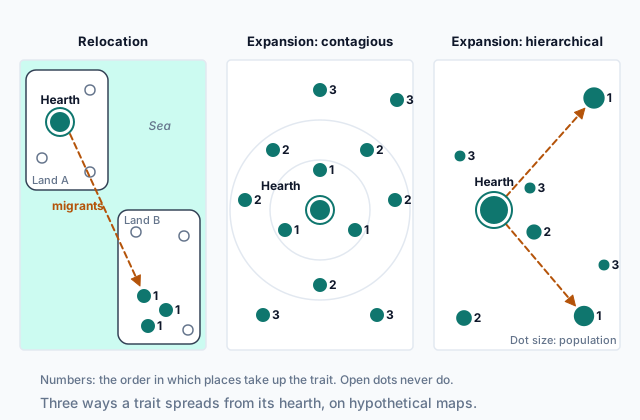
On a map, contagious diffusion grows outward in rings, like ripples from a stone dropped in a pond. Places close to the hearth get the trait before places far away, because people have less contact with places farther off. Geographers call that drop in contact as distance grows distance decay, and contagious diffusion follows it. The band of places that have it has no gaps. The middle map at the top of the page shows this: the numbers rise ring by ring.
The clue is nearness. If places took up the trait in order of their distance from the hearth, the spread was contagious.
Quick check · Rank it
On a flat hypothetical plain where people meet their neighbors freely, a new style of woven basket spreads only by contagious diffusion from the village where it began. Rank these places by when they would most likely take up the style.
Earliest first
Give each one a place, 1 for first. Give two the same place if they are equal.
Your ranking: none yet
2c. Hierarchical diffusion
The second kind is hierarchical diffusion: the trait moves from the most important people or places to less important ones, down a ladder of rank. The ladder can be places, from the largest cities to mid-sized cities to towns. It can also be people, from leaders, celebrities or the wealthy to everyone else.
Picture a hypothetical phone-payment service launched in Country H's capital. It opens next in Country H's other large cities, hundreds of kilometers away, then in mid-sized cities, and only last in small towns, including towns just outside the capital. Large places get it first because they have more customers and more links to the capital.
On a map, hierarchical diffusion leapfrogs. It skips small places near the hearth and lands in large places far away. The right-hand map at the top of the page shows it: the small town beside the hearth is among the last to get the trait.
The clue is rank. If size or status, not distance, explains the order, the spread was hierarchical. One trait can spread by more than one kind at different stages, such as down a city hierarchy and then from neighbor to neighbor inside each city. Name the kind for each stage.
Quick check · Put it in order
A hypothetical clothing brand opens its first shop in the capital of Country J, a city of 5,000,000 people. It then spreads by hierarchical diffusion through Country J's cities and towns. Put these places in the order the brand most likely reaches them, first to last.
2d. Stimulus diffusion
The third kind is stimulus diffusion: the idea behind a trait spreads, but the people who take it up change the trait itself. They change it because the original form clashes with their values, does not suit their climate, or needs things they do not have. The idea arrives. The exact trait does not.
Suppose a hypothetical mountain town hears about the ice-skating festivals held each winter in a colder neighboring country. The town has no ice. So it holds a winter festival on roller skates in its main square, with music and a costume parade. The festival spread as an idea, and the town reworked it.
A changed trait still counts as diffusion. It came from somewhere, and the change shows how its new adopters fit it to their own place. Stimulus diffusion is a kind of expansion: the idea reached people where they already lived, and nobody moved to carry it.
So ask what arrived. If the trait arrived in its original form, look at how it traveled: who moved, nearness or rank. If only the idea arrived and the trait was reworked, the spread was stimulus diffusion.
Quick check · Fill the statement
Complete the description of a custom reaching a hypothetical island.
Families on a mainland carve lanterns from large gourds each autumn. A hypothetical island nearby grows no gourds, so after hearing of the custom, its families carve lanterns from coconut shells. The of the custom reached the island, but the trait itself was , so this is diffusion.
Part 3 Watch it done Read the order of a spread
Watch each step, then do the last one yourself.
A new style of short video, called a loop, began at School 1 in hypothetical City V, and School 1's students still make loops. Students everywhere make the same kind of loop. No student changed schools. A geographer records when students at four other schools in the city began making loops:
- School 2: 1 km from School 1, 300 students, month 1
- School 3: 2 km from School 1, 2,000 students, month 2
- School 4: 4 km from School 1, 600 students, month 3
- School 5: 8 km from School 1, the city's largest and best-known school, 3,500 students, month 4
Which type of diffusion carried the loop across City V?
Predict first
Before the steps, which type do you expect?
Step 1 · Ask who moved
No student changed schools, so no one moved to carry the loop. That is what rules out relocation. The trait reached new people where they already were, while School 1's students kept making loops: this is expansion diffusion.
Step 2 · Line the order up against distance and size
Write the three lists in the order the schools started, School 2, then 3, then 4, then 5. Months: 1, 2, 3, 4. Distances from School 1: 1, 2, 4 and 8 km. Sizes: 300, 2,000, 600 and 3,500 students. One of the last two lists rises in step with the months, and one does not.
Why this step?
Why compare the order with both distance and size, instead of just noting that every school ends up making loops?
By the end, every school has the trait whichever kind of expansion carried it. Only the order shows what did the work: nearness in contagious diffusion, rank in hierarchical diffusion.
Your step · Fill the statement
A style of short video called a loop spread from School 1 in hypothetical City V, and no student changed schools. Schools 2, 3, 4 and 5 took it up in that order, one a month. They are 1, 2, 4 and 8 km from School 1 and have 300, 2,000, 600 and 3,500 students; School 5 is the city's largest and best-known school. Name the kind of expansion and the evidence for it.
The loop spread by diffusion, because the schools took it up in order of their School 1, and School 5, the largest, came .
Part 4 Try it Name the type in new cases
Try it · Match
Each case is set in a hypothetical place. Match each type of diffusion to the case that shows it.
Try it · Decide and justify
A bank in the capital of hypothetical Country P launches a new savings card. Within a year, the card is offered in Country P's two other large cities, each about 500 km away, though no bank staff or customers moved there. Small towns 20 km from the capital get the card three years later. Which type of diffusion is this?
Which reason supports your answer?
Part 5 Explain it Explain how a game spread
Nothing you type leaves this page. Check your answer against the model and each scoring point.
Free response is 50% of the exam score. This one is shaped like Question 1, from free-response II.
Free-response practice · Question 1 style
A board game called Kesh was invented in the capital of hypothetical Country K, where it is still popular. Within two years, Kesh cafes run by local owners opened in Country K's four other large cities, all far from the capital, before any opened in the small towns near the capital. Inside each city, players taught friends and neighbors, and the game spread from one city block to the next. A family from the capital later moved to hypothetical Country W and brought sets of the game with them. In hypothetical Country Z, where many people avoid games played with dice, players took up Kesh but replaced its dice with a spinning top.
(A) Identify the hearth of Kesh.
(B) Identify the type of diffusion that brought Kesh to Country W.
(C) Explain why the opening of Kesh cafes in the large cities before the nearby small towns is an example of hierarchical diffusion.
(D) Describe how Kesh spread by contagious diffusion inside each city.
(E) Explain why the spread of Kesh to Country Z is an example of stimulus diffusion.
(F) Explain why the spread of Kesh among Country K's cities is expansion diffusion rather than relocation diffusion.
(G) Explain how distance decay shapes the spread of Kesh from one city block to the next.
Model answer
(A) The capital of Country K, where Kesh was invented.
(B) Relocation diffusion.
(C) The cafes reached the four large cities first, although they are far from the capital, and the small towns near the capital later. Size, not distance, set the order, so the game moved down the urban hierarchy from the largest places to smaller ones. That is hierarchical diffusion.
(D) Inside each city, players taught their friends and neighbors face to face. Each new player passed the game to people nearby, so it spread from one block to the block next to it, growing outward like ripples.
(E) The idea of the game reached Country Z, but players there changed one of its traits, the dice, because many people avoid dice games. When the idea spreads and the trait is changed to fit local customs, that is stimulus diffusion.
(F) Local owners, not migrants from the capital, opened the cafes, so no one moved to carry the game. That rules out relocation. The game reached people where they already lived and spread to more and more places while it stayed popular in the capital, which is expansion.
(G) Distance decay means interaction falls as distance grows. Players talk most with people on their own block and the blocks beside it, so a block next to one that already plays is the most likely to learn Kesh next, and far blocks learn it later.
Score your own answer. This is a self-check, not a grade. Tick each point your answer makes.
Part 6 Check yourself Noodle carts in Country R
The case questions use the table. The others mix the ideas from the whole lesson.
A style of noodle cart first appeared in the capital of hypothetical Country R in Year 1, and the carts are still common there. The menu is the same everywhere the carts appear. In each new place, the cart owners are local people who learned the trade from suppliers, not migrants from the capital.
| Place | Population | Distance from the capital | Year carts first appeared |
|---|---|---|---|
| Capital | 4,000,000 | 0 km | 1 |
| City S | 1,500,000 | 520 km | 2 |
| City P | 900,000 | 300 km | 3 |
| Town Q | 30,000 | 15 km | 6 |
| Town U | 25,000 | 700 km | 6 |
| Village W | 2,000 | 8 km | 8 |
Case question 1 · Multiple choice
Which type of diffusion does the table show most clearly?
Case question 2 · Match
Each fact from the case rules out one type of diffusion. Match each type to the fact that rules it out.
Case question 3 · Multiple choice
Suppose the carts had spread by contagious diffusion instead. Which place in the table would most likely have had carts next after the capital?
The rest stand on their own and do not use the case.
Check yourself · Spot the error
A student explains how a dance reached a new country. Which line is the first to go wrong?
Check yourself · Select all
Which two are examples of stimulus diffusion? Select two.
Select 2 answers, then check.
Part 7 Keep it Bring back earlier ideas
Diffusion spreads the culture traits of Topic 3.1 and builds the regional patterns of Topic 3.3. These two questions bring back centrifugal forces from Topic 3.3 and attitudes toward cultural difference from Topic 3.1.
Bring it back · Multiple choice
Hypothetical Country F has two regions that speak different languages. Each region's schools teach only in its own language, and a movement in one region now calls for it to become a separate country. How does the language difference act on Country F?
Bring it back · Fill the statement
Two travelers react to a custom in a hypothetical country.
A traveler from hypothetical Country G sees people in Country H eat with their hands and calls the custom rude, judging it by Country G's own customs. That attitude is . A second traveler tries to understand the custom by the values of the people of Country H. That attitude is .
In three lines
- Relocation diffusion: people move and carry a trait to a new place. Expansion diffusion: a trait spreads to more people and places while it stays at its hearth.
- Contagious diffusion follows nearness, ring by ring; hierarchical diffusion follows rank, from the largest or most important places and people down, skipping small places nearby.
- Stimulus diffusion: the idea spreads but the trait is changed. One trait can spread by different types at different stages.
Exam strategy for this topic
- Section I, Multiple Choice: 60 questions in 60 minutes.
- Section II, Free Response: 3 questions in 75 minutes.
When a question asks for a type of diffusion, ask first whether people moved and carried the trait. If not, ask what set the order or the form: nearness, rank or a reworked trait. Then name the type and point to the evidence that shows it.
Questions students ask
What is the difference between relocation and expansion diffusion?
In relocation diffusion, people move and take a trait with them to a new place. In expansion diffusion, the trait spreads to more people and places while it stays at its hearth, and the people who adopt it do not have to move.
Is stimulus diffusion a kind of expansion diffusion?
Yes. Contagious, hierarchical and stimulus diffusion are the kinds of expansion. Stimulus is the one where the idea spreads but the people who take it up change the trait itself.
How can I tell contagious from hierarchical diffusion on a map?
Look at the order. Contagious diffusion reaches the nearest places first and grows in a band with no gaps. Hierarchical diffusion reaches the largest or most important places first, even far ones, and skips small places near the hearth.
Can one trait spread by more than one type?
Yes. A trait can jump down a hierarchy of cities and then spread from neighbor to neighbor inside each one, or be carried abroad by migrants and then spread around their new home. Name the type for each stage.
Are the places in this lesson real?
No. Every country, city, town, island and school here is hypothetical, made up to show each type of diffusion clearly.
Course alignment, for teachers
AP Human Geography topic 3.4, Unit 3: Cultural Patterns and Processes.
- Skill 1.D: Describe a relevant geographic concept, process, model, or theory in a specified context.
This lesson maps the one essential knowledge statement of the topic to the part that teaches each one: 1 is checked by a scored question. The map is in the lesson file.