Unit 3 · Topic 3.5 · about 30 minutes · 7 parts · 14 scored checks, 3 of them multiple choice
AP Human Geography 3.5: Historical Causes of Diffusion
Unit 3: 12 to 17% of the multiple-choice section
What you'll be able to do
- Explain how colonialism, imperialism and long-distance trade shaped cultural patterns that remain today, and how contact between cultures under those forces produced new forms of cultural expression, such as creole languages and lingua francas.
Key vocabulary
| Term | What it means | The exam trap |
|---|---|---|
| Colonialism | A state's rule over a territory outside its own borders, usually with people from the ruling state settling there. | Colonialism usually means settlers and officials living in the territory; control without settling is imperialism, not colonialism. |
| Imperialism | A state's extension of its power over other lands and peoples, by conquest, rule or economic and political control, with or without settling them. | It does not need settlers, so look for control, not only settlement. |
| Creolization | The blending of culture traits from different groups, brought together by forces such as colonialism and trade, into a new form of cultural expression. | It covers food, music, dress and belief as well as language. |
| Pidgin | A simplified language with a small vocabulary that people with no shared language build to talk to one another. | It is easy to swap with creole, so learn what separates the two. |
| Creole | A mixed language, often grown from a pidgin, that has become a community's first language. | Do not trade it for lingua franca; the two terms answer different questions about a language. |
| Lingua franca | A language used for communication between people who do not share a first language. | It names how a language is used, so decide what job the language is doing before you use the term. |
 Tap to open the picture full size
Part 1 Think first Whose language runs the courts?
Commit to a guess first. Being wrong now makes the right idea stick better.
Predict first
Nadia is reading about hypothetical Country Q for a class project. Almost nobody in Country Q speaks Language P at home, yet Country Q's laws, university lectures and national newspapers are all in Language P. Which history best explains this?
In short. Historical forces, above all colonialism, imperialism and long-distance trade, carried culture traits between places and brought peoples together, which left cultural patterns that remain today and produced new forms of expression such as creole languages and lingua francas.
- Colonial and imperial rule spread the rulers' languages, religions, laws and building styles, and many of those patterns outlast independence.
- Trade moved people as well as goods, so ports and trade routes became places where culture traits mixed and spread.
- Creolization blends traits from different groups into a new form. A creole is a mixed language that has become a community's first language; a lingua franca is any language used between people who do not share a first language.
Part 2 Learn it How history spread culture
2a. Colonialism and imperialism
Colonialism is a state's rule over a territory outside its own borders, usually with settlers and officials from the ruling state living there. Imperialism is the wider idea: a state extending its power over other lands and peoples, by conquest, rule or economic and political control, whether or not its people move there. Colonialism is one form of imperialism.
Both moved culture along with power. Colonial governments ran courts, offices and schools in the ruler's language, so the people trained for government jobs learned it. Missionaries spread the ruler's religion. Planners laid out capitals with the avenues and buildings of the ruler's home cities. Plantations grew crops for sale overseas and brought workers from distant regions, mixing peoples who had never met.
Many of these patterns outlast independence. In hypothetical Country H, the former colonial language is still the language of laws and universities, a house of worship in the colonizer's style still faces the main square, and the old plantation districts still grow the export crop. Traits flowed the other way too, as foods and words from the colonies reached the ruling country. And colonized peoples kept and reshaped their own traditions, so the result was rarely a simple copy.
Quick check · Put it in order
Hypothetical Country L runs its courts in Language M, which few of its people speak at home. Put these events in the order that explains how that came about.
2b. Trade carries culture
Long-distance trade moved people as well as goods. Merchants stayed in foreign ports for months or for life. They married into local families, built houses of worship, cooked their own food and taught their words to the people they bargained with. Local people took up some of those traits and passed them on.
So trade routes became paths for culture. A port where several sea routes meet hears many languages and sees many faiths, and its food mixes ingredients from far away. Traits then travel inland along the roads and rivers that carry the trade, thinning out with distance. A place off every route meets few outsiders and keeps more of its traditions as they were.
Trade and colonialism often worked together. In many places trading companies came first, and colonial rule followed to protect their business. Plantations then grew crops for that trade, which is how trade helped bring workers of many languages to the same land.
Take hypothetical Port S, on a sea route between hypothetical Countries J and W. Its oldest street has merchants' houses in Country J's style, its market sells spices from Country W, and its sailors use words from both.
Quick check · Rank it
Three hypothetical places sit in the same region. Place A is a farming village in a mountain valley, off every trade route. Place B is a port where three long-distance sea routes meet and merchants from many countries live. Place C is an inland market town on one road that carries goods from the port. Rank them by how many culture traits from distant places you would expect to find in each.
Most traits from distant places first
Give each one a place, 1 for first. Give two the same place if they are equal.
Your ranking: none yet
2c. Creolization: new forms from contact
When larger forces such as colonial rule, plantation labor and trade put different groups in the same place for generations, their traits do not just sit side by side. They blend into new forms of cultural expression. Geographers call this creolization: traits from different cultures mixing into something new that belongs to the place where they met.
Language shows the process step by step. People who share no language build a pidgin to work together: a small vocabulary, often taken mostly from the language of the people in charge, and a simple grammar. A pidgin is a second language; no one grows up speaking it at home. When children grow up hearing it every day and speak it as their first language, they fill it out with a full grammar and a large vocabulary. It is now a creole, a mixed language that has become a community's first language.
Creolization reaches past language. A hypothetical port's music might set one group's drum rhythms under another group's string instruments, sung in the local creole. What makes it creolization is that the result is new. A trait copied unchanged from one group, such as a bank built exactly like the banks in the ruler's capital, spread without blending.
Quick check · Sort it
Each card describes something in a hypothetical colony. Tap a card, then the bin it belongs in.
Creolization: a new blended form
Adopted with little change
2d. Lingua franca
A lingua franca is a language people use to communicate when they do not share a first language. The term names a job a language does, not a kind of language. A trade pidgin can be a lingua franca. So can a creole, when people of other groups learn it to talk with its speakers. So can a full language that is some people's first language and everyone else's second one.
Trade and empire spread lingua francas. Merchants from many places need one language to bargain in, and the language of a busy trading people often becomes it along a whole route. Colonial rulers made their own language the shared language of government, schools and business across colonies whose peoples spoke many languages, and in many places it kept that job after independence.
| Term | A community's first language? | What makes a language one |
|---|---|---|
| Pidgin | No | A simple contact language built by people with no shared language |
| Creole | Yes | A mixed language, often grown from a pidgin, that children learn first |
| Lingua franca | It can be, for some of its speakers | It is used between people who do not share a first language |
Quick check · Match
In a hypothetical colonial port, dockworkers from four language groups load ships for traders from many countries. Match each term to the example from the port that shows it.
Part 3 Watch it done Where did Island V's language come from?
Watch each step, then do the last one yourself.
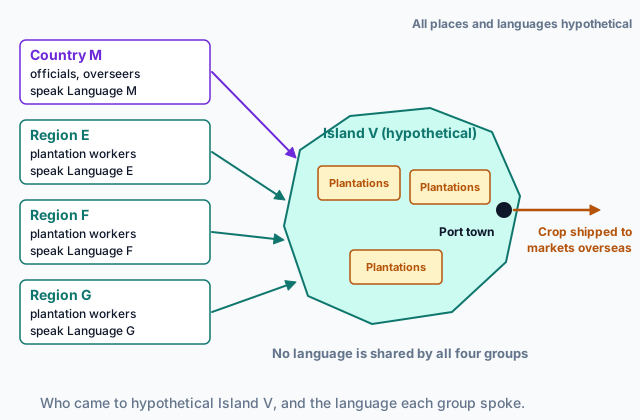
Hypothetical Island V was a colony of hypothetical Country M, and its plantations grew a crop for sale overseas. The overseers spoke Language M. The plantation workers were brought from hypothetical Regions E, F and G and spoke Languages E, F and G, which no other group understood. Explain how colonialism and trade produced the language most of Island V's people speak at home today.
Predict first
Before the steps, what do you expect the workers spoke with one another in their first years together?
Step 1 · Name the larger forces
Colonialism put Island V under Country M's rule, and trade gave the plantations their purpose: the crop was grown to sell overseas. Together they brought speakers of four languages to one island and made them work side by side.
Step 2 · Find the contact
Workers from different regions had to talk with one another and with the overseers every day, and no language was shared. So they built a pidgin: a small vocabulary, mostly from Language M, with sounds and word order drawn from Languages E, F and G. At first nobody spoke it at home.
Why this step?
Why did most of the pidgin's words come from Language M, when most people on the island spoke Languages E, F and G?
Language M was the one language every group heard, from the overseers who gave the orders, so its words were the ones the groups had in common. Power on the plantation, not the number of speakers, decided whose words were used most.
Your step · Fill the statement
Finish it. Complete the last step of the explanation for Island V.
Children born on Island V hear the plantation speech every day and speak it as their . Over the generations it gains a full grammar and a large vocabulary, so it becomes a . Because that language is new, made from the meeting of four groups under colonial rule, it is one product of .
Part 4 Try it Read a colony's history in its culture
Try it · Match
Hypothetical Country H was a colony of hypothetical Country P, and its coast lies on an old sea trade route. Match each cultural pattern in Country H today to the history that shaped it.
Try it · Decide and justify
In hypothetical Port Y's market, merchants speak five different first languages. The largest group, about a third of the merchants, speaks Language U at home. Merchants of every group bargain with one another in Language T, which only a few of them speak at home. Rafi, a new merchant from a distant hypothetical country, can learn one language this year. Which one will let him trade with the most merchants?
Which reason supports your answer?
Part 5 Explain it Explain a former colony's languages
Nothing you type leaves this page. Check your answer against the model and each scoring point.
Free response is 50% of the exam score. This one is shaped like Question 1, from free-response II.
Free-response practice · Question 1 style
Hypothetical Country K was a colony of hypothetical Country P for about two hundred years. For centuries before that, merchants from across the sea traded in K's coastal ports. Today Language P is K's official language, most people in K's old plantation districts speak a creole at home, and in K's inland markets, traders from K's many language groups bargain in a trade language that few of them speak at home.
(A) Identify one cultural pattern in Country K that colonialism helped shape.
(B) Describe the difference between a pidgin and a creole.
(C) Explain how colonial plantations led to the creole spoken in the old plantation districts.
(D) Explain why the inland trade language is a lingua franca.
(E) Explain one way long-distance trade shaped the culture of Country K's coastal ports.
(F) Since independence, Language P has been the one language used in Country K's government and schools nationwide. Explain how this could act as a centripetal force for Country K.
(G) Migrants from Country K carry their creole music to cities in Country P. Identify the type of diffusion by which the migrants bring it there.
Model answer
(A) Language P is the official language, the language of K's laws and government, because colonial officials governed and taught in it.
(B) A pidgin is a simple contact language with a small vocabulary, built by people who share no language, and nobody speaks it as a first language. A creole is a full language that grew from that kind of mixing and has become a community's first language.
(C) The plantations brought workers who spoke different languages to work together under overseers who spoke Language P. To talk, they built a pidgin, mostly from Language P's words. Their children grew up speaking it as their first language and filled it out into a full language, the creole.
(D) Traders in the inland markets have different first languages, and they use the trade language to talk with one another. A language used between people who do not share a first language is a lingua franca, even though few of them speak it at home.
(E) Merchants from across the sea settled in the ports and brought their religion, food and words. Local people took up some of those traits, so the ports' food and speech mix traits from overseas that inland villages lack.
(F) Language P belongs to none of K's own language groups, so no group is favored, and it gives people of every group one language to use with the government and with each other. A shared language that ties the groups to one state is a centripetal force: it pulls the country together.
(G) Relocation diffusion, because the music moves with the migrants as they move to a new place.
Score your own answer. This is a self-check, not a grade. Tick each point your answer makes.
Part 6 Check yourself The languages of Country N
The case questions use the table. The others mix the ideas from the whole lesson.
Hypothetical Country N is a former colony of hypothetical Country X. A national survey asked adults which language they learned first and which language they use with people whose first language differs from theirs. Language X is Country N's only official language. A person can use more than one language with other groups, so the last column does not add to 100.
| Language | Learned it as their first language | Use it with people of other first languages | Where it came from |
|---|---|---|---|
| Language X | 2 | 8 | Brought by colonial rule; used in laws, courts and universities |
| Language C | 22 | 15 | Grew in the colonial port towns from Language X and local languages |
| Language S | 1 | 72 | Carried inland by traders along the old caravan routes |
| Language D | 33 | 6 | A local language spoken before colonial rule |
| About 40 other local languages | 42 | 4 | Spoken before colonial rule |
Case question 1 · Multiple choice
Which language in the table serves as Country N's main lingua franca?
Case question 2 · Decide and justify
Is Language C a pidgin or a creole?
Which fact from the table supports your answer?
Case question 3 · Multiple choice
Which conclusion about Country N's history does the table best support?
The rest stand on their own and do not use the case.
Check yourself · Spot the error
A student explains how a new language formed on a hypothetical island. Which line is the first to go wrong?
Check yourself · Select all
Which two describe ways long-distance trade shaped culture in the port cities along a hypothetical sea route? Select two.
Select 2 answers, then check.
Part 7 Keep it Bring back earlier ideas
This lesson stands on the types of diffusion from Topic 3.4 and cultural landscapes from Topic 3.2.
Bring it back · Multiple choice
A new video game first catches on among players in a hypothetical country's three largest cities. Next it spreads to the country's mid-sized cities, and it reaches small towns only years later, skipping the countryside between them. Which type of diffusion does this show?
Bring it back · Fill the statement
A street in hypothetical Town R has a stone fort built by its first settlers, a market hall built by a later group and a temple added by recent migrants.
The fort, the hall and the temple are evidence of . Together with the river and the farms around the town, the street is part of Town R's .
In three lines
- Colonialism and imperialism spread rulers' languages, religions and building styles, and many of those patterns outlast independence.
- Trade moved people as well as goods, so ports and routes became places where culture traits mixed and spread.
- Contact makes new forms of expression: creolization blends groups' traits into something new, such as a creole, and trade and rule spread lingua francas, languages that people with different first languages share.
Exam strategy for this topic
- Section I, Multiple Choice: 60 questions in 60 minutes.
- Section II, Free Response: 3 questions in 75 minutes.
When a question asks how history shaped a cultural pattern, name the force (colonial rule or trade) and then the people who carried the trait: officials and teachers, settlers, merchants or plantation workers. For a language, ask whose first language it is and what job it does before you choose pidgin, creole or lingua franca.
Questions students ask
What is the difference between a pidgin and a creole?
A pidgin is a simple contact language that people with no shared language build to work or trade together, and nobody speaks it as a first language. A creole is a full language that grew from that kind of mixing and has become a community's first language, usually once children grow up speaking it.
Is a lingua franca always a pidgin or a creole?
No. A lingua franca is any language used between people who do not share a first language. A pidgin, a creole or a full language that many people speak at home can each serve as one. What makes it a lingua franca is how it is used.
What is the difference between colonialism and imperialism?
Imperialism is a state extending its power over other lands and peoples, by rule or by economic and political control. Colonialism is one form of it, in which the ruling state governs a territory and usually sends settlers and officials to live there.
Does creolization only happen to languages?
No. Creolization is any blending of culture traits from different groups into a new form. Music, food, dress and religious practice can all be creolized, as well as language.
Are the places and languages in this lesson real?
No. Every country, colony, port and language here is hypothetical, made up to show each idea clearly. Real places show these processes in messier ways.
Course alignment, for teachers
AP Human Geography topic 3.5, Unit 3: Cultural Patterns and Processes.
- Skill 2.C: Explain a likely outcome in a geographic scenario using geographic concepts, processes, models, or theories.
This lesson maps all 2 essential knowledge statements of the topic to the part that teaches each one: 2 are checked by a scored question. The map is in the lesson file.