Unit 3 · Topic 3.6 · about 30 minutes · 7 parts · 14 scored checks, 3 of them multiple choice
AP Human Geography 3.6: Contemporary Causes of Diffusion
Unit 3: 12 to 17% of the multiple-choice section
What you'll be able to do
- Explain how processes at work today, such as urbanization, globalization and new communication technology, change cultural ideas and practices and speed up how they spread, making cultures more alike in some ways and more distinct in others.
Key vocabulary
| Term | What it means | The exam trap |
|---|---|---|
| Socially constructed | Made by people through their shared ideas and actions. | It describes where culture comes from, so pair it with a process and a channel when you explain a change. |
| Urbanization | The movement of a country's people into its cities, and the growth in the share of people who live there. | It is a population process, so link it to culture through a channel such as jobs or neighbors. |
| Globalization | The growing connection of places around the world through trade, money, migration, media and ideas. | Name the channel it works through in the case you are given, not only the word. |
| Time-space convergence | The shrinking of the time it takes to travel or communicate between places as transport and communication technology improve. | Read convergence here as places coming closer in time, not as cultures growing alike. |
| Cultural convergence | The process by which cultures in contact grow more alike. | It is easy to confuse with time-space convergence; check whether a question is about cultures or about travel time. |
| Cultural divergence | The process by which cultures grow more distinct from one another, or a group holds itself apart. | Check what grows more different, and from what, before you use the term. |
| Indigenous language | A language that began among the people native to a place. | It names where a language began, not how many people speak it now. |
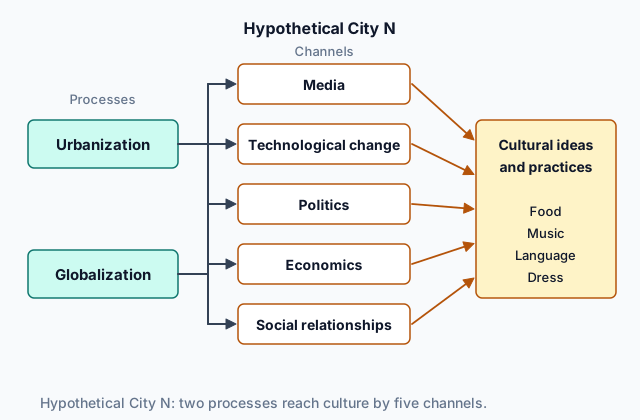 Tap to open the picture full size
Part 1 Think first A road and a signal reach the village
Commit to a guess first. Being wrong now makes the right idea stick better.
Predict first
Hypothetical Village K sits in a mountain valley, two days' walk from the capital. Its people speak Seli, a language found nowhere else, and its teenagers have always spoken Seli at home. In the same year, a paved road and a fast internet connection reach the village. Within about ten years, what do you expect to happen to the teenagers' use of Seli?
In short. Contemporary causes of diffusion are the processes at work today, above all urbanization, globalization and communication technology, that change how people live and speed the spread of culture from place to place.
- Culture is socially constructed: people make and remake their ideas and practices, through small-scale processes and large-scale ones such as urbanization and globalization, by way of media, technological change, politics, economics and social relationships.
- Communication technologies such as the internet, and the time-space convergence they bring, make interaction between distant places faster and more frequent.
- Faster contact changes practices, as in the growing use of English and the loss of indigenous languages, and it creates both cultural convergence (cultures growing alike) and cultural divergence (cultures growing distinct).
Part 2 Learn it How culture changes today
2a. Culture is made by people, and it changes
Culture is socially constructed. People make their ideas and practices (how they cook, dress, worship, speak and celebrate) and they keep remaking them. No practice is fixed by nature, and none is so old that it cannot change.
Change happens at different scales. Some processes are small-scale: a family adopts a new holiday dish after a cousin marries in, or students at one school invent their own slang. Others are large-scale, working across a whole country or the world. The two you will meet most are urbanization, the movement of a country's people into its cities, and globalization, the growing ties among places worldwide through trade, money, migration and media.
Large-scale processes still show up in small places. When hypothetical Country R urbanizes, millions of farm families move to its cities over a generation. That is one large-scale process. Yet you can see it in a single apartment, where a family that once ate its main meal together at midday on the farm now eats in the evening, after factory shifts.
A changed practice is still culture. The evening meal is as much a part of that family's culture as the midday meal was.
Quick check · Sort it
Each card describes something that is changing culture in a hypothetical place. Tap a card, then the scale of the process behind it.
Small-scale process
Large-scale process
2b. The channels change travels through
Urbanization and globalization do not change a culture on their own. They reach it through channels you can name.
- Media: what people watch, read and hear. A family that moves to the city meets new billboards, radio and screens.
- Technological change: new tools change daily routines. A phone lets a migrant call home every night, so village news and city news mix.
- Politics: laws and government choices. A city's schools may teach only in the national language.
- Economics: jobs, wages and prices. Work shifts set when families eat, and a global chain's prices change what is cheap to eat.
- Social relationships: the people you live, work and marry among. Neighbors from many villages share songs and recipes, and their children marry across groups.
Picture a teenager in hypothetical City N whose parents moved from a farming village. She speaks the village language at home, the national language at school because the law requires it, dances to songs from abroad that she finds online, and eats at a later hour than her grandparents because of her parents' jobs. Each change came by its own channel. When you explain a cultural change, name the process and the channel it ran through.
Quick check · Fill the statement
Name the channel each change in hypothetical City N runs through.
Night-shift jobs, which pay more than day work, move many families' main meal to midnight, a change through . A city law requires every shop sign to use the national language, a change through . Neighbors who came from different villages teach one another their wedding dances, a change through .
2c. Faster contact: communication technology and time-space convergence
For most of history, new ideas traveled at the speed of people. A song moved as fast as a traveler could carry it, and places far apart rarely met.
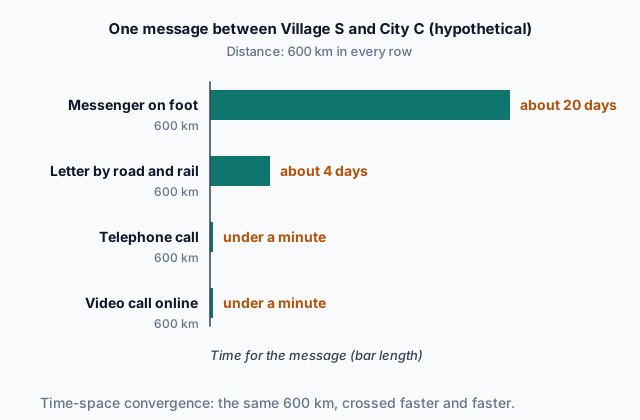
Time-space convergence is the shrinking of the time it takes to travel or communicate between places. The distance between them stays the same; the time to cross it falls. The chart shows it for hypothetical Village S and City C, 600 km apart.
 Tap to open the picture full size
Communication technologies such as the internet and the phone have cut that time to almost nothing. That speeds interaction up: a dance posted in City C at noon can be copied in Village S that evening. It also reshapes who meets whom. A teenager in Village S may chat every day with players in another country and rarely with the next village. Ideas no longer have to pass from neighbor to neighbor across the land. They can jump straight from one connected place to another, however far apart, and the more often people meet, the faster their practices change.
Quick check · Put it in order
A fast internet connection reaches hypothetical Village S. Put these events in the order they happen.
2d. English, indigenous languages, convergence and divergence
Faster contact changes what people do, and language shows it most clearly.
English is widely used online and in international business and entertainment, so the use of English is increasing. Young people learn it for jobs, games and videos, and it becomes a common second language among people who share no other.
The same pull can cost a community its own language. An indigenous language began among the people native to a place. When children hear more English, or a national language, at school, online and at work, some stop using their parents' language at home. A language that children no longer learn can disappear within a few generations, and many indigenous languages are being lost this way.
Two terms sum up these effects. Cultural convergence is cultures growing more alike: teenagers in hypothetical City N and in a far-off city wearing the same brands and quoting the same shows. Cultural divergence is cultures growing more distinct, or a group holding itself apart. The same internet that spreads English lets speakers of a hypothetical indigenous language, Tavi, post lessons and songs that keep Tavi alive and set its speakers apart. One technology can push a culture both ways.
Quick check · Sort it
Each card describes a change in a hypothetical place. Tap a card, then the kind of change it shows.
Cultural convergence
Cultural divergence
Part 3 Watch it done Trace a language shift on an island
Watch each step, then do the last one yourself.
Hypothetical Island T has its own indigenous language, Ruma. Ten years ago a fiber cable linked the island to the mainland, and hotels opened that hire staff who speak English. Today most grandparents speak Ruma at home, most parents speak Ruma and some English, and most teenagers speak mainly English with friends and online. A group of teenagers has also started a Ruma-language music channel. Explain what is happening to the island's culture.
Predict first
Before the steps, what do you expect is happening to the island's culture overall?
Step 1 · Name the process and its scale
Globalization is at work, a large-scale process. It arrives through the cable and through hotels that serve visitors from many countries: global ties reaching one small island.
Step 2 · Trace the channels
Economics: hotel jobs go to people who speak English. Technological change and media: the cable brings English-language videos, games and chats every day. Social relationships: teenagers talk with friends online and with guests at work in English. The channels push the same way, so English use grows, and it grows most among the young.
Why this step?
Why is the change sharpest among teenagers and weakest among grandparents?
Teenagers spend the most time online, so most of their contact runs in English. Grandparents learned Ruma long before the cable came and still use it with each other. A language shift shows up first in the youngest group, the people who would pass the language on.
Your step · Fill the statement
Finish it. Complete the explanation of what is happening on Island T.
Teenagers switching to English makes the island more like many other places, an example of cultural . If the island's children stop learning Ruma, the island faces the of an indigenous language. The Ruma music channel keeps the island's language distinct, an example of cultural , made possible by the same cable.
Part 4 Try it Read change in new places
Try it · Match
Match each idea to the observation from a hypothetical country that shows it.
Try it · Decide and justify
Hypothetical District D is a mountain district that kept the same festival songs for centuries while it took a week to reach the nearest city. In one year, a highway and a fast internet connection reach it, and its people stay put. Over the next decade, will the district's festival songs most likely change faster or more slowly than in the centuries before?
Which reason supports your answer?
Part 5 Explain it Explain a language shift
Nothing you type leaves this page. Check your answer against the model and each scoring point.
Free response is 50% of the exam score. This one is shaped like Question 1, from free-response II.
Free-response practice · Question 1 style
Hypothetical Country Z has a large capital city and a rural northern region where most people speak an indigenous language, Halu. Over 20 years, many young people have moved from the north to the capital for work, and fast internet now reaches most northern homes. Surveys show that fewer northern children speak Halu at home each year, while use of English among young people across the country is rising.
(A) Identify one communication technology that is changing cultural practices in Country Z.
(B) Describe time-space convergence.
(C) Explain how urbanization can change one cultural practice of the young people who move to the capital.
(D) Explain one reason the use of English is increasing among young people in Country Z.
(E) Explain how the loss of Halu would be an example of cultural convergence.
(F) Explain one way communication technology could create cultural divergence in the northern region.
(G) Explain one way the government of Country Z could slow the loss of Halu.
Model answer
(A) The internet, which brings videos, games and messages from around the world into northern homes.
(B) Time-space convergence is the shrinking of the time it takes to travel or communicate between places as technology improves, while the distance between them stays the same.
(C) In the capital, young migrants work set shifts and live among neighbors from many regions. Their meal times may follow their work hours, and they pick up the capital's food and slang from coworkers and friends, so practices from the north are used less.
(D) English is widely used online and in international business, so young people who want jobs, games and videos from beyond Country Z learn and use it.
(E) Cultural convergence is cultures growing more alike. If northern children grow up speaking English instead of Halu, the north loses one of the things that set it apart, and its culture becomes more like that of the rest of the country and the world.
(F) Halu speakers can post lessons, songs and stories in Halu online, so children far from fluent elders can still learn it. That keeps the north's language distinct, which is cultural divergence.
(G) The government could pay for Halu classes in northern schools, so children learn the language even while they hear English everywhere else.
Score your own answer. This is a self-check, not a grade. Tick each point your answer makes.
Part 6 Check yourself A language survey in Province V
The case questions use the table. The others mix the ideas from the whole lesson.
Hypothetical Province V is a rural province where most families have spoken an indigenous language, Oru, for generations. A university surveyed its residents twice, 15 years apart. Every figure is invented for this lesson.
| Measure | First survey | 15 years later |
|---|---|---|
| Homes with an internet connection | 10% | 80% |
| People aged 15 to 24 who speak Oru at home | 70% | 35% |
| People aged 65 and older who speak Oru at home | 90% | 88% |
| People aged 15 to 24 who use English online every day | 15% | 70% |
| People aged 15 to 24 who follow an Oru-language channel online | 0% | 30% |
Case question 1 · Multiple choice
Which conclusion do the survey results best support?
Case question 2 · Sort it
Use the table. Tap each statement, then whether the survey supports it.
Supported by the table
Not supported by the table
Case question 3 · Multiple choice
Which concept best explains the last row of the table, young people following an Oru-language channel online?
The rest stand on their own and do not use the case.
Check yourself · Spot the error
A student explains how urbanization changed meals in hypothetical Country R. Which line is the first to go wrong?
Check yourself · Select all
Which two are effects of time-space convergence on cultural interaction? Select two.
Select 2 answers, then check.
Part 7 Keep it Bring back earlier ideas
This lesson stands on historical causes of diffusion from Topic 3.5 and cultural patterns from Topic 3.3.
Bring it back · Multiple choice
In a hypothetical port, merchants from four different language groups bargain with one another in a fifth language that each of them learned for trade. What role is that fifth language playing?
Bring it back · Fill the statement
Two forces at work in hypothetical Country J.
In Country J, every school teaches in one shared national language, and people from every region use it to talk with one another. That shared language is a force. In its southern region, most people speak a different language and many want their own government. That language difference is a force.
In three lines
- Culture is socially constructed, and urbanization and globalization change it through media, technological change, politics, economics and social relationships.
- Communication technology and time-space convergence make interaction faster and let ideas jump between distant places.
- Faster contact spreads English and can cost indigenous languages, and it drives both cultural convergence and cultural divergence.
Exam strategy for this topic
- Section I, Multiple Choice: 60 questions in 60 minutes.
- Section II, Free Response: 3 questions in 75 minutes.
When a question asks how a process changes culture, name the channel it works through (media, technological change, politics, economics or social relationships) and say whether the result makes cultures more alike or more distinct.
Questions students ask
Is time-space convergence the same as cultural convergence?
No. Time-space convergence is about places becoming quicker to reach or contact. Cultural convergence is about cultures growing more alike. Faster contact can lead to cultural convergence, and it can also lead to divergence.
Does globalization make every place the same?
No. It spreads some practices widely, such as English and global brands, but the same connections let groups keep, revive and share their own languages and customs. Look for both effects.
Why does this lesson name English?
Its use is rising in many places because it is widely used online and in international business and entertainment. In some regions another widely used language plays a similar role, and the same reasoning applies.
What does socially constructed mean?
That people, not nature, make a culture's ideas and practices, and that people keep changing them. A practice that changes is still culture.
Are the places and languages in this lesson real?
No. Every country, city, village and language here is hypothetical, and every number is invented, so each process shows clearly. Real places show these processes in more mixed ways.
Course alignment, for teachers
AP Human Geography topic 3.6, Unit 3: Cultural Patterns and Processes.
- Skill 5.B: Explain spatial relationships across various geographic scales using geographic concepts, processes, models, or theories.
This lesson maps all 2 essential knowledge statements of the topic to the part that teaches each one: 2 are checked by a scored question. The map is in the lesson file.