Unit 3 · Topic 3.7 · about 30 minutes · 7 parts · 14 scored checks, 3 of them multiple choice
AP Human Geography 3.7: Diffusion of Religion and Language
Unit 3: 12 to 17% of the multiple-choice section
What you'll be able to do
- Explain what leads universalizing and ethnic religions to diffuse as they do: where they began, how their practices and beliefs shape their reach, and which diffusion processes carry them, and read the diffusion of religions and language families on maps, charts and place names.
Key vocabulary
| Term | What it means | The exam trap |
|---|---|---|
| Cultural hearth | The place where a cultural trait, such as a language or a religion, began and from which it diffused. | Look for where a trait began, which may not be where it is most common today. |
| Language family | A group of languages that descend from one common ancestor language, such as Indo-European. | A family is a group of languages, so do not use its name as if it were one language. |
| Dialect | A regional version of one language, with some of its own words, sounds or grammar. | Before you call two forms of speech separate languages, ask whether their speakers understand each other. |
| Toponym | A place name. | A toponym is the name, not the place or feature it names. |
| Universalizing religion | A religion that seeks to appeal to people of every background, wherever they live. | Learn all four religions the course names as universalizing. |
| Ethnic religion | A religion tied mainly to one people, and often to the land of its hearth. | Learn both religions the course names as ethnic. |
 Tap to open the picture full size
Part 1 Think first Read the village names
Commit to a guess first. Being wrong now makes the right idea stick better.
Predict first
In hypothetical Valley J, nearly everyone speaks Language Q today. Yet many of the valley's farm villages have names ending in -mor, which means spring of water in Language P. Almost no one in the valley speaks Language P now. What do the village names most likely tell you?
In short. Religions and languages diffuse from the cultural hearths where they began, and a religion's practices and beliefs shape how far it spreads: universalizing religions spread through expansion and relocation diffusion, while ethnic religions are generally found near their hearths or spread through relocation diffusion.
- A language family, such as Indo-European, holds languages that descend from one ancestor, and a language can hold several dialects. Each diffuses from a hearth.
- Arrow maps, distribution maps, family trees, charts and toponyms each show a different side of diffusion, and a place name can keep a language on the map after people stop speaking it there.
- The AP course names Christianity, Islam, Buddhism and Sikhism as universalizing religions, and Hinduism and Judaism as ethnic religions.
Part 2 Learn it How religions and languages spread
2a. Cultural hearths
A cultural hearth is the place where a cultural trait began and from which it diffused. Language families, languages and dialects diffuse from hearths. So do world religions and ethnic cultures, and so do gender roles, a culture's expectations about how women and men act.
Languages sit in a hierarchy. A language family is a group of languages that descend from one common ancestor language. Indo-European is one language family, and it holds many languages. A language is one form of speech within a family; speakers of two different languages cannot understand each other without study. A dialect is a regional version of one language, with some of its own words, sounds or grammar, and its speakers can still understand speakers of other dialects of that language.
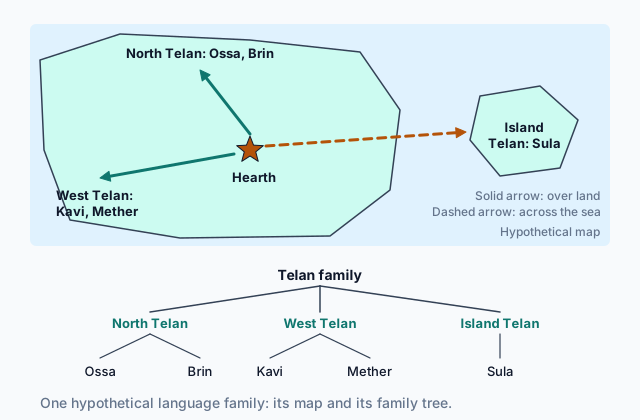
The map at the top of the page shows the hypothetical Telan family. It began in one hearth valley. As its speakers spread north and west over land, and across the sea to an island, the groups lost touch, and their speech drifted apart into branches and then separate languages. Inside one language, such as Ossa, a hill town and a coastal town could each develop a dialect of their own.
Quick check · Match
A geographer is studying the hypothetical Marro languages. Match each term to the example from her notes.
2b. Showing diffusion on maps, charts and place names
Geographers represent the diffusion of language families and religions in several ways, and each answers a different question.
- A map with arrows running out from a hearth shows where a trait began and the routes it took.
- A map that shades places by their main language or religion shows its distribution today, but not how it got there.
- A family tree, like the one under the map at the top of the page, shows how the languages of one family, such as Indo-European, branch from a common ancestor.
- A chart of speakers or followers over time shows when and how fast a trait spread.
- Toponyms, or place names, can preserve a language or a religion on the map long after the place changed.
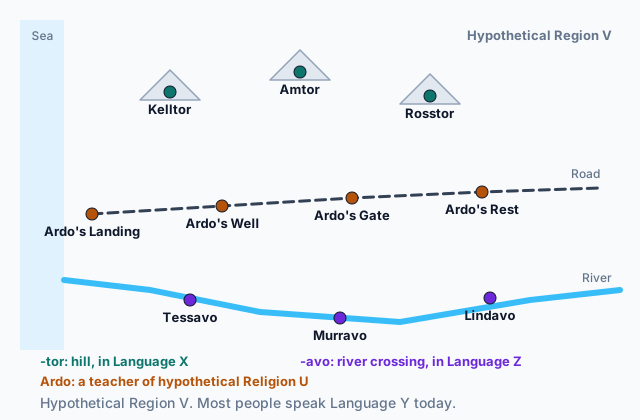
In hypothetical Region V, below, most people speak Language Y today. But the hill towns in the north end in -tor, the word for hill in Language X, and the river towns in the south end in -avo, river crossing in Language Z. Those names are evidence that speakers of Language X once lived in the hills and speakers of Language Z by the river. A name records who lived in a place when it was given, not who lives there now.
 Tap to open the picture full size
Quick check · Decide and justify
A map of hypothetical Region V shows a port, Ardo's Landing, on the west coast, and towns named Ardo's Well, Ardo's Gate and Ardo's Rest running east from it along a road. Ardo was a teacher of hypothetical Religion U. Hill towns in the north end in -tor, which means hill in Language X, and river towns in the south end in -avo, which means river crossing in Language Z. Most people in Region V speak Language Y today. A student claims that Religion U reached Region V at its port and then spread inland along the road. Does the map support the claim?
Which evidence on the map decides it?
2c. Where a religion starts and how far it goes
Every religion has a distinct place of origin, its hearth, and diffuses from there to other places through different processes. Relocation diffusion carries it when followers move and bring it with them. Expansion diffusion spreads it to new people while it stays strong at home, for a religion most often from neighbor to neighbor (contagious) or from leaders and large places down to others (hierarchical).
How far a religion spreads depends a great deal on its practices and belief systems. Compare two hypothetical religions that began in the same century, in neighboring valleys.
Religion Fen welcomes anyone who chooses to join, and its teachers travel to share its teachings with new peoples. Each new follower can pass it on, so it keeps spreading by expansion, and by relocation whenever its followers move.
Religion Gar passes mainly by birth into the Gar people, and its holy places are the rivers and hills of its home valley. It adds few followers from outside, so most of its followers stay near its hearth. It reaches far places mainly when Gar families move and carry it with them.
The two started side by side, yet their maps look nothing alike. The difference comes from who each religion counts as belonging, and how it is shared.
Quick check · Fill the statement
Two more hypothetical religions began in the same region. Complete the comparison.
Religion Hal welcomes anyone who chooses to join, so each new follower can share it with neighbors, and it spreads by diffusion as well as by migration. Membership in Religion Ira passes mainly by birth, so most of its followers live its hearth, and it reaches distant places mainly by diffusion.
2d. Universalizing and ethnic religions
Geographers group religions into two broad kinds by how they relate to people and place.
A universalizing religion seeks to appeal to people of every background, wherever they live. Universalizing religions spread through both expansion diffusion and relocation diffusion. The AP course names Christianity, Islam, Buddhism and Sikhism as universalizing religions.
An ethnic religion is tied mainly to one people, and often to the land of its hearth. Ethnic religions are generally found near their hearths, or have spread through relocation diffusion as their followers moved. The AP course names Hinduism and Judaism as ethnic religions.
Two cautions. First, size does not decide the kind. An ethnic religion can have a very large number of followers and still be concentrated near its hearth, and a universalizing religion can be small. Second, ethnic religions travel too. Followers far from the hearth do not by themselves make a religion universalizing, so ask how they got there. Followers who moved and carried the religion are relocation diffusion, which both kinds show. Followers who joined in a new place, from neighbors or from rulers, are expansion diffusion, the pattern of a universalizing religion.
Quick check · Sort it
Tap each religion, then the kind the AP course classifies it as. The last two cards describe hypothetical religions.
Universalizing religion
Ethnic religion
Part 3 Watch it done Trace how Religion M spread
Watch each step, then do the last one yourself.
Hypothetical Religion M began in the river town of Hessa. Anyone who chooses may join it, and its teachers travel to share its teachings. Five records describe how it reached new places. Classify Religion M, then name the diffusion process behind each record.
Predict first
Before the steps, how do you expect Religion M to have spread?
Step 1 · Find the hearth
Religion M's hearth is Hessa, the place it began. Every record traces a path out from there, so read each one as a move away from Hessa.
Step 2 · Read the practices
Anyone may join, and teachers travel to share it. A religion like that gains followers who were not born into it, wherever it is shared. That makes Religion M a universalizing religion, so expect expansion diffusion in the records as well as relocation.
Why this step?
Why read the practices before sorting the records?
A religion's practices and beliefs shape how widely it diffuses. A religion that gains new followers can keep spreading past the places its own people move to, so the practices tell you which processes to look for.
Your step · Sort it
Tap each record of how hypothetical Religion M spread from its hearth town of Hessa, then the diffusion process behind it.
Contagious expansion
Hierarchical expansion
Relocation
Part 4 Try it Read the displays, classify the religion
Try it · Match
A hypothetical museum exhibit on the diffusion of Religion Kesh has four displays. Match each display to the question it answers best.
Try it · Decide and justify
Membership in hypothetical Religion Ulo passes mainly by birth into the Ulo people, and its holy sites are in the Ulo home valley. Most followers live in that valley. Small groups also live in three distant cities, in neighborhoods founded by Ulo families who moved there for work. How should Religion Ulo be classified?
Which reason supports your answer?
Part 5 Explain it Explain two religions' maps
Nothing you type leaves this page. Check your answer against the model and each scoring point.
Free response is 50% of the exam score. This one is shaped like Question 1, from free-response II.
Free-response practice · Question 1 style
Hypothetical Religion Pell began in a river valley of hypothetical Country Z. Anyone who chooses may join it, and its teachers travel to share its teachings. Hypothetical Religion Oran began in a nearby mountain valley. Membership in Oran passes mainly by birth into the Oran people, and its holy sites are in that valley. Today Pell has followers across much of the continent. Most of Oran's followers live in or near their valley, with small communities in two distant cities. The region's languages belong to the hypothetical Tavic language family, which began in the same river valley as Pell.
(A) Identify the cultural hearth of Religion Oran.
(B) Describe one difference between a universalizing religion and an ethnic religion.
(C) Explain how one of Religion Pell's practices helped it diffuse widely.
(D) Explain why most of Religion Oran's followers live near its hearth.
(E) Describe the diffusion process that best explains Oran's communities in two distant cities.
(F) Explain how a map of town names could show where a Tavic language was spoken in the past, even where it is not spoken today.
(G) A map shades each region of Country Z by the religion most of its people follow. Explain one limitation of this map for showing the diffusion of Religion Oran.
Model answer
(A) The mountain valley where Oran began.
(B) A universalizing religion seeks to appeal to people of every background, wherever they live, while an ethnic religion is tied mainly to one people and often to the land of its hearth.
(C) Pell welcomes anyone who chooses to join. Each person who joins can share it with neighbors, so Pell gains followers in each new place it reaches and keeps spreading by expansion diffusion, not only where its own people move.
(D) Oran passes mainly by birth, so it gains few followers from outside the Oran people, and its holy sites in the valley tie its followers to that land. With few new followers elsewhere, most of them stay near the hearth.
(E) Relocation diffusion. Oran families who moved to the two cities carried the religion with them and formed communities there.
(F) Place names often outlast the language that gave them. Towns whose names are built from Tavic words were named by people who spoke a Tavic language, so a map of those names marks where Tavic speakers once lived, even if a different language is spoken there now.
(G) The map shows only the religion most people follow in each region. Oran's small communities in the two cities are not a majority anywhere outside the valley, so they disappear from the map, and the map shows where Oran is today, not the route it took to get there.
Score your own answer. This is a self-check, not a grade. Tick each point your answer makes.
Part 6 Check yourself Three religions of Continent W
The case questions use the table. The others mix the ideas from the whole lesson.
Three hypothetical religions, R, S and T, began in different hearth regions of hypothetical Continent W, which has nine regions. A survey counted each religion's followers and asked those living outside the hearth region how they came to follow it. All the numbers are invented.
| Religion | Total followers | Followers living in the hearth region | Regions with followers | How most followers outside the hearth region came to follow it |
|---|---|---|---|---|
| R | 8,000,000 | 7,360,000 | 3 | Their families moved from the hearth to two distant port cities |
| S | 5,000,000 | 1,000,000 | 8 | They joined it in the places where they already lived |
| T | 2,000,000 | 900,000 | 4 | They joined it in towns along one trade route |
Case question 1 · Multiple choice
Based on the table, which religion is best classified as an ethnic religion?
Case question 2 · Rank it
Rank the three religions by the share of their followers who live outside their hearth region. Work out each share from the table before you rank.
Largest share outside the hearth region first
Give each one a place, 1 for first. Give two the same place if they are equal.
Your ranking: none yet
Case question 3 · Multiple choice
Using the table, which process best explains how Religion R came to have followers in two distant port cities?
The rest stand on their own and do not use the case.
Check yourself · Spot the error
A student reasons about the spread of hypothetical Religion Q. Which line is the first to go wrong?
Check yourself · Select all
Which two practices would do the most to help a hypothetical religion diffuse widely from its hearth? Select two.
Select 2 answers, then check.
Part 7 Keep it Bring back earlier ideas
This lesson stands on the types of diffusion from Topic 3.4 and on how communication technology changes culture from Topic 3.6.
Bring it back · Multiple choice
High-speed internet reaches the villages of hypothetical Country H. Almost no one moves in or out, but over twenty years more young villagers use English online, and fewer children learn the villages' indigenous language. Which idea best describes this change?
Bring it back · Fill the statement
Three things spread in a hypothetical country. Name the type of diffusion in each.
A family moves from Town A to City B and keeps cooking the dishes of home there: diffusion. A new dance passes from friend to friend through neighboring villages: diffusion. A fashion appears first in the largest cities and only later in small towns: diffusion.
In three lines
- Languages, language families, religions and other cultural traits diffuse from the hearths where they began, and maps, family trees, charts and toponyms record that spread.
- A religion's practices and beliefs shape how far it diffuses: gaining followers from anyone carries it far, and membership tied to one people keeps it near home.
- Universalizing religions spread through expansion and relocation diffusion; ethnic religions are generally found near their hearths or spread through relocation.
Exam strategy for this topic
- Section I, Multiple Choice: 60 questions in 60 minutes.
- Section II, Free Response: 3 questions in 75 minutes.
When a question asks why a religion is widespread or concentrated, name the kind of religion and the diffusion process, and tie them to a practice or to evidence in the map or table you are given.
Questions students ask
Why does this lesson use hypothetical religions for most of its examples?
So you can practice the ideas on invented cases, and so the lesson says nothing about a real religion beyond how the course classifies it. For the six religions the course names, learn which kind each is and the diffusion pattern that kind shows.
Can an ethnic religion have followers far from its hearth?
Yes. When followers of an ethnic religion move, they carry it with them, which is relocation diffusion. What an ethnic religion generally does not do is gain many followers from outside its own people.
What is the difference between a language and a dialect?
Speakers of two dialects of one language can understand each other, though their words, sounds or grammar differ somewhat. Speakers of two different languages cannot understand each other without study.
Is Indo-European a language?
No. It is a language family, a group of many languages that descend from one common ancestor.
Are the places, languages and religions in this lesson real?
The six religions the course names and the Indo-European family are real. Every other place, language, religion and number here is hypothetical, made up to show each idea clearly.
Course alignment, for teachers
AP Human Geography topic 3.7, Unit 3: Cultural Patterns and Processes.
- Skill 4.E: Explain how maps, images, and landscapes illustrate or relate to geographic principles, processes, and outcomes.
This lesson maps all 5 essential knowledge statements of the topic to the part that teaches each one: 5 are checked by a scored question. The map is in the lesson file.