Unit 3 · Topic 3.8 · about 30 minutes · 7 parts · 14 scored checks, 3 of them multiple choice
AP Human Geography 3.8: Effects of Diffusion
Unit 3: 12 to 17% of the multiple-choice section
What you'll be able to do
- Explain how diffusion changes cultures and the cultural landscape through acculturation, assimilation, syncretism and multiculturalism, and tell the four effects apart in a case.
Key vocabulary
| Term | What it means | The exam trap |
|---|---|---|
| Acculturation | The process in which a group adopts traits of another culture while keeping its own culture. | A new trait taken up tells you only part of the story, so check what the group still keeps before you choose a term. |
| Assimilation | The process in which a group gives up its own culture and is absorbed into another culture. | Look for what the group has lost, not only for what it has taken up. |
| Syncretism | The blending of traits from two cultures into a new form that neither culture had before. | Before you use the term, ask whether the meeting of two cultures produced something new. |
| Multiculturalism | The coexistence of several cultures in one society or place, with each keeping its own identity. | Check whether a case is about one group or about a whole place before you use the term. |
| Cultural landscape | The visible mark that people and their cultures leave on a place, such as buildings, signs, places of worship and street names. | A building may have been made by one group and used now by another, so ask both who built it and who keeps it up. |
 Tap to open the picture full size
Part 1 Think first Whose culture changed?
Commit to a guess first. Being wrong now makes the right idea stick better.
Predict first
Over 40 years, several thousand newcomers from hypothetical Country N settle in hypothetical Town Orveth, which had about 20,000 people. A geographer visits Orveth today to look for cultural changes since the newcomers arrived. Whose culture is she most likely to find has changed?
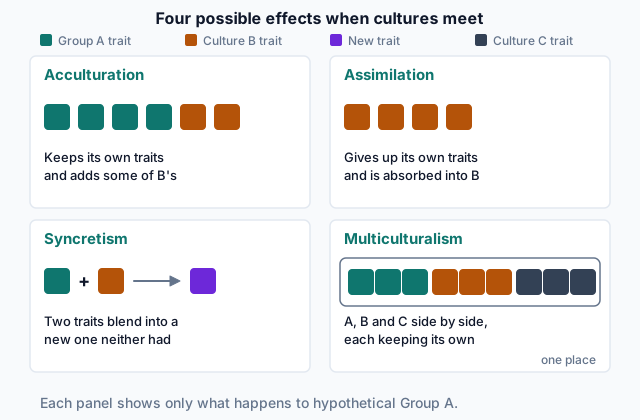
In short. When cultures meet through diffusion, they change in four ways: a group can take up another culture's traits and keep its own (acculturation), give up its own and be absorbed (assimilation), blend traits into a new form (syncretism), or live side by side with other cultures, each keeping its identity (multiculturalism).
- Acculturation and assimilation are about what one group keeps: in acculturation it keeps its own culture while adding new traits, and in assimilation its own culture is gone.
- Syncretism makes something new from two cultures, such as a dish, a festival or a building style that neither group had before.
- Multiculturalism describes a whole society or place where several cultures coexist, and each effect leaves its own marks on the cultural landscape.
Part 2 Learn it Four effects of diffusion
2a. Acculturation and assimilation
Both of these effects are about one group meeting another culture, often a group of migrants meeting the culture of the place they move to. The question that separates them is what the group keeps.
In acculturation, a group adopts traits of another culture while keeping its own. Picture a hypothetical family that moves from Country N to Country M. The parents learn Country M's language for work, and the children celebrate Country M's national holidays at school. At home the family still speaks N's language, cooks N's food and holds N's new-year festival. They have added traits. They have not given up their own.
In assimilation, a group gives up its own culture and is absorbed into the other one. Suppose that, three generations later, the family's great-grandchildren speak only Country M's language, keep only its holidays and no longer think of themselves as from Country N. Nothing distinct is left. That is assimilation.
Acculturation often comes first, and assimilation can follow over generations, but it does not have to. Many groups stay acculturated for a long time. And acculturation runs both ways: the people of Country M can take up N's foods while keeping their own.
Quick check · Sort it
Each card describes a hypothetical group after it met another culture. Tap a card, then the effect it shows.
Acculturation
Assimilation
2b. Syncretism
Sometimes traits from two cultures do not simply sit side by side. They blend into a new form that neither culture had before. That blending is syncretism.
In hypothetical Town Pell, newcomers brought a tradition of steamed dumplings, and the townspeople had a tradition of spiced meat pies. A Pell bakery now sells a steamed dumpling filled with the town's spiced pie filling. It is not the newcomers' dumpling, and it is not the town's pie. It is a third thing made from both.
Syncretism shows up in food, music, festivals, religion and buildings. A religious practice can join beliefs or rituals from two traditions. A building can join one culture's floor plan with another's decoration. A song can set one culture's melodies to another's rhythms.
The test that separates syncretism from acculturation is whether something new was made. If Pell's newcomers buy the town's meat pies and eat them just as the town makes them, while still making their own dumplings, they have adopted a trait as it is. That is acculturation. Syncretism needs the blend: a new form built from traits of both cultures.
Quick check · Fill the statement
Two changes in hypothetical Town Pell. Fill each blank with the effect of diffusion it shows.
Pell's woodcarvers have joined the newcomers' carved masks and the townspeople's painted cloth banners into a new kind of painted wooden banner that neither group made before. That is . Meanwhile, many newcomer families buy the townspeople's cloth banners, just as the town makes them, to hang beside the masks they still carve. That is .
2c. Multiculturalism
Acculturation, assimilation and syncretism describe what happens to a group or to a trait. Multiculturalism describes a whole society or place: several cultures coexist side by side, and each keeps its own identity.
Take hypothetical City Arlo. Migrants from four countries have settled there over 80 years. Each group runs its own newspapers and places of worship, children can study in their family's language, and the city calendar lists every group's festivals. The groups share streets, jobs and a city government, but none has dissolved into the others or into one shared culture.
Multiculturalism is the opposite of a society where every group is expected to assimilate. Some governments push one language and one set of customs on everyone. Others make room for several, for example by printing official notices in several languages or funding schools that teach in them.
Multiculturalism is about the place, so it describes a city or a country, not one family. Groups in a multicultural place often acculturate too: a family in Arlo may speak the city's main language at work. That does not stop Arlo being multicultural, as long as the groups keep their own identities.
Quick check · Decide and justify
Hypothetical City Lunde has five migrant groups. Each group runs its own newspaper and places of worship. Children learn in their family's language and in the city's main language, and the city calendar lists each group's festivals. Which effect of diffusion does Lunde show as a city?
Which reason supports your answer?
2d. Reading the effects in the cultural landscape
The cultural landscape is the visible mark people leave on a place: buildings, signs, places of worship, shops, street names. Each effect of diffusion changes it in its own way, so you can read the effects from what you see.
- Acculturation puts two cultures' traits next to each other. A shop sign appears in the group's language and the majority's language. A family keeps its own style of garden behind a house built the local way.
- Assimilation makes a group's marks fade. Signs in the group's language disappear, a place of worship it built closes or is put to another use, and in the end a street name may be the only trace.
- Syncretism adds new forms. A building joins one culture's plan to another's decoration, or a market sells a dish found nowhere else.
- Multiculturalism gives a place several distinct cultural landscapes at once: districts where different groups' signs, shops and places of worship stand side by side, each kept up by its group.
The landscape also changes over time. One district can show a group's arrival, then its acculturation, then its assimilation, generation by generation, as its signs, shops and buildings change.
Quick check · Put it in order
Over four generations, a hypothetical group of newcomers goes from first arriving, through acculturation, to full assimilation, and its district's landscape changes with it. Put the scenes in order, first to last.
Part 3 Watch it done Read the effects in one town
Watch each step, then do the last one yourself.
Sixty years ago, migrants from hypothetical Country N and from hypothetical Country P settled in hypothetical Town Belmar. A geographer writes down four observations today.
- The grandchildren of the Country N migrants speak Belmar's language at school and N's language at home.
- At Belmar's harvest festival, people now dance the lantern reel, which sets N's lantern dance to Belmar's fiddle tunes. Neither group danced it before.
- None of the great-grandchildren of the Country P migrants speak P's language or keep its customs, and one street name is the only trace of their old district.
- Belmar's council prints signs in both Belmar's and N's languages, and N's community still runs its own school and its own festival grounds alongside Belmar's.
Name the effect of diffusion each observation shows.
Predict first
Before the steps, which effect do you expect the lantern reel in observation 2 to show?
Step 1 · Observation 1: ask what the group kept and what it added
The N grandchildren have added Belmar's language and kept N's language at home. A trait added, the group's own kept: acculturation.
Step 2 · Observation 2: ask whether something new was made
The lantern reel is not N's lantern dance done as it was, and it is not a Belmar dance. It joins traits of both into a new form neither group had. That is syncretism.
Why this step?
Why does it matter that neither group danced the lantern reel before?
That is the test that separates syncretism from acculturation. If Belmar's people had taken up N's lantern dance just as N's people dance it, they would have adopted a trait as it is, which is acculturation. A new form made from both cultures is syncretism.
Your step · Fill the statement
Name the effect of diffusion that observations 3 and 4 show.
Observation 3, where the P migrants' descendants keep nothing of P's language or customs, shows . Observation 4, where Belmar's and N's languages share the town's signs and N's community keeps its own school and festival grounds alongside Belmar's, shows .
Part 4 Try it Sort out a region's changes
Try it · Match
A geographer studies four places in a hypothetical region where newcomers have settled. Match each effect of diffusion to the observation that shows it.
Try it · Decide and justify
Three migrant groups are growing in hypothetical City Sorn. The city council says it wants Sorn to stay a multicultural city as they grow. Which policy fits that goal?
Which reason supports your answer?
Part 5 Explain it Explain how diffusion changed a city
Nothing you type leaves this page. Check your answer against the model and each scoring point.
Free response is 50% of the exam score. This one is shaped like Question 1, from free-response II.
Free-response practice · Question 1 style
Sixty years ago, many families moved from hypothetical Country N, where jobs were scarce after a long drought, to hypothetical City Halden in Country M. Today the grandchildren of those families speak Country M's language at school and work and Country N's language at home. Halden's people now eat N's flatbread as an everyday food, alongside their own breads. Halden also has a new style of music that sets N's songs to Halden's brass-band rhythms, which neither culture played before.
(A) Identify the effect of diffusion shown by the grandchildren's use of two languages.
(B) Describe what would have to change for the grandchildren's descendants to show assimilation.
(C) Explain why the new style of music is an example of syncretism rather than acculturation.
(D) Halden's government decides to fund schools that teach in Country N's language and to print city notices in both languages. Describe one way multiculturalism could appear in Halden's cultural landscape as a result.
(E) Explain how Halden's people eating N's flatbread shows that diffusion can change the culture of the place migrants move to, not only the migrants.
(F) Identify the type of diffusion that brought Country N's culture to Halden.
(G) Explain one push factor behind the families' move from Country N.
Model answer
(A) Acculturation.
(B) The descendants would have to give up Country N's culture: stop speaking N's language, drop its customs and no longer see themselves as from N, so that they are absorbed into Country M's culture.
(C) The music is a new form made by blending traits from both cultures, N's songs and Halden's brass-band rhythms, and neither culture had it before. In acculturation a group takes up another culture's trait as it is while keeping its own, so no new form is made.
(D) Shop and street signs could appear in both Country M's and Country N's languages, and the N community's schools, shops and places of worship could stand alongside Halden's own, each kept up by its group.
(E) Diffusion runs in both directions when groups live in contact. Halden's own people have adopted a trait of the migrants' culture, the flatbread, while keeping their own food, so the host culture has acculturated too.
(F) Relocation diffusion, because the culture moved with the people who migrated.
(G) The drought left few jobs in Country N, and a lack of work pushes people to leave in search of a living elsewhere.
Score your own answer. This is a self-check, not a grade. Tick each point your answer makes.
Part 6 Check yourself Three groups in Country M
The case questions use the table. The others mix the ideas from the whole lesson.
Hypothetical Country M surveyed the grandchildren of three migrant groups. When each group arrived, about 60 years ago, its members spoke only their group's home language and held only their own festivals. The figures are invented for this lesson.
| Group | Speak Country M's language | Speak the group's home language | Hold the group's own festivals |
|---|---|---|---|
| Group F | 99% | 91% | 87% |
| Group G | 100% | 3% | 5% |
| Group H | 40% | 97% | 95% |
Case question 1 · Multiple choice
Compared with their grandparents when they arrived, which effect of diffusion do Group F's grandchildren show?
Case question 2 · Rank it
Using the table's columns for the home language and the group's festivals, rank the three groups by how much of their original culture their grandchildren still keep.
Keeps the most of its original culture first
Give each one a place, 1 for first. Give two the same place if they are equal.
Your ranking: none yet
Case question 3 · Multiple choice
A report calls Country M a multicultural country. Which group's figures give the least support to that description?
The rest stand on their own and do not use the case.
Check yourself · Spot the error
A student explains a change in hypothetical Town Ostra. Which line is the first to go wrong?
Check yourself · Select all
Which two features of hypothetical City Rell's cultural landscape show syncretism? Select two.
Select 2 answers, then check.
Part 7 Keep it Bring back earlier ideas
This lesson stands on how religions spread from Topic 3.7 and the new forms of culture that historical diffusion made from Topic 3.5.
Bring it back · Multiple choice
Religion X began in a hypothetical hearth, welcomes converts from any people and sends teachers abroad. Religion Y belongs to one hypothetical people and seldom seeks converts. Which pattern of diffusion fits these two religions best?
Bring it back · Fill the statement
Two ways language changed where cultures met through trade and colonialism, in hypothetical places.
In a hypothetical port, traders from many lands use Language L to do business with one another, though each still speaks their own language at home. Language L is serving as a . In a hypothetical former colony, a new language formed from the colonizers' language mixed with local languages, and it became the first language of the children born there. The process that formed that new language is .
In three lines
- Acculturation: a group takes up another culture's traits and keeps its own. Assimilation: a group gives up its own culture and is absorbed.
- Syncretism: traits from two cultures blend into a new form neither had. Multiculturalism: several cultures coexist in one place, each keeping its identity.
- Each effect leaves marks on the cultural landscape, from two-language signs to blended buildings to districts where several cultures stand side by side.
Exam strategy for this topic
- Section I, Multiple Choice: 60 questions in 60 minutes.
- Section II, Free Response: 3 questions in 75 minutes.
When a question describes two cultures meeting, ask in order: is it about a whole place where cultures coexist, was a new form made from both, and what has the group kept? Then name the effect and point to the detail in the case that shows it.
Questions students ask
What is the difference between acculturation and assimilation?
In acculturation a group takes up traits of another culture and keeps its own. In assimilation the group's own culture is gone and it has been absorbed into the other one. Acculturation can lead to assimilation over generations, but many groups stay acculturated.
How is syncretism different from acculturation?
Syncretism makes something new from two cultures, such as a dish, a festival or a building style that neither had before. In acculturation a group takes up another culture's trait as it is, beside its own, and nothing new is made.
Can a city be multicultural if its groups also acculturate?
Yes. Groups in a multicultural place often take up the main language or some customs. The place is still multicultural as long as several cultures coexist and each keeps its own identity.
Does diffusion change only the culture of migrants?
No. When groups live in contact, traits move both ways. The people of a place can take up migrants' foods, words or music, and some traits blend into new forms.
Are the places in this lesson real?
No. Every country, town, city and group here is hypothetical, with figures invented to show each effect clearly.
Course alignment, for teachers
AP Human Geography topic 3.8, Unit 3: Cultural Patterns and Processes.
- Skill 2.B: Explain spatial relationships in a specified context or region of the world, using geographic concepts, processes, models, or theories.
This lesson maps the one essential knowledge statement of the topic to the part that teaches each one: 1 is checked by a scored question. The map is in the lesson file.