Unit 4 · Topic 4.10 · about 30 minutes · 7 parts · 13 scored checks, 3 of them multiple choice
AP Human Geography 4.10: Consequences of Centrifugal and Centripetal Forces
Unit 4: 12 to 17% of the multiple-choice section
What you'll be able to do
- Explain how centrifugal and centripetal forces apply at the state scale: forces that divide a state can lead to failed states, uneven development, stateless nations and ethnic nationalist movements, and forces that unite it can lead to ethnonationalism, more equitable infrastructure development and greater cultural cohesion.
Key vocabulary
| Term | What it means | The exam trap |
|---|---|---|
| Centrifugal force | Anything that divides a state's people and weakens their loyalty to the state. | Judge a trait by what it does in that particular state before you label it. |
| Centripetal force | Anything that unites a state's people and strengthens their loyalty to the state. | A force and its consequence are different things, so read whether a question asks for the cause or the result. |
| Nation | A people who share a culture and an identity and see themselves as one group. | A nation is a group of people, and a state is a country with a government; do not use the words as twins. |
| Failed state | A state whose government can no longer control its territory or provide basic services and security. | It describes a government that has stopped working, so check what the case says about the government. |
| Stateless nation | A nation that has no state of its own, its homeland lying inside one or more states run by others. | It describes a people, not a government, so check what the case says about who governs the group. |
| Ethnonationalism | Loyalty to a nation defined by a shared ethnicity, such as a common ancestry, language or religion. | Ask whose identity it is and which way it pulls before you call it centripetal or centrifugal. |
| Uneven development | A pattern in which some regions of a state pull far ahead of others in wealth, jobs and services. | It compares regions within one state, so look at the gap between them, not at the country's total wealth. |
 Tap to open the picture full size
Part 1 Think first New highways, but only near the capital
Commit to a guess first. Being wrong now makes the right idea stick better.
Predict first
Hypothetical Country Brenn has three language groups, each living mostly in its own region. For twenty years Brenn's government builds new highways, power lines and hospitals only in the region around the capital. What would you expect in the other two regions?
In short. At the state scale, centrifugal forces divide a state's people and pull the state apart, and centripetal forces unite them and hold it together; each kind of force has its own consequences.
- Centrifugal forces, such as deep ethnic, religious or language divisions, a weak government or regions left far behind, can lead to failed states, uneven development, stateless nations and ethnic nationalist movements.
- Centripetal forces, such as a shared national identity, institutions people trust and a government seen as fair, can lead to ethnonationalism, more equitable infrastructure development and greater cultural cohesion.
- Ethnonationalism among a state's majority pulls people toward the state; an ethnic nationalist movement by a group that sees itself as a separate nation pulls away from it.
Part 2 Learn it Forces that pull a state apart or hold it together
2a. Centrifugal and centripetal forces
At the state scale, a centrifugal force is anything that divides a state's people and weakens their loyalty to the state. A centripetal force is anything that unites them and strengthens that loyalty. The words come from physics: centrifugal means fleeing the center, and centripetal means seeking it.
Common centrifugal forces:
- deep divisions of ethnicity, religion or language, especially when one group holds most of the power
- a government that is weak, corrupt or unable to provide services
- physical barriers, such as mountains or seas, that cut a region off
- regions left far behind the rest in jobs, roads and schools
Common centripetal forces:
- a shared national identity, built through national symbols, holidays, sports teams and a shared history taught in schools
- a shared language or religion, or laws that protect the differences between groups
- a government seen as fair and effective
- transportation and communication that link every region to the others
The same trait can push either way. A national language unites a state where nearly everyone speaks it, and divides one where a large minority does not and is made to use it. Ask what the trait does in that state, not only what kind of trait it is.
Quick check · Sort it
Each card describes something in a hypothetical country. Tap a card, then the kind of force it is.
Centrifugal: divides the state
Centripetal: unites the state
2b. What centrifugal forces lead to
When centrifugal forces win out, four consequences can follow.
- Failed state. The government can no longer control its territory or provide basic services and security. Armed groups may rule whole regions, and people may flee.
- Uneven development. Some regions pull far ahead in wealth, jobs, roads and schools while others fall behind. This is also a cause: a neglected region has a reason to resent the state, which can deepen the divide.
- Stateless nation. A nation is a people who share a culture and an identity and see themselves as one group. A stateless nation has no state of its own: its homeland lies inside one or more states run by others, often split by their borders.
- Ethnic nationalist movement. A group that sees itself as a separate nation organizes to win more self-rule or a state of its own, through parties, protests or sometimes armed struggle.
These often feed one another. Hypothetical Country Morva neglects its northern region, home to the Ilk people. The north falls behind, an Ilk party demands independence, and fighting spreads until the government can no longer keep order or run services in much of the country. A neglected region has led to uneven development, an ethnic nationalist movement and, in the end, a failed state.
Quick check · Match
Match each consequence of centrifugal forces to the hypothetical case that shows it.
2c. What centripetal forces lead to
When centripetal forces are strong, three consequences can follow.
- More equitable infrastructure development. A government that wants every region loyal builds roads, rail, power lines, internet links, schools and clinics across the whole state, not only around the capital. Each link also ties the state together: people, goods and ideas move between regions, and every region gains from belonging.
- Increased cultural cohesion. Shared schooling, national media, holidays, sports and a common language give people more of a shared culture and a stronger sense that they belong to one country.
- Ethnonationalism. Ethnonationalism is loyalty to a nation defined by a shared ethnicity, such as a common ancestry, language or religion. Where most of a state's people share that identity and the state celebrates it, it binds them tightly to the state.
Consequences feed back. Equitable infrastructure is a result of centripetal forces and, once built, works as one, like the transportation links in the list of centripetal forces in 2a.
Watch the two similar terms. Ethnonationalism among a state's majority is a centripetal consequence: it pulls the majority toward the state. An ethnic nationalist movement is a group's campaign for its own self-rule or state, and it pulls away. A strong majority identity can also leave minorities feeling shut out, which can feed a minority's own movement. So ask whose identity it is, and whether it pulls people toward the state or away from it.
Quick check · Fill the statement
Complete the account of hypothetical Country Rell.
Rell's government extends its highways and power lines into every province, an example of . Children everywhere learn the same national songs and history, and over a generation people come to feel they share one way of life, which is increased . Most of Rell's people share one ancestry and language, and their pride in that shared identity, known as , ties them closely to the state.
Part 3 Watch it done A road plan for the highlands
Watch each step, then do the last one yourself.
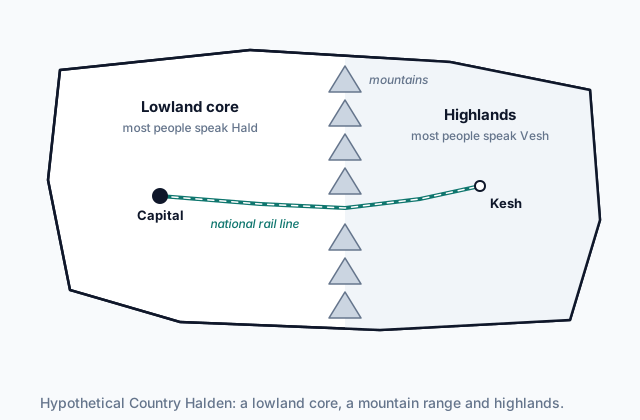
Hypothetical Country Halden, in the map at the top of the page, has a lowland core around the capital, where most people speak Hald, and highlands to the east, behind a mountain range, where most people speak Vesh. For decades nearly all new roads, power lines and hospitals went to the lowlands, and the highlands now have far fewer jobs. A Vesh party wants the highlands to leave Halden. Name the forces at work and their consequences, then judge a new plan.
Step 1 · Name the centrifugal forces
Three things divide Halden's people: the mountains, which cut the highlands off; the language difference between Hald and Vesh speakers; and decades of investment that went to one region only.
Step 2 · Name their consequences
The highlands have fallen behind in jobs and services, which is uneven development. The Vesh party's campaign to leave Halden is an ethnic nationalist movement: a group that sees itself as a separate people, seeking a state of its own.
Why this step?
Why is the Vesh party not the centripetal consequence called ethnonationalism?
Ethnonationalism is centripetal when the shared identity is the one the state is built on, so it ties people to the state. The Vesh identity belongs to a minority that the state has neglected, and the party uses it to pull the highlands away from Halden. That makes it a centrifugal consequence, an ethnic nationalist movement.
Your step · Decide and justify
Finish it. Halden's government now builds highways, power lines and hospitals across the highlands, linked to the rest of the country. Which kind of force does the new plan strengthen?
Which reason supports your answer?
Part 4 Try it From neglect to collapse, and the way back
Try it · Put it in order
In hypothetical Country Ostrova, the government neglected most of the country for decades. Put these events in order, from cause to final consequence.
Try it · Select all
Hypothetical Country Ulma has two large language groups. Which two describe consequences of centripetal forces in Ulma? Select two.
Select 2 answers, then check.
Part 5 Explain it Explain the forces in a divided country
Nothing you type leaves this page. Check your answer against the model and each scoring point.
Free response is 50% of the exam score. This one is shaped like Question 1, from free-response II.
Free-response practice · Question 1 style
Hypothetical Country Kerro has a capital region where most people share one ethnicity and language, and a southern region, across a wide river, where most people belong to a different ethnic group. The capital region has most of the country's paved roads, factories and universities.
(A) Define a centrifugal force.
(B) Identify one centrifugal force in Kerro.
(C) Explain how the gap between the capital region and the south could lead to an ethnic nationalist movement.
(D) Describe what would make Kerro a failed state.
(E) Explain how one government policy could act as a centripetal force in Kerro.
(F) Explain how ethnonationalism among the capital region's majority could unite that majority but push the southern group away.
(G) Explain one way the gap between the regions could change migration within Kerro.
Model answer
(A) A centrifugal force is anything that divides a state's people and weakens their loyalty to the state.
(B) The ethnic difference between the capital region's majority and the southern group.
(C) People in the south see the capital region get most of the jobs and services. They blame a government run by another ethnic group, and a southern party can use that grievance to rally the group to demand self-rule or its own state.
(D) Kerro would be a failed state if its government could no longer control its territory or provide basic services and security, for example if armed groups ruled the south and schools and clinics closed.
(E) The government could build roads, power lines and universities in the south. That more equitable infrastructure development gives southerners jobs and services, ties the regions together and gives the south a reason to stay in Kerro.
(F) Pride in a shared ethnicity and language binds the capital region's majority to the state. But if the state celebrates only that identity, the southern group feels shut out, which can strengthen its own movement.
(G) Young people may move from the south to the capital region for jobs and university places, internal migration that can leave the south further behind.
Score your own answer. This is a self-check, not a grade. Tick each point your answer makes.
Part 6 Check yourself The regions of Country Tarsa
The case questions use the table. The others mix the ideas from the whole lesson.
Hypothetical Country Tarsa publishes these figures for its four regions. Most Lomi speakers live in the highlands, and Lomi is not used in Tarsa's courts or national schools. A highland party campaigns for the highlands to become an independent Lomi state.
| Region | Main language | Homes with electricity | Paved road per 100 square km | Vote for the highland independence party |
|---|---|---|---|---|
| Capital region | Tarsan | 98% | 60 km | 2% |
| West | Tarsan | 91% | 41 km | 4% |
| Coast | Tarsan and Lomi | 85% | 35 km | 9% |
| Highlands | Lomi | 38% | 6 km | 57% |
Case question 1 · Multiple choice
The electricity and road columns show which consequence of centrifugal forces most directly?
Case question 2 · Spot the error
A student uses the case to explain the highland independence party. Which line is the first to go wrong?
Case question 3 · Multiple choice
Tarsa's government plans to bring the highlands up to the other regions' levels of electricity and paved road and to allow Lomi in highland courts and schools. If the plan works as intended over several decades, which change is most likely?
The rest stand on their own and do not use the case.
Check yourself · Decide and justify
Hypothetical Country Wend makes Wendish, spoken by nine in ten of its people, the only language of its schools and government. Hypothetical Country Zara does the same with Zaran, spoken by just over half its people; most of the rest speak Kallic and live together in one region. In which country is the policy more likely to divide the state?
Which reason supports your answer?
Check yourself · Sort it
Each card describes a hypothetical case. Tap a card, then the kind of force it is a consequence of.
Consequence of centrifugal forces
Consequence of centripetal forces
Part 7 Keep it Bring back earlier ideas
This lesson builds on devolution from Topic 4.9 and unitary and federal states from Topic 4.7.
Bring it back · Multiple choice
Hypothetical Country Coren, until now run entirely from its capital, divides its whole territory into provinces, each with its own elected assembly that runs its schools, while Coren's central government keeps the army and foreign policy. Which term best describes this change?
Bring it back · Sort it
Each card describes the government of a hypothetical country. Tap a card, then the form of governance it shows.
Unitary state
Federal state
In three lines
- Centrifugal forces divide a state and can lead to failed states, uneven development, stateless nations and ethnic nationalist movements.
- Centripetal forces unite a state and can lead to ethnonationalism, more equitable infrastructure development and greater cultural cohesion.
- The same trait can unite or divide: ask what it does in that state, and whether an identity pulls people toward the state or away from it.
Exam strategy for this topic
- Section I, Multiple Choice: 60 questions in 60 minutes.
- Section II, Free Response: 3 questions in 75 minutes.
When a question asks for a consequence of a centrifugal or centripetal force, name the consequence and explain the link: say which group or region is affected and why it is pulled toward the state or away from it.
Questions students ask
What is the difference between centrifugal and centripetal forces?
Centrifugal forces divide a state's people and pull the state apart. Centripetal forces unite them and hold the state together.
Is ethnonationalism the same as an ethnic nationalist movement?
No. Ethnonationalism among a state's majority ties people to the state, a centripetal consequence. An ethnic nationalist movement is a group's campaign for its own self-rule or state, a centrifugal consequence.
Is a stateless nation the same as a failed state?
No. A stateless nation is a people without a state of its own. A failed state is a state whose government can no longer control its territory or provide basic services.
Can the same trait be centrifugal in one country and centripetal in another?
Yes. A single national language unites a country where nearly everyone speaks it and divides one where a large minority is made to use it.
Are the countries and peoples in this lesson real?
No. Every country, region, people and language here is hypothetical, with details chosen to show each idea clearly. Real countries mix many forces at once.
Course alignment, for teachers
AP Human Geography topic 4.10, Unit 4: Political Patterns and Processes.
- Skill 5.C: Compare geographic characteristics and processes at various scales.
This lesson maps all 2 essential knowledge statements of the topic to the part that teaches each one: 2 are checked by a scored question. The map is in the lesson file.