Unit 4 · Topic 4.9 · about 30 minutes · 7 parts · 14 scored checks, 3 of them multiple choice
AP Human Geography 4.9: Challenges to Sovereignty
Unit 4: 12 to 17% of the multiple-choice section
What you'll be able to do
- Explain how political, economic, cultural and technological changes challenge state sovereignty: from below, when power moves to regions or a state breaks apart, and from above, when supranational organizations limit what their member states may do.
Key vocabulary
| Term | What it means | The exam trap |
|---|---|---|
| Sovereignty | A state's final authority over its own territory and people, free from control by outside powers. | Ask what a state can still decide alone; that is where its sovereignty shows. |
| Devolution | The transfer of some power from a state's central government to regions or other units within it. | Check whether a new sovereign state forms before you name the change. |
| Subnational political-territorial unit | A unit below the state, such as a province, a state within a federation or an autonomous community, with powers of its own. | The word state can mean a country or a unit inside a federation, so read which one a question means. |
| Supranationalism | Cooperation among three or more states through an organization that has some authority over its members. | Look at the scale the power moves to before you name the change. |
| Democratization | A shift toward a government chosen by its people in free and fair elections. | It describes how a country is governed, not how its power is split among regions. |
 Tap to open the picture full size
Part 1 Think first Phones, the internet and a regional movement
Commit to a guess first. Being wrong now makes the right idea stick better.
Predict first
In hypothetical Country Vell, the people of the Orrin region speak their own language. For decades Vell's national government ran every newspaper and TV station, all in the national language. Then cheap phones and the internet reach Orrin. What do you expect to happen to Orrin's movement for more self-rule?
In short. A state's sovereignty, its final authority over its own territory and people, can be challenged from below, when power moves to regions or the state breaks apart, and from above, when the state joins a supranational organization that limits what its members may do.
- Devolution moves power from a central government to regions or other units inside the state, as in Spain, Belgium, Canada and Nigeria; when a state disintegrates, as Sudan and the former Soviet Union did, new sovereign states take over part or all of its territory.
- States join supranational organizations to handle problems that cross borders, gain economies of scale, trade freely and defend one another, and in return accept limits on some of their economic or political actions.
- Advances in communication technology have made devolution, supranationalism and democratization easier.
Part 2 Learn it Sovereignty challenged from below and above
2a. Devolution: power moves down, or new states form
A state is sovereign when it has final authority over its territory and people. Devolution moves some of that authority from the central government to smaller units inside the state. It takes three forms.
- Autonomous regions. One region gets its own government for some matters, such as schools, language or police, while the state keeps the rest. The push often comes from a region whose language or religion sets its people apart, giving them an identity of their own.
- Subnational political-territorial units. The state is divided into units with powers of their own. Spain is divided into autonomous communities, each with its own parliament, and some, such as Catalonia, with an official language alongside Spanish. Belgium's Dutch-speaking north and French-speaking south have their own regional governments. Canada's provinces hold strong powers, and Quebec, a mostly French-speaking province, has voted on leaving Canada and stayed. Nigeria is a federation of states.
- Disintegration. New sovereign states form on the old state's territory. South Sudan separated from Sudan, and the Soviet Union broke apart into independent countries.
In the first two forms the regions hold their powers inside the state, which keeps sovereignty over the whole territory. Power can also move further down, to a city or county, the local scale. In disintegration, new sovereign states take over part or all of the old territory. Power moving from regions to the capital is centralization, not devolution.
Quick check · Sort it
Each card describes a change in a hypothetical country. Tap a card, then the kind of change it shows.
Devolution: regions gain power inside the state
Disintegration: new sovereign states form
Not devolution
2b. Why states join supranational organizations
A supranational organization is one that three or more states join, giving it some authority over matters each state once decided alone. Supranationalism is this kind of cooperation across state borders. States accept it because some goals are hard to reach alone.
- Transnational and environmental challenges. Pollution, disease, drug trafficking and overfishing cross borders, so no one state can solve them. The Arctic Council brings together states with Arctic territory to cooperate on protecting the Arctic environment.
- Economies of scale. A larger market lets producers sell more and lower their cost for each unit. Members of the European Union (EU) trade in one single market, and many of them share one currency, the euro.
- Trade agreements. Members cut tariffs and other barriers on one another's goods. The Association of Southeast Asian Nations (ASEAN) works to expand trade among its members.
- Military alliances. Members promise to defend one another. In the North Atlantic Treaty Organization (NATO), an armed attack on one member is treated as an attack on them all.
Some organizations take on many of these at once. The United Nations (UN) and the African Union work on peace, security and development, the UN among nearly all the world's states and the African Union across Africa.
Quick check · Match
Hypothetical states are forming new organizations. Match each reason for supranationalism to the goal that shows it.
2c. How supranational organizations limit their members
Joining a supranational organization is a trade. A member gets the organization's benefits and accepts limits on its own economic or political actions. That is how supranationalism challenges state sovereignty from above.
- Economic limits. An EU member cannot set its own tariffs on goods from other members, and it follows the single market's shared rules for many products. A trade bloc may bar its members from signing trade deals on their own.
- Political limits. A NATO member has promised to help defend the others, which shapes its military choices. The UN Security Council can approve sanctions that member states are expected to carry out, even against a trading partner. The African Union has suspended members whose governments took power by force.
Two points keep this straight. First, a member stays sovereign: it chose to join, it keeps most of its powers, and it can usually leave. Supranationalism limits sovereignty; it does not end it. Second, choosing to join does not make the limits go away. Once inside, a member that wants to act alone on a matter the organization covers often cannot, and that is the challenge.
Quick check · Spot the error
A student explains what joining a hypothetical trade bloc, the Ravel Union, means for hypothetical Country Sorn. Which line is the first to go wrong?
2d. Communication technology
Advances in communication technology, from radio and satellite TV to cell phones, the internet and social media, have made it cheaper and faster to spread a message and to organize people. They have made three kinds of change easier.
- Devolution. A regional movement can publish news and lessons in its own language, link supporters across the region and call a protest within hours, without relying on national media the central government may control.
- Supranationalism. Officials of member states meet by video, share data instantly and run joint systems, such as linked customs records, that make close cooperation practical.
- Democratization, the shift toward a government chosen by its people in free elections. Citizens can record and share abuses, compare vote counts and organize, which makes it harder for a government to hide fraud or silence its critics.
Governments can use the same tools to watch people and spread their own message, so the technology does not guarantee any of these outcomes. What it has done is lower the cost of organizing, for regions, for states working together and for citizens.
Quick check · Fill the statement
Complete the account of three hypothetical cases.
In Country Lune, a regional party streams news in the region's own language and builds support for self-rule within Lune, an example of technology aiding . Ministers of a hypothetical trade bloc link their customs systems so goods cross members' borders in minutes, an example of technology aiding . In Country Pell, citizens share videos of ballot boxes being stuffed and protest until a free election is held, an example of technology aiding .
Part 3 Watch it done Pressure on Larsa from two directions
Watch each step, then do the last one yourself.
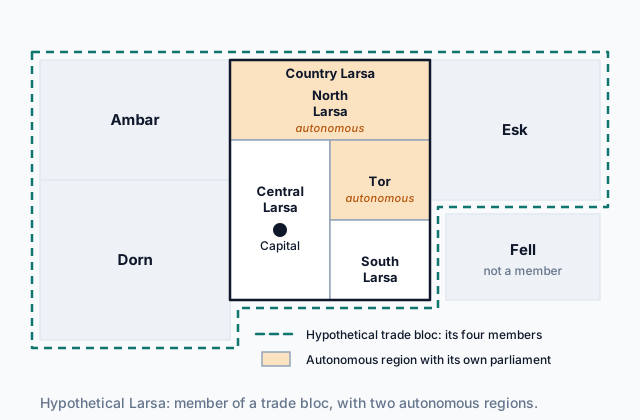
Hypothetical Country Larsa, shown in the map at the top of the page, faces two changes. North Larsa gains its own parliament, which now runs the region's schools and police and sets some of its taxes. Larsa also belongs to a hypothetical trade bloc whose rules bar tariffs on goods from other members. Compare the two challenges to Larsa's sovereignty: for each, name the scale the challenge comes from and what Larsa's central government can no longer do alone.
Predict first
Before the steps: do the two changes challenge Larsa's sovereignty in the same way?
Step 1 · Find the scale of the first change
North Larsa is a region inside Larsa. Power moves down from the central government to a subnational unit, so this challenge comes from below the state. North Larsa holds its new powers inside Larsa, and no new state forms, so the change is devolution, not disintegration.
Step 2 · Say what the central government loses
Larsa's capital can no longer run North Larsa's schools or police, or set the taxes the region now sets. Those choices belong to the region's parliament.
Why this step?
Why does it matter that North Larsa holds its powers inside Larsa?
That is what separates devolution from disintegration. North Larsa holds its powers inside Larsa, and Larsa keeps sovereignty over the whole territory, with its own borders, army and dealings with other states. If North Larsa had become its own sovereign country, a new state would have formed on Larsa's territory: disintegration.
Your step · Select all
Finish it. Which two statements correctly describe how the trade bloc challenges Larsa's sovereignty? Select two.
Select 2 answers, then check.
Part 4 Try it A region on the road to independence
Try it · Put it in order
Hypothetical Country Pellara has a region, Dunmore, where most people speak Dunmori. Put the events of Dunmore's path in the order they happened.
Try it · Decide and justify
Before Dunmore's vote, in the years when Pellara gave Dunmore its own parliament, Pellara also joined a hypothetical trade bloc whose court can overturn Pellara's laws on trade. A student says: "Pellara lost power to Dunmore's parliament and to the bloc's court, so both changes are devolution." Is the student right?
Which reason supports your answer?
Part 5 Explain it Explain the pressures on a state
Nothing you type leaves this page. Check your answer against the model and each scoring point.
Free response is 50% of the exam score. This one is shaped like Question 1, from free-response II.
Free-response practice · Question 1 style
Hypothetical Country Tavira has a central government in its capital and a northern region whose people speak a different language from the rest of the country. Tavira also belongs to a hypothetical regional organization of states that sets shared trade rules and runs a joint defense force.
(A) Define devolution.
(B) Describe one way Tavira could devolve power to its northern region while staying one state.
(C) Explain how advances in communication technology could help a movement for self-rule in the northern region.
(D) Explain one reason Tavira might have joined the regional organization.
(E) Explain one way the organization's trade rules limit Tavira's sovereignty.
(F) Compare the scale of the challenge to Tavira's sovereignty in (B) with the scale of the challenge in (E).
(G) Explain how the northern region's language, as a cultural trait, could strengthen support for devolution there.
Model answer
(A) Devolution is the transfer of some power from a state's central government to regions or other units inside the state.
(B) Tavira could give the northern region its own elected parliament that runs the region's schools, police and language policy, while Tavira's central government keeps the army, borders and foreign policy.
(C) Phones, the internet and social media let the movement publish news in the region's own language and organize meetings and protests quickly, without depending on national media the central government controls.
(D) The organization's joint defense force means its members will help defend Tavira if it is attacked, which Tavira could not match alone. Its shared trade rules also give Tavira's producers a larger market.
(E) If the rules bar tariffs on goods from other members, Tavira can no longer protect its own producers by taxing those goods. A choice Tavira once made alone is now limited by the organization.
(F) The challenge in (B) comes from below, from a region inside Tavira, while the challenge in (E) comes from above, from an organization of several states at a larger scale than Tavira.
(G) A shared language gives the region's people their own media, schools and sense of identity, apart from the rest of Tavira. That sense of being a distinct group builds support for running more of their own affairs.
Score your own answer. This is a self-check, not a grade. Tick each point your answer makes.
Part 6 Check yourself The rules of the Teal Coast Compact
The case questions use the table. The others mix the ideas from the whole lesson.
Five hypothetical states on the Teal Coast formed the Teal Coast Compact. Each member's government signed the rules below, and the Compact's council can fine a member that breaks them.
| Rule | What every member agrees to |
|---|---|
| 1 | Charge no tariffs on goods made in another member state |
| 2 | Keep its yearly tuna catch within the limit the council sets, because the tuna swim through every member's waters |
| 3 | Send troops to help any member that is invaded |
| 4 | Let the Compact's observers watch every national election |
| 5 | Sell packaged food only if it meets the Compact's shared standards, so food made in any member can be sold in every member |
Case question 1 · Multiple choice
Rule 2 best shows which reason states form supranational organizations?
Case question 2 · Sort it
Each rule limits something a member could once decide alone. Sort the Compact's rules by the kind of action they limit.
Limits an economic action
Limits a political or military action
Case question 3 · Multiple choice
A new president of Navara, one of the Compact's members, wants to bar the Compact's observers from Navara's next national election. Which statement best describes Navara's position?
The rest stand on their own and do not use the case.
Check yourself · Rank it
Each change below moves power over one matter in a hypothetical country. Rank the changes by the scale at which the power ends up, from the smallest scale to the largest.
Smallest scale first
Give each one a place, 1 for first. Give two the same place if they are equal.
Your ranking: none yet
Check yourself · Select all
Which two describe advances in communication technology making devolution or democratization easier? Select two.
Select 2 answers, then check.
Part 7 Keep it Bring back earlier ideas
This lesson builds on the factors behind devolution from Topic 4.8 and voting districts from Topic 4.6.
Bring it back · Multiple choice
Most people in the eastern province of hypothetical Country Pardo speak the language of neighboring Country Quel. Quel's leaders claim the province and call for it to be joined to Quel. Which factor that can lead to devolution does this show?
Bring it back · Fill the statement
Two events in the hypothetical state of Varna.
After each census, Varna's legislature redraws the boundaries of its voting districts so that each holds about the same number of people, a process called . In one round, the party in power draws the lines so it wins far more seats than its share of the votes would give it, which is .
In three lines
- Devolution moves power from the central government to regions that hold it inside the state; in disintegration, new sovereign states take over part or all of its territory.
- Supranational organizations help states with problems that cross borders, larger markets, trade and defense, and limit their members' economic or political actions in return.
- Communication technology has made devolution, supranationalism and democratization easier.
Exam strategy for this topic
- Section I, Multiple Choice: 60 questions in 60 minutes.
- Section II, Free Response: 3 questions in 75 minutes.
When a question asks how sovereignty is challenged, name the scale the pressure comes from, below the state or above it, and the specific action the state can no longer take alone.
Questions students ask
Is devolution the same as a country breaking up?
No. Devolution usually gives regions more power that they hold inside the state. Disintegration, when new sovereign states form on part or all of a state's territory, is the most extreme case.
Do members of the EU or NATO stop being sovereign states?
No. They accept limits on some economic or political actions in return for the organization's benefits, but they keep most of their powers and can leave.
Why would a state agree to limits on its own sovereignty?
Because some goals are hard to reach alone: solving problems that cross borders, selling to a larger market, trading freely and defending against attack.
Does communication technology always weaken governments?
No. It has made devolution, supranationalism and democratization easier, but governments can use the same tools to watch people and spread their own message.
Are the countries and organizations in this lesson real?
The examples in the teaching, Spain, Belgium, Canada, Nigeria, Sudan, the former Soviet Union, the UN, NATO, the EU, ASEAN, the Arctic Council and the African Union, are real. Every country, region and organization in the map, the questions and the case is hypothetical.
Course alignment, for teachers
AP Human Geography topic 4.9, Unit 4: Political Patterns and Processes.
- Skill 5.C: Compare geographic characteristics and processes at various scales.
This lesson maps all 4 essential knowledge statements of the topic to the part that teaches each one: 4 are checked by a scored question. The map is in the lesson file.