Unit 5 · Topic 5.1 · about 30 minutes · 7 parts · 14 scored checks, 3 of them multiple choice
AP Human Geography 5.1: Introduction to Agriculture
Unit 5: 12 to 17% of the multiple-choice section
What you'll be able to do
- Explain how physical geography, including climates such as the Mediterranean and tropical climates, shapes the way people farm a place, and tell intensive farming practices from extensive ones.
Key vocabulary
| Term | What it means | The exam trap |
|---|---|---|
| Mediterranean climate | A climate with hot or warm, dry summers and mild, rainy winters. | The name comes from one sea, but the climate type is found on several coasts in the middle latitudes. |
| Tropical climates | Climates of the low latitudes near the equator, warm in every month, some rainy all year and some with a long dry season. | Warm all year does not mean wet all year; read a tropical place's rainfall month by month. |
| Intensive farming practices | Farming that puts large amounts of labor, capital or both into each unit of land and gets a large output from it. | The word describes inputs, so learn what counts as an input: capital as well as labor. |
| Market gardening | Growing vegetables, fruits and flowers for sale, usually on small farms near the cities that buy them fresh. | It is commercial farming, not a home garden. |
| Plantation agriculture | Large commercial estates, mostly in tropical and subtropical climates, that grow one or two cash crops for sale, often for export, with many hired workers. | A plantation is a business that sells its crop, so do not mix it up with farming to feed a family. |
| Mixed crop-livestock systems | Farming that raises crops and animals on the same farm, with much of the crop fed to the animals and the animals' manure returned to the fields. | Having a few animals beside the crops is not enough; the term means the crops and the animals depend on each other. |
| Extensive farming practices | Farming that puts small amounts of labor and capital into each unit of land, spread across a large area. | It describes how land is used, not how much work the farmers do in a day. |
| Shifting cultivation | Clearing a plot, often by cutting and burning, farming it for a few years until the soil wears out, then moving to a new plot while the old one grows back. | Farmers move their fields, not always their homes: a village can stay put while its plots rotate. |
| Nomadic herding | Moving herds of animals from pasture to pasture across dry or cold lands, with no fixed farm, largely to supply the herders' own families, with some animals traded or sold. | The herders follow a pattern set by the seasons, grass and water; they do not wander at random. |
| Ranching | Raising grazing animals, such as cattle or sheep, on very large areas of land for sale to market. | Ranching is commercial: raising a few animals to feed one family is not ranching. |
 Tap to open the picture full size
Part 1 Think first When should the grain go in?
Commit to a guess first. Being wrong now makes the right idea stick better.
Predict first
A grower in a hypothetical coastal region gets almost no rain from May through September, while October through April is mild and rainy, with only a rare frost. She has no way to irrigate. Which plan gives her grain crop the water it needs?
In short. Agriculture starts with physical geography: climate, soil and landforms shape what farmers grow and how hard they work each acre, from intensive practices that put heavy labor and capital into small areas to extensive practices that use large areas lightly.
- A Mediterranean climate has hot, dry summers and mild, rainy winters, so farmers grow drought-tolerant trees and vines, plant grain in autumn and irrigate in summer; tropical climates are warm in every month and suit crops that cannot survive frost.
- Intensity is inputs per unit of land, not farm size: intensive farming practices include market gardening, plantation agriculture and mixed crop-livestock systems.
- Extensive farming practices, which put little labor and capital into each acre of a large area, include shifting cultivation, nomadic herding and ranching.
Part 2 Learn it From climate to farming practice
2a. Climate and land shape farming
Every farm starts with its physical environment: how warm it is and for how many months, how much rain falls and when, what the soil holds, and how steep the land is. Farmers choose crops and animals that fit those conditions, or they pay to change them with irrigation, fertilizer or terraces.
Two climate types show the link clearly.
A Mediterranean climate has hot or warm, dry summers and mild, rainy winters. Crops must get through months with almost no rain. Farmers grow trees and vines that survive drought, such as olives, grapes and citrus, plant grain in autumn so it grows through the wet winter, and graze sheep and goats on dry hillsides. Where water can be brought in, they irrigate through the summer.
Tropical climates, in the low latitudes near the equator, are warm in every month and have no frost. Some are rainy all year; others have a long wet season and a long dry one. Year-round heat suits crops that frost would kill, such as bananas, sugarcane and cacao. Heavy rain also washes nutrients out of many tropical soils, so a field cleared from forest can wear out within a few years.
The environment sets limits and offers chances; it does not decide everything. Money, markets and culture shape farming too, which later topics take up.
Quick check · Decide and justify
A hypothetical company wants to plant cacao trees, which need warmth and rain in every month and are killed by frost. It can buy land in Region 1, which has hot, dry summers, mild, rainy winters and a light frost in some winters, or in Region 2, which is hot with heavy rain in every month and never has frost. Where should it plant?
Which reason supports your answer?
2b. Intensive and extensive farming
Geographers sort farming practices by how much goes into each unit of land. Intensive practices put large amounts of labor, capital (machines, buildings, fertilizer, irrigation, bought feed) or both into each acre, and they get a large output from each acre. Extensive practices put little labor and capital into each acre and spread across large areas of land.
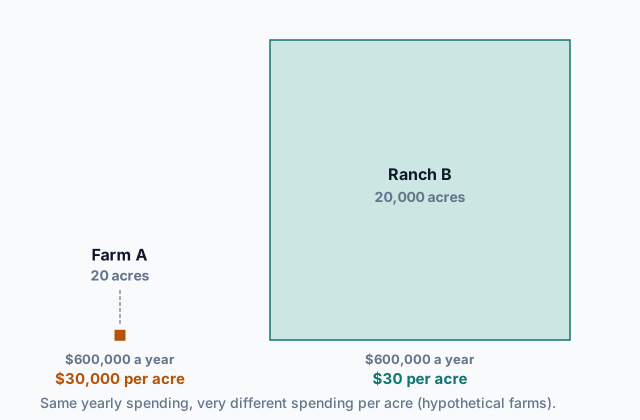
The picture at the top of the page shows two hypothetical farms that each spend $600,000 a year. Farm A spends it on 20 acres, which is $30,000 per acre. Ranch B spends it on 20,000 acres, which is $30 per acre. Their totals are the same, but Farm A is intensive and Ranch B is extensive.
So always divide by the land. A total, whether of workers, dollars or acres, says nothing about intensity until you divide it by the area farmed. A very large farm can be intensive, and a farm with few workers can be intensive if it spends heavily on machines and fertilizer for each acre.
Physical geography helps explain which is used where. Deep soil and reliable water repay heavy inputs. Dry grassland, thin soil or a short growing season give back little from each acre, so farmers there use a lot of land lightly.
Quick check · Rank it
Four hypothetical farms report their land and their yearly spending on inputs (labor, seed, feed, fertilizer and machines). Rank them from most intensive to least intensive. Work out the spending per acre for each farm before you rank.
Most intensive first
Give each one a place, 1 for first. Give two the same place if they are equal.
Your ranking: none yet
2c. Intensive farming practices
Intensive farming practices include market gardening, plantation agriculture and mixed crop-livestock systems. They are examples, not a full list.
Market gardening grows vegetables, fruits and flowers for sale, usually on small farms close to cities. The produce spoils quickly and sells fresh, so these farms pour labor, greenhouses, irrigation and fertilizer into a few acres.
Plantation agriculture is a large commercial estate that grows one or two cash crops, such as sugarcane, bananas, coffee or rubber, mostly in tropical and subtropical climates. The crop is sold, often for export, and many hired workers plant, tend and harvest it, sometimes with a mill on the estate to process it. A plantation can cover thousands of acres and still be intensive, because of the labor and capital that go into every acre.
A mixed crop-livestock system raises crops and animals on the same farm, and the two depend on each other. Much of the crop, such as corn or hay, feeds the farm's own animals, and the animals' manure goes back on the fields. The animals, or their milk, are the main product sold. Such a farm can have few workers and still be intensive, because of what it spends on machines, buildings, seed and fertilizer for each acre.
Quick check · Fill the statement
Name the farming practice each hypothetical farm shows.
On a 6-acre farm, a family grows tomatoes, peppers and herbs in greenhouses and trucks them to a nearby city's markets each morning: . On a 4,000-acre estate, hundreds of hired workers tend coffee trees, and the beans are dried and shipped abroad: . On a 300-acre farm, barley and clover are grown to fatten the farm's own sheep and cattle before they are sold: .
2d. Extensive farming practices
Extensive farming practices include shifting cultivation, nomadic herding and ranching, again as examples, not a full list. Each one uses a large area of land with little labor and capital for each acre, often where the physical environment gives back little from any one acre.
Shifting cultivation is common in tropical forests with poor soils. Farmers clear a plot, often by cutting and burning the plants, and the ash briefly feeds the soil. After a few years the soil wears out and weeds take over, so they clear a new plot and leave the old one to grow back into forest for many years. Each plot is small, but the practice needs far more land than is farmed at any one time.
Nomadic herding moves herds of animals, such as camels, goats, sheep or cattle, from pasture to pasture across dry or cold lands where crops do poorly. The herders have no fixed farm. They follow grass and water through the seasons, largely to supply their own families, with some animals traded or sold.
Ranching raises grazing animals, such as cattle or sheep, on very large areas of land that the rancher owns or leases, and sells them to market. A ranch has few workers for its size and little spending on each acre.
Quick check · Sort it
Each card describes a hypothetical farm or herd. Tap a card, then the extensive farming practice it shows.
Shifting cultivation
Nomadic herding
Ranching
Part 3 Watch it done Which farm is more intensive?
Watch each step, then do the last one yourself.
In a hypothetical farming county, a vegetable and flower farm near the county's city spends $500,000 a year on inputs on 25 acres. A cattle ranch in the county's dry hills spends $250,000 a year on 5,000 acres. Which is the more intensive farm, and how many times as much does it spend on each acre?
Predict first
Before the steps, which farm do you expect to spend more on each acre, and by about how much?
Step 1 · Choose the measure
Intensity is inputs per unit of land, so the comparison is spending per acre, not total spending.
Step 2 · Work out the vegetable and flower farm
$500,000 ÷ 25 acres = $20,000 per acre.
Why this step?
Why divide by the acres instead of comparing the two farms' total spending?
Total spending mixes how hard each acre is farmed with how many acres there are. Dividing by the land leaves only the inputs each acre gets, which is what intensive and extensive describe.
Your step · Calculate
Finish it. Work out the ranch's spending per acre, then divide the vegetable and flower farm's $20,000 per acre by it. How many times as much does the vegetable and flower farm spend on each acre as the ranch?
times
Part 4 Try it Match farming to the land
Try it · Multiple choice
Hypothetical Island R lies near the equator. It is hot and rainy all year and covered in thick forest, and its soil loses its nutrients within a few years of being cleared. Families there farm mainly to feed themselves, and the island has few roads. Which farming practice best fits these conditions?
Try it · Spot the error
A student explains how families farm hypothetical Region D, a dry grassland. Which line is the first to go wrong?
Part 5 Explain it Explain two farming regions
Nothing you type leaves this page. Check your answer against the model and each scoring point.
Free response is 50% of the exam score. This one is shaped like Question 2, from free-response II.
Free-response practice · Question 2 style
Stimulus, hypothetical descriptions of two farming regions in hypothetical Country Z:
- Region North: rain falls mostly from November to March, and summers are hot and dry. Farms average 60 acres. Main products: olives, grapes, and wheat planted in autumn.
- Region South: hot all year, with heavy rain in every month and thick forest on poor soils. Two kinds of farms: estates of several thousand acres, each growing one export crop with hundreds of hired workers, and family plots of a few acres cleared from the forest and left after a few years.
(A) Identify the type of climate in Region North.
(B) Using the descriptions, describe one way Region North's farmers fit their farming to its dry summers.
(C) Explain why the large estates in Region South are an example of plantation agriculture.
(D) Explain why the family plots in Region South belong to an extensive farming practice even though each plot is small.
(E) Explain one way the physical environment of Region South helps explain why families clear a plot and then leave it.
(F) Compare plantation agriculture and shifting cultivation in how much labor and capital each puts into an acre of land.
(G) Explain one limitation of using a regional average, such as Region North's average farm size, to describe the farms of a region.
Model answer
(A) A Mediterranean climate.
(B) The farmers grow olives and grapes, trees and vines that survive a dry summer, and they plant wheat in autumn so it grows through the rainy winter and is harvested before the summer drought.
(C) Each estate is a large commercial farm growing one cash crop for export, with hundreds of hired workers, in a hot, rainy tropical climate that suits crops that cannot survive frost. That is plantation agriculture.
(D) The plots are farmed by shifting cultivation. Each plot is used for only a few years and then left to regrow for many years, so the practice needs a large area of forest for every plot farmed at one time, with little capital spent on each acre. Intensity is judged by inputs per acre of all the land the practice uses, so it is extensive.
(E) The heavy rain washes nutrients out of the poor soil, so a cleared plot loses its fertility within a few years, and families must clear a new plot to keep harvests up.
(F) Plantation agriculture puts large amounts of labor and capital, such as hired workers, fertilizer and mills, into each acre, so it is intensive. Shifting cultivation puts little labor and almost no capital into each acre of the land it uses, so it is extensive.
(G) An average hides the spread. Region North could have many small family orchards and a few very large estates and still average 60 acres, so the average may describe almost no real farm, and it says nothing about how each farm uses its land.
Score your own answer. This is a self-check, not a grade. Tick each point your answer makes.
Part 6 Check yourself The farms of Country K
The case questions use the table. The others mix the ideas from the whole lesson.
Hypothetical Country K's farm agency surveyed four farms in different parts of the country. Spending is the farm's total yearly spending on labor, seed, feed, fertilizer, machines and buildings.
| Farm | Where it is | Land | Workers | Yearly spending | What it produces |
|---|---|---|---|---|---|
| 1 | Edge of the capital city | 12 acres | 10 | $360,000 | Lettuce, strawberries and cut flowers, sold fresh at city markets |
| 2 | Hot, rainy lowland | 2,500 acres | 600 | $10,000,000 | Sugarcane only, crushed at its own mill and shipped overseas |
| 3 | Central plains | 400 acres | 5 | $1,200,000 | Corn, soybeans and hay, most fed to its own hogs and cattle, which are sold |
| 4 | Dry grassland | 30,000 acres | 6 | $600,000 | Beef cattle grazed on fenced land and sold to meatpackers |
Case question 1 · Multiple choice
Which statement best describes Farm 3?
Case question 2 · Calculate
How many dollars does Farm 4 spend on each acre of its land in a year?
Case question 3 · Multiple choice
A student says Farm 2 is an extensive farm. Which statement best classifies Farm 2?
The rest stand on their own and do not use the case.
Check yourself · Decide and justify
Orchards on the Mediterranean-climate coast of hypothetical Country J are irrigated through the summer, while banana farms in its tropical, rainy lowland are rarely irrigated. In a summer when the irrigation canals run dry, which farms would suffer more?
Which reason supports your answer?
Check yourself · Select all
Which two statements correctly compare intensive and extensive farming? Select two.
Select 2 answers, then check.
Part 7 Keep it Bring back earlier ideas
This lesson stands on human-environment interaction from Topic 1.5 and population density from Topic 2.1.
Bring it back · Fill the statement
Two geographers explain farming in hypothetical Region X, a dry plain crossed by one river.
The first says the dry climate forced every group in Region X to herd animals; that view is . The second points to families who dug canals and grew crops along the river, and says the climate set limits but people chose how to live within them; that view is .
Bring it back · Calculate
Hypothetical Country H has 30,000,000 people, of whom 3,000,000 are farmers. It has 500,000 square miles of land, of which 60,000 square miles are arable. What is Country H's agricultural density?
In three lines
- Physical geography shapes farming: a Mediterranean climate's dry summers and wet winters, and the year-round warmth of tropical climates, decide what grows where and when.
- Intensity is labor and capital per unit of land: intensive practices include market gardening, plantation agriculture and mixed crop-livestock systems.
- Extensive practices use large areas lightly: shifting cultivation, nomadic herding and ranching are examples.
Exam strategy for this topic
- Section I, Multiple Choice: 60 questions in 60 minutes.
- Section II, Free Response: 3 questions in 75 minutes.
When a question asks whether a farm is intensive or extensive, divide its inputs by its land before you answer, and say what the numbers show. When it asks why farming differs between two places, name the physical difference, such as when the rain falls, and tie it to the practice.
Questions students ask
What is the difference between intensive and extensive farming?
Intensive farming puts large amounts of labor, capital or both into each acre and gets a large output from it. Extensive farming puts little labor and capital into each acre and uses a large area. The difference is per unit of land, not the size of the farm.
Can a large farm be intensive?
Yes. A plantation can cover thousands of acres and still be intensive because of the workers, fertilizer and machinery that go into each acre. A big ranch is extensive because each acre gets very little.
Why do Mediterranean farmers plant grain in autumn?
In a Mediterranean climate the rain falls in the mild winter and the summer is hot and dry. Grain planted in autumn grows through the wet months and is harvested before the drought.
Is shifting cultivation the same as nomadic herding?
No. Shifting cultivation grows crops on cleared plots and moves the fields as the soil wears out, usually in tropical forests. Nomadic herding moves herds of animals between pastures, usually across dry or cold lands. Both are extensive.
Are the countries, regions and farms in this lesson real?
No. Every country, region, island and farm here is hypothetical, with numbers chosen to show each idea clearly. The Mediterranean and tropical climates are real climate types.
Course alignment, for teachers
AP Human Geography topic 5.1, Unit 5: Agriculture and Rural Land-Use Patterns and Processes.
- Skill 2.D: Explain the significance of geographic similarities and differences among different locations and/or at different times.
This lesson maps all 3 essential knowledge statements of the topic to the part that teaches each one: 3 are checked by a scored question. The map is in the lesson file.