Unit 4 · Topic 4.3 · about 30 minutes · 7 parts · 14 scored checks, 3 of them multiple choice
AP Human Geography 4.3: Political Power and Territoriality
Unit 4: 12 to 17% of the multiple-choice section
What you'll be able to do
- Describe how geographers use political power and territoriality: power as control over people, land and resources, as choke points, shatterbelts and neocolonialism show, and territoriality as the connection of people, their culture and their economic systems to the land.
Key vocabulary
| Term | What it means | The exam trap |
|---|---|---|
| Political power | In political geography, control over people, land and resources. | Name which of the three a situation is about before you call it power. |
| Choke point | A narrow passage on a route, such as a strait, canal or mountain pass, that ships or other traffic have little choice but to use. | The term names the passage itself; the country that holds it is a separate fact. |
| Shatterbelt | A region caught between rival outside powers that compete for influence there, usually divided inside as well, where conflict is frequent. | Check both parts of the definition before you use the term. |
| Neocolonialism | Control of a formally independent country by a former colonial power, another strong country or foreign companies, mostly through economic means such as debt, trade and ownership. | It is a pattern of control, so name who holds the control and how. |
| Territoriality | The connection of people, their culture and their economic systems to the land. | It works at every scale, from a family's fields to a state's whole territory. |
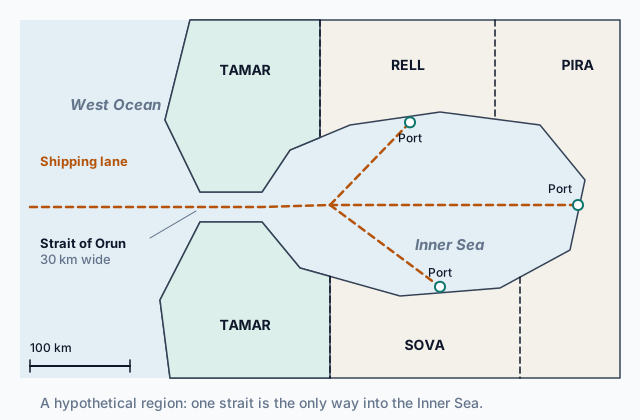 Tap to open the picture full size
Part 1 Think first Who feels a closed strait?
Commit to a guess first. Being wrong now makes the right idea stick better.
Predict first
Look at the map. Country Tamar is small, with a small army and a small economy, but it holds both shores of the Strait of Orun. Tamar announces that for one month it will stop every tanker and cargo ship from passing through. Who will feel the effects?
In short. Geographers see political power in who controls people, land and resources, and territoriality in the way people tie their culture and their way of making a living to a piece of land.
- Control can be direct, through boundaries, laws and armies, or indirect, as in neocolonialism, where a stronger country or its companies steer a formally independent country through debt, trade and ownership.
- A choke point is a narrow passage, such as a strait or canal, that traffic has little choice but to use, so whoever controls it holds power well beyond its own size.
- A shatterbelt is a region divided inside and caught between rival outside powers that compete for influence there, so conflict breaks out often and is hard to end.
Part 2 Learn it Power and territory on the map
2a. Power over people, land and resources
Geographers look for political power on the map, and they find it as control over three things.
- People: who may enter or leave a place, who is counted, taxed or drafted, which language the schools must teach.
- Land: where boundaries run, who may build or farm where, where an army may go, which empty islands a country claims.
- Resources: who owns the mines, oil fields, forests, fresh water and fishing grounds, and who decides who may use them.
A state's usual tools for this control are its boundaries, laws, police and army. But control does not have to come from a soldier or a governor. A country can hold power over another through loans, trade deals and companies that own its land and its minerals. And a small place can hold power far beyond its size when it sits where others must pass, as Tamar does on the map.
When you meet a situation, ask two questions: what is being controlled, people, land or resources, and who holds the control?
Quick check · Sort it
Each card describes a hypothetical country using its power. Tap a card, then what that country is controlling most directly.
People
Land
Resources
2b. Choke points and shatterbelts
A choke point is a narrow passage that ships, trucks or pipelines have little choice but to use: a strait between two seas, a canal, a mountain pass. Whoever controls it can inspect, tax, slow or close the traffic, so a small country on a choke point can hold power over countries much larger than itself.
The map at the top of the page shows the hypothetical Strait of Orun. It is 30 km wide at its narrowest and the only sea route between the West Ocean and the Inner Sea, and Country Tamar holds both shores. Every ship bound for a port on the Inner Sea passes along Tamar's coast.
A shatterbelt is a region caught between rival outside powers that compete for influence there, and usually divided inside as well, by ethnicity, religion or language. Each outside power backs a side, and the divisions inside give them sides to back, so conflict breaks out often and is hard to end. Being poor, or having many groups, does not by itself make a region a shatterbelt; the competing outside powers are part of what defines one.
Quick check · Select all
Hypothetical Country Brask holds both banks of the Kell Canal. Which two facts make the canal a choke point? Select two.
Select 2 answers, then check.
2c. Neocolonialism
Under colonialism, a foreign power ruled a territory directly, with its own governors, laws and soldiers. Most former colonies are now independent states. Neocolonialism is control that goes on after independence by other means: a former colonial power, another strong country, or its companies steer a formally independent country's economy and decisions.
The tools are economic. A lender can attach conditions to its loans. Foreign companies can own the best mines and plantations, ship the raw ore or crop abroad, do the processing at home, and keep most of the profit. A powerful buyer can set the price of the one export a country depends on. The country keeps its flag, its own government and its own army, yet decisions about its land and resources are partly made somewhere else.
So neocolonialism does not show up as a boundary line on a political map. You see it in who owns what, where the profits go and who sets the terms.
Quick check · Fill the statement
Hypothetical Country Lusa won its independence from Country Varn decades ago. Today Varn's banks hold most of Lusa's debt, and Varn's companies own Lusa's largest mines. Complete the description.
Lusa's own elected government makes its laws, so Varn's power over Lusa today is not . Varn steers Lusa's economy through instead, which makes its power over Lusa .
2d. Territoriality
Territoriality is the connection of people, their culture and their economic systems to the land. People name a place, mark it, defend it and make their living from it, and over time the land becomes part of who they are.
It works at every scale. A farming family that has worked one valley for generations knows every field, buries its dead there and earns its living from that soil. An indigenous people's land holds its sacred sites, its hunting and grazing grounds and the names its language gives to rivers and hills. Herders who move between summer and winter pastures are tied to both, though they own neither as a fixed farm. A state's people show territoriality when they treat its land as their homeland: they name its places, honor its landmarks and will defend its boundaries.
Territoriality explains why land is rarely just property. Offer a family a high price for a valley that will be flooded by a dam, and they may still refuse, because selling would cut them off from their history and from the way they earn a living.
Quick check · Decide and justify
A hypothetical government plans a dam that will flood the Lio Valley, where the Tavi people have farmed and fished for centuries. It offers each family twice the market price of its land, and most families refuse. What best explains their refusal?
Which reason supports your answer?
Part 3 Watch it done Is Region V a shatterbelt?
Watch each step, then do the last one yourself.
Hypothetical Region V lies between two rival powers, Power M to the north and Power N to the south. Two ethnic groups live in Region V, the Ost and the Varan, each with its own language and its own armed militias. Power M sells weapons to the Ost militias and has built a base on Ost land; Power N trains and pays the Varan militias. Decide whether Region V is a shatterbelt, then trace how a local quarrel there grows into a contest between the two powers.
Predict first
Before the steps: if Power M and Power N stopped competing over Region V, would it still be a shatterbelt?
Step 1 · Look inside the region
Region V is divided: two ethnic groups with different languages, each with armed militias. Divisions inside the region are one part of a shatterbelt.
Step 2 · Look outside the region
Region V sits between two rival powers, and each backs a side: Power M arms the Ost, Power N pays the Varan. Competing outside powers are the other part. Both parts are present, so Region V is a shatterbelt. Without the outside rivalry it would be a divided region, but not a shatterbelt.
Why this step?
Why does the outside rivalry matter, when the groups are already divided?
Outside backing ties a local quarrel to a much larger contest. Each side gets weapons and money it could not raise alone, and each power keeps its side going so the rival does not win the region. That is why conflict in a shatterbelt lasts longer and is harder to end.
Your step · Put it in order
Finish it. Put these events in Region V in the order they unfold, from a quarrel in one place to a contest across the region.
Part 4 Try it Power and territory in new places
Try it · Match
Match each idea to the hypothetical situation that shows it best.
Try it · Decide and justify
Hypothetical Country Dresk has no coast. Almost all its trade goes by rail to a port in Country Sova on the Inner Sea, then by ship out through the Strait of Orun, Tamar's strait and the only way out of the Inner Sea. Dresk is building a second rail line, to a port in Country Corra on the open ocean, a route that passes through none of Tamar's land or water. Once it opens, how does Tamar's power over Dresk change?
Which reason supports your answer?
Part 5 Explain it Explain power and territory in Tamar
Nothing you type leaves this page. Check your answer against the model and each scoring point.
Free response is 50% of the exam score. This one is shaped like Question 1, from free-response II.
Free-response practice · Question 1 style
Hypothetical Country Tamar is small, but it holds both shores of the Strait of Orun, the only sea route into the Inner Sea. Tamar became independent from Country Calda decades ago, yet Calda's companies still own Tamar's largest cocoa plantations. Inland, the Seri people have herded animals across the same high pastures for centuries.
(A) Define territoriality.
(B) Describe how the Strait of Orun gives Tamar political power over other countries.
(C) Explain how a decision Tamar makes about the strait could affect people far beyond the Inner Sea region.
(D) Explain how Calda's ownership of the cocoa plantations is an example of neocolonialism.
(E) Explain one way neocolonialism could limit Tamar's control over its own resources.
(F) Describe one way the Seri people show territoriality toward the high pastures.
(G) Explain why a plan to fence the high pastures for a national park could lead to conflict between the Seri and Tamar's government.
Model answer
(A) Territoriality is the connection of people, their culture and their economic systems to the land.
(B) The strait is a choke point: every ship bound for the Inner Sea must pass through it, and Tamar holds both shores, so Tamar can inspect, tax, slow or close the traffic that Rell, Sova and Pira depend on.
(C) If Tamar closed the strait or raised its fees, fuel and goods could not reach the Inner Sea's ports, or would cost more. Prices would rise in those countries, and companies far away that buy from or sell to them would face delays and higher costs, so a decision at one strait reaches the global scale.
(D) Tamar is formally independent and governs itself, but companies from its former ruler, Calda, own its largest plantations. Calda's control now runs through ownership and the economy, not through governors or soldiers, which is neocolonialism.
(E) Calda's companies decide how much cocoa to grow, where it is processed and where the profit goes, so much of the money from Tamar's own resource leaves the country, and Tamar has less say over how its land is used.
(F) The Seri's way of making a living is tied to the pastures: for centuries they have moved their herds across the same high ground with the seasons, so their herding economy depends on that land.
(G) A fence would cut the Seri off from land their way of making a living and their culture depend on. Because their tie to the pastures is part of their identity, not only a matter of ownership, they would likely resist the government's control of the land.
Score your own answer. This is a self-check, not a grade. Tick each point your answer makes.
Part 6 Check yourself Copper in Country Brenna
The case questions use the table. The others mix the ideas from the whole lesson.
Hypothetical Country Brenna was ruled by Country Hale until it became independent several decades ago. Copper is Brenna's largest export. A researcher gathered these facts about Brenna today.
| Fact | Today |
|---|---|
| Who passes Brenna's laws | Brenna's elected parliament |
| Who commands Brenna's army | Brenna's own government |
| Copper mines owned by companies based in Hale | 8 of Brenna's 10 mines |
| Where Brenna's copper ore is refined | In Hale |
| Brenna's largest lender | A group of Hale's banks |
| A condition of those loans | Brenna sells its copper to Hale at a price fixed in advance |
Case question 1 · Multiple choice
Which concept best describes Hale's power over Brenna today?
Case question 2 · Select all
Which two facts in the table show that Brenna is formally independent of Hale? Select two.
Select 2 answers, then check.
Case question 3 · Multiple choice
Brenna's government wants more of the money from its copper to stay in Brenna. Which step would most directly weaken Hale's control over Brenna's copper?
The rest stand on their own and do not use the case.
Check yourself · Spot the error
A student explains territoriality. Which line is the first to go wrong?
Check yourself · Sort it
Each card describes a hypothetical region. Tap a card, then whether the region is a shatterbelt.
Shatterbelt
Not a shatterbelt
Part 7 Keep it Bring back earlier ideas
This lesson stands on political processes from Topic 4.2 and the effects of cultural diffusion from Topic 3.8.
Bring it back · Multiple choice
Province Ket, in hypothetical Country Arun, has its own language. After years of protest, Arun's national government gives Ket an elected assembly that runs Ket's schools and sets some of its taxes. Which process does this show?
Bring it back · Fill the statement
Two hypothetical immigrant families settle in the same city.
The Aro family speaks its own language at home but learns the new country's language and customs for work and school, which is . The Bel family's grandchildren speak only the new country's language and keep none of the old customs, which is .
In three lines
- Political power is control over people, land and resources; a small state on a choke point can hold a lot of it.
- A shatterbelt is divided inside and contested by rival outside powers; neocolonialism controls an independent country through debt, trade and ownership.
- Territoriality is the connection of people, their culture and their economic systems to the land, at every scale from a family to a state.
Exam strategy for this topic
- Section I, Multiple Choice: 60 questions in 60 minutes.
- Section II, Free Response: 3 questions in 75 minutes.
When a question names a choke point, a shatterbelt or neocolonialism, say what is controlled (people, land or resources) and who holds the control. When it asks about scale, follow the effect from the place where it starts to the places it reaches.
Questions students ask
Is neocolonialism the same as colonialism?
No. Colonialism is direct rule of a territory by a foreign power, with its governors and soldiers. Neocolonialism comes after independence: the country governs itself, but a stronger country or foreign companies still steer its economy through debt, trade and ownership.
Does a shatterbelt have to be at war?
No. The term describes a region's position between rival outside powers and its divisions inside. Conflict breaks out often there, but a shatterbelt can have quiet years.
Is every strait a choke point?
Not in the same way. A strait matters as a choke point when much traffic depends on it and has no easy way around it. A wide strait with little traffic, or one ships can easily avoid, gives whoever holds it little power.
Can a whole country show territoriality, or only small groups?
Both. A family, a village, an indigenous people and a state's whole people can all show territoriality. A state's people show it when they treat its land as their homeland: they name its places, honor its landmarks and defend its boundaries.
Are the places in this lesson real?
No. Every country, region, strait and people here is hypothetical, made up to show each idea clearly. Real places fit these ideas more loosely, and real disputes have many causes.
Course alignment, for teachers
AP Human Geography topic 4.3, Unit 4: Political Patterns and Processes.
- Skill 5.B: Explain spatial relationships across various geographic scales using geographic concepts, processes, models, or theories.
This lesson maps all 2 essential knowledge statements of the topic to the part that teaches each one: 2 are checked by a scored question. The map is in the lesson file.