Unit 4 · Topic 4.7 · about 30 minutes · 7 parts · 14 scored checks, 3 of them multiple choice
AP Human Geography 4.7: Forms of Governance
Unit 4: 12 to 17% of the multiple-choice section
What you'll be able to do
- Define unitary and federal states, the two forms of governance this course studies, and tell them apart by asking where a region's powers come from and who can take them away.
- Explain how a unitary state's top-down, centralized power and a federal state's locally based, dispersed power centers shape the spatial organization of a country: where government sits, where laws change and how internal boundaries work.
Key vocabulary
| Term | What it means | The exam trap |
|---|---|---|
| Form of governance | The way a state divides power between its central government and its regions; the two forms this course studies are unitary and federal. | A form is about the whole state's structure, not about one agency or one office. |
| Unitary state | A state in which the central government holds the power, and any provinces or districts have only the powers it gives them. | Do not judge the form by whether regional bodies exist or are elected; chunk 2a shows what to check. |
| Federal state | A state in which a constitution divides power between a national government and regional governments, such as states or provinces, that keep powers of their own. | The national government of a federal state still holds major powers of its own. |
| Centralized governance | Top-down governance in which decisions are made at the center and passed down for regional offices to carry out. | Look for who makes the decision, not who carries it out on the ground. |
| Dispersed power centers | Several places where government decisions are made, such as a national capital and regional capitals with their own lawmaking bodies. | A regional office that only carries out national decisions is not a power center of its own. |
| Spatial organization | How places, people and activities are arranged across an area; here, where a state's government power sits on its map. | Name a place on the map, such as a capital or an internal boundary, when you describe it. |
 Tap to open the picture full size
Part 1 Think first Write a constitution
Commit to a guess first. Being wrong now makes the right idea stick better.
Predict first
A hypothetical country covers a huge area. Its three regions are far apart, and in each one most people speak a different language. The country's founders are writing its constitution, and they want the country to hold together. Which plan would you guess holds it together best?
In short. A state's form of governance is usually described as unitary, with power held by the central government, or federal, with power divided by a constitution between a national government and regional governments that keep powers of their own.
- In a unitary state, decisions run top down from the capital, regional and district offices carry them out, and the same rules tend to apply across the country.
- In a federal state, states or provinces have their own capitals and lawmaking bodies, so power centers are spread across the map and some laws change at internal boundaries.
- To tell the forms apart, ask where the regions' powers come from and whether the center can take them back on its own.
Part 2 Learn it Where a state's power sits
2a. Unitary and federal states
Every state has to settle where its power sits. The two forms of governance this course studies are unitary and federal.
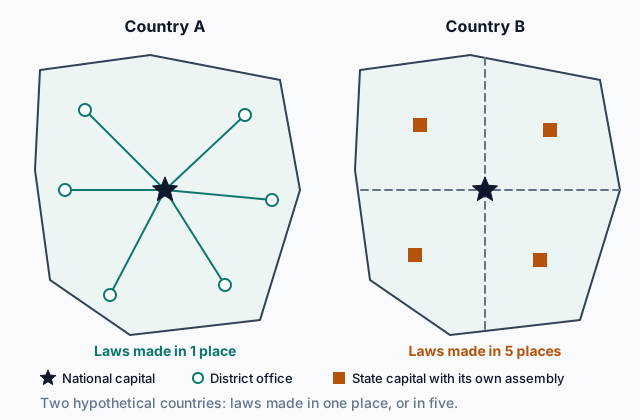
In a unitary state, the central government holds the power. The country is divided into provinces or districts, but those units exist to carry out national decisions. The central government creates them, gives them their tasks, and can redraw them or take their tasks away.
In a federal state, a constitution divides power between the national government and regional governments, often called states or provinces. Each regional government has its own lawmaking body and powers of its own, such as over schools, police or local roads, and the national government cannot take those powers away on its own.
Both forms have internal units with names on the map, so the units alone tell you nothing. Ask who gives the units their power. If it comes from the center and the center can take it back, the state is unitary. If the constitution guarantees it, the state is federal.
In the picture at the top of the page, Country A is drawn as a unitary state and Country B as a federal state.
Quick check · Sort it
Each card describes a hypothetical country. Tap a card, then the form of governance it describes.
Unitary state
Federal state
2b. Unitary states: power from the top down
A unitary state tends to have a top-down, centralized form of governance. Decisions are made in the capital and passed down through national ministries to regional and district offices, whose officials carry them out.
That shapes the country's spatial organization in ways you can see:
- One main center of power. The national lawmaking body, the top courts and the head offices of government agencies cluster in the capital.
- Uniform policy. A law or a school curriculum set in the capital usually applies the same way in every part of the country, so crossing from one province into the next changes little about the rules.
- Administrative units. Internal boundaries are drawn to run services, and the center can redraw them when it reorganizes.
Take hypothetical Country Lund. Its education ministry, in the capital, sets the exams every student takes, in the same week, in every district. Each district office hires teachers and runs the schools, but it follows the ministry's rules and cannot write its own.
Centralized power lets a national plan reach every district at once. The cost is distance: people far from the capital can feel that their region's needs come last.
Quick check · Fill the statement
Complete the description of hypothetical Country Lund, a unitary state.
In Country Lund, the rules for schools are written in the . A district office those rules, and a student who moves from one district to another finds the rules .
2c. Federal states: many centers of power
A federal state has more locally based, dispersed power centers. The national capital is one center, and each state or province has its own capital, lawmaking body and courts. Power is spread across the map instead of gathered in one city.
That gives a federal state a different spatial organization:
- Several capitals. Government offices, jobs and political attention are spread among the regional capitals as well as the national one.
- Laws that change at internal boundaries. Where states set their own rules, a short drive across a state line can change a tax rate, the age to get a driver's license or what schools teach.
- Boundaries with weight. An internal boundary in a federal state marks the edge of a government with real powers, so it is usually much harder to redraw than an administrative line.
Take hypothetical Country Brask, a federal state of six states. Each state sets its own minimum wage. A company choosing where to build a warehouse compares six sets of rules, which it would not need to do in Country Lund.
The cost of dispersed power is that rules vary, and the national government cannot carry out every plan everywhere at once.
Quick check · Select all
Hypothetical Country Brask is a federal state. Which two would you expect to see on a map of how its government is organized? Select two.
Select 2 answers, then check.
2d. Why a state takes one form or the other
This part is background. It helps you explain why a country might have its form, but it is not how you identify the form. A state's form of governance is tied to its geography, though no rule decides it.
Federal states tend to be found where the territory is large, or where distinct groups live in different regions. Spreading power to regional governments puts decisions closer to people who live far from the national capital, and it can let a region whose people differ from the rest of the country, in language or way of life, govern matters such as schooling in its own way.
Unitary states tend to be found where the territory is smaller, or where people share a language and culture across the country. With fewer regional differences to manage, one set of national rules can serve everyone.
These are tendencies, not tests. A large country can be unitary, and a small one can be federal. A unitary state can also hand some powers to elected regional councils while keeping the right to take them back, and it stays unitary. It is less centralized, though, than a unitary state whose regions only carry out the center's orders.
So when you read about a country, use its size and its people to explain why it might have chosen its form. Use where its regions' powers come from to say which form it has.
Quick check · Decide and justify
Hypothetical Country Pell is small, and nearly all its people speak one language. Its provinces elect councils that run local parks and libraries, but the national parliament can abolish any council by passing an ordinary law. Which form of governance does Pell have?
Which reason supports your answer?
Part 3 Watch it done Read a country's form from its constitution
Watch each step, then do the last one yourself.
Hypothetical Country Orvan has five provinces, and each elects an assembly. Orvan's constitution lists the matters that belong to the provinces, including schools, police, road building and licenses to open a shop. The national parliament may not change that list without the agreement of a majority of the provinces. Identify Orvan's form of governance, then describe what it does to Orvan's spatial organization.
Predict first
Before the steps, which form do you expect Orvan to have?
Step 1 · Find who holds the provinces' powers
The constitution lists the provinces' powers, and the national parliament cannot change the list on its own. Those powers belong to the provinces, not to the center.
Step 2 · Name the form
Power divided by a constitution between a national government and regional governments that keep powers of their own is the mark of a federal state. Orvan is federal.
Why this step?
Why do the provinces' elected assemblies not settle the question on their own?
A unitary state can have elected regional councils too. What decides the form is whether the center can take the regions' powers back on its own, and in Orvan it cannot.
Your step · Fill the statement
Finish it. Describe what Orvan's form of governance does to its spatial organization.
Power in Orvan is . A shop owner who moves her store across a provincial boundary may face rules. Because Orvan's boundaries mark governments with powers of their own, the national government would find it to redraw one on its own.
Part 4 Try it Compare countries by how they govern
Try it · Rank it
Three hypothetical countries each divide their territory into regions. Rank them by how centralized their governance is.
Most centralized first
Give each one a place, 1 for first. Give two the same place if they are equal.
Your ranking: none yet
Try it · Decide and justify
Hypothetical Country Ulm is a unitary state. Hypothetical Country Vey is a federal state whose states run their own schools. Each national government wants every school in its country to start teaching a new course next fall. In which country is the course more likely to start in every school at once?
Which reason supports your answer?
Part 5 Explain it Explain two ways to govern
Nothing you type leaves this page. Check your answer against the model and each scoring point.
Free response is 50% of the exam score. This one is shaped like Question 1, from free-response II.
Free-response practice · Question 1 style
Hypothetical Country Wend is a unitary state with its capital on the west coast. Hypothetical Country Yarrow is a federal state of seven states, each with its own capital and elected assembly.
(A) Define a unitary state.
(B) Describe one way Wend's form of governance shows in where its government offices are.
(C) Explain why a law passed in Wend's capital is likely to apply the same way in every part of Wend.
(D) Describe one difference a traveler might notice when crossing a state boundary in Yarrow.
(E) Explain why Yarrow's state boundaries are likely harder to redraw than Wend's district boundaries.
(F) Using scale of analysis, explain why a decision about a town's bus routes in Yarrow is likely made at a different scale from a decision about Yarrow's army.
(G) Explain one drawback of Wend's centralized governance for people who live far from its capital.
Model answer
(A) A unitary state is one where the central government holds the power, and its provinces or districts carry out national decisions with only the powers the center gives them.
(B) Wend's government offices cluster in one place: the parliament, the national ministries and the top courts are all in the capital, because that is where decisions are made.
(C) In a unitary state, decisions are made at the center and passed down. District offices carry out the national law instead of writing their own, so the same law applies everywhere.
(D) A rule can change at the state line, such as a sales tax, the age to get a driver's license or what schools teach, because each of Yarrow's states makes some of its own laws.
(E) Each of Yarrow's state boundaries marks the edge of a government whose powers the constitution protects, so the national government cannot simply redraw it on its own. Wend's districts are administrative units the center drew to run services, so it can redraw them when it reorganizes.
(F) Bus routes serve one town, so they are decided at a local or state scale by a government close to the riders. The army defends the whole country, so it is decided at the national scale by the national government.
(G) Decisions are made by officials far away, so the needs of a distant region can be slow to reach the capital, and one national rule may not fit local conditions there.
Score your own answer. This is a self-check, not a grade. Tick each point your answer makes.
Part 6 Check yourself The governments of Country Zell
The case questions use the table. The others mix the ideas from the whole lesson.
Hypothetical Country Zell is divided into eight regions. Each region has a capital and an elected assembly. The table shows which level of government decides each matter under Zell's constitution, and whether the national parliament can change that on its own.
| Matter | Decided by | Can the national parliament change this alone? |
|---|---|---|
| Defense and the currency | National government | Yes |
| Highways between regions | National government | Yes |
| Schools | Each region's assembly | No: the constitution gives it to the regions |
| Police | Each region's assembly | No: the constitution gives it to the regions |
Case question 1 · Multiple choice
Which statement best describes Zell's form of governance?
Case question 2 · Multiple choice
A family moves from one of Zell's regions to another. Which change does the table suggest the family is most likely to meet?
Case question 3 · Spot the error
A student writes about Country Zell, using the table. Which line is the first to go wrong?
The rest stand on their own and do not use the case.
Check yourself · Match
Match each form of governance, or part of one, to its description.
Check yourself · Put it in order
Hypothetical Country Lund is a unitary state. Put the steps of a new school exam rule in the order they happen, from first to last.
Part 7 Keep it Bring back earlier ideas
This lesson stands on voting districts from Topic 4.6 and types of boundaries from Topic 4.4.
Bring it back · Multiple choice
In the hypothetical state of Ardo, the party in power redraws the voting districts. It packs most of the other party's voters into two districts, which that party wins by huge margins, and spreads the rest thinly across the other districts. What is this, and what does it do?
Bring it back · Fill the statement
Two boundaries in hypothetical places.
A boundary drawn along a straight line of latitude, with no regard to the land or the people, is the type. One drawn to separate two language groups is the type.
In three lines
- Unitary state: the central government holds the power, and regional units carry out its decisions, so governance is top down and centralized.
- Federal state: a constitution divides power with regional governments, so power centers are dispersed and some laws change at internal boundaries.
- Identify the form by where regions' powers come from and who can take them back, not by size, language or elected councils.
Exam strategy for this topic
- Section I, Multiple Choice: 60 questions in 60 minutes.
- Section II, Free Response: 3 questions in 75 minutes.
When a question asks for a state's form of governance, say where the regions' powers come from, not how many regions the map shows. When it asks how the form shapes spatial organization, name something on the map: the capital where offices cluster, or the internal boundary where laws change.
Questions students ask
Is every country with states or provinces a federal state?
No. Unitary states have provinces or districts too. A state is federal when its constitution gives the regions powers the national government cannot take away on its own.
Can a unitary state have elected regional governments?
Yes. A unitary state can hand some powers to elected regional councils. It stays unitary as long as the central government can take those powers back.
Does a federal state have a weak national government?
Not necessarily. The national government of a federal state keeps powers such as defense and the currency. What differs is that the regions also hold powers of their own.
Why are large countries often federal?
Spreading power to regional governments puts decisions closer to people far from the national capital and lets distinct regions run some matters their own way. It is a tendency, not a rule: some large countries are unitary.
Are the countries in this lesson real?
No. Every country and state here is hypothetical, made up to show each idea clearly. Real countries follow these forms with many variations.
Course alignment, for teachers
AP Human Geography topic 4.7, Unit 4: Political Patterns and Processes.
- Skill 2.A: Describe spatial patterns, networks, and relationships.
This lesson maps all 2 essential knowledge statements of the topic to the part that teaches each one: 2 are checked by a scored question. The map is in the lesson file.