Unit 4 · Topic 4.8 · about 30 minutes · 7 parts · 14 scored checks, 3 of them multiple choice
AP Human Geography 4.8: Defining Devolutionary Factors
Unit 4: 12 to 17% of the multiple-choice section
What you'll be able to do
- Define the factors that can lead to the devolution of states (the division of groups by physical geography, ethnic separatism, ethnic cleansing, terrorism, economic and social problems, and irredentism) and tell which ones are at work from a map, a table or a description of a state.
Key vocabulary
| Term | What it means | The exam trap |
|---|---|---|
| Devolution | The movement of power from a state's central government to its regions, which can go as far as a region breaking away. | Devolution can stop well short of independence, as when a region gains its own assembly. |
| Devolutionary factor | A pressure that can push a state toward devolution. | Several factors can be at work in one state, so name the one the evidence points to. |
| Division of groups by physical geography | Mountains, deserts, seas or long distances that separate a region's people from the rest of the state. | Name the barrier, then say how it weakens the region's ties to the capital. |
| Ethnic separatism | A movement by an ethnic group to win more self-rule for the region where it is concentrated, or to form a state of its own. | Separatism and irredentism are easy to confuse; chunk 2d shows the question that separates them. |
| Ethnic cleansing | The forced removal of an ethnic group from a territory by another group, through killing, terror or expulsion. | Do not confuse ethnic cleansing with separatism just because both involve an ethnic group. |
| Terrorism | The use of violence, or the threat of it, against civilians to spread fear and force a political change. | It is a method a group uses, so look for what the group wants as well. |
| Economic and social problems | Grievances over money, jobs, services or the unequal treatment of a group that make a region feel the central government does not serve it. | Name the grievance the evidence shows, then say how it turns people against the center. |
| Irredentism | A movement to claim territory in a neighboring state where people who share the claiming side's nationality, language or ethnic ties live. | Do not call every breakaway movement irredentism; chunk 2d shows what to check. |
 Tap to open the picture full size
Part 1 Think first What drives a region's push for self-rule?
Commit to a guess first. Being wrong now makes the right idea stick better.
Predict first
In hypothetical Country Ostra, the northern region is the richest. Each year, the north sends far more to the national government than it gets back in spending. A party that wants the north to govern itself starts winning elections there. What would you guess is driving that party's support?
In short. Devolution is the movement of power from a state's central government to its regions, and several factors can push a state toward it: the division of groups by physical geography, ethnic separatism, ethnic cleansing, terrorism, economic and social problems, and irredentism.
- Mountains, deserts, seas and long distances can cut a region off from the capital, and the people beyond the barrier can come to see themselves as separate.
- Ethnic separatism, ethnic cleansing and terrorism all grow out of conflict between groups, or between a group and the state, and each can weaken the state's hold on a region.
- Not every push for self-rule is about culture: money, jobs and services matter too. Irredentism pulls a region toward a neighboring state that claims it.
Part 2 Learn it What pushes a state toward devolution
2a. Devolution, and the barriers of physical geography
Devolution is the movement of power from a state's central government to its regions. It can be modest, as when a region gains its own assembly, or go as far as a region breaking away. This lesson is about the devolutionary factors, the pressures that can push a state in that direction. Topic 4.9 looks at what devolution produces.
The first factor is the division of groups by physical geography. Mountains, deserts, seas and sheer distance can separate a region from the capital. When travel and trade across the barrier are hard, the people beyond it build their economy and their ties around their own region. Over generations they can come to see themselves as a people apart, with interests of their own, and a central government far away has a harder time providing services or keeping their loyalty.
Take hypothetical Country Rhee. Its eastern province is a chain of islands far out to sea, reached from the capital only by a long ferry ride. The islanders trade mostly with one another, feel that the capital overlooks them, and elect leaders who ask for more control over their own affairs.
Quick check · Select all
Which two describe physical geography dividing a hypothetical state's groups? Select two.
Select 2 answers, then check.
2b. Ethnic separatism and ethnic cleansing
An ethnic group shares a sense of common ancestry and culture, often a language or a religion. When such a group is concentrated in one region of a state, it may come to see that region as its homeland.
Ethnic separatism is a movement by an ethnic group to gain more self-rule for its region, or to break away and form a state of its own. It grows when a group feels its language, religion or customs are threatened, or when a larger group shuts it out of power. Its demands range from schools in its own language to full independence.
Ethnic cleansing is the forced removal of an ethnic group from a territory by another group, through killing, terror or expulsion, so that only the group doing the removing is left. It is a grave abuse of human rights, and it tears a state apart along ethnic lines. Survivors lose trust in the state, groups demand territories of their own where they can be safe, and the state can lose control of whole regions.
To tell them apart, ask who acts and what they want. In separatism, a group seeks power over its own region. In ethnic cleansing, a group drives other people out of a territory.
Quick check · Sort it
Each card describes events in a hypothetical state. Tap a card, then the factor it shows.
Ethnic separatism
Ethnic cleansing
2c. Terrorism, and economic and social problems
Terrorism is the use of violence, or the threat of it, against civilians to spread fear and force a political change. A separatist group that bombs public places or kidnaps officials is trying to make the state's control of a region too costly to keep. Terrorism weakens a state's hold where it happens: people stop trusting that the state can protect them, and a harsh response from the government can turn more of the region's people against it.
Economic and social problems can drive devolution with no violence at all. Two patterns stand out:
- A richer region resents sending its taxes to the rest of the country and wants to keep more of its own money.
- A poorer region feels neglected: fewer jobs, worse roads and schools, and a sense that the capital spends its money elsewhere.
Social problems add to these: unequal treatment of a group, a language kept out of schools and courts, or services that never reach a region. Whatever the cause, the result is the same feeling, that the central government does not serve the region, and a demand that the region run more of its own affairs.
Quick check · Fill the statement
Complete the description of hypothetical Country Pava.
In Pava's southern region, the mines have closed and many workers have no jobs. People there say the capital spends its money everywhere but the south. The factor at work in the south is . In Pava's western region, an armed group sets off bombs at train stations to frighten people and force the government out of the region. The factor at work in the west is .
2d. Irredentism
Irredentism is a movement to claim territory in a neighboring state, because people who share the claiming side's nationality, language or ethnic ties live there, or because the land once belonged to it. The word comes from the Italian for "unredeemed".
Irredentism usually starts across a border. Hypothetical Country Kesh looks at a province of its neighbor where most people speak Kesh's language, and its leaders say the province should be part of Kesh. The claim can draw in the province's own people: some come to feel closer to Kesh than to their own capital, and a movement grows to join Kesh.
That is what makes irredentism a devolutionary factor for the state that holds the province. Its control is challenged from inside, by people who want to leave, and from outside, by a neighbor that wants the land.
Compare it with separatism. A separatist movement wants its region to govern itself or become a new state. An irredentist claim wants the region to join a state that already exists.
Quick check · Decide and justify
In hypothetical Country Lorr, most people in the border province of Tesk speak the language of neighboring Country Mavi. Mavi's government says Tesk belongs in Mavi, and a movement in Tesk campaigns to join Mavi. Which factor is at work?
Which reason supports your answer?
Part 3 Watch it done Read the map of Country Varna
Watch each step, then do the last one yourself.
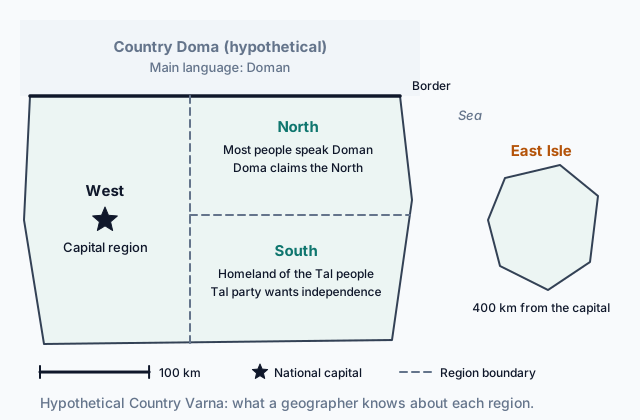
The map at the top of the page shows hypothetical Country Varna. Each of the three regions outside the capital region has a movement asking for more self-rule. Use the map to name the devolutionary factor at work in each region.
Step 1 · Read what the map says about each region
North: most people speak Doman, the language of neighboring Country Doma, and Doma's government claims the North. South: the homeland of the Tal people, whose party wants independence. East Isle: an island across the sea, 400 km from the capital.
Step 2 · Start with the North
A neighboring state claims the North because people who speak its language live there. A claim by an existing neighbor on land where its language group lives is irredentism.
Why this step?
Why is the North not ethnic separatism, even though its people speak a different language from the capital region?
Separatism seeks self-rule or a new state. The pressure on the North comes from Doma, an existing neighbor that wants the region, so the North would end up in Doma. That is irredentism.
Your step · Fill the statement
Finish it. Name the factor the map points to in the other two regions.
The South shows . East Isle shows .
Part 4 Try it New states, new evidence
Try it · Put it in order
In hypothetical Country Brin, economic problems in the Hale region build toward devolution. Put the events in the order they would most likely happen, from first to last.
Try it · Spot the error
A student explains events in a hypothetical state. Which line is the first to go wrong?
Part 5 Explain it Explain the pressures on a state
Nothing you type leaves this page. Check your answer against the model and each scoring point.
Free response is 50% of the exam score. This one is shaped like Question 1, from free-response II.
Free-response practice · Question 1 style
Hypothetical Country Quell has its capital on a central plain. Its far western province lies beyond a high mountain range. Its southern province is home to most of the Oru people, an ethnic minority, and it is also the poorest province, with the fewest jobs.
(A) Define devolution.
(B) Describe how the mountain range could act as a devolutionary factor for the western province.
(C) Explain how ethnic separatism could develop among the Oru in the southern province.
(D) Explain how the southern province's economic problems could add to demands for self-rule.
(E) Explain the difference between ethnic separatism and irredentism.
(F) Quell is a unitary state. Explain one change in its form of governance that could answer the southern province's demands without the province leaving Quell.
(G) Describe one way the Oru language could help hold the Oru together as an ethnic group.
Model answer
(A) Devolution is the movement of power from a state's central government to its regions, which can range from a region gaining its own assembly to a region breaking away.
(B) The mountains make travel and trade with the capital hard, so the western province builds its economy and ties around itself. Its people can come to see themselves as separate and feel that a distant capital ignores them, which feeds demands for self-rule.
(C) The Oru are concentrated in one province they may see as their homeland. If they feel their language or customs are threatened, or that the majority shuts them out of power, a movement can grow to win self-rule for the province or independence.
(D) As the poorest province with the fewest jobs, the south can feel the capital neglects it and spends money elsewhere. That grievance gives people a reason to want their own government to run the province's affairs.
(E) Ethnic separatism is a group seeking self-rule or a new state for its own region. Irredentism is a claim on a region by a neighboring state, so the region would join a state that already exists.
(F) Quell could hand power to an elected assembly for the southern province, or become a federal state whose constitution gives the province its own powers, such as over schools. Self-rule inside Quell can answer the demands without the province leaving.
(G) A shared language marks who belongs to the group and sets the Oru apart from the majority, so it gives them a common identity to rally around.
Score your own answer. This is a self-check, not a grade. Tick each point your answer makes.
Part 6 Check yourself The regions of Country Selva
The case questions use the table. The others mix the ideas from the whole lesson.
Hypothetical Country Selva has four regions outside its capital region, and each has a movement asking for more self-rule. A geographer collects these facts about each region. Income per person is shown with Selva's average set to 100.
| Region | Main language | Income per person (Selva = 100) | Other facts |
|---|---|---|---|
| Amar | Selvan, the national language | 190 | Its largest party wants Amar to keep more of its own taxes |
| Bell | Selvan, the national language | 100 | A wide desert, crossed by one road, separates it from the capital |
| Cora | Coran, the national language of neighboring Country Dess | 95 | Dess's government says Cora belongs in Dess |
| Dun | Dunic, spoken nowhere else | 100 | A Dunic party wants Dun to become an independent state |
Case question 1 · Multiple choice
Which region's data most clearly point to irredentism?
Case question 2 · Multiple choice
What do the data for Amar imply about its push for self-rule?
Case question 3 · Select all
A student claims that in Selva only regions whose main language is not Selvan face pressure toward devolution. Which two regions' data show that the claim is wrong? Select two.
Select 2 answers, then check.
The rest stand on their own and do not use the case.
Check yourself · Match
Match each devolutionary factor to the hypothetical event that shows it.
Check yourself · Fill the statement
Two regions in hypothetical states.
A region cut off from the capital by mountains, whose people trade mostly among themselves, shows . A region linked to the capital by good roads, whose people earn half the national average and whose villages still wait for the clinics and schools other regions got decades ago, shows .
Part 7 Keep it Bring back earlier ideas
This lesson stands on forms of governance from Topic 4.7 and maritime boundaries from Topic 4.5.
Bring it back · Multiple choice
Which pattern would you expect on a map of how a federal state's government is organized?
Bring it back · Fill the statement
A hypothetical coastal state measures its waters under the UN Convention on the Law of the Sea.
Its territorial sea reaches nautical miles from its coast, and its exclusive economic zone reaches nautical miles from its coast.
In three lines
- Devolution moves power from a state's central government to its regions, from a regional assembly up to a region breaking away.
- Physical barriers and economic and social problems can push a region toward self-rule even when it shares the country's culture.
- Ethnic separatism seeks self-rule or a new state, ethnic cleansing forces a group out, terrorism uses fear, and irredentism pulls a region toward a neighbor that claims it.
Exam strategy for this topic
- Section I, Multiple Choice: 60 questions in 60 minutes.
- Section II, Free Response: 3 questions in 75 minutes.
When a question names a devolutionary factor, tie it to evidence in the case: a barrier and a distance, a group and its homeland, a neighbor's claim, or a grievance about money or treatment. When it asks you to explain, say how that factor weakens the central government's hold on the region.
Questions students ask
Is devolution the same as a state breaking up?
Not always. Devolution covers any movement of power from the center to the regions. A region gaining its own assembly is devolution, and so, at the far end, is a region breaking away.
What is the difference between ethnic separatism and irredentism?
Ethnic separatism is a group seeking self-rule or a new state for its own region. Irredentism is a claim by a neighboring state on a region where its language or ethnic group lives, so the region would join a state that already exists.
Can a region seek self-rule if its people share the country's language and culture?
Yes. A region cut off by mountains or the sea, a rich region that resents paying for the rest, or a poor region that feels neglected can all push for self-rule with no cultural difference at all.
Can more than one factor be at work in the same state?
Yes. A poor region that is also home to an ethnic minority can feel both economic grievances and separatist pressure, and the two can strengthen each other.
Are the countries in this lesson real?
No. Every country, region and group here is hypothetical, made up to show each factor clearly. Real cases usually mix several factors at once.
Course alignment, for teachers
AP Human Geography topic 4.8, Unit 4: Political Patterns and Processes.
- Skill 3.E: Explain what maps or data imply or illustrate about geographic principles, processes, and outcomes.
This lesson maps the one essential knowledge statement of the topic to the part that teaches each one: 1 is checked by a scored question. The map is in the lesson file.