Unit 5 · Topic 5.10 · about 30 minutes · 7 parts · 12 scored checks, 3 of them multiple choice, plus 2 from earlier lessons
AP Human Geography 5.10: Consequences of Agricultural Practices
Unit 5: 12 to 17% of the multiple-choice section
What you'll be able to do
- Explain how agricultural practices have environmental consequences, such as pollution, land cover change, desertification and soil salinization, and reshape the landscape, and how they have societal consequences for diets, the role of women in agricultural production and the economic purpose of farming.
Key vocabulary
| Term | What it means | The exam trap |
|---|---|---|
| Pollution | Harm done by substances, such as fertilizer, pesticide or manure, carried from farmland into water, soil or air. | Name the substance and where it ends up, not only "chemicals". |
| Land cover change | The replacement of one kind of surface, such as forest, grassland or wetland, with another, such as cropland or pasture. | It describes what covers the land, so give the before and the after. |
| Desertification | The spread of desert-like conditions into dry land that once supported plants, driven by drought together with practices such as overgrazing. | Drought is only part of the story, so name the farming practice involved as well. |
| Soil salinization | The buildup of salt in soil, most common where irrigation water evaporates in a dry climate. | Say where the salt came from when you use the term. |
| Conservation efforts | Steps that protect soil, water and habitat on farmland, such as cover crops, windbreaks and contour plowing. | Match the effort to the problem it is meant to fix. |
| Slash and burn | Clearing a plot by cutting trees and brush and burning them, which leaves ash that fertilizes the soil for a short time. | The ash enriches the soil for only a few seasons. |
| Terraces | Level steps cut into a hillside, each held by a wall or bank, that make steep land farmable. | Terraces are built structures; plowing across a slope without building anything is contour plowing, a different practice. |
| Irrigation | Supplying water to crops by canals, ditches, wells, pipes or sprinklers. | It means water people add, so rain falling on a field is not irrigation. |
| Deforestation | The lasting removal of a forest so the land can be used for something else, such as cropland, pasture or plantations. | Logging for timber also removes forest; this topic looks at forest cleared for farming. |
| Draining wetlands | Removing water from marshes, swamps or bogs with ditches, pipes or pumps so the land can be farmed. | It is done to wet land, the reverse of irrigation, so check which way the water moves. |
| Shifting cultivation | Farming a cleared plot for a few years until its soil wears out, then moving to a new plot and leaving the old one to grow back. | Old plots are often farmed again after many years of regrowth. |
| Pastoral nomadism | Moving herds of animals, such as sheep, goats or camels, from pasture to pasture with the seasons. | It is herding, not crop growing, so it shapes grasslands rather than fields. |
| Changing diets | Shifts in what people eat that follow from, and lead to, changes in what farms produce. | Name the food that changed and the farming that changed with it. |
| Role of women in agricultural production | The work women do in growing, processing and selling food, and how that work shifts as farming changes. | It varies by place and by type of farming, so describe the setting. |
| Economic purpose | Why a farm produces: to feed its own household (subsistence) or to sell for income (commercial). | Many farms do some of each, so describe which purpose comes first. |
 Tap to open the picture full size
Part 1 Think first A green lake with no farms
Commit to a guess first. Being wrong now makes the right idea stick better.
Predict first
Hypothetical Lake Town has no farms inside its borders. For the past ten summers its lake has turned green with algae, and fish have died. Upstream, farmers in the river valley have spread more fertilizer on their fields each year. What is the most likely main cause of the green lake?
In short. Agricultural practices have environmental consequences, for land, water and soil, and societal consequences, for the people who farm and eat.
- Environmental effects of agricultural land use include pollution, land cover change, desertification and soil salinization, and conservation efforts work to reduce them.
- Practices such as slash and burn, shifting cultivation, deforestation, draining wetlands, terraces, irrigation and pastoral nomadism reshape the landscape.
- Societal effects include changing diets, the role of women in agricultural production, and the economic purpose of a farm, whether it feeds its household or sells for income.
Part 2 Learn it What farming does to land and people
2a. Pollution, land cover change and conservation
Farming changes places far beyond the field. Its environmental effects include pollution, land cover change, desertification and soil salinization, among others; this chunk and the next take each in turn.
Pollution from agricultural land use is harm done by substances carried off the farm. Fertilizer and manure wash into streams and lakes and feed algae, as in Lake Town. Pesticides drift or drain into water and kill insects, fish and birds. Dust from plowed fields and the smell and gases of crowded livestock pens foul the air.
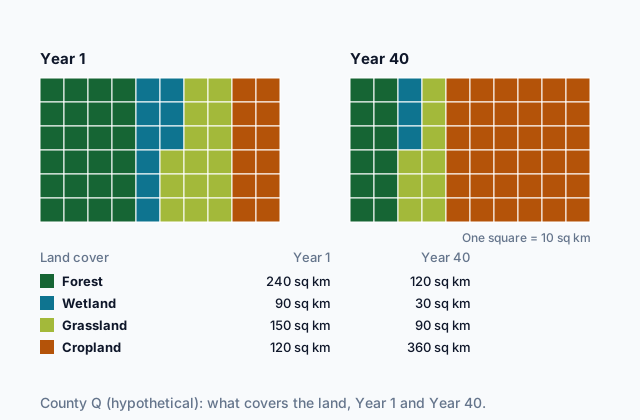
Land cover change is the replacement of one kind of surface with another: forest, grassland or wetland turned into cropland or pasture. The maps at the top of the page show hypothetical County Q, where cropland tripled in 40 years while forest halved and wetland fell by two thirds. Each change removes habitat, and bare or plowed land sheds more rain and soil than forest or grass.
Conservation efforts are steps that farmers, communities and governments take to protect soil, water and habitat. Examples include plowing across a slope instead of up and down it (contour plowing), planting cover crops between harvests, rows of trees as windbreaks, strips of grass along streams to catch runoff, and setting land aside as forest or wetland. Some reverse land cover change, as when a drained field is flooded back into a marsh.
Quick check · Fill the statement
Complete the description of a hypothetical farming county.
Pesticide sprayed on the county's orchards drains into a stream and kills its insects and fish, a form of . A century ago the county's farmers plowed most of its grassland into orchards and fields, a . Today some farmers grow cover crops between the orchard rows to hold the soil in place, a .
2b. Desertification and soil salinization
Desertification is the spread of desert-like conditions into dry land that once supported grass, shrubs or crops. Drought plays a part, but farming practices push it further. Herds kept too long on dry pasture eat plants down to the roots (overgrazing), fields are plowed and planted year after year with no rest, and shrubs and trees are cut for fuel or fields. Without roots to hold it, the topsoil dries out and blows or washes away, and the thin soil left behind holds little water, so plants struggle to come back even after rain.
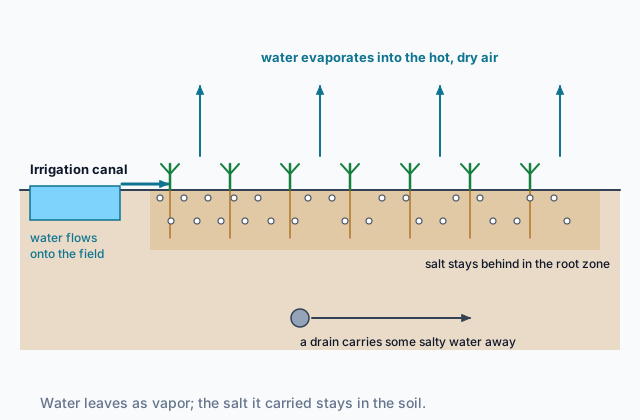
Soil salinization is the buildup of salt in soil. All irrigation water carries some dissolved salt. In a hot, dry climate much of that water evaporates from the field or is taken up by the crops, and the salt it carried stays in the soil.
 Tap to open the picture full size
Where drains are few, the salt collects in the root zone year after year, a white crust can form on the surface, and crops grow poorly or not at all, however much water they get. The two problems look alike from a distance, since both leave land that grows little. Desertification is a loss of plant cover and soil on dry land; salinization is a gain of salt in soil that is often well watered.
Quick check · Decide and justify
In a hot, dry hypothetical valley, farmers have watered their fields from a river canal for thirty years. A white crust now forms on the fields each summer, and crop harvests are falling, though the fields get as much water as ever. Which effect is this?
Which reason supports your answer?
2c. Practices that alter the landscape
Farming reshapes the land it uses. Practices that alter the landscape include these seven.
- Slash and burn: cutting down trees and brush and burning them to clear a plot. The ash fertilizes the soil for a few seasons.
- Shifting cultivation: farming a cleared plot for a few years, until its soil wears out, then clearing a new plot and leaving the old one to grow back. It usually clears land by slash and burn, and it leaves a patchwork of fields and forest of different ages.
- Deforestation: the lasting removal of a forest so the land can be used for cropland, pasture or plantations. The forest is not left to return.
- Draining wetlands: digging ditches, laying pipes or pumping water out of marshes and swamps so they can be farmed. Wetland plants and animals lose their home, and the land loses its power to soak up floodwater.
- Terraces: level steps cut into a steep hillside, each held by a wall or bank. They hold soil and water on slopes too steep to plow.
- Irrigation: bringing water to crops by canals, ditches, wells, pipes or sprinklers. It turns dry land green, and the dams and reservoirs that feed it change whole rivers.
- Pastoral nomadism: moving herds of animals, such as sheep, goats or camels, from pasture to pasture with the seasons. Grazing shapes dry grasslands, and heavy grazing near wells can strip them bare.
Quick check · Match
Each change happened in a hypothetical farming region. Match each practice to the change it made.
2d. Societal effects
Agricultural practices change societies as well as land. Societal effects include these three.
Changing diets. What farms produce shapes what people eat, and what people eat shapes what farms produce. As incomes rise and farms turn commercial, many families eat more meat, dairy and processed food, and more cropland grows feed for animals. A farm family that once ate mostly what it grew buys more of its food.
The role of women in agricultural production. In many places women do much of the planting, weeding, harvesting, processing and selling of food, and grow most of a household's own food. When farming turns to cash crops and machines, men in many places take over the crops for sale and the machinery, while women's farm work stays unpaid or shifts to other tasks. Topic 5.12 looks at these roles in depth.
Economic purpose. This is why a farm produces: to feed its own household, which is subsistence, or to sell for income, which is commercial. A change in purpose reshapes daily life. A household that plants its land in a crop to sell earns cash, but it now depends on market prices and on stores for food it once grew. A crop that feeds the family is judged by what the family needs; a crop for sale is judged by its price.
Quick check · Multiple choice
Farm families in a hypothetical valley stop growing grain, beans and vegetables for their own meals and plant all their land in coffee to sell abroad. Which societal effect follows most directly from this change in the farms' economic purpose?
Part 3 Watch it done How fast does the salt build up?
Watch each step, then do the last one yourself.
In a hot, dry hypothetical valley, each hectare of irrigated cropland receives 10,000 cubic meters of irrigation water a year. Each cubic meter carries 0.3 kilograms of dissolved salt. Nearly all the water evaporates or is taken up by the crops, which leaves its salt in the soil, and the valley's few drains carry away 1,200 kilograms of salt per hectare each year. How many kilograms of salt build up in each hectare's soil over 10 years?
Predict first
Before the steps, about how much salt do you expect each hectare to gain over 10 years?
Step 1 · Find the salt the water brings in
Each year: 10,000 cubic meters × 0.3 kilograms per cubic meter = 3,000 kilograms of salt per hectare.
Step 2 · Note what the drains remove
The drains carry off 1,200 kilograms of salt per hectare each year. Whatever the water brings in and the drains do not carry off stays in the soil.
Why this step?
Why does the salt stay in the soil when nearly all the water leaves?
Evaporation and the crops take up the water, not the salt dissolved in it. Only water that drains away through the soil can carry salt off, so in a hot, dry place with few drains the salt is left behind and adds up year after year.
Your step · Calculate
Finish it. How many kilograms of salt build up in each hectare's soil over 10 years if nothing changes?
kilograms
Part 4 Try it Read a changing landscape
Try it · Put it in order
A dry grassland in a hypothetical region turns desert-like over twenty years. Put the steps in order, from first to last.
Try it · Decide and justify
In a hypothetical forest region, farmers cut and burn a plot of forest, grow crops on it for three years, then clear a new plot and leave the old one to grow back. After fifty years the region is a patchwork of fields and young and old forest, and its total forest area has changed little. Which practice describes this farming best?
Which reason supports your answer?
Part 5 Explain it Explain a country's changing farms
Nothing you type leaves this page. Check your answer against the model and each scoring point.
Free response is 50% of the exam score. This one is shaped like Question 2, from free-response II.
Free-response practice · Question 2 style
Stimulus, a hypothetical table for Country T, Year 1 and Year 30: meat eaten per person each year, 15 kilograms and 45 kilograms; land planted in animal feed crops, 2 million hectares and 6 million hectares; forest, 20 million hectares and 15 million hectares; share of farms that sell most of what they grow, 30 percent and 70 percent.
(A) Identify the change in diet shown in the table.
(B) Describe the change in land cover shown in the table.
(C) Explain how the change in diet is connected to the change in land cover.
(D) Explain one environmental effect, other than land cover change, that could follow from growing more feed crops.
(E) Describe one conservation effort that could reduce the effect you named in part (D).
(F) The table shows a change in the economic purpose of Country T's farms. Explain one way this change could alter the role of women in agricultural production.
(G) Explain one limitation of national data like this table for showing where the environmental effects of farming happen.
Model answer
(A) People in Country T eat three times as much meat as before, 45 kilograms a person each year instead of 15.
(B) Forest fell from 20 million hectares to 15 million, while land in feed crops rose from 2 million to 6 million hectares.
(C) Meat comes from animals that eat feed crops. As people eat more meat, more land is needed to grow feed, and some of that land likely came from cleared forest, which would explain why forest shrank as feed land grew.
(D) Feed crops are often grown with heavy fertilizer. Rain washes some of it into rivers and lakes, where it feeds algae that use up the oxygen fish need, a form of water pollution.
(E) Farmers could leave strips of grass or trees along streams to catch fertilizer before it reaches the water, or plant cover crops that hold soil and nutrients on the field.
(F) More farms now sell most of what they grow. Where men take over the cash crops and the machinery, women may lose control of land they once farmed for the family, or their work may shift to unpaid tasks such as processing food at home.
(G) A national total does not show where in Country T the forest was cleared or where the fertilizer runs off. The effects may be concentrated in a few regions, so the national scale can hide large local differences.
Score your own answer. This is a self-check, not a grade. Tick each point your answer makes.
Part 6 Check yourself Salt in Basin R
The case questions use the table. The others mix the ideas from the whole lesson.
Hypothetical Basin R lies in a hot, dry region. Starting in Year 0, its farmers dug canals from the river to irrigate new fields, and drained marshes along the river to plant more crops.
| Year | Irrigated cropland | Irrigated cropland with salt-damaged soil | Wetland |
|---|---|---|---|
| 0 | 400 | 0 | 300 |
| 15 | 700 | 70 | 150 |
| 30 | 900 | 270 | 60 |
Case question 1 · Calculate
In Year 30, what percentage of Basin R's irrigated cropland had salt-damaged soil?
Case question 2 · Multiple choice
Which conclusion do the data in the table best support?
Case question 3 · Multiple choice
Basin R's farmers want to stop the salt damage and keep farming. Which conservation effort fits their problem best?
The rest stand on their own and do not use the case.
Check yourself · Sort it
Each card describes a societal effect of farming in a hypothetical place. Tap a card, then the kind of effect it shows.
Changing diets
Role of women in agricultural production
Economic purpose
Check yourself · Spot the error
A student describes how farming changed a hypothetical hill region. Which line is the first to go wrong?
Part 7 Keep it Bring back earlier ideas
This lesson stands on earlier Unit 5 ideas about how farming practices and settlement shape the land.
From 5.5 The Green Revolution · Fill the statement
Complete the description of two environmental consequences of the Green Revolution in a hypothetical farming region.
When farmers across the region replace dozens of local rice varieties with a few high yielding ones, its crops lose genetic , so a new plant disease can spread through its fields than before. And as each hectare now grows more rice, the region needs new farmland to feed the same number of people.
From 5.2 Settlement Patterns and Survey Methods · Fill the statement
Complete the description of two rural survey methods.
Under , a property's boundary is traced from landmark to landmark, such as a tree, a bend in a stream or a stone wall, so its fields take shapes that follow the land. Under the long-lot method, each farm is a narrow strip with on a river or road, running far back from it.
In three lines
- Environmental effects of agricultural land use include pollution, land cover change, desertification and soil salinization; conservation efforts try to reduce them.
- Slash and burn, shifting cultivation, deforestation, draining wetlands, terraces, irrigation and pastoral nomadism each reshape the landscape in their own way.
- Societal effects include changing diets, the role of women in agricultural production and a farm's economic purpose, subsistence or commercial.
Exam strategy for this topic
- Section I, Multiple Choice: 60 questions in 60 minutes.
- Section II, Free Response: 3 questions in 75 minutes.
When a question asks for a consequence of a farming practice, name the practice, say what it does to the land or to people, and say whether the effect is environmental or societal. When a table is given, quote the numbers that show the change.
Questions students ask
What is the difference between desertification and soil salinization?
Desertification is dry land losing its plant cover and soil until it turns desert-like, pushed by drought and practices such as overgrazing. Soil salinization is salt building up in soil, mostly where irrigation water evaporates in a dry climate and few drains carry the salt away.
Is slash and burn the same as shifting cultivation?
No. Slash and burn is a way of clearing a plot, by cutting and burning its plants. Shifting cultivation is a farming system that farms a plot for a few years, then moves on and lets it regrow; it usually uses slash and burn to clear each new plot.
Can a farming practice be good for the land?
Yes. Terraces hold soil on steep slopes, and conservation efforts such as cover crops, windbreaks and grass strips along streams protect soil and water. Many practices help in one way and harm in another, so weigh both.
What does economic purpose mean for a farm?
It is why the farm produces: to feed its own household, which is subsistence, or to sell for income, which is commercial. When the purpose changes, so do the household's diet, its income and often who does which work.
Are the places and numbers in this lesson real?
No. Every county, valley, basin, country and number here is hypothetical, chosen to show each idea clearly. The practices and effects are real ones that geographers study.
Course alignment, for teachers
AP Human Geography topic 5.10, Unit 5: Agriculture and Rural Land-Use Patterns and Processes.
- Skill 2.E: Explain the degree to which a geographic concept, process, model, or theory effectively explains geographic effects in different contexts and regions of the world.
This lesson maps all 3 essential knowledge statements of the topic to the part that teaches each one: 3 are checked by a scored question. The map is in the lesson file.