Unit 5 · Topic 5.11 · about 30 minutes · 7 parts · 12 scored checks, 3 of them multiple choice, plus 2 from earlier lessons
AP Human Geography 5.11: Challenges of Contemporary Agriculture
Unit 5: 12 to 17% of the multiple-choice section
What you'll be able to do
- Explain the challenges and debates that come with how food is produced today: new farming technology, food-choice movements, the problems of feeding a growing population, and the economic forces that shape what farms produce.
Key vocabulary
| Term | What it means | The exam trap |
|---|---|---|
| Biotechnology | The use of living things, or their genes, to make or improve products; in farming, mostly changing the genes of crops and animals. | It names a set of techniques, and a GMO is one thing those techniques produce, so keep the two terms apart. |
| Genetically modified organism (GMO) | A plant or animal whose DNA has been changed in a lab, for example to resist an insect or survive a weedkiller. | Crossbreeding plants the ordinary way over generations also changes crops, but it does not make a GMO. |
| Aquaculture | The farming of fish, shellfish or water plants in ponds, tanks or pens, instead of catching them wild. | A fishing boat that catches wild fish is not aquaculture, however modern its gear. |
| Sustainability | Meeting today's needs, here for food, without using up the soil, water and living variety that future farming will need. | It is judged over many years, so look past a single season's figures. |
| Biodiversity | The variety of living things in a place, including the varieties within one crop or one kind of animal. | It is measured for a place, so compare the same place before and after a change. |
| Urban farming | Growing food or raising animals inside a city, on rooftops, empty lots, balconies or community gardens. | Location defines it: a farm outside the city that sells to city people is not urban farming. |
| Community-supported agriculture (CSA) | An arrangement in which households pay a farm before the growing season and receive a share of its harvest through the season. | Members share the farm's risk: a poor harvest means smaller shares, not a refund. |
| Organic farming | Farming without synthetic fertilizers, synthetic pesticides or engineered seeds, under standards a certifier checks. | Organic farms still fight pests and feed the soil, with methods the standards allow. |
| Value-added specialty crop | A specialty crop, such as fruit, nuts or heirloom vegetables, that earns a higher price because of what the farm does to it: processing, packaging, certification or branding, such as fruit made into jam. | The extra value comes from what is done to the crop, so a bigger harvest of the same raw crop is not value added. |
| Fair trade | A certification that promises farmers and workers, often in poorer countries, a minimum price and fair working conditions, in return for buyers paying more. | It sets the terms of trade; it does not by itself say how the food was grown. |
| Local-food movement | Buying food grown near where it is eaten, from nearby farms, farmers markets, and stores and restaurants that buy from them. | There is no single cutoff distance; each program or store sets its own. |
| Dietary shift | A change over time in what a population eats, such as more meat as incomes rise, or less meat by choice. | It is a change across a population over time, so one meal or one shopper's taste does not show one. |
| Food insecurity | When a household cannot count on enough safe, nutritious food for an active, healthy life, most often because it cannot afford it. | It describes a household's situation over time, so one skipped meal does not make a household food insecure. |
| Food desert | An area where people have poor access to affordable, nutritious food, usually where a full-service grocery store is far away and many residents lack a car or transit. | Desert is a figure of speech here; the term has nothing to do with climate or rainfall. |
| Distribution system | The chain of storage, transport and selling that moves food from farms to the people who eat it. | It includes storage and refrigeration as well as trucks and stores. |
| Suburbanization | The growth of homes, roads and stores on the edges of cities, often onto land that was farmed. | Suburbs grow outward from a city, so the farmland lost first is usually the land nearest the city. |
| Food-processing facility | A plant that turns raw farm products into food for sale, such as a cannery, a mill or a meatpacking plant. | Processing sits between the farm and the store, so it is a step after growing, not part of it. |
| Economies of scale | The savings a business gets as it grows, because fixed costs such as buildings and machines are spread over more output, lowering the cost of each unit. | A bigger business pays more in total; the saving shows up in the cost of each unit. |
 Tap to open the picture full size
Part 1 Think first Guess where the spraying goes
Make a guess before you read. A wrong guess now makes the idea easier to remember.
Predict first
A farmer in hypothetical Brook County starts planting a corn variety engineered to survive a common weedkiller, so she can spray the whole field and kill the weeds without harming the corn. She uses the same weedkiller every year. Over the next ten years, what do you predict happens to the amount of weedkiller she uses?
In short. Contemporary agriculture comes with debates over new technology, changes driven by what shoppers choose to buy, problems getting food to everyone who needs it, and economic forces that shape what farms produce.
- Biotechnology, genetically modified organisms and aquaculture can raise output, and each is debated over sustainability, soil and water use, reductions in biodiversity, and heavy fertilizer and pesticide use.
- Food-choice movements, among them urban farming, CSAs, organic farming, value-added specialty crops, fair trade, local food and dietary shifts, change what farms grow and how they sell it.
- Feeding everyone is held back by food insecurity and food deserts, failing distribution systems, adverse weather and farmland lost to suburbs, and processing plants, economies of scale and government policy shape how food is produced.
Part 2 Learn it Debates and challenges in farming today
2a. New farming technology and its debates
Biotechnology is the use of living things, or their genes, to make or improve products. In farming it mostly means changing crops and animals at the level of their genes. A genetically modified organism (GMO) is a plant or animal whose DNA has been changed in a lab, such as a crop given a gene to resist an insect or to survive a weedkiller. Aquaculture is the farming of fish, shellfish or water plants in ponds, tanks or pens.
These innovations, among others, can produce more food from the same land or water, and each is debated:
- Sustainability: can the method keep producing for generations without using up what farming depends on? The three debates below are parts of it.
- Soil and water usage: crops grown in dry places and fish ponds filled from wells can drain water supplies, and planting one crop on the same fields year after year can wear out and erode the soil.
- Reductions in biodiversity, the variety of living things in a place: when farmers across a region switch to one engineered variety, older local varieties disappear, and escaped farmed fish can breed with wild fish and weaken them.
- Extensive fertilizer and pesticide use: crops bred for high yields can need heavy fertilizer, and weeds and insects that adapt can push spraying back up.
Supporters answer that some engineered crops need less spraying or survive drought, and that fish farms take pressure off wild fish.
Quick check · Sort it
Each card describes a worry about a new farming method in a hypothetical place. Every card is a sustainability worry; sort each one by the narrower debate it belongs to. Tap a card, then its debate.
Soil and water usage
Reductions in biodiversity
Fertilizer and pesticide use
2b. Food choices that reshape farming
Some changes in farming start with the people who buy food. Movements tied to individual food choice include these, among others:
- Urban farming: growing food or raising animals inside a city, on rooftops, empty lots or community gardens.
- Community-supported agriculture (CSA): households pay a farm before the season starts and receive a share of its harvest through the season, so they share the risk of a poor year.
- Organic farming: farming without synthetic fertilizers, synthetic pesticides or engineered seeds, under standards a certifier checks.
- Value-added specialty crops: specialty crops, such as fruit, nuts or heirloom vegetables, that earn a higher price because of what the farm does to them: processing, packaging, certification or branding, such as grapes made into wine on the farm.
- Fair trade: a certification that promises farmers and workers, often in poorer countries, a minimum price and fair working conditions, paid for by buyers who pay more.
- Local-food movements: buying food grown close to where it is eaten, from nearby farms, farmers markets, and stores and restaurants that buy from them.
- Dietary shifts: changes over time in what a population eats, such as more meat as incomes rise, or less meat by choice.
Each choice moves money and land. A CSA lets a small farm near a city earn more from each hectare than bulk grain would, certification lets a farm charge a premium, and a shift away from beef frees pasture for other uses.
Quick check · Match
Match each food-choice movement to the example of it from a hypothetical place.
2c. Feeding everyone
Growing enough food is only part of feeding people. The challenges of feeding a global population include these:
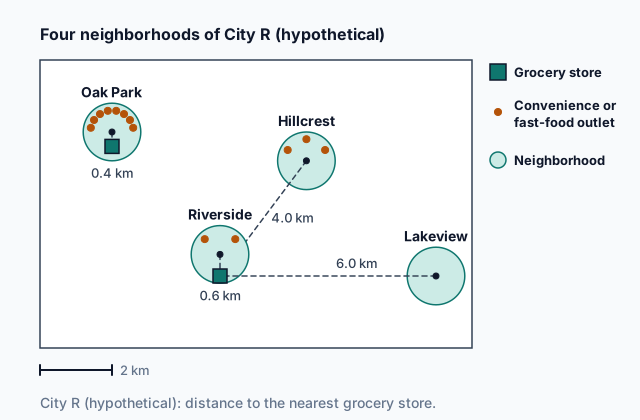
- Lack of food access. Food insecurity is when a household cannot count on enough safe, nutritious food, most often because it cannot afford it. A food desert is an area where people have poor access to affordable, healthy food, usually a neighborhood far from a full-service grocery store where many residents have no car or good transit. Convenience stores and fast food may be close by while fresh produce is not. The two ideas overlap but measure different things: food insecurity describes a household, a food desert describes a place.
- Problems with distribution systems. A distribution system is the chain of storage, transport and selling that moves food from farms to the people who eat it. Bad roads, too little storage or refrigeration, conflict or high fuel costs can keep food from reaching people, and stored food can rot before it moves.
- Adverse weather. Drought, floods, frost and storms can ruin a season's harvest.
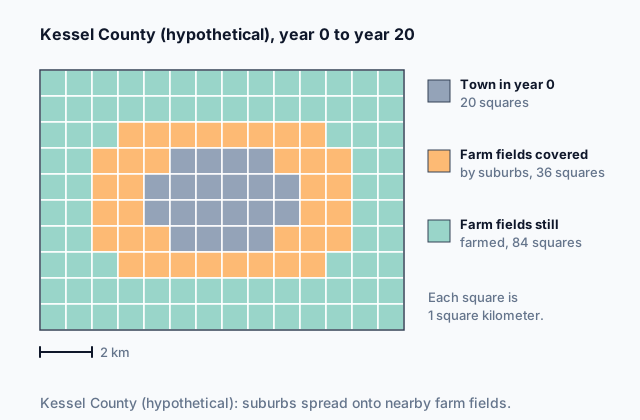
- Land use lost to suburbanization. Suburbanization is the growth of homes, roads and stores on the edges of cities. Much of it is built on farmland, often flat, fertile land close to the city, so there is less land to farm just as there are more people to feed.
The map at the top of the page shows that last challenge in a hypothetical county.
Quick check · Decide and justify
Hypothetical Country W's farms harvest more grain each year than its people eat. Most of the grain is grown and stored in the south. Every spring, villages in the dry, mountainous north run short of food, while the southern warehouses still hold grain from the last harvest. Which challenge best explains the shortages in the north?
Which reason supports your answer?
2d. The economics behind what farms produce
These economic forces shape what farms grow and how they grow it:
- The location of food-processing facilities and markets. A food-processing facility turns raw farm products into food for sale: a cannery, a mill, a meatpacking plant. Farms that sell to one cluster within easy trucking distance of it, and foods that spoil quickly, such as milk and fresh vegetables, are grown close to the cities that buy them. When a plant closes or moves, nearby farmers may have to haul farther or change what they grow.
- Economies of scale. Economies of scale are the savings a business gets as it grows: the cost of buildings, machines and managers is spread over more output, so each unit costs less to make. Large plants and large farms can sell more cheaply, so processors often buy from fewer, bigger farms, and small farms sell out or find a niche.
- Distribution systems. Refrigerated trucks, warehouses and supermarket chains decide which foods reach which markets. A farm that cannot get its harvest into that chain cannot sell it, however good it is.
- Government policies. A subsidy is a government payment to producers, which makes a product more profitable to produce. A tariff is a tax on imports, which raises the price of foreign food and helps home farmers sell theirs. Price supports, food-safety rules and zoning that keeps land in farming change what farms do too.
Quick check · Fill the statement
Complete the description of hog farming in a hypothetical country.
A meatpacking company in hypothetical Country N closes three small plants and builds one large one, which packs each kilogram of pork more cheaply than the small plants did. That saving is called . Hog farmers far from the new plant now pay more to truck their animals to it, so the farms most likely to keep selling to the plant are the ones it. Country N's government also charges a on every kilogram of pork brought in from abroad, which helps its own hog farmers sell theirs. A supermarket chain will stock the plant's pork only if it arrives chilled by refrigerated truck, so a hog farm with no route into that cannot sell to the chain.
Part 3 Watch it done Which cannery packs more cheaply?
Follow the steps, then finish the last one on your own.
Tomato growers in a hypothetical farming region sell to canneries. A small cannery has fixed costs (its building, machines and managers) of 600,000 dollars a year, spends 20 cents to pack each can, and packs 1,000,000 cans a year. A large cannery has fixed costs of 2,400,000 dollars a year, spends 15 cents to pack each can, and packs 8,000,000 cans a year. Find the cost of each can at each cannery.
Predict first
Before the steps, which cannery do you expect to pack each can more cheaply?
Step 1 · Write the cost of one can
Cost per can = fixed costs ÷ cans packed, plus the cost to pack one can. Fixed costs are paid whatever the output, so they are shared by every can.
Step 2 · Work out the small cannery
600,000 dollars ÷ 1,000,000 cans = 0.60 dollars, or 60 cents a can. Add the 20 cents it spends to pack each can: 80 cents a can.
Why this step?
Why spread the fixed costs over the cans instead of comparing the two canneries' fixed costs directly?
A large plant pays more in total but packs far more cans, so each can carries a smaller share of the fixed costs. The cost of each can is what decides which cannery can pay growers more or sell for less.
Your step · Calculate
Finish it. Work out the large cannery's cost per can, in cents, the same way: its fixed costs spread over its own cans, plus what it spends to pack each can.
cents per can
Part 4 Try it A county at the edge of a growing city
Hypothetical Kessel County lies on the edge of a growing city. The map at the top of the page shows it as a grid of 1-square-kilometer squares, comparing year 0 with year 20. Over those twenty years the county's population roughly doubled.
Try it · Calculate
In year 0, hypothetical Kessel County had 120 squares of farm fields outside its town. By year 20, new suburbs had covered 36 of them. What percent of the county's year-0 farmland was lost to suburbs over those twenty years?
Try it · Multiple choice
Hypothetical Country K, where Kessel County lies, has many dairy farms. Its government begins paying dairy farmers a subsidy for every liter of milk they sell. Which change in Country K's farming is most likely?
Part 5 Explain it Explain the challenges of farming today
This is a self-check: nothing you type leaves this page. Compare your answer with the model and the scoring points.
Free response is 50% of the exam score. This one is shaped like Question 1, from free-response II.
Free-response practice · Question 1 style
Answer each part.
(A) Define aquaculture.
(B) Describe one debate over the use of genetically modified crops.
(C) Explain how community-supported agriculture (CSA) changes the way a small farm earns its income.
(D) Describe the difference between food insecurity and a food desert.
(E) Explain how suburbanization can make it harder to feed a growing population.
(F) Explain how economies of scale at a large food-processing plant can change the size of the farms that supply it.
(G) Explain one way a government policy can change what farmers choose to produce.
Model answer
(A) Aquaculture is the farming of fish, shellfish or water plants in controlled water such as ponds, tanks or pens, instead of catching them wild.
(B) One debate is over biodiversity. Supporters say engineered crops raise yields on the same land. Critics answer that when farmers across a region switch to one engineered variety, the older local varieties disappear, which leaves the region's crops less varied and more exposed to a single pest or disease.
(C) In a CSA, households pay the farm before the season and receive a share of the harvest through the season. The farm gets its money early, when it needs to buy seed and pay workers, and the members share the risk of a poor harvest, so the farm depends less on selling each crop at market prices.
(D) Food insecurity describes a household that cannot count on enough safe, nutritious food, often because it cannot afford it. A food desert describes a place where people have poor access to affordable, healthy food, such as a neighborhood far from a grocery store where many residents have no car.
(E) Suburbs are often built on the flat, fertile farmland closest to a growing city. As they spread, that land stops producing food, so there is less farmland just as the number of people to feed grows.
(F) A large plant spreads its fixed costs over more output, so each unit costs less. It prefers to buy from farms that can supply large, steady amounts at low cost, so it signs contracts with fewer, bigger farms, and small farms that cannot match their costs sell out or are bought up.
(G) A subsidy pays farmers for each unit of a crop they produce. That makes the crop more profitable than others, so farmers move land and money into it and produce more of it.
Score your own answer. This is a self-check, not a grade. Tick each point your answer makes.
Part 6 Check yourself Food access in City R
The first three questions use the map and the table. The last two mix ideas from the whole lesson.
Hypothetical City R's planning office mapped its four neighborhoods and their distance to the nearest full-service grocery store, and surveyed households in each one.
 Tap to open the picture full size
| Neighborhood | Households | Low-income households | Households without a car | Food-insecure households |
|---|---|---|---|---|
| Hillcrest | 2,400 | 40% | 45% | 28% |
| Riverside | 3,000 | 42% | 30% | 31% |
| Oak Park | 2,000 | 12% | 15% | 9% |
| Lakeview | 1,500 | 5% | 3% | 4% |
Case question 1 · Multiple choice
Using the map and the table, which neighborhood best fits the definition of a food desert?
Case question 2 · Calculate
How many households in Hillcrest have no car?
Case question 3 · Multiple choice
City R's council wants to reduce food insecurity in Riverside. Using the map and the table, which plan fits Riverside's situation best?
The rest stand on their own and do not use the case.
Check yourself · Spot the error
A student judges a new shrimp farm in a hypothetical country. Which line is the first to go wrong?
Check yourself · Select all
Members of a food co-op in a hypothetical town describe four changes in how they shop and eat. Which two are examples of the local-food movement? Select two.
Select 2 answers, then check.
Part 7 Keep it Bring back earlier ideas
This lesson stands on the consequences of farming practices from Topic 5.10 and the global system of agriculture from Topic 5.9.
From 5.10 Consequences of Agricultural Practices · Decide and justify
In a hot, dry hypothetical valley, farmers have watered their fields from a river canal for thirty years. A white crust now forms on the fields each summer, and crop harvests are falling, though the fields get as much water as ever. Which effect is this?
Which reason supports your answer?
From 5.9 The Global System of Agriculture · Calculate
Hypothetical Country K earns $800 million a year from its exports. Of that, $440 million comes from cacao beans and $120 million from cut flowers. What percentage of Country K's export earnings comes from cacao beans?
In three lines
- New technology: biotechnology, GMOs and aquaculture raise output and are debated over sustainability, soil and water, biodiversity, and fertilizer and pesticide use.
- Food choices and access: movements such as CSAs, organic, fair trade and local food reshape farming, while food insecurity, food deserts, distribution, weather and suburbs stand between harvest and table.
- Economics: processing plants, economies of scale, distribution systems and government policy decide what farms produce and how big they grow.
Exam strategy for this topic
- Section I, Multiple Choice: 60 questions in 60 minutes.
- Section II, Free Response: 3 questions in 75 minutes.
When a question names a challenge, say who or what it affects: food insecurity describes a household, a food desert a place, and suburbanization the land. When it names an innovation or a policy, give its effect on production and one side of the debate, with a reason.
Questions students ask
Are genetically modified foods safe to eat?
That question is part of the public debate. In this course the task is to explain the debates that come with GMOs and other innovations, over sustainability, soil and water use, biodiversity, and fertilizer and pesticide use, and to give the reasoning on each side.
What is the difference between a CSA and a farmers market?
At a farmers market you buy what you want, item by item, on the day. In a CSA you pay the farm before the season for a share of whatever it harvests, so you share the risk of a poor year and the farm gets its money early.
Why does suburbanization matter for food?
Suburbs are built on land, and much of it near cities was farmland, often flat and fertile. Once it is covered by homes and roads it stops producing food, while the people moving in add to the number to feed.
Do economies of scale help or hurt farmers?
Both, depending on the farm. They let large farms and plants produce each unit more cheaply, which can lower prices, and they squeeze small farms that cannot match those costs, which often sell out or turn to niches such as CSAs or value-added crops.
Are the places in this lesson real?
No. Every country, county, city, neighborhood and farm here is hypothetical, with numbers chosen to show each idea clearly.
Course alignment, for teachers
AP Human Geography topic 5.11, Unit 5: Agriculture and Rural Land-Use Patterns and Processes.
- Skill 4.D: Compare patterns and trends in visual sources to draw conclusions.
This lesson maps all 4 essential knowledge statements of the topic to the part that teaches each one: 4 are checked by a scored question. The map is in the lesson file.