Unit 5 · Topic 5.9 · about 30 minutes · 7 parts · 12 scored checks, 3 of them multiple choice, plus 2 from earlier lessons
AP Human Geography 5.9: The Global System of Agriculture
Unit 5: 12 to 17% of the multiple-choice section
What you'll be able to do
- Explain how regions that grow food and regions that buy it depend on one another: follow a product through a global supply chain, measure how much a country depends on its export commodities, and explain how political relationships, infrastructure and patterns of world trade shape where food is sold.
Key vocabulary
| Term | What it means | The exam trap |
|---|---|---|
| Global supply chain | The series of steps, and the places they happen, that a food or other agricultural product passes through from farm inputs to the person who uses it. | It covers farm products that are not food, such as cotton and cut flowers, as well as food. |
| Interdependence | The condition in which regions rely on one another, as farming regions need buyers and consuming regions need farms. | It is a relationship between regions, so name the region on each side of it. |
| Export commodity | A raw or lightly processed product, such as coffee beans or cotton, that a country sells abroad in bulk. | A country can be dependent on two or three commodities, not only on one. |
| Food distribution network | The routes, links and agreements that move food from where it is grown to where it is eaten. | Three things shape it: political relationships, infrastructure and patterns of world trade, so name which one a question is about. |
| Political relationships | The ties between governments, friendly or hostile, that set the rules for what may cross a border. | Name the government action, such as a tariff or an agreement, rather than writing only "politics". |
| Infrastructure | The built network that moves and stores goods, such as roads, railroads, ports, airports and refrigerated warehouses. | Name the built thing, such as the road, the port or the warehouse, when you use the term. |
| Patterns of world trade | The regular flows of a product between regions: which export it, which import it, and how much moves along each link. | It describes flows between regions, so read it from data on who exports and who imports. |
 Tap to open the picture full size
Part 1 Think first A frost far away
Commit to a guess first. Being wrong now makes the right idea stick better.
Predict first
A hard frost destroys half of this year's orange crop in hypothetical Country G, which grows most of the oranges that the world's juice makers buy. Hypothetical Country H, far away, grows no oranges at all. What happens to the price of orange juice in Country H's grocery stores over the next months?
In short. Food and other agricultural products move through a global supply chain that links the regions that grow them to the regions that buy them, so those regions depend on one another.
- A global supply chain runs from farm inputs through growing, processing, shipping and sale, and each step can sit in a different country.
- Some countries are highly dependent on one or more export commodities: measure it as the commodity's share of total export earnings, and expect a price fall or a bad harvest to hit the whole country.
- Political relationships, infrastructure and patterns of world trade decide where food can go: a tariff, a missing road or an old trade route can matter as much as the harvest.
Part 2 Learn it How food moves around the world
2a. The global supply chain
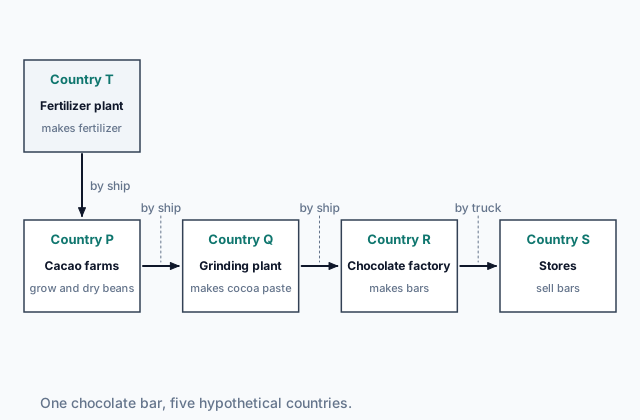
Much of what you eat crossed a border before it reached you. A global supply chain is the series of steps, and the places they happen, that a food or other agricultural product passes through on its way from the farm to the person who uses it. It starts with farm inputs such as seed, fertilizer and machinery, then growing and harvesting, then processing, storage and shipping, and ends with sale to consumers. Each step can happen in a different country.
 Tap to open the picture full size
No country in the picture could make the bar alone. Country P has the climate for cacao but no factory; Country R has the factory but grows no cacao; Country S's shoppers rely on all of them. That is interdependence: regions of production and regions of consumption each need the others. Farmers in P need buyers abroad, and stores in S need farms abroad. So a change at one step, such as a poor harvest, a factory closing or a jump in shipping costs, travels along the chain to places far from where it began.
Food is not the only thing that moves this way. Cotton, rubber, wool and cut flowers are agricultural products too, and each has its own chain from farm to buyer.
Quick check · Put it in order
A cotton T-shirt sold in hypothetical Country Y began on a farm in hypothetical Country W. Put the steps of its supply chain in order, from first to last.
2b. Depending on export commodities
An export commodity is a raw or lightly processed product that a country sells abroad in bulk, such as coffee beans, cacao, bananas, sugar or cotton, where one grower's crop is much like another's. Some countries have become highly dependent on one or more export commodities: one product, or a few, earns most of the money the country makes selling abroad.
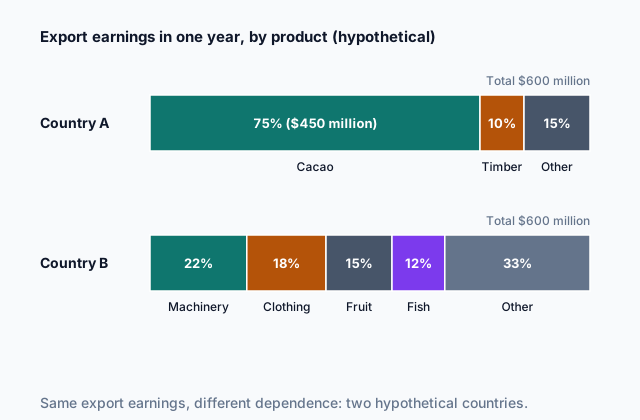
Measure dependence as a share. Divide what the commodity earns by the country's total export earnings. The chart at the top of the page shows two hypothetical countries that each earn $600 million a year from exports. Cacao earns $450 million of Country A's: 450 ÷ 600 = 0.75, or 75 percent. No single export earns even a quarter of Country B's.
Dependence ties a country's income to things it cannot control. A commodity's world price rises and falls with harvests in other countries and with demand far away, and one drought, storm or crop disease can cut the harvest at home. When the price of its main export falls, a dependent country's farmers, farmworkers, traders and government all lose income at the same time, and it has few other products to sell instead. Country B, earning from many products, feels a fall in any one price much less.
Dependence can rest on two or three commodities as well. A country that earns most of its export money from coffee and tea together is still highly dependent.
Quick check · Calculate
Hypothetical Country K earns $800 million a year from its exports. Of that, $440 million comes from cacao beans and $120 million from cut flowers. What percentage of Country K's export earnings comes from cacao beans?
2c. Political relationships
A food distribution network is the set of routes, links and agreements that moves food from where it is grown to where it is eaten. Its main elements are affected by three things: political relationships, infrastructure and patterns of world trade. This chunk takes the first.
Political relationships are the ties, good or bad, between governments, and they decide much of what may cross a border.
- A tariff is a tax on imports. It raises the price of foreign food in the country's stores and protects its own farmers from that competition.
- A trade agreement can remove tariffs between the countries that sign it, so more food flows between them.
- An embargo bans some or all trade with another country, often after a dispute. Its buyers must find other sellers, and its farmers lose a market.
- A subsidy is a government payment to its own farmers. It can let their crops sell abroad for less than other exporters' crops.
Food aid from one government to another follows political ties too. Countries on good terms trade more food with each other, and a war or a broken alliance can close a route that ran for decades.
Quick check · Match
Match each political tool to the event that shows it.
2d. Infrastructure and patterns of world trade
Infrastructure is the built network that moves and stores food: roads, railroads, ports, airports, grain elevators, warehouses, and the cold chain, the refrigerated trucks, ships and storage that keep fresh food cold from farm to store. A region can grow a crop well and still sell none of it abroad if the crop cannot reach a port or airport in time. Grain keeps for months and can wait for a slow train. Berries, fresh fish and cut flowers spoil in days, so they need fast transport and cold storage at every step. A new highway, port or cold-storage warehouse can open a farming region to buyers on another continent.
Patterns of world trade are the regular flows of each product between regions: which regions export it, which import it, and how much moves along each link. For many crops, a handful of exporting countries supply buyers in a great many importing ones. Fresh fruit grown in one hemisphere's summer fills stores in the other hemisphere's winter. These flows are slow to change. Buyers keep dealing with sellers, shipping lines and ports they already know, so a country that has long sold most of a crop to one market cannot switch to new buyers overnight.
Quick check · Fill the statement
Complete the description of a hypothetical farming region.
Growers in an inland region of hypothetical Country N pick fresh strawberries, and buyers overseas want them. Grain from the same region already reaches the coast on a slow, unrefrigerated railroad, but grain can wait for months while strawberries within days. A paved highway to the port would improve the region's , and refrigerated trucks on it with refrigerated warehouses at the port would give the berries a .
Part 3 Watch it done How far do export earnings fall?
Watch each step, then do the last one yourself.
Hypothetical Country M earns $500 million a year from exports: $300 million from coffee, $100 million from tea and $100 million from everything else. One year the world price of coffee falls by 30 percent. Country M sells the same amount of coffee as before, and its other exports earn the same as before. By what percentage do Country M's total export earnings fall?
Predict first
Before the steps, how far do you expect Country M's total export earnings to fall?
Step 1 · Find coffee's share
Coffee earns $300 million of Country M's $500 million: 300 ÷ 500 = 0.60. Sixty percent of M's export earnings come from one commodity, so M is highly dependent on coffee.
Step 2 · See what changes
Only coffee's earnings change. The same amount of coffee sold at a price 30 percent lower earns 30 percent less than its $300 million, while tea and the other exports still earn $200 million.
Why this step?
Why work out coffee's loss on its own, instead of cutting the whole $500 million by 30 percent?
Only the coffee price fell. Tea and the other exports earn what they did, so the loss is 30 percent of the coffee money, not of everything. How hard that loss hits the country depends on how large a share of the total coffee is.
Your step · Calculate
Finish it. By what percentage do Country M's total export earnings fall? Give the nearest whole percent.
percent
Part 4 Try it When prices and rules change
Try it · Rank it
Record harvests in many banana-growing regions push the world price of bananas down by 20 percent. Each of these hypothetical countries sells the same amount of bananas as before, and its other exports earn the same as before. Rank the countries by how much the price fall cuts their total export earnings, as a percentage of those earnings. Work out each country's banana share first.
Largest percentage cut first
Give each one a place, 1 for first. Give two the same place if they are equal.
Your ranking: none yet
Try it · Decide and justify
Hypothetical Country N has long charged a high tariff on imported rice. A new government removes the tariff, and cheaper rice from abroad starts arriving in N's markets. Which group in Country N is most likely to lose income?
Which reason supports your answer?
Part 5 Explain it Explain a country's coffee trade
Nothing you type leaves this page. Check your answer against the model and each scoring point.
Free response is 50% of the exam score. This one is shaped like Question 3, from free-response II.
Free-response practice · Question 3 style
Stimulus 1, a hypothetical table of Country V's export earnings in one year: coffee, $640 million; cut flowers, $80 million; timber, $40 million; all other exports, $40 million; total, $800 million.
Stimulus 2, a hypothetical map of Country V: the coffee farms are in the central highlands, and they grow about a third of all the coffee sold on world markets. One railroad runs from the highlands to the country's only seaport. Ships from the port carry most of the coffee to hypothetical Country U, which has a trade agreement with Country V that lets V's coffee in without a tariff.
(A) Using Stimulus 1, identify the commodity on which Country V's export earnings depend most.
(B) Using Stimulus 1, describe how dependent Country V is on that commodity.
(C) Explain one effect on Country V of a sharp fall in the world price of coffee.
(D) Using Stimulus 2, explain how Country V's infrastructure affects its coffee exports.
(E) Using Stimulus 2, explain how a political relationship affects where Country V's coffee is sold.
(F) A frost ruins most of Country V's coffee harvest. Describe one effect at the local scale of a highland farming town and one effect at the global scale.
(G) Explain one limitation of Stimulus 1 for judging how dependent Country V is on coffee.
Model answer
(A) Coffee.
(B) Coffee earns $640 million of $800 million, or 80 percent of Country V's export earnings, so the country is highly dependent on one export commodity.
(C) With 80 percent of its export income from coffee, a fall in the coffee price cuts the income of V's farmers, farmworkers and traders and the taxes the government collects on exports, and V has few other exports to make up the loss.
(D) The coffee reaches buyers abroad only along the one railroad to the one seaport. Coffee keeps well, so slow rail works, but if the line or the port closes, V's coffee exports stop, and the farms cannot reach any other market.
(E) The trade agreement with Country U lets V's coffee in without a tariff, so V's coffee costs buyers in U less than coffee from countries that pay the tax. That is why most of V's coffee goes to U, and it ties V's farmers to U's buyers.
(F) Locally, the farm families of a highland town lose most of a year's income, and the town's shops and workers lose customers. Globally, V grows about a third of the world's traded coffee, so losing most of its harvest shrinks world supply and raises the price for roasters and coffee drinkers in Country U and other importing countries.
(G) The table shows a single year. Coffee's share could be higher or lower in a year when the price or harvest changes, so one year cannot show whether V's dependence is steady, growing or shrinking.
Score your own answer. This is a self-check, not a grade. Tick each point your answer makes.
Part 6 Check yourself Country D's exports
The case questions use the table. The others mix the ideas from the whole lesson.
In Year 1, no paved road linked hypothetical Country D's highland farms to its capital's airport, and the airport had no refrigerated storage. Between Year 1 and Year 10, D paved a highway from the highlands to the airport and built refrigerated warehouses there. It also signed a trade agreement with hypothetical Country E that ended E's tariff on D's cut flowers. By Year 10, most of D's flowers are flown to E.
| Export | Year 1 | Year 10 |
|---|---|---|
| Coffee | 360 | 450 |
| Cut flowers | 0 | 300 |
| Avocados | 10 | 150 |
| All other exports | 30 | 100 |
| Total | 400 | 1,000 |
Case question 1 · Multiple choice
Which statement best describes the change in Country D's dependence on coffee between Year 1 and Year 10?
Case question 2 · Multiple choice
Which statement best explains why Country D's cut flower exports grew from nothing in Year 1 to 300 million dollars in Year 10?
Case question 3 · Multiple choice
In Year 11, Country E puts its tariff on cut flowers back in place. Nothing else changes. Which outcome is most likely?
The rest stand on their own and do not use the case.
Check yourself · Sort it
Each card describes something that shapes where food goes. Tap a card, then the element of a food distribution network it shows.
Political relationship
Infrastructure
Pattern of world trade
Check yourself · Spot the error
Hypothetical Country J grows no coffee, yet its cafes serve coffee every day. A student explains how J is linked to coffee farms abroad. Which line is the first to go wrong?
Part 7 Keep it Bring back earlier ideas
This lesson stands on earlier Unit 5 ideas about how commercial farming is organized.
From 5.7 Spatial Organization of Agriculture · Put it in order
A loaf of packaged bread is sold in a hypothetical town. Put the steps of its commodity chain in order, from first to last.
From 5.6 Agricultural Production Regions · Sort it
Each card describes a farm in a hypothetical country. Tap a card, then the kind of agriculture it practices.
Subsistence agriculture
Commercial agriculture
In three lines
- Global supply chain: farm inputs, growing, processing, shipping and sale can each happen in a different country, so producing and consuming regions depend on one another.
- Export dependence: divide a commodity's earnings by total export earnings; a high share means a price fall or a bad harvest hits the whole country.
- Political relationships, infrastructure and patterns of world trade decide where food can go and how fast.
Exam strategy for this topic
- Section I, Multiple Choice: 60 questions in 60 minutes.
- Section II, Free Response: 3 questions in 75 minutes.
When a question gives export data, turn each amount into a share of the total before you call a country dependent. When it asks for an effect, follow the product along the chain and name who gains or loses at each end, and say at what scale.
Questions students ask
What is the difference between a global supply chain and a food distribution network?
A supply chain follows one product through its steps, from farm inputs to the consumer. A food distribution network is the wider web of routes, links and agreements that many products move along. A supply chain uses the network.
How do you know a country is highly dependent on an export commodity?
Divide what the commodity earns abroad by the country's total export earnings. When one product, or two or three together, earns most of that income, the country is highly dependent on them.
Why does a fall in one crop's price hurt some countries more than others?
The loss is a share of that crop's earnings, so the larger the crop's share of a country's exports, the larger the part of its income the fall takes away. A country with many exports feels it much less.
Is a tariff a political relationship or a pattern of world trade?
A tariff is a political tool: a government decides it, often as part of its relations with other countries. It can change patterns of world trade over time, as buyers switch to sellers whose goods are not taxed.
Are the countries and numbers in this lesson real?
No. Every country, region and number here is hypothetical, chosen to show each idea clearly. Real supply chains and trade figures are larger and messier, but they follow the same logic.
Course alignment, for teachers
AP Human Geography topic 5.9, Unit 5: Agriculture and Rural Land-Use Patterns and Processes.
- Skill 5.D: Explain the degree to which a geographic concept, process, model, or theory effectively explains geographic effects across various geographic scales.
This lesson maps all 3 essential knowledge statements of the topic to the part that teaches each one: 3 are checked by a scored question. The map is in the lesson file.