Unit 5 · Topic 5.12 · about 30 minutes · 7 parts · 12 scored checks, 3 of them multiple choice, plus 2 from earlier lessons
AP Human Geography 5.12: Women in Agriculture
Unit 5: 12 to 17% of the multiple-choice section
What you'll be able to do
- Explain how women's roles in producing, distributing and consuming food differ from place to place, and how the type of production involved helps account for the differences.
Key vocabulary
| Term | What it means | The exam trap |
|---|---|---|
| Food production | Growing crops, raising animals, and the farm work that turns a harvest into food, such as threshing or drying grain. | It covers animals as well as crops, so milking and herding count. |
| Food distribution | Moving food from where it is produced to where it is bought, including transport, trading and selling at markets or stores. | A trader who buys from farmers and resells is doing distribution, even without growing anything. |
| Food consumption | Buying, preparing, serving and eating food, including deciding what a household eats. | It is work too: planning, buying and cooking take hours that a time-use survey can count. |
| Type of production | The kind of farming a place practices: subsistence or commercial, by hand or by machine, crops or animals, for the household or for sale. | Describe it with more than the crop: say how the work is done and who the food is for. |
 Tap to open the picture full size
Part 1 Think first Who does the farm work?
Make a guess before you read. A wrong guess now makes the idea easier to remember.
Predict first
A farm census in hypothetical Country T lists one farmer for each farm household: the person named as the household's head. Nine of every ten farmers it lists are men. Does that mean men do about nine of every ten hours of farm work in Country T?
In short. Women's roles in the production, distribution and consumption of food differ from place to place, and the type of production involved is a main reason why.
- In subsistence farming with hand tools, women in many places do much of the planting, weeding, harvesting and processing; where farming uses an animal-drawn plow, men have more often done the field work.
- Commercial farming can cut women's field hours as machines take over, draw women into wage work in export horticulture, or leave them the food crops while men control the crop grown for sale.
- To compare places, use each group's share of the hours a task takes, from a time-use survey, rather than job titles: a census of household heads can miss much of women's farm work.
Part 2 Learn it Women's roles in food, place by place
2a. Three stages, and how to measure who works
Food passes through three stages, and at each one somebody does the work:
- Food production: growing crops and raising animals, along with the farm work that turns a harvest into food, such as threshing or drying grain.
- Food distribution: moving food and selling it, from carrying a harvest to market to trading at a stall or driving a truck.
- Food consumption: buying, preparing and serving food, and deciding what a household eats.
Who does each task is not fixed. The role of women at each stage varies from place to place, and much of that variation depends on the type of production involved: subsistence or commercial, by hand or by machine, crops or animals, for the family or for sale.
To compare places, measure the work, not the job titles. A census that lists one head for each farm household can count a farm as one man's work when other members of the household put in many of its hours. A time-use survey asks each person how many hours they spend on each task, so it shows who does the work. From it you can work out a share:
women's share of a task = women's hours ÷ (women's hours + men's hours) × 100
A share puts places with more work, or more people, on the same scale.
Quick check · Sort it
Each card is a food task in a hypothetical place. Sort each one into the stage of the food system it belongs to. Tap a card, then its stage.
Food production
Food distribution
Food consumption
2b. Subsistence farming: hoe and plow
In subsistence farming, families grow food mainly to feed themselves. Where the work is done with hand tools such as hoes, women in many places do much of the planting, weeding and harvesting. They also process the harvest, tend kitchen gardens and small animals such as chickens and goats, and fetch water and fuel. Men may clear new land, herd larger animals or leave for paid work.
Where farmers break the soil with a plow pulled by oxen or horses, the pattern has often been different. Plowing takes heavy upper-body work and long days in fields away from the house, and in many plow-farming places men took on most of the field work. Women's farm work there centered on the house: gardens, animals kept nearby, and processing food. Women in plow-farming households still produce food; the tasks they do are different.
These are patterns, not rules. In some places women plow and men weed. The point for geography is that the same task falls to different people in different places, and the type of production is one of the main reasons why.
Quick check · Decide and justify
Two hypothetical villages grow millet to feed their own families. In Village P, farmers break and weed the soil with hand hoes. In Village Q, farmers plow with teams of oxen. In which village would you expect women to do the larger share of the field work?
Which reason supports your answer?
2c. Commercial farming: machines, wages and cash crops
In commercial farming, farms grow crops and raise animals to sell. Women's roles shift with it, and not always in the same direction:
- Machines. Where tractors and combines replace hand work, far fewer people work in the fields, and in many places men run the machines. Women on mechanized family farms often spend fewer hours in the fields and more on keeping the farm's accounts and records, or on jobs off the farm. Many women own and run farms of their own.
- Wage work. Plantations and export horticulture, which grows fruit, vegetables and flowers for distant markets, hire workers for wages. Who plantations hire varies by crop and place. In many places export horticulture firms hire mostly women to pick, sort and pack delicate produce, often for seasonal, low-paid work.
- Cash crops in the household. When a household starts growing a crop to sell, in many places the men take charge of that crop and the money from it, while the women keep growing the food the family eats.
So commercial farming can take women out of the fields, bring them into paid farm work, or leave them with the food crops, depending on the kind of production. Each is a different answer to the same question: who does the work, and who controls what it earns?
Quick check · Fill the statement
Complete the account of farming in a hypothetical village.
Households in hypothetical Village Z used to grow only maize and beans to eat. Then a buyer offered a good price for cotton, and the village's farming became partly . As in many such places, the men took charge of the cotton and the money from selling it, while the women kept growing the . Some of Village Z's women then formed a group to sell their beans at the town market, which gave them a larger role in food .
2d. Selling, cooking, and why roles shift
Women's roles beyond the farm vary too.
- Distribution. In many places women run much of the small-scale food trade, selling vegetables, fish and cooked food at open-air markets and on the street, and many market traders buy from farmers and resell, while in other places market trade is mostly men's work. Where food moves through trucking firms, warehouses and supermarket chains, the work becomes wage jobs, and who holds them varies.
- Consumption. In many households women do most of the buying, cooking and serving, so they decide much of what a family eats. Where that changes, it shows up as men cooking more or households buying more prepared food.
Roles also change when the conditions of production change. When men leave farms for wage work in cities or abroad, women in many places take on more of the farming and its decisions. Women who cannot hold title to land, or cannot get loans, seed and training, farm with less than men on the same soil, which limits what they can grow and sell.
Nature cannot explain the differences between places, because the same task is women's work in one place and men's in another. The explanation lies in the type of production and in how each society divides its work, for example whether a task can be combined with caring for children near the house.
Quick check · Select all
In hypothetical Village K, women do a much larger share of the farm field work than women in nearby hypothetical Village L. Which two could help explain the difference? Select two.
Select 2 answers, then check.
Part 3 Watch it done Women's share at each stage
Follow the steps, then finish the last one on your own.
A time-use survey in hypothetical Village A asked every adult how many hours a week they spend on each food task. Average hours per adult: field work and animal care, women 24 and men 16; selling at the market, women 9 and men 3; buying and cooking food, women 20 and men 5. Find women's share of the hours at each stage.
Predict first
Before the steps, at which stage do you expect women's share of the hours to be smallest?
Step 1 · Write the share
Women's share of a task = women's hours ÷ (women's hours + men's hours) × 100. Field work and animal care is production, selling is distribution, and buying and cooking is consumption.
Step 2 · Work out field work and animal care
24 ÷ (24 + 16) = 24 ÷ 40 = 0.60, or 60%.
Why this step?
Why divide by both groups' hours instead of comparing women's 24 hours with men's 16?
A share puts every stage, and every village, on the same scale. Raw hours depend on how much work a task takes in total, so only the share shows how large women's role in it is compared with another task or another place.
Your step · Calculate
Finish it. Work out women's share of the hours spent selling at the market in Village A, as a percent.
%
Part 4 Try it Compare the regions of Country T
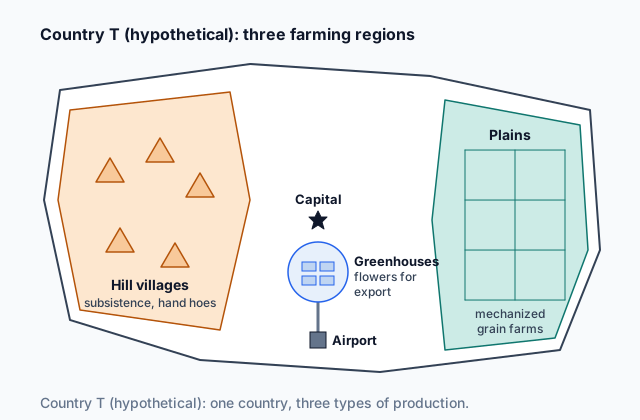
Hypothetical Country T, mapped at the top of the page, has three farming regions, each with a different type of production. Its farm survey counted everyone who does farm work in each region, in the fields or in the greenhouses.
| Region | Type of production | Women doing farm work | Men doing farm work |
|---|---|---|---|
| Hill villages | Subsistence farming with hand hoes | 900 | 600 |
| Plains | Mechanized grain farms | 150 | 600 |
| Greenhouse district | Flowers grown for export | 700 | 300 |
Try it · Rank it
Rank Country T's three regions by women's share of the people doing farm work. Work out each region's share before you rank.
Largest share of women first
Give each one a place, 1 for first. Give two the same place if they are equal.
Your ranking: none yet
Try it · Multiple choice
Which conclusion do Country T's figures best support?
Part 5 Explain it Explain a change in a dairy region
This is a self-check: nothing you type leaves this page. Compare your answer with the model and the scoring points.
Free response is 50% of the exam score. This one is shaped like Question 3, from free-response II.
Free-response practice · Question 3 style
Stimulus 1, a hypothetical table. Average hours a week per household in the highland region of hypothetical Country V, where each household keeps a few cows: - Milking: women 14, men 4 - Making cheese from the milk: women 10, men 0 - Selling cheese at the weekly market: women 6, men 2 - Herding the cows to pasture: women 3, men 12
Stimulus 2, a hypothetical report. A dairy company has opened a processing plant in the highlands. Its trucks collect fresh milk from each farm every day, and the company pays each month into the account of each cow's registered owner, in most households the husband. Fewer households now make cheese.
(A) Using Stimulus 1, identify the task in which men do most of the hours.
(B) Using Stimulus 1, describe women's role in the highland dairy system, in production and in distribution.
(C) Explain how the type of production in Stimulus 1, small household herds whose milk is made into cheese at home and sold locally, helps account for the role women hold.
(D) Using Stimulus 2, explain one likely change in women's role in distribution after the plant opened.
(E) Using both stimuli, explain how the plant could change who controls the household's income from dairy.
(F) Explain one limitation of Stimulus 1 for comparing women's roles across the whole region.
(G) Compare women's role in this dairy region before the plant opened with women's role in export horticulture, where companies hire workers for wages.
Model answer
(A) Herding the cows to pasture: men 12 hours a week, women 3.
(B) Women do most of the milking and all of the cheese making, so they produce most of the household's dairy food. They also do most of the selling at the weekly market, so they handle distribution too.
(C) The herds are small, so they need no hired workers or machines. Milking twice a day and making cheese at home can be fitted around other household work near the house, and the cheese is sold in small amounts at a local market. Together these let women do and manage most of the dairy work, while herding, which takes the cows away to pasture, falls mostly to men.
(D) The company's trucks now collect the milk at the farm, and fewer households make cheese, so fewer women have cheese to sell. Women's role in distribution, selling at the weekly market, shrinks.
(E) Before, women sold the cheese, so the money from dairy passed through their hands. Now the company pays the registered owner of each cow, usually the husband, so control of the dairy income moves from women to men, even if women still do most of the milking.
(F) The hours are averages for each household, so they hide differences between households, such as households headed by widows or those with no cows. They also count hours, not who decides how the money is spent.
(G) Before the plant, women in the highlands worked for their own households and sold their own cheese, controlling both the work and much of its income. In export horticulture women also do much of the work, but as wage workers for a company that owns the crop and sets the pay, so they earn wages but do not control the product.
Score your own answer. This is a self-check, not a grade. Tick each point your answer makes.
Part 6 Check yourself Two regions of Country M
The first three questions use the table. The last two mix ideas from the whole lesson.
Hypothetical Country M's farm survey asked adults in two regions how many hours a week they spend on food tasks. In the North, families grow millet and beans with hand hoes, mostly to eat. In the South, families run large commercial wheat farms with tractors and combines.
| Task | North, women | North, men | South, women | South, men |
|---|---|---|---|---|
| Field work and animal care | 25 | 15 | 6 | 30 |
| Selling at markets | 6 | 2 | 1 | 3 |
| Buying and cooking food | 14 | 2 | 12 | 4 |
Case question 1 · Multiple choice
Which comparison of the two regions does the table support?
Case question 2 · Calculate
In the South, what percent of the hours spent buying and cooking food are women's hours?
Case question 3 · Multiple choice
Which best explains the difference between the two regions in women's share of field work?
The rest stand on their own and do not use the case.
Check yourself · Spot the error
A student describes women's roles in a hypothetical plow-farming village. Which line is the first to go wrong?
Check yourself · Match
Match each type of production to a role women commonly hold in it in many farming regions.
Part 7 Keep it Bring back earlier ideas
This lesson stands on the challenges of feeding everyone from Topic 5.11 and the consequences of farming practices from Topic 5.10.
From 5.11 Challenges of Contemporary Agriculture · Decide and justify
Hypothetical Country W's farms harvest more grain each year than its people eat. Most of the grain is grown and stored in the south. Every spring, villages in the dry, mountainous north run short of food, while the southern warehouses still hold grain from the last harvest. Which challenge best explains the shortages in the north?
Which reason supports your answer?
From 5.10 Consequences of Agricultural Practices · Multiple choice
Farm families in a hypothetical valley stop growing grain, beans and vegetables for their own meals and plant all their land in coffee to sell abroad. Which societal effect follows most directly from this change in the farms' economic purpose?
In three lines
- Women's roles in food production, distribution and consumption vary from place to place, depending on the type of production involved.
- Hand-hoe subsistence farming in many places gives women much of the field work; plow farming and machines have more often put men in the fields; export horticulture hires many women for wages.
- Compare places with shares of hours from a time-use survey, not with job titles or raw totals.
Exam strategy for this topic
- Section I, Multiple Choice: 60 questions in 60 minutes.
- Section II, Free Response: 3 questions in 75 minutes.
When a question asks about women's roles, name the stage (production, distribution or consumption), the type of production, and the role, then link them with a reason. When it gives data, compare shares, not raw totals, and say what the data cannot show.
Questions students ask
Do women grow most of the world's food?
Claims like that are repeated often, but the answer depends on the place and on how the work is counted, and single world figures are hard to measure. This course asks you to explain how women's roles vary with the type of production, not to quote one number for the world.
Is women's farm work counted in farm statistics?
Not always. A count that lists only the head of each household, or only paid jobs, can miss work done by wives, daughters and other family members. A time-use survey, which asks everyone about their hours, shows more of it.
Does mechanization always reduce women's farm work?
No. It cuts the field hours a farm needs, and in many places men run the machines, but women may move into keeping the farm's accounts, into work off the farm or elsewhere in the food system, or into owning and running mechanized farms themselves.
What does type of production mean in this topic?
The kind of farming a place practices: whether food is grown for the household or for sale, by hand, with animals or with machines, and whether it is crops or animals. The same crop can be grown under different types of production.
Are the places in this lesson real?
No. Every country, region, village and survey here is hypothetical, with numbers chosen to show each idea clearly. Real places fit these patterns more loosely, and many have exceptions.
Course alignment, for teachers
AP Human Geography topic 5.12, Unit 5: Agriculture and Rural Land-Use Patterns and Processes.
- Skill 3.D: Compare patterns and trends in maps and in quantitative and geospatial data to draw conclusions.
This lesson maps the one essential knowledge statement of the topic to the part that teaches each one: 1 is checked by a scored question. The map is in the lesson file.