Unit 6 · Topic 6.1 · about 30 minutes · 7 parts · 14 scored checks, 3 of them multiple choice
AP Human Geography 6.1: The Origin and Influences of Urbanization
Unit 6: 12 to 17% of the multiple-choice section
What you'll be able to do
- Explain how site and situation, changes in transportation and communication, population growth, migration, economic development and government policies start cities and drive the growth of cities and their suburbs.
Key vocabulary
| Term | What it means | The exam trap |
|---|---|---|
| Site | The physical character of the place where a city stands, such as its landforms, water, soil, climate and resources. | Name the actual landform or body of water when you describe a site; "a good location" says nothing. |
| Situation | A city's location relative to other places: the routes, resources, markets and cities it is connected to. | Name what the city is linked to and how, not only that it is well placed. |
| Urbanization | The growth in the share of a population that lives in urban areas. | It is a percent of all the people, so work out the share for each date before you compare. |
| Suburbanization | The growth of population, housing and businesses in the areas around a central city. | Suburbs are urban areas too, so do not read suburbanization as people leaving urban life. |
| Migration | A move from one place to another to live there, either within a country or between countries. | A move within one country counts too, not only a move across a border. |
| Economic development | The growth of a country's economy and the rise in its people's incomes, health and education. | When you use it to explain urbanization, name the kind of work it brings and where that work is, not only that the economy grew. |
| Population growth | The rise in the number of people in a place, from births outnumbering deaths and from people moving in. | Name what changed, births or deaths, and where the extra people go, not only that the population grew. |
| Government policy | A law, rule or program a government uses to shape what people and businesses do. | Name the specific law or program and the people it affects, not only that the government acted. |
 Tap to open the picture full size
Part 1 Think first Which town grew?
Commit to a guess first. Being wrong now makes the right idea stick better.
Predict first
Two hypothetical towns in the same farming region were founded about 250 years ago. Town A sits on a hill above a river bend, easy to defend and safe from floods. Town B sits on flat, low land 30 km away. About 120 years ago a railroad was built through Town B, and later a highway joined Town B to the country's capital. Both passed Town A by. Which town is more likely to be the larger city today?
In short. A city's site and situation shape where it starts and how it grows, and changes in transportation and communication, population growth, migration, economic development and government policies drive urbanization, the growth in the share of people who live in urban areas.
- Site is the physical character of the place a city stands on, and it often explains the city's origin and first function. Situation is the city's location relative to other places; it shapes a city's function and growth too, and it changes far more often.
- Faster transportation and better communication let cities trade farther and let homes and jobs spread outward from the center, which is suburbanization.
- Population growth, rural-to-urban migration, economic development and government policies raise or slow a country's urban share, a percent of all its people, not a count.
Part 2 Learn it Why cities start, and why they grow
2a. Site
A city's site is the physical character of the place where it stands: its landforms, water, soil, climate and natural resources. Site explains much of a city's origin, why people settled on that spot, and its first function, what the place did for the people who lived there and around it. Settlements were founded on hills that were easy to defend, at river crossings shallow enough to wade, beside springs with clean water, and by sheltered harbors where ships could anchor.
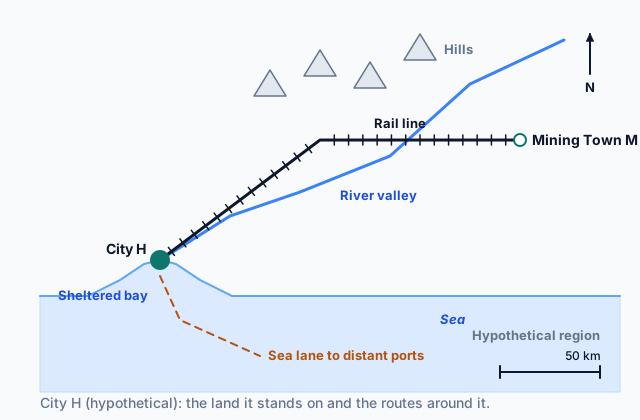
The map at the top of the page shows hypothetical City H. Its site is a small sheltered bay where a river reaches the sea, with flat land beside the water for docks and houses. That site gave City H its first function, as a port.
Site also shapes growth. A city squeezed between hills and the sea runs short of flat land to build on, and a city on a floodplain has to build levees as it spreads. People can change a site, too, by draining a marsh, dredging a harbor deeper or leveling a hill. A site's value can change as well: a harbor deep enough for the ships of 1850 can be too shallow for the far larger ships of today, though its water is just as deep as it was. Either way, a site feature is always something physical at the place itself.
Quick check · Fill the statement
Complete the description of a hypothetical town.
Town D was founded where a river ran shallow enough for carts to cross, so its explains its . Its first was as a market where farmers from both banks of the river traded.
2b. Situation
A city's situation is its location relative to other places: the routes, resources, markets and other cities it is connected to. Site is about the spot; situation is about the city's links.
City H's situation is the river valley that leads inland, the rail line to Mining Town M and the sea lane to distant ports. Ore from the mines and crops from the valley pass through City H on their way to ships, and imported goods pass back the other way. That gave City H a second function, as the place where cargo moves between trains, river boats and ships, and that work draws warehouses, merchants and jobs.
Situation explains much of a city's growth, and it changes far more often than site. A new railroad, highway, canal or airport can turn a town into a crossroads and set it booming. A route that moves away can leave a city stranded with nothing about its ground changed at all. A new border, a closed mine or a shift in trade does the same. So geographers read a city's growth from both: site helps explain why a city began where it did, and situation helps explain why it kept growing, or stopped.
Quick check · Sort it
Each card describes hypothetical City R. Tap a card, then whether it describes City R's site or its situation.
Site
Situation
2c. Transportation and communication
Changes in transportation help cities grow. Railroads and steamships brought food from far away, so a city could feed more people than its own surroundings could, and carried its goods to distant markets.
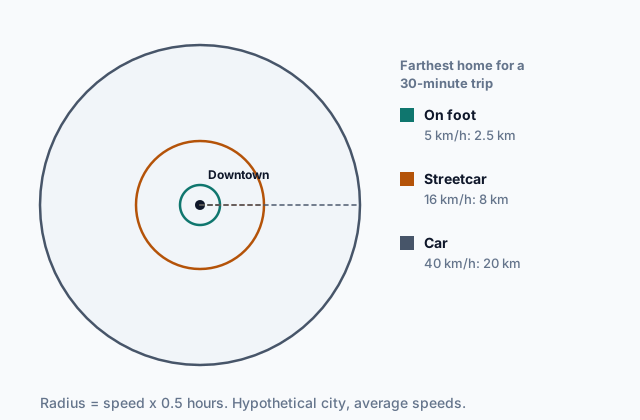
Transportation also sets how far people can live from work. When most people walked, a city stayed compact, because a worker could live only a short walk from a job. Streetcars and commuter trains let homes spread out along their lines; cars and highways let them spread in every direction. The growth of population, housing and businesses in the areas around a central city is suburbanization. Suburbs are still urban areas, so suburbanization spreads a city out without reversing urbanization.
 Tap to open the picture full size
The farthest a worker can live is speed times travel time. A 30-minute trip is half an hour, so on foot at 5 km per hour that is 2.5 km, and by car at 40 km per hour it is 20 km.
Communication matters too. The telegraph and the telephone let a company keep its head office downtown and its factories elsewhere. The internet lets some people work from home, so they can live farther out, and lets businesses reach customers from almost any place.
Quick check · Calculate
In a hypothetical city, workers will travel at most 45 minutes each way to downtown jobs. A new commuter rail line lets them travel at 30 km per hour instead of walking at 5 km per hour. At most, how many kilometers from downtown can a worker now live and still reach work in 45 minutes?
2d. Population, migration, the economy and government
Urbanization is the growth in the share of a population that lives in urban areas. It is a share, so it is found by dividing the urban population by the total population. If a country's cities and countryside grow at the same rate, its cities get bigger but it does not urbanize. Four more forces drive it.
- Population growth. When death rates fall and birth rates stay high, a population grows fast. Farmland can support only so many families, so many of the extra people head for cities, and births in the cities add to their numbers too.
- Migration. Rural-to-urban migration moves people from the countryside to cities, so it raises the urban share directly. Migrants from abroad often settle in cities as well.
- Economic development. As an economy shifts from farming toward manufacturing and services, the new jobs gather in cities, where workers, customers and suppliers are close together.
- Government policies. A government can speed urbanization by building a new capital, an industrial zone or housing, and slow it by limiting who may move to a city. Policies shape suburbs, too: government-backed home loans and new highways make houses at a city's edge cheaper to buy and easier to reach.
Quick check · Match
Each observation comes from a different hypothetical country whose cities are growing. Match each force that influences urbanization to the observation that shows it.
Part 3 Watch it done How much did the country urbanize?
Watch each step, then do the last one yourself.
Hypothetical Country N had 10.0 million people in 1970, 2.5 million of them living in urban areas. By 2020 it had 25.0 million people, 15.0 million of them urban. By how many percentage points did Country N's urban share rise from 1970 to 2020?
Predict first
Country N's urban population grew sixfold. Before the steps, how do you expect its urban share to have changed?
Step 1 · Write what urbanization measures
Urbanization is a change in the share of people living in urban areas: the urban population divided by the total population, written as a percent.
Step 2 · Find the 1970 share
2.5 million ÷ 10.0 million = 0.25, or 25 percent of Country N's people lived in urban areas in 1970.
Why this step?
Why divide by the total population instead of comparing the two urban populations?
An urban population can grow just because the whole country grows. Only the share shows whether people are shifting from rural areas to urban ones.
Your step · Calculate
Finish it. Find Country N's urban share in 2020, then compare it with the 1970 share, 25 percent. By how many percentage points did the urban share rise?
percentage points
Part 4 Try it Explain why cities rise and fall
Try it · Decide and justify
Hypothetical City W grew as a river port, where barges from the grain farms upriver unloaded onto ships bound for the coast. Then a new railroad began carrying the grain from the farms straight to the coast, passing 40 km from City W, and the port lost most of its jobs. A planner writes, "City W's site has changed, and that is why it is losing jobs." Is the planner right?
Which reason supports your answer?
Try it · Multiple choice
Hypothetical Country Z moves its capital from its largest port to a new planned city on an inland plateau and builds highways from the new capital to the country's other cities. Which outcome for the new capital over the next 30 years is most likely?
Part 5 Explain it Explain how cities start and grow
Nothing you type leaves this page. Check your answer against the model and each scoring point.
Free response is 50% of the exam score. This one is shaped like Question 1, from free-response II.
Free-response practice · Question 1 style
Cities grow at different rates and in different ways, and so does the share of a country's people who live in them.
(A) Define a city's site.
(B) Describe one way a city's situation can change while its site stays the same.
(C) Explain how a feature of a city's site can influence the city's original function.
(D) Explain how a change in communication technology can influence suburbanization.
(E) Explain how economic development in a country influences its level of urbanization.
(F) Explain how rapid population growth in rural areas can lead to urbanization.
(G) Explain how a push factor in rural areas can increase a country's level of urbanization.
Model answer
(A) A city's site is the physical character of the place where it stands, such as its landforms, water, soil and natural resources.
(B) A new highway or railroad can be built to another town, bypassing the city, so trade and travel that once passed through it go elsewhere, even though its land and water have not changed.
(C) A sheltered, deep harbor lets ships anchor safely, so a city founded beside one began with the function of a port, handling trade and fishing.
(D) Telephones and then the internet let offices stay in touch with workers and customers from almost anywhere. Some people can work from home or in offices away from downtown, so they can live in suburbs farther from the center, and the suburbs grow.
(E) As a country develops, work shifts from farming toward manufacturing and services. Those jobs gather in cities, so people move from rural areas to cities and the urban share rises.
(F) When death rates fall and birth rates stay high, rural populations grow faster than the farmland can support. Many of the extra young people move to cities for work, so the urban population grows faster than the rural one and the urban share rises.
(G) Falling prices for the crops villagers sell can push people to leave farming. When they move to cities for work, the urban population grows and the rural population shrinks, so the urban share rises.
Score your own answer. This is a self-check, not a grade. Tick each point your answer makes.
Part 6 Check yourself Country K's cities
The case questions use the tables. The others mix the ideas from the whole lesson.
Hypothetical Country K's statistics office counts its people every 30 years. The second table splits Country K's capital into the central city and the suburbs around it.
| Year | Total population | Urban population |
|---|---|---|
| 1950 | 8.0 million | 2.0 million |
| 1980 | 14.0 million | 5.6 million |
| 2010 | 20.0 million | 13.0 million |
| Part of the capital | 1980 | 2010 |
|---|---|---|
| Central city | 3.0 million | 2.6 million |
| Suburbs | 0.8 million | 4.4 million |
Case question 1 · Calculate
What percent of Country K's people lived in urban areas in 2010?
Case question 2 · Multiple choice
Which statement about Country K is supported by the first table?
Case question 3 · Multiple choice
From 1980 to 2010, the central city of Country K's capital lost people while its suburbs grew more than fivefold. Which development would best explain that change?
The rest stand on their own and do not use the case.
Check yourself · Spot the error
A student explains the history of hypothetical City F. Which line is the first to go wrong?
Check yourself · Decide and justify
Hypothetical Countries T and U have similar populations, and the economies of both grew fast for 30 years as factories opened in their cities. Country T requires a permit to live in a city and issues few of them, while Country U has no such rule. Compared with Country U, how did Country T's urban share most likely change over those years?
Which reason supports your answer?
Part 7 Keep it Bring back earlier ideas
Cities grow from migration and from farms that need fewer workers: push and pull factors from Topic 2.10 and the second agricultural revolution from Topic 5.4.
Bring it back · Sort it
Each card is a cause of migration from hypothetical farm villages to a growing city. Tap a card, then whether it is a push factor or a pull factor.
Push factor
Pull factor
Bring it back · Decide and justify
In hypothetical Country R, new farm machines such as seed drills and reapers, better crop rotation and new fertilizers spread across the farms over 60 years, and each farmworker now grows far more food. Over those years, what most likely happened to the share of Country R's people living in cities?
Which reason supports your answer?
In three lines
- Site, the physical character of a place, often explains a city's origin and first function; situation, its links to other places, shapes its function and growth too, and it changes far more often.
- Faster transportation and better communication let cities trade farther and let homes and jobs spread into suburbs.
- Population growth, migration, economic development and government policies drive urbanization, the rise in the urban share of a population.
Exam strategy for this topic
- Section I, Multiple Choice: 60 questions in 60 minutes.
- Section II, Free Response: 3 questions in 75 minutes.
When a question asks why a city began or grew, name the specific feature and say whether it is site or situation. When it asks about urbanization, talk about the share of people in urban areas, and name the force, such as migration or a government policy, that changed it.
Questions students ask
What is the difference between site and situation?
Site is the physical character of the place a city stands on: its landforms, water, soil and resources. Situation is where the city is relative to other places: its routes, trade partners and neighbors. A useful test is whether you can describe the feature without naming another place.
Can a city's site change?
Yes, a little. People drain marshes, dredge harbors and level hills, and rivers shift their courses. More often, a site feature stays the same while its value changes, as when new technology makes it matter less.
Does suburbanization mean a country is becoming less urban?
No. Suburbs are part of the urban area, so people moving from a central city to its suburbs are still urban. Suburbanization changes where in the urban area people live, not whether they live in one.
If a country's cities keep getting bigger, is it urbanizing?
Not necessarily. Urbanization is a rise in the share of people living in urban areas. If the countryside grows just as fast as the cities, the cities get bigger but the share stays the same.
Are the places in this lesson real?
No. Every city, town and country here is hypothetical, with numbers made up to show each idea clearly. Real cities grow for a mix of these reasons at once.
Course alignment, for teachers
AP Human Geography topic 6.1, Unit 6: Cities and Urban Land-Use Patterns and Processes.
- Skill 2.D: Explain the significance of geographic similarities and differences among different locations and/or at different times.
This lesson maps all 2 essential knowledge statements of the topic to the part that teaches each one: 2 are checked by a scored question. The map is in the lesson file.