Unit 5 · Topic 5.3 · about 30 minutes · 7 parts · 12 scored checks, 3 of them multiple choice, plus 2 from earlier lessons
AP Human Geography 5.3: Agricultural Origins and Diffusions
Unit 5: 12 to 17% of the multiple-choice section
What you'll be able to do
- Identify the major hearths where people first domesticated plants and animals, including the Fertile Crescent, the Indus River Valley, Southeast Asia and Central America.
- Explain how plants and animals spread around the world, through patterns of diffusion such as the Columbian Exchange and the agricultural revolutions.
Key vocabulary
| Term | What it means | The exam trap |
|---|---|---|
| Domestication | Breeding wild plants or animals over many generations until they depend on people and differ from their wild ancestors. | Taming one wild animal is not domestication; it takes many generations of breeding. |
| Hearth | The place where an innovation, such as a crop, a farming method or an idea, first began. | The word is used for any innovation, such as a religion or a language, so say what began there. |
| Fertile Crescent | An arc of river valleys and hill country in Southwest Asia, running from the eastern Mediterranean coast to the Tigris and Euphrates rivers, and one of the early hearths of domestication. | Learn its place on a map: Southwest Asia, not South Asia, where the Indus River Valley is. |
| Indus River Valley | The valley of the Indus River in South Asia, one of the early hearths of domestication. | Its hearth is separate from the Fertile Crescent, so do not merge the two into one Middle Eastern hearth. |
| Southeast Asia | The mainland and islands south of China and east of India, one of the early hearths of domestication. | It is not the same region as East Asia, which lies to its north. |
| Central America | The land between North and South America, taken here to include southern Mexico, one of the early hearths of domestication. | In this course it includes southern Mexico, so a crop bred in Mexico's highlands counts as Central American. |
| Agricultural revolution | A period when farming methods changed so much that they changed how people lived; the first began farming itself, and later ones brought new methods and seeds. | There is more than one, so say which one you mean. |
| Columbian Exchange | The transfer of plants, animals, people and diseases between the Eastern and Western Hemispheres after European voyages to the Americas began in the late 1400s. | Name what moved and in which direction, not only that things moved. |
| Diffusion | The spread of an idea, a practice, a crop or an animal from its hearth to other places. | Name the type of diffusion and what carried it, such as migrants or trade. |
 Tap to open the picture full size
Part 1 Think first Where did the tomato start?
Commit to a guess first. Being wrong now makes the right idea stick better.
Predict first
A cook in hypothetical Country M, a warm, sunny country on a sea coast in the Eastern Hemisphere, makes a sauce of tomatoes that grow in her own garden. Families in Country M have cooked with tomatoes for generations. Where were tomatoes first domesticated?
In short. Agriculture began on its own in several early hearths of domestication, including the Fertile Crescent, the Indus River Valley, Southeast Asia and Central America, and patterns of diffusion such as the agricultural revolutions and the Columbian Exchange later spread their plants and animals around the world.
- Each hearth domesticated the wild plants and animals around it: wheat, barley, sheep and goats in the Fertile Crescent; maize, beans, squash and turkeys in Central America.
- From each hearth, farming spread by expansion diffusion, neighbor to neighbor, and by relocation diffusion, carried by migrating farmers, most easily into places with a similar climate.
- The Columbian Exchange, from the late 1400s, carried crops and animals both ways between the Eastern and Western Hemispheres, and later agricultural revolutions spread new methods and seeds.
Part 2 Learn it Where farming began and how it spread
2a. Hearths of domestication
Domestication is the slow work of breeding wild plants and animals, over many generations, until they rely on people and differ from their wild relatives: a grain whose seeds stay on the stalk until harvest, a sheep that stays with the flock. A hearth is a place where an innovation begins. The first hearths of domestication arose about 10,000 years ago, a change called the first agricultural revolution, or the Neolithic Revolution.
Farming did not begin in one place. People in several regions domesticated the wild plants and animals around them, on their own. The course names four early hearths. The Fertile Crescent is an arc of river valleys and hill country in Southwest Asia, from the eastern Mediterranean coast to the Tigris and Euphrates rivers. The Indus River Valley lies in South Asia. Southeast Asia takes in the mainland and islands south of China and east of India. Central America here includes southern Mexico.
| Hearth | Plants | Animals |
|---|---|---|
| Fertile Crescent | wheat, lentils | goats |
| Indus River Valley | sesame | humped zebu cattle |
| Southeast Asia | root and tree crops grown from cuttings | chickens |
| Central America | maize (corn), beans, squash | turkeys |
The Fertile Crescent's farmers also domesticated barley and sheep. Other hearths existed too, such as the river valleys of China, where rice and millet were domesticated, the Andes mountains of South America, where the potato was domesticated, and West Africa. Each hearth started from its own wild species. Some crops, such as squash and beans, were domesticated separately in more than one hearth, so read the table as one hearth for each, not the only one.
Quick check · Sort it
Each card names a plant or an animal. Tap a card, then the early hearth where it was first domesticated.
Fertile Crescent
Indus River Valley
Southeast Asia
Central America
2b. The first agricultural revolution spreads
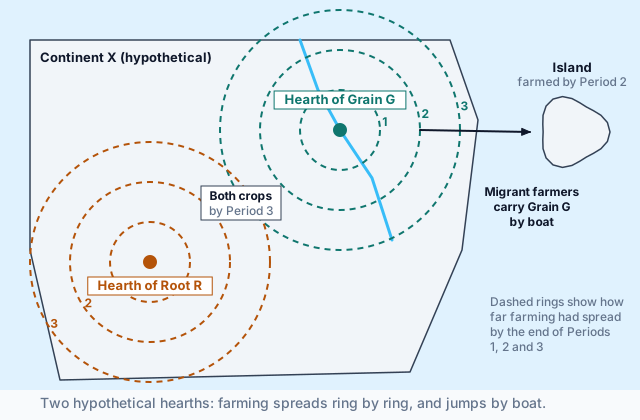
From each hearth, farming spread. The picture at the top of the page shows two ways it moves, on hypothetical Continent X. In expansion diffusion, a practice spreads outward while it stays strong at home: villages next to the first farms take up the crop from their neighbors, then the villages beyond them do, ring by ring. In relocation diffusion, people carry a practice with them when they move: farmers who migrate take their seed and herds to a new land, and the crop can jump a sea or a mountain range.
A crop spreads most easily into places with a climate like its hearth's, since a plant bred for one growing season does poorly in a very different one. Wheat and barley spread out of the Fertile Crescent, by both kinds of diffusion, into Europe, North Africa and South Asia, lands with similar seasons. Maize spread north and south through the warm lands of the Americas.
Farming changed the people who took it up. A field feeds far more people than the same land feeds hunters and gatherers, so farmers settled in villages and stored surplus food, and their numbers grew.
Quick check · Fill the statement
Complete the description of how farming spread in the first agricultural revolution.
Farming began on its own in . When villages next to a hearth took up its crops from their neighbors, farming spread by diffusion. When farmers migrated across a sea with their seed and herds, farming spread by diffusion.
2c. The Columbian Exchange
For thousands of years the Eastern and Western Hemispheres farmed apart. After European voyages to the Americas began in the late 1400s, ships carried plants and animals both ways across the Atlantic Ocean. This transfer is the Columbian Exchange, relocation diffusion on a global scale.
| From the Americas to Africa, Asia and Europe | From Africa, Asia and Europe to the Americas |
|---|---|
| maize, potatoes, tomatoes | wheat, sugarcane, coffee |
| chili peppers, squash, turkeys | horses, cattle, pigs, chickens |
Climate still steered each crop. The potato, from the cool Andes, did well in cool, rainy lands where wheat often failed. Maize, from warm Central America, spread across warm lands of Africa and Asia. Sugarcane and coffee needed tropical heat, and they spread across warm, wet lands of the Americas as plantation agriculture. Horses and cattle changed how many peoples of the Americas hunted, traveled and herded.
New crops that grew where the old ones did poorly fed growing populations. The exchange also carried diseases such as smallpox, which killed vast numbers of the Indigenous peoples of the Americas.
Quick check · Multiple choice
A historian reads the records of a hypothetical farm in the Americas. Which item in the records shows that they were written after the Columbian Exchange began?
2d. Later revolutions keep crops moving
Each later agricultural revolution was another wave of diffusion.
The second agricultural revolution began in Western Europe in the 1700s. New methods, such as rotating crops with turnips and clover, and later new farm machines, spread from there through Europe and to North America. Topic 5.4 covers it.
The Green Revolution, sometimes called the third agricultural revolution, began in the middle 1900s. It spread seeds of wheat, rice and maize bred for bigger harvests, with chemical fertilizers, to many developing countries. Topic 5.5 covers it.
Put the patterns together and you get the story of how farming reached nearly every inhabited land: several hearths, slow spread outward from each, an ocean crossing that joined the hemispheres, and then waves of new methods and seeds.
Quick check · Put it in order
Put these spreads of plants, animals and farming methods in order by when each began, earliest first.
Part 3 Watch it done Trace a farm's harvest to its hearths
Watch each step, then do the last one yourself.
A farm in hypothetical Country H, in the Eastern Hemisphere, grows wheat and maize and keeps a herd of goats. For each one, name the hearth where it was first domesticated and the pattern of diffusion that brought it to Country H.
Predict first
Before the steps, which of the three do you expect reached Country H last?
Step 1 · Start with the wheat
Wheat was domesticated in the Fertile Crescent, in the Eastern Hemisphere. It reached Country H thousands of years ago, as farming spread out of that hearth in the first agricultural revolution.
Step 2 · Then the goats
Goats were also domesticated in the Fertile Crescent. Herders moving with their flocks carried them outward in the same early wave of farming, so they too have been in Country H for thousands of years.
Why this step?
Why name the hearth before the pattern of diffusion?
The hearth says which hemisphere a plant or animal started in. One from Country H's own hemisphere could have spread overland or with early migrants; one from the other hemisphere had to cross an ocean, which happened only with the Columbian Exchange.
Your step · Decide and justify
Finish it. Which pattern of diffusion brought maize to Country H?
Which fact supports your answer?
Part 4 Try it Read the spread of a grain
Try it · Match
Archaeologists in a hypothetical region trace how hypothetical Grain T was first farmed and how it spread. Match each term to the finding that shows it.
Try it · Decide and justify
Hypothetical Country E, in the Eastern Hemisphere, has cool, short summers and heavy rain, and its wheat harvest fails in wet years. After the Columbian Exchange, which American crop is more likely to become one of Country E's staple foods?
Which reason supports your answer?
Part 5 Explain it Explain the crops of one country
Nothing you type leaves this page. Check your answer against the model and each scoring point.
Free response is 50% of the exam score. This one is shaped like Question 3, from free-response II.
Free-response practice · Question 3 style
Hypothetical Country N lies in the Eastern Hemisphere. It has a warm southern plain and cool northern hills.
Stimulus 1, a hypothetical land-use map of Country N's farms today, described in words: maize fields cover the warm southern plain; wheat and barley fields cover the cool northern hills; herds of goats graze the dry uplands between them.
Stimulus 2, hypothetical records of Country N's main crops:
- In the year 1400: wheat, barley, lentils
- In the year 1900: wheat, barley, lentils, maize, potatoes
(A) Identify the hearth where wheat and barley were first domesticated.
(B) Identify the hearth where maize was first domesticated.
(C) Using Stimulus 2, identify the pattern of diffusion that brought maize and potatoes to Country N.
(D) Describe one plant or animal that moved in the opposite direction in that same pattern of diffusion, and one effect it had where it arrived.
(E) Using Stimulus 1, explain why maize grows on the southern plain while wheat and barley grow in the northern hills.
(F) Explain how wheat first reached Country N, thousands of years before 1400.
(G) Explain one limitation of Stimulus 2 for showing how important maize became in Country N.
Model answer
(A) The Fertile Crescent, in Southwest Asia.
(B) Central America, including southern Mexico.
(C) The Columbian Exchange. Both crops were domesticated in the Americas, and they appear in Country N's records only after ships began crossing the Atlantic in the late 1400s.
(D) Horses were carried from the Eastern Hemisphere to the Americas. Many peoples of the Americas used them to hunt, travel and herd over long distances in ways they could not before.
(E) Maize was domesticated in warm Central America and needs a long, hot growing season, which the southern plain has. Wheat and barley were domesticated in the Fertile Crescent as cool-season crops that grow through its cool, wet winters, so they suit the cooler northern hills.
(F) Wheat spread out of the Fertile Crescent in the first agricultural revolution. Neighboring villages took it up one after another, which is expansion diffusion, and migrating farmers carried its seed to new lands, which is relocation diffusion, until it reached lands with seasons like Country N's.
(G) Stimulus 2 lists which crops were grown but not how much of each, so it cannot show whether maize became a main food or stayed a small crop. With only two years, it also cannot show when maize arrived.
Score your own answer. This is a self-check, not a grade. Tick each point your answer makes.
Part 6 Check yourself The market in Country E
The case questions use the table. The others mix the ideas from the whole lesson.
A town market in hypothetical Country E, in the Eastern Hemisphere, has eight food stalls. Each stall sells one main food, and every food is grown or raised in Country E today.
| Stall | Main food |
|---|---|
| 1 | Wheat bread |
| 2 | Lentil soup |
| 3 | Maize flatbread |
| 4 | Roast potatoes |
| 5 | Tomato salad |
| 6 | Goat cheese |
| 7 | Chicken skewers |
| 8 | Chili pepper sauce |
Case question 1 · Calculate
How many of the eight stalls sell a main food made from a plant or animal first domesticated in the Americas?
Case question 2 · Multiple choice
Records show that Country E's market sold the foods at Stalls 3 and 4 in the 1800s but not in the 1300s. Which statement best explains the difference?
Case question 3 · Multiple choice
In the 1600s, merchants from Country E ship goats and sacks of wheat to a newly founded hypothetical colony in the Americas, where neither had been raised before. Which pattern of diffusion does this shipment belong to?
The rest stand on their own and do not use the case.
Check yourself · Spot the error
A student explains the Columbian Exchange. Which line is the first to go wrong?
Check yourself · Select all
Which two statements about the first agricultural revolution are accurate? Select two.
Select 2 answers, then check.
Part 7 Keep it Bring back earlier ideas
These questions bring back ideas from earlier Unit 5 lessons that this one builds on.
From 5.1 Introduction to Agriculture · Decide and justify
A hypothetical company wants to plant cacao trees, which need warmth and rain in every month and are killed by frost. It can buy land in Region 1, which has hot, dry summers, mild, rainy winters and a light frost in some winters, or in Region 2, which is hot with heavy rain in every month and never has frost. Where should it plant?
Which reason supports your answer?
From 5.2 Settlement Patterns and Survey Methods · Sort it
Each card describes the homes in a hypothetical farming area. Tap a card, then the settlement pattern it shows.
Clustered
Dispersed
Linear
In three lines
- Hearths: farming began on its own in several places, including the Fertile Crescent, the Indus River Valley, Southeast Asia and Central America, each with its own plants and animals.
- Spread: from each hearth, crops moved by expansion diffusion and relocation diffusion, most easily into similar climates.
- Exchanges: the Columbian Exchange carried crops and animals both ways between the hemispheres, and later agricultural revolutions spread new methods and seeds.
Exam strategy for this topic
- Section I, Multiple Choice: 60 questions in 60 minutes.
- Section II, Free Response: 3 questions in 75 minutes.
When a question names a crop or an animal, place it in its hearth first, then ask what could carry it from there: overland spread or migrants from a hearth in the same hemisphere, or a ship in the Columbian Exchange if it began in the other one.
Questions students ask
Was the Fertile Crescent the only place farming began?
No. Farming began on its own in several hearths. The course names the Fertile Crescent, the Indus River Valley, Southeast Asia and Central America, and there were others, such as the river valleys of China, the Andes of South America and West Africa.
How is the first agricultural revolution different from the second?
The first was the start of farming itself, when people domesticated wild plants and animals in early hearths. The second, beginning in Western Europe in the 1700s, brought new methods and machines that made each farm produce much more. Topic 5.4 covers it.
Did the Columbian Exchange carry only crops and animals?
No. It also carried people and diseases. Smallpox and other diseases from the Eastern Hemisphere killed vast numbers of the Indigenous peoples of the Americas.
Why do so many foods seem to belong to places far from their hearths?
Centuries of diffusion. Tomatoes, potatoes and maize have been grown in the Eastern Hemisphere for hundreds of years, long enough to become part of its cooking, even though all three began in the Americas.
Are the countries and places in this lesson real?
The hearths, the agricultural revolutions and the Columbian Exchange are real, and taught as the course names them. Every country, continent, island, farm, market and colony in a scenario is hypothetical, and so is every number attached to one.
Course alignment, for teachers
AP Human Geography topic 5.3, Unit 5: Agriculture and Rural Land-Use Patterns and Processes.
- Skill 2.B: Explain spatial relationships in a specified context or region of the world, using geographic concepts, processes, models, or theories.
This lesson maps all 2 essential knowledge statements of the topic to the part that teaches each one: 2 are checked by a scored question. The map is in the lesson file.