Unit 5 · Topic 5.4 · about 30 minutes · 7 parts · 12 scored checks, 3 of them multiple choice, plus 2 from earlier lessons
AP Human Geography 5.4: The Second Agricultural Revolution
Unit 5: 12 to 17% of the multiple-choice section
What you'll be able to do
- Explain the new farming technology of the second agricultural revolution and how the extra food it produced led to better diets, longer life expectancies and more people available to work in factories.
Key vocabulary
| Term | What it means | The exam trap |
|---|---|---|
| Second agricultural revolution | The period of new farming technology and rising food production that began in Western Europe in the 1700s. | It overlapped with the Industrial Revolution, so an answer about one may need the other. |
| Crop rotation | Planting different crops on a field in a planned order from year to year to keep the soil fertile. | Say which crops rotate and what each one adds to the soil or the farm. |
| Fallow | Farmland left unplanted for a season or a year so its soil can recover. | A fallow field is resting, not abandoned; it comes back into crops later in the rotation. |
| Seed drill | A machine that plants seeds in straight rows at an even depth. | It plants; cutting the ripe grain is the reaper's job. |
| Selective breeding | Mating the animals or plants with the most wanted traits so their offspring have more of them. | It works over generations on a whole herd or crop, not on one animal in its lifetime. |
| Enclosure | Joining scattered strips of open fields into single fenced or hedged farms, each run by one holder. | It is a change in who holds and fences the land; the new crops and rotations were a separate change it made easier. |
| Diet | The kinds and amounts of food a person regularly eats. | Judge a diet by its variety and nutrition, not by its calories alone. |
| Life expectancy | The average number of years a newborn can expect to live, in a given place and time. | It describes a population at one time, so compare two dates or two places rather than reading one value alone. |
| Industrial Revolution | The shift to manufacturing with machines in factories, which began in Western Europe in the 1700s. | Keep it separate from the second agricultural revolution in an answer: one changed manufacturing, the other changed farms. |
 Tap to open the picture full size
Part 1 Think first Where do the spare hands go?
Commit to a guess first. Being wrong now makes the right idea stick better.
Predict first
In hypothetical Village V, 80 of the 100 adults work in the fields, and the harvest just feeds the village. Over fifty years, new tools and new ways of planting let 30 adults grow more food than the 80 once did. What happens to most of the other 50 adults?
In short. The second agricultural revolution, which began in Western Europe in the 1700s alongside the Industrial Revolution, brought new farming technology that raised food production, and the extra food led to better diets, longer life expectancies and more people available to work in factories.
- New technology included crop rotation with turnips and clover in place of a fallow field, the seed drill, iron and steel plows, selective breeding of livestock and machines such as the reaper and the threshing machine.
- More food, and more kinds of it, meant better diets; better-fed people resisted disease, fewer died young, and life expectancy rose.
- Each farm worker could feed more people, so fewer farm workers were needed, and many rural people moved to towns to work in the new factories.
Part 2 Learn it New farm technology and what it changed
2a. New technology on the farm
The second agricultural revolution began in Western Europe in the 1700s and spread through Europe and to North America in the 1800s. Its new technology made each field, and each farm worker, produce more food.
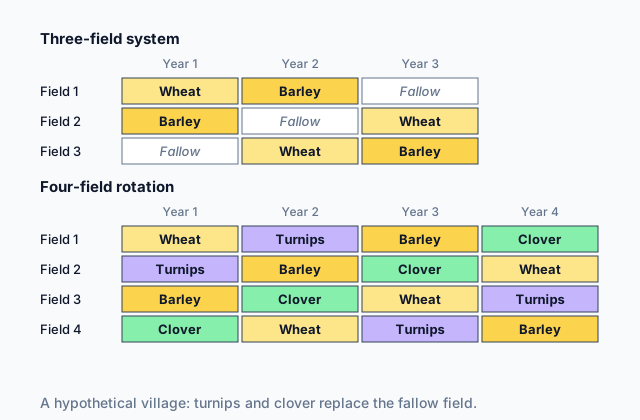
- Crop rotation with turnips and clover. Under the older three-field system, one field in three lay fallow, left unplanted for a year so its soil could recover. A four-field rotation planted that field with turnips or clover instead. Clover puts nitrogen back into the soil, and both crops feed livestock, so no field sat idle. The picture at the top of the page shows the change.
- The seed drill planted seeds in straight rows at an even depth instead of scattering them by hand, so less seed was wasted and more of it sprouted.
- Iron and later steel plows turned heavy soil faster, with fewer animals pulling.
- Selective breeding of livestock, mating the largest and healthiest animals, gave heavier cattle and sheep.
- Machines such as the horse-drawn mechanical reaper and the threshing machine, built in the new factories, cut grain and separated it from the straw with far fewer hands.
Enclosure joined each village's scattered open-field strips into single fenced or hedged farms, which made the new methods easier to use.
Quick check · Calculate
A farm in a hypothetical village has 120 hectares in three equal fields under the three-field system, so one field lies fallow each year. The farm switches to a four-field rotation on the same 120 hectares, with turnips and clover in place of the fallow. How many more hectares does the farm plant each year after the switch?
2b. Better diets and longer lives
With these advances, food production rose: the same land, with fewer workers, grew far more. Turnips and clover fed cattle and sheep through the winter, when farmers had once slaughtered many animals each fall for lack of feed, so meat, milk and cheese reached more people's meals all year. Potatoes, which had arrived from the Americas, added cheap, filling food. Canals and then railroads carried grain and meat from farms to growing cities.
More food, and more kinds of it, meant better diets. People who eat enough, with more protein, resist disease better, and fewer of their children die young. Better diets were one cause of falling death rates, alongside cleaner water and, later, medicine. Death rates fell, and life expectancy, the average number of years a newborn can expect to live, rose. Birth rates stayed high for a time, so populations grew quickly.
The chain runs in one direction: new technology, then more food, then better diets, then fewer early deaths and longer life expectancy. Leave out a link and the explanation has a gap.
Quick check · Multiple choice
In a hypothetical country, the second agricultural revolution raised food production, and over the next century life expectancy rose. Which explanation best links the two?
2c. More people available for factory work
When each farm worker grows more food, a country needs fewer farm workers to feed everyone. Machines and enclosure cut farm jobs further. Many rural people, no longer needed on the land, moved to towns and cities, where the new factories of the Industrial Revolution needed workers. The two revolutions fed each other: factories built the plows, reapers and threshers that farms bought, and farms fed the factory workers.
A count shows the size of the change. Everyone eats, farmers included, so the farm workforce a country needs is its population divided by the number of people one farm worker can feed. In hypothetical Country P, with 1,000,000 people, workers who each feed 4 people means 1,000,000 ÷ 4 = 250,000 farm workers. Once each worker feeds 8 people, it needs 1,000,000 ÷ 8 = 125,000, and the other 125,000 are free for other work, much of it in factories.
Quick check · Put it in order
Put these steps of the second agricultural revolution in order, from the first cause to the last effect.
2d. Reading the change in a landscape
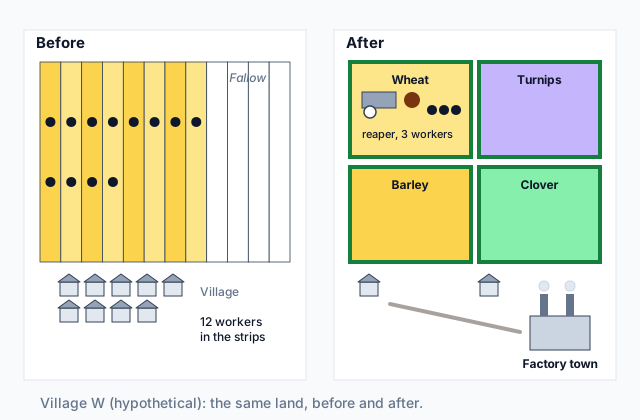
A landscape records the revolution, and so do paintings, maps and records of it. When you compare two visual sources, such as views of one village before and after its farms changed, name a feature that changed, then say what the change shows.
- Narrow open-field strips becoming larger hedged fields shows enclosure.
- A fallow field disappearing, with turnips and clover in its place, shows the new rotation.
- Fewer people at work in the fields, with a machine among them, shows labor being freed.
- A factory town growing nearby shows where that labor could go.
One feature is a clue; two or three that point the same way make a conclusion. Say which features you compared, in which source, before you say what they show.
Quick check · Sort it
Each card describes a scene a historian might find in a painting or record of a hypothetical farming village. Tap a card, then the period it belongs to.
Before the second agricultural revolution
After the second agricultural revolution
Part 3 Watch it done Count the workers set free
Watch each step, then do the last one yourself.
Hypothetical Country G has 3,000,000 people. Before its second agricultural revolution, each farm worker grows enough food for 5 people. After it, each farm worker grows enough for 12. How many workers does the change free from farming for other work, such as in factories?
Predict first
Before the steps, what share of Country G's farm workers do you expect the change to free?
Step 1 · Say what the numbers mean
Everyone in Country G eats, farm workers included. So the number of farm workers needed is the population divided by the number of people one farm worker can feed.
Step 2 · Farm workers needed before
3,000,000 ÷ 5 = 600,000 farm workers.
Why this step?
Why divide the population by the number of people each worker feeds, instead of subtracting?
Each worker feeds a group of people, so the workforce is the number of such groups in the population. Subtracting 5 from 12 compares the workers' output, not how many workers the country needs.
Your step · Calculate
Finish it. Work out how many farm workers Country G needs once each feeds 12 people, then subtract that from the 600,000 needed before. How many workers does the change free?
workers
Part 4 Try it Compare two views of a village
The figure shows hypothetical Village W, before and after its second agricultural revolution. Compare the two views before you answer.
 Tap to open the picture full size
Try it · Decide and justify
The figure shows two views of hypothetical Village W, before and after its farms changed. Which conclusion do the two views together best support?
Which evidence from the two views supports your answer?
Try it · Fill the statement
Complete the chain from new technology to factory work in hypothetical Village W.
Planting turnips and clover in place of the field let every field grow a crop each year, and the turnips fed the cattle through the . With more food grown per worker, the village needed farm workers, and many moved to towns to work in .
Part 5 Explain it Explain the second agricultural revolution
Nothing you type leaves this page. Check your answer against the model and each scoring point.
Free response is 50% of the exam score. This one is shaped like Question 1, from free-response II.
Free-response practice · Question 1 style
Answer each part about the second agricultural revolution.
(A) Identify one new farming technology of the second agricultural revolution.
(B) Describe how the technology you identified in (A) increased food production.
(C) Explain how increased food production led to better diets.
(D) Explain how better diets led to longer life expectancies.
(E) Explain how the second agricultural revolution made more people available for work in factories.
(F) Explain one way the second agricultural revolution and the growth of factories supported each other.
(G) Explain one reason the second agricultural revolution reached some regions of the world much later than others.
Model answer
(A) Crop rotation with turnips and clover.
(B) It replaced the fallow field of the three-field system with turnips or clover. Clover returned nitrogen to the soil, so every field could be planted every year and more land grew crops.
(C) The turnips and clover fed livestock through the winter, so meat, milk and cheese reached people's meals all year. With more grain and more kinds of food, people ate more, and more protein.
(D) Better-fed people resist disease better. Fewer people, especially children, died of illness, so the average number of years a newborn could expect to live rose.
(E) Each farm worker could now feed more people, so the country needed fewer farm workers. Rural people no longer needed on the land moved to towns and cities, where they took jobs in factories.
(F) Factories built the plows, reapers and threshing machines that farms bought, and the farms grew the food that fed the factory workers.
(G) The new methods spread outward from their hearth in Western Europe. Regions far from it, or where farmers could not afford machines, adopted them later.
Score your own answer. This is a self-check, not a grade. Tick each point your answer makes.
Part 6 Check yourself A century of change in Country F
The case questions use the table. The others mix the ideas from the whole lesson.
Hypothetical Country F went through its second agricultural revolution between 1760 and 1880. Its government's records give these figures.
| Year | Share of workers in farming | Food per person per day (calories) | Life expectancy at birth (years) | Factory workers |
|---|---|---|---|---|
| 1760 | 75% | 2,000 | 34 | 50,000 |
| 1800 | 62% | 2,300 | 37 | 200,000 |
| 1840 | 46% | 2,600 | 41 | 600,000 |
| 1880 | 30% | 2,900 | 46 | 1,400,000 |
Case question 1 · Multiple choice
Which pair of trends in the table best supports the claim that the second agricultural revolution made more people available for factory work?
Case question 2 · Calculate
By what percent did food per person per day in Country F rise from 1760 to 1880?
Case question 3 · Multiple choice
A student uses the table to claim that better diets caused Country F's longer life expectancy. Which is a limitation of the table for supporting that claim?
The rest stand on their own and do not use the case.
Check yourself · Spot the error
A student explains how the second agricultural revolution changed life expectancy. Which line is the first to go wrong?
Check yourself · Select all
Which two were advances of the second agricultural revolution? Select two.
Select 2 answers, then check.
Part 7 Keep it Bring back earlier ideas
These questions bring back ideas from earlier Unit 5 lessons that this one builds on.
From 5.3 Agricultural Origins and Diffusions · Fill the statement
Complete the description of how farming spread in the first agricultural revolution.
Farming began on its own in . When villages next to a hearth took up its crops from their neighbors, farming spread by diffusion. When farmers migrated across a sea with their seed and herds, farming spread by diffusion.
From 5.3 Agricultural Origins and Diffusions · Put it in order
Put these spreads of plants, animals and farming methods in order by when each began, earliest first.
In three lines
- Technology: rotation with turnips and clover, the seed drill, better plows, selective breeding and machines made each field and each worker produce more food.
- Diets and life spans: more and better food meant better diets, fewer early deaths and longer life expectancy.
- Work: farms needed fewer workers, so many rural people moved to towns and took jobs in the new factories.
Exam strategy for this topic
- Section I, Multiple Choice: 60 questions in 60 minutes.
- Section II, Free Response: 3 questions in 75 minutes.
When a question asks for an impact of the second agricultural revolution, write the whole chain: the technology, the rise in food production, then the result asked for, whether better diets, longer life expectancy or more workers for factories.
Questions students ask
When and where did the second agricultural revolution happen?
It began in Western Europe in the 1700s and spread through Europe and to North America in the 1800s, at the same time as the Industrial Revolution.
Is the second agricultural revolution the same as the Industrial Revolution?
No. The second agricultural revolution changed farming; the Industrial Revolution changed manufacturing. They happened at the same time and fed each other: factories made farm machines, and farms fed and freed the factory workers.
How is it different from the Green Revolution?
The second agricultural revolution began in Western Europe in the 1700s with rotation, the seed drill and early machines. The Green Revolution, in the middle 1900s, spread new seeds, chemicals and machines to developing countries. Topic 5.5 covers it.
Why did more food raise life expectancy?
Better-fed people resist disease better, so fewer of them, especially children, died young. Life expectancy is an average, so fewer early deaths raise it. Better diets were one cause; cleaner water and, later, medicine also lowered death rates.
Are the countries and villages in this lesson real?
No. Every country, county and village here is hypothetical, with numbers chosen to show each idea clearly. The second agricultural revolution itself, and its technology, are real.
Course alignment, for teachers
AP Human Geography topic 5.4, Unit 5: Agriculture and Rural Land-Use Patterns and Processes.
- Skill 4.D: Compare patterns and trends in visual sources to draw conclusions.
This lesson maps the one essential knowledge statement of the topic to the part that teaches each one: 1 is checked by a scored question. The map is in the lesson file.