Unit 5 · Topic 5.5 · about 30 minutes · 7 parts · 12 scored checks, 3 of them multiple choice, plus 2 from earlier lessons
AP Human Geography 5.5: The Green Revolution
Unit 5: 12 to 17% of the multiple-choice section
What you'll be able to do
- Explain how the Green Revolution, with its high yielding seeds, chemicals and machines, changed the food supply, the lives of farmers and the environment in the developing world, for better and for worse.
Key vocabulary
| Term | What it means | The exam trap |
|---|---|---|
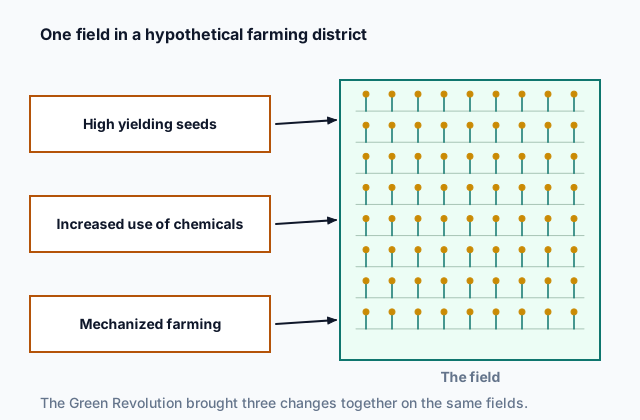
| Green Revolution | The spread of high yielding seeds, increased use of chemicals and mechanized farming through much of the developing world in the second half of the twentieth century. | It is a change in farming methods, not a political revolution or an environmental movement. |
| High yielding seeds | Crop varieties bred to produce much more grain per plant, and per hectare, than the varieties they replaced. College Board's course framework calls them high yield seeds. | Say what makes a seed high yielding: more grain from each plant and each hectare, not a bigger plant. |
| Yield | The amount of a crop harvested from one unit of land, such as tonnes per hectare. | Yield is a rate for each unit of land, so check the units before you compare two farms. |
| Fertilizer | A substance added to the soil to supply nutrients, such as nitrogen, that crops need to grow. | Manure is a fertilizer too, but the Green Revolution spread synthetic fertilizers made in factories. |
| Pesticide | A chemical used to kill or control pests: insects, weeds or plant diseases that damage crops. | A pesticide protects a crop; it does not feed it, which is the job of fertilizer. |
| Mechanized farming | Farming done with engine-powered machines in place of human and animal labor. | Mechanized means powered by engines; a farm can be mechanized and still use few chemicals. |
| Food supply | The amount of food available to feed a population. | A food supply can be counted for a district, a country or the world, so say which one you mean. |
 Tap to open the picture full size
Part 1 Think first Who gains from the new seed?
Make a guess before you read. A guess you have to fix is one you remember.
Predict first
In hypothetical Valley K, a new rice variety arrives that can yield about three times as much grain per hectare, but only with fertilizer, pesticide and a steady water supply that farmers must pay for. Which farmers do you expect to gain the most in the first ten years?
In short. The Green Revolution was the spread of high yielding seeds, much greater use of chemicals and mechanized farming in the developing world, and it brought both gains and costs for people and for the environment.
- Its three marks are high yielding seeds bred to put more growth into grain, more chemical fertilizers and pesticides, and engine-powered machines such as tractors, pumps and harvesters.
- For people, harvests and the food supply grew, but the gains went mostly to farmers who could pay for the inputs, and machines cut farm jobs.
- For the environment, higher yields meant less new land had to be cleared, but heavy chemical and water use polluted streams, drew down groundwater and narrowed the crops grown.
Part 2 Learn it What the Green Revolution was and what it changed
2a. High yielding seeds
The Green Revolution was a change in farming methods that spread through much of the developing world in the second half of the twentieth century. Its first mark was high yielding seeds: new varieties of staple grains such as wheat and rice, bred to put more of their growth into grain and less into leaf and stalk. Many had short, stiff stems, so a heavy head of grain did not bend the plant to the ground.
The gain is measured as yield, the amount harvested from each hectare of land. Take a hypothetical farming county that grows rice on 5,000 hectares. With its old varieties it harvested 2 tonnes per hectare (a tonne, or metric ton, is 1,000 kg), 10,000 tonnes in all. With high yielding seeds on the same land it harvests 5 tonnes per hectare, 25,000 tonnes in all: 15,000 tonnes more without plowing a single new hectare.
The new seeds reached yields like that only with a package around them: plenty of nutrients, protection from pests and a steady supply of water. Planted the old way, without those inputs, they often did little better than the varieties they replaced.
Quick check · Calculate
A hypothetical farming district grows wheat on 8,000 hectares. With its old varieties it harvested 1.5 tonnes per hectare. After its farmers switch to high yielding seeds with fertilizer, the same 8,000 hectares yield 4.0 tonnes per hectare. How many more tonnes of wheat does the district now harvest each year?
2b. Chemicals and machines
The other two marks of the Green Revolution were an increased use of chemicals and mechanized farming.
The chemicals were of two kinds. Synthetic fertilizers, made in factories, added the nitrogen and other nutrients that the new varieties drew from the soil in large amounts. Pesticides killed the insects, weeds and plant diseases that spread easily when one crop fills field after field.
Mechanized farming means doing farm work with engine-powered machines in place of people and animals. Tractors plowed and planted fields that oxen and hand tools once worked. Engine-driven pumps lifted water from wells and canals to irrigate crops through the dry months. Harvesting machines cut grain and separated it from the stalks in a fraction of the time a crew of workers took.
The three marks worked as a package. The seeds needed the nutrients and the protection from pests to reach their yields, and machines let a farmer plant, water and harvest more land on time. All of it had to be paid for before the first seed went into the ground, and that shaped who gained.
Quick check · Sort it
Each card describes something on a farm in a hypothetical district during the Green Revolution. Tap a card, then the mark of the Green Revolution it shows.
High yielding seeds
Increased use of chemicals
Mechanized farming
2c. Consequences for people
The Green Revolution had positive and negative consequences for people.
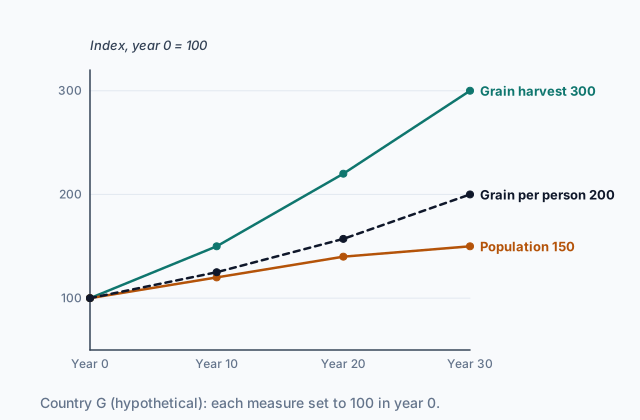
On the positive side, harvests grew much faster than farmland did, so the food supply, the amount of food available to a population, grew. Countries that had faced famine could feed growing populations, and more grain on the market kept prices lower for city families. To judge the food supply, compare the harvest with the number of people it feeds, as the chart does for hypothetical Country G.
 Tap to open the picture full size
Country G's harvest tripled, but its population grew by half, so grain per person doubled rather than tripled. It still rose, and that rise is the gain.
The negative side fell hardest on people with the least. Farmers with more land and access to loans bought the package first and gained most. Many small farmers borrowed to keep up and fell into debt when a harvest failed, and some sold their land. Machines did work that hired laborers once did, so landless workers lost wages, and many moved to cities to look for work. And as farmers planted more of a few high yielding grains, many grew fewer of the beans and vegetables their families had eaten, so diets could narrow even as grain grew.
Quick check · Spot the error
A student reasons about the food supply in a hypothetical farming region after the Green Revolution. Which line is the first to go wrong?
2d. Consequences for the environment
The consequences for the environment were also positive and negative.
The main positive one came from yield itself. When each hectare produces more, a country can feed more people from the farmland it already has, so less forest, grassland and wetland has to be cleared for new fields.
The negative ones came from the package:
- Fertilizer runoff. Rain washes fertilizer the crops did not take up into streams and lakes. The extra nutrients feed fast-growing algae, and when the algae die and rot they use up the oxygen that fish need.
- Harm from pesticides. Sprays kill helpful insects, such as the bees that pollinate crops, along with the pests. They can poison fish in canals and sicken the farm workers who handle them.
- Falling groundwater. Engine pumps can draw water from wells faster than rain refills the ground, so the water table drops and wells must be dug deeper.
- Fewer crop varieties. Where farmers replace many local varieties with a few high yielding ones, the crops lose genetic diversity, and one new pest or disease can sweep through a whole region's fields.
Quick check · Fill the statement
Complete the description of two environmental consequences of the Green Revolution in a hypothetical farming region.
When farmers across the region replace dozens of local rice varieties with a few high yielding ones, its crops lose genetic , so a new plant disease can spread through its fields than before. And as each hectare now grows more rice, the region needs new farmland to feed the same number of people.
Part 3 Watch it done Did the food supply really grow?
Open each step, then do the last one yourself.
Hypothetical District N grows wheat on 12,000 hectares. Before the Green Revolution it harvested 1.5 tonnes per hectare and had 90,000 people. Twenty years after its farmers adopted high yielding seeds, fertilizer and pumps, it harvests 3.5 tonnes per hectare on the same land, and its population is 140,000. How much grain per person does the district have now, compared with before?
Predict first
Before the steps, what do you expect happened to District N's grain per person?
Step 1 · Find the harvest before
Harvest = area × yield = 12,000 hectares × 1.5 tonnes per hectare = 18,000 tonnes.
Step 2 · Find grain per person before
18,000 tonnes ÷ 90,000 people = 0.2 tonnes per person. A tonne is 1,000 kg, so that is 200 kg per person each year.
Step 3 · Find the harvest now
12,000 hectares × 3.5 tonnes per hectare = 42,000 tonnes, on the same land as before.
Why this step?
Why divide by the population instead of just comparing the two harvests?
The harvest has to feed everyone in the district. When the population grows, the same grain is shared among more people, so comparing harvests alone can make the food supply look better than it is.
Your step · Calculate
Finish it. Using District N's harvest now and its population now, how many kilograms of grain per person does the district have now?
kg per person
Part 4 Try it Bring the package to a new province
Hypothetical Country W's government plans to bring high yielding seeds, fertilizer and farm machines to its farming provinces, and its advisers are asked what to expect.
Try it · Put it in order
In one province of hypothetical Country W, the largest farms adopt the Green Revolution package, and many landless workers there live on seasonal farm wages. Put these changes in order, first to last.
Try it · Multiple choice
Hypothetical Country W's population is growing, and its only unfarmed land is forest on steep hillsides. If farmers on its existing lowland fields adopt high yielding seeds and fertilizer, which consequence for the hill forest is most likely, compared with the clearing that would happen if they kept their old seeds?
Part 5 Explain it Explain a country's Green Revolution
Nothing you type leaves this page. Compare your answer with the model and each scoring point.
Free response is 50% of the exam score. This one is shaped like Question 2, from free-response II.
Free-response practice · Question 2 style
Stimulus 1, a hypothetical list of figures for Country Z, a developing country, at the start and at the end of 30 years of the Green Revolution:
- Farmland: 15 million hectares at the start, 16 million hectares at the end
- Grain harvest: 20 million tonnes at the start, 54 million tonnes at the end
- Population: 80 million at the start, 135 million at the end
- Fertilizer used: 5 kg per hectare at the start, 90 kg per hectare at the end
- Grain land planted with high yielding seeds: none at the start, 70 percent at the end
(A) Identify two characteristics of the Green Revolution shown in Stimulus 1.
(B) Using Stimulus 1, describe the change in Country Z's grain supply per person.
(C) Explain one positive consequence of that change for people in Country Z.
(D) Explain one negative consequence of the Green Revolution for Country Z's small farmers or farm laborers.
(E) Explain one negative consequence for the environment suggested by the data in Stimulus 1.
(F) Using the farmland and harvest data, explain one positive consequence for the environment.
(G) Explain one limitation of Stimulus 1 for judging who in Country Z gained from the Green Revolution.
Model answer
(A) High yielding seeds, which went from none of the grain land to 70 percent of it, and increased use of chemicals, with fertilizer use rising from 5 kg to 90 kg per hectare.
(B) Grain per person rose from 250 kg (20 million tonnes for 80 million people) to 400 kg (54 million tonnes for 135 million people), an increase of 60 percent, even though the population grew by more than two-thirds.
(C) More grain per person means a larger food supply. Fewer families go hungry, the risk of famine falls, and more grain on the market keeps food prices lower for city households.
(D) The new seeds needed fertilizer, pesticide and water that had to be bought before planting. Small farmers who could not afford them gained little, and those who borrowed to buy them could fall into debt and lose their land when a harvest failed.
(E) Fertilizer use per hectare rose eighteenfold. Fertilizer the crops do not take up washes into streams and lakes, where it feeds algae that use up the oxygen fish need.
(F) The harvest grew to 2.7 times its old size while farmland grew by only about 7 percent. Growing far more food on nearly the same land meant much less forest and grassland had to be cleared to feed the growing population.
(G) The figures give national totals and averages. It does not show how the gains were shared between large and small farmers or between regions, so it cannot show who gained and who was left behind.
Score your own answer. This is a self-check, not a grade. Tick each point your answer makes.
Part 6 Check yourself Two districts of Country M
The case questions use the table. The others mix ideas from the whole lesson.
Hypothetical Country M has two rice-growing districts with a similar climate. District East adopted high yielding seeds, fertilizer and engine pumps at the start of a 20-year period; District West kept its old methods. The table gives both districts at the start and at the end of the period.
| Measure | East, start | East, year 20 | West, start | West, year 20 |
|---|---|---|---|---|
| Rice yield (tonnes per hectare) | 1.6 | 4.0 | 1.5 | 1.7 |
| Rice farmland (hectares) | 30,000 | 30,000 | 25,000 | 26,000 |
| Population | 200,000 | 300,000 | 150,000 | 210,000 |
| Hired farm laborers | 24,000 | 15,000 | 18,000 | 19,000 |
| Rice varieties grown | 40 | 4 | 35 | 33 |
| Depth to groundwater (meters) | 8 | 22 | 9 | 10 |
Case question 1 · Calculate
By what percent did District East's rice yield per hectare rise over the 20 years?
Case question 2 · Multiple choice
Which conclusion about the people of the two districts is best supported by the table?
Case question 3 · Multiple choice
Which environmental consequence of the Green Revolution does the table give evidence of in District East?
The rest stand on their own and do not use the case.
Check yourself · Decide and justify
Hypothetical Country P's government finds that the gains from high yielding seeds are going mostly to its largest farms. A survey finds that the few small farmers who did buy fertilizer and pumps got as much grain per hectare as the large farms. The government plans to offer small farmers low-interest loans for fertilizer and pumps, repaid after harvest, with nothing owed in a year the harvest fails. Would the plan spread the gains of the new seeds to more small farmers?
Which reason supports your answer?
Check yourself · Rank it
After switching to high yielding seeds and fertilizer, three hypothetical villages harvest more rice. Rank them by how many more tonnes of rice each now harvests in a year. Work out each village's gain before you rank.
Largest gain first
Give each one a place, 1 for first. Give two the same place if they are equal.
Your ranking: none yet
Part 7 Keep it Bring back earlier ideas
This lesson stands on the second agricultural revolution and the spread of crops from earlier in this unit.
From 5.4 The Second Agricultural Revolution · Multiple choice
In a hypothetical country, the second agricultural revolution raised food production, and over the next century life expectancy rose. Which explanation best links the two?
From 5.3 Agricultural Origins and Diffusions · Multiple choice
A historian reads the records of a hypothetical farm in the Americas. Which item in the records shows that they were written after the Columbian Exchange began?
In three lines
- The Green Revolution spread high yielding seeds, increased use of chemicals and mechanized farming through much of the developing world.
- For people, it raised harvests and the food supply, but its gains went mostly to farmers who could pay for the inputs, and machines cut farm jobs.
- For the environment, it spared land from clearing but brought fertilizer runoff, harm from pesticides, falling groundwater and fewer crop varieties.
Exam strategy for this topic
- Section I, Multiple Choice: 60 questions in 60 minutes.
- Section II, Free Response: 3 questions in 75 minutes.
When a question asks for consequences of the Green Revolution, say whether each one is positive or negative and whether it falls on people or on the environment. When it gives a harvest and a population, divide before you say the food supply rose.
Questions students ask
Was the Green Revolution good or bad?
Both. It raised harvests and the food supply and spared land from clearing, and it also favored farmers who could afford the inputs, cut farm jobs, and harmed water and wildlife in many places. A strong answer names consequences of each kind.
How is the Green Revolution different from the second agricultural revolution?
The second agricultural revolution, Topic 5.4, came with industrialization and fed the workers of the first factory cities. The Green Revolution came later, in the twentieth century, and centered on high yielding seeds, chemicals and machines in the developing world.
Why did the Green Revolution favor larger farms?
The seeds paid off only with fertilizer, pesticide, water and machines bought before planting. Farmers with more land and access to loans could pay for them and spread the cost over many hectares.
Were the Green Revolution's seeds genetically modified?
No. Its high yielding varieties were bred the older way, by crossing plants and choosing the best offspring. Genetically modified crops came later, and the debates over them belong to Topic 5.11.
Are the places in this lesson real?
No. Every country, district, valley and village here is hypothetical, with numbers chosen to show each idea clearly. The Green Revolution itself was real, and its consequences differed from place to place.
Course alignment, for teachers
AP Human Geography topic 5.5, Unit 5: Agriculture and Rural Land-Use Patterns and Processes.
- Skill 2.D: Explain the significance of geographic similarities and differences among different locations and/or at different times.
This lesson maps all 2 essential knowledge statements of the topic to the part that teaches each one: 2 are checked by a scored question. The map is in the lesson file.