Unit 5 · Topic 5.6 · about 30 minutes · 7 parts · 12 scored checks, 3 of them multiple choice, plus 2 from earlier lessons
AP Human Geography 5.6: Agricultural Production Regions
Unit 5: 12 to 17% of the multiple-choice section
What you'll be able to do
- Explain how economic forces, such as land costs and access to markets, shape whether farms grow for their own households or for sale, whether they specialize in one crop, and whether they farm intensively or extensively.
Key vocabulary
| Term | What it means | The exam trap |
|---|---|---|
| Subsistence agriculture | Farming mainly to feed the farmer's own household or community, with little of the harvest sold. | Do not confuse it with extensive farming: a subsistence farm can work its land very intensively. |
| Commercial agriculture | Farming mainly to sell crops or animals for profit, often to buyers far from the farm. | Commercial and intensive are different ideas: a cattle ranch is commercial but works its land lightly. |
| Agricultural production region | An area defined by the kind of farming its farms practice, such as how far they grow for their own use or for sale. | A region's boundaries are drawn by geographers from farming data; they need not follow country borders. |
| Monoculture | Growing a single crop across a field or farm at one time, instead of several crops mixed together. | A monoculture can be a tree crop, such as oil palms, not only a field crop like wheat. |
| Monocropping | Growing the same crop on the same land year after year, with no rotation to other crops. | Monoculture and monocropping are easy to mix up, so learn the question each one answers. |
| Intensive farming | Farming that puts a lot of labor and capital into each hectare of land to get a high output from it. | Intensive is not the same as commercial; a subsistence rice farmer working by hand can farm intensively. |
| Extensive farming | Farming that puts little labor and capital into each hectare, usually across a large area, with a low output per hectare. | Low output per hectare is not low income: an extensive farm can still earn a profit. |
| Land costs | What a farmer pays to use land, as a yearly rent per hectare or a price to buy it. | Read the unit: a yearly rent per hectare and a price to buy a hectare are very different numbers. |
| Bid-rent theory | The theory that the amount a land user will pay for land falls with distance from a market, so each piece of land goes to the use that can pay the most for it. | It applies to farmland around a market and to land inside a city, so read the question for the scale. |
 Tap to open the picture full size
Part 1 Think first Which farmer works each hectare harder?
Make a guess before you read. A guess you have to fix is one you remember.
Predict first
Two hypothetical farmers each rent 50 hectares. Farmer A's land is 3 km from a large city, where land rents for 1,500 dollars per hectare each year. Farmer B's land is 150 km away, where it rents for 20 dollars per hectare. Which farmer do you expect to put more labor, fertilizer and machinery into each hectare?
In short. Agricultural production regions differ in how far their farms grow food for their own households (subsistence) or for sale (commercial), and land costs, as bid-rent theory explains, help decide whether farms use land intensively or extensively.
- Subsistence farming feeds the farm's own household; commercial farming grows for sale, often as monoculture or monocropping; a region is defined by where it falls between mostly subsistence and mostly commercial.
- Intensive farming puts a lot of labor and capital into each hectare; extensive farming puts little into each of many hectares.
- Under bid-rent theory, land costs most near the market, so intensive uses that can pay high rents take the land there and extensive uses take cheap land far away; climate, soil and policy also play a part.
Part 2 Learn it What farms grow, for whom, and how hard they work the land
2a. Subsistence and commercial agriculture
Farms differ first in what the harvest is for. In subsistence agriculture, farmers grow food mainly for their own household or community to eat. They may sell or trade a small surplus, but most of the harvest never reaches a market. In commercial agriculture, farmers grow crops or raise animals mainly to sell, for profit, often to buyers far away, such as a grain company, a meat packer or a city market.
Economic forces push farms toward one or the other. A family with little land, no road to a market and no cash to buy food grows what it eats. Where roads, buyers and good prices make selling pay, farms turn to the crops the market wants.
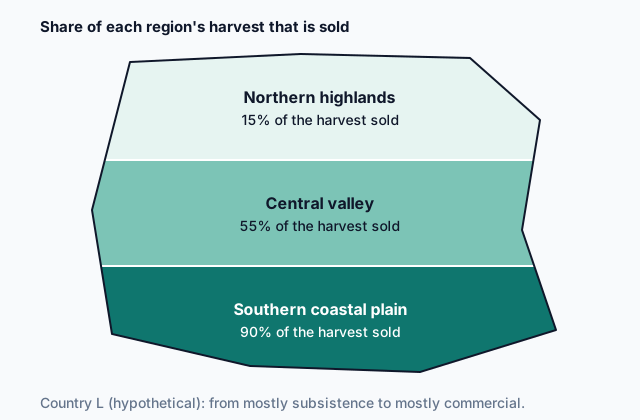
Geographers describe agricultural production regions by the extent to which their farms follow each practice. Regions fall along a range from mostly subsistence to mostly commercial, and most hold some farms of each kind. The central valley on the map at the top of the page, where farms sell about half of their harvest, is a mixed region. So judge a region by what most of its farms do with most of their harvest, not by its exceptions.
Quick check · Sort it
Each card describes a farm in a hypothetical country. Tap a card, then the kind of agriculture it practices.
Subsistence agriculture
Commercial agriculture
2b. Monoculture and monocropping
Commercial farms often specialize, in two related ways.
Monoculture is growing a single crop across a field or a whole farm at one time, instead of several crops mixed together. A plantation covered in oil palms is a monoculture, and so is a farm planted wall to wall in soybeans.
Monocropping is growing the same crop on the same land year after year, with no rotation to other crops.
The two overlap, and many books use the words almost as one, but they answer different questions. Monoculture describes the land at one moment: how many crops are growing on it now? Monocropping describes the same land over many years: does the crop ever change?
Economic forces favor both. A farm that grows one crop for sale needs one set of machines and one set of skills, and it can sell in bulk to one kind of buyer. Subsistence farms, which must feed a household through the year, more often grow several crops together. Specializing has costs too: a single crop draws its own pests and uses up particular soil nutrients, so it leans on fertilizer and pesticides.
Quick check · Decide and justify
Hypothetical Farm R plants all 800 of its hectares in corn, on the same fields every year, as it has for 20 years, and sells the whole harvest to a grain company. Does Farm R's practice reflect commercial agriculture?
Which reason supports your answer?
2c. Intensive and extensive farming
Farms also differ in how hard they work each hectare. Intensive farming puts a lot of labor and capital (machines, fertilizer, buildings, irrigation) into each hectare to get a high output from it. Extensive farming puts little labor and capital into each hectare, usually across a large area, and gets a low output per hectare. Topic 5.1 named practices of each kind, such as market gardening (intensive) and ranching (extensive).
Intensity is measured per hectare. Take two hypothetical farms. A vegetable farm spends 60,000 dollars a year on workers, seed, fertilizer and machines across 20 hectares: 3,000 dollars per hectare. A cattle ranch spends 200,000 dollars across 10,000 hectares: 20 dollars per hectare. The ranch spends more in total, but the vegetable farm is far more intensive.
Intensity and purpose are separate questions. A subsistence family can farm a small rice plot intensively, by hand, and a commercial ranch is extensive. So describe a farm both ways: who the harvest is for, and how much goes into each hectare.
Quick check · Rank it
Rank four hypothetical farms from most intensive to least intensive, using each farm's yearly spending on labor, machines, seed and fertilizer. Work out each farm's spending per hectare before you rank.
Most intensive first
Give each one a place, 1 for first. Give two the same place if they are equal.
Your ranking: none yet
2d. Land costs and bid-rent theory
Why is one farm intensive and another extensive? Part of the answer is the cost of land. Bid-rent theory says that the amount a land user will pay for land, its bid rent, falls with distance from a market. Close to a city's market, many users compete for land and save on getting goods to buyers, so land is expensive. Farther away, land is cheap.
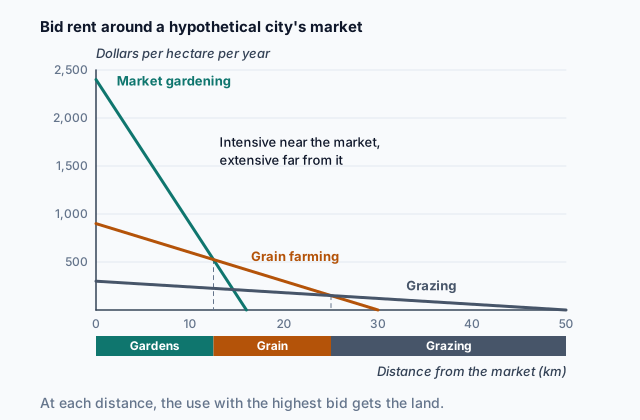
A farmer paying a high land rent has to earn a lot from each hectare to cover it, so near the market the land goes to intensive uses with a high value per hectare. A use that earns little per hectare can pay only a low rent, so it ends up on cheap land far away. The graph shows three hypothetical uses around one city.
 Tap to open the picture full size
At each distance, the use with the highest bid can pay the most, so it gets the land. One use takes over from another where their bids are equal: here, where the market gardening and grain lines cross at 12.5 km.
Land costs determine farming practices only in part. Climate, soil, water, technology and government policy also shape what a farm can grow and earn, so real farms do not always sit where bid-rent theory puts them.
Quick check · Calculate
Around a hypothetical city, market gardening can bid 1,800 dollars per hectare per year at the market, and its bid falls by 90 dollars for each kilometer away. Wheat farming can bid 600 dollars at the market, and its bid falls by 15 dollars per kilometer. Beyond what distance from the market does wheat farming outbid market gardening?
Part 3 Watch it done Who gets the land 15 km out?
Open each step, then do the last one yourself.
Around hypothetical City V, three farming uses compete for land. Market gardening can bid 2,000 dollars per hectare per year at the market, and its bid falls by 120 dollars for each kilometer away. Dairy farming can bid 1,100 dollars, falling by 40 dollars per kilometer. Grazing can bid 250 dollars, falling by 5 dollars per kilometer. Which use gets a plot 10 km from the market, and which gets a plot 15 km away?
Predict first
Before the steps, which use do you expect to win the plot 15 km from the market?
Step 1 · Write each bid at a distance d
Market gardening: 2,000 − 120d. Dairy farming: 1,100 − 40d. Grazing: 250 − 5d. All are in dollars per hectare per year.
Step 2 · Work out the bids at 10 km
Market gardening: 2,000 − 1,200 = 800. Dairy farming: 1,100 − 400 = 700. Grazing: 250 − 50 = 200. Market gardening bids the most, so it gets the plot 10 km out.
Why this step?
Why does the plot go to the use with the highest bid?
A landowner rents to whoever pays the most. The highest bidder is the use that earns enough from each hectare at that distance to cover the highest rent, so the others are priced out.
Your step · Calculate
Finish it. Work out all three bids at 15 km from City V's market. How many dollars per hectare does the highest bidder offer there?
dollars per hectare
Part 4 Try it Farms in a changing country
Hypothetical Country T has several farming regions, from lowland grain plains to remote highland valleys.
Try it · Multiple choice
Commercial grain farms across Country T's Region S plant all of their land in a single crop. Which reason best explains this practice?
Try it · Multiple choice
The farm families of Country T's remote Region H grow a mix of grains, beans and vegetables and eat most of what they grow. A new paved road now links Region H to a port city with a large market for farm goods. Over the next twenty years, which change in Region H is most likely?
Part 5 Explain it Explain Country N's farming regions
Nothing you type leaves this page. Compare your answer with the model and each scoring point.
Free response is 50% of the exam score. This one is shaped like Question 3, from free-response II.
Free-response practice · Question 3 style
Stimulus 1, a hypothetical map of Country N, described in words: the north is dry hill country, where families grow millet and beans on small plots and keep a few goats, and most of what they grow feeds their own households. The south is a wide plain around the capital, City C, where large farms each plant all of their land in a single crop, such as soybeans, and sell it to exporters.
Stimulus 2, a hypothetical table of farmland around City C:
- 0 to 10 km from the city: land rent 2,000 dollars per hectare per year; mostly market gardens and dairy farms
- 10 to 50 km: land rent 400 dollars; soybean and corn farms
- 50 to 200 km: land rent 60 dollars; cattle ranches
(A) Identify the region of Country N where subsistence agriculture dominates.
(B) Describe one difference between subsistence and commercial agriculture shown in Stimulus 1.
(C) Explain one economic reason the southern farms practice monoculture.
(D) Using Stimulus 2, describe the relationship between distance from City C and land rent.
(E) Using bid-rent theory, explain why the land within 10 km of City C is farmed intensively.
(F) City C's suburbs spread 20 km outward over the next decade. Explain one likely effect on the farms 10 to 20 km from the city.
(G) Explain one limitation of bid-rent theory for explaining where intensive farming is found in Country N.
Model answer
(A) The northern hill country.
(B) The northern families grow mixed food crops mainly to feed their own households, while the southern farms grow a single crop mainly to sell to exporters.
(C) The southern farms grow for sale. Planting all of their land in one crop means they need only one set of machines and skills, and they can sell the crop in bulk to exporters.
(D) Land rent falls as distance from City C grows, from 2,000 dollars per hectare within 10 km to 60 dollars beyond 50 km.
(E) Bid-rent theory says users will pay the most for land near the market, where many compete for it. A farmer paying 2,000 dollars a hectare must earn a lot from each hectare to cover that rent, so only intensive uses with high output per hectare, such as market gardens and dairy farms, can afford the land.
(F) The suburbs bring new bidders, such as housing developers, so land rent 10 to 20 km out rises. Soybean and corn farms that cannot earn enough per hectare to pay it will switch to more intensive uses, such as market gardening, or sell their land for housing.
(G) Bid-rent theory explains farming practices only in part, by land cost and distance. It leaves out the physical environment: the north's dry climate limits what its farms can grow whatever its land costs, and an irrigated valley far from City C could support intensive farming that the theory would not predict.
Score your own answer. This is a self-check, not a grade. Tick each point your answer makes.
Part 6 Check yourself Farms around City Q
The case questions use the table. The others mix ideas from the whole lesson.
Five hypothetical farms lie in the countryside around City Q, the only large market in the region. The land is flat and the climate is the same across the region, except around Farm E, which sits in a small district of sunny slopes with rich volcanic soil.
| Farm | Distance from City Q | Main product | Land rent | Spending on labor and capital | Value of output |
|---|---|---|---|---|---|
| A | 4 km | Vegetables | 1,400 | 5,000 | 8,000 |
| B | 15 km | Milk | 600 | 1,800 | 3,000 |
| C | 40 km | Wheat | 150 | 350 | 700 |
| D | 110 km | Beef cattle on open range | 20 | 40 | 90 |
| E | 95 km | Wine grapes | 900 | 4,500 | 9,000 |
Case question 1 · Calculate
After paying its land rent and its spending on labor and capital, how many dollars per hectare does Farm B have left from the value of its output each year?
Case question 2 · Decide and justify
Farm A's owner is offered a deal to turn its land into cattle grazing like Farm D's, with output worth about 90 dollars and spending of about 40 dollars per hectare each year. Would grazing pay on Farm A's land?
Which reason supports your answer?
Case question 3 · Multiple choice
Which statement best judges how well bid-rent theory explains the farms in the table?
The rest stand on their own and do not use the case.
Check yourself · Spot the error
A student classifies the farming of hypothetical Region R. Which line is the first to go wrong?
Check yourself · Put it in order
A cattle-grazing farm sits 30 km beyond the edge of a fast-growing hypothetical city. Put the changes bid-rent theory predicts in order, first to last.
Part 7 Keep it Bring back earlier ideas
This lesson stands on the farming practices of Topic 5.1 and the Green Revolution of Topic 5.5.
From 5.1 Introduction to Agriculture · Fill the statement
Name the farming practice each hypothetical farm shows.
On a 6-acre farm, a family grows tomatoes, peppers and herbs in greenhouses and trucks them to a nearby city's markets each morning: . On a 4,000-acre estate, hundreds of hired workers tend coffee trees, and the beans are dried and shipped abroad: . On a 300-acre farm, barley and clover are grown to fatten the farm's own sheep and cattle before they are sold: .
From 5.5 The Green Revolution · Sort it
Each card describes something on a farm in a hypothetical district during the Green Revolution. Tap a card, then the mark of the Green Revolution it shows.
High yielding seeds
Increased use of chemicals
Mechanized farming
In three lines
- Production regions are defined by the extent of subsistence farming, for the household, or commercial farming, for sale, often as monoculture or monocropping.
- Intensive farming puts much labor and capital into each hectare; extensive farming puts little into each of many hectares.
- Bid-rent theory: land costs most near the market, so intensive uses take land close in and extensive uses take cheap land far out, with climate, soil and policy also playing a part.
Exam strategy for this topic
- Section I, Multiple Choice: 60 questions in 60 minutes.
- Section II, Free Response: 3 questions in 75 minutes.
When a question asks why a farm is intensive or extensive, start with land cost and distance from the market, then name a second force, such as climate or soil, if the farm breaks the pattern. When it asks about a region, say whether most of its harvest is eaten at home or sold.
Questions students ask
Is all commercial farming intensive?
No. Purpose and intensity are separate. A cattle ranch is commercial and extensive, a vegetable farm near a city is commercial and intensive, and a family's hand-worked rice plot can be subsistence and intensive.
What is the difference between monoculture and monocropping?
Monoculture is a single crop on the land at one time. Monocropping is the same crop on the same land year after year. Many books use the two words loosely, almost as one; both are practices of commercial farms.
How is bid-rent theory related to the von Thünen model?
Both explain farming patterns by distance from a market. Bid-rent theory, in this topic, compares what land users can pay at each distance. The von Thünen model, Topic 5.8, builds rings of farming around a market from the cost of moving goods to it.
Do subsistence farmers ever sell anything?
Yes. Many sell or trade a small surplus. What makes farming subsistence is that most of the harvest feeds the farm's own household.
Are the places in this lesson real?
No. Every country, region, city and farm here is hypothetical, with numbers chosen to show each idea clearly. Real farming regions fit these ideas more loosely.
Course alignment, for teachers
AP Human Geography topic 5.6, Unit 5: Agriculture and Rural Land-Use Patterns and Processes.
- Skill 2.E: Explain the degree to which a geographic concept, process, model, or theory effectively explains geographic effects in different contexts and regions of the world.
This lesson maps all 2 essential knowledge statements of the topic to the part that teaches each one: 2 are checked by a scored question. The map is in the lesson file.