Unit 5 · Topic 5.7 · about 30 minutes · 7 parts · 12 scored checks, 3 of them multiple choice, plus 2 from earlier lessons
AP Human Geography 5.7: Spatial Organization of Agriculture
Unit 5: 12 to 17% of the multiple-choice section
What you'll be able to do
- Explain how economic forces shape the way farming is organized: why large commercial operations are replacing small family farms, how commodity chains link the places that grow food with the places that eat it, and how technology has increased economies of scale and the carrying capacity of the land.
Key vocabulary
| Term | What it means | The exam trap |
|---|---|---|
| Large-scale commercial agriculture | Farming on a very large area or with very many animals, using hired workers and costly machines, to produce crops or livestock for sale. | Ownership does not define it: a large operation can be a corporation or a family business. |
| Small family farm | A farm run mainly by one household, which supplies most of its work and makes its decisions. | Many small family farms sell all they grow, so do not read small as subsistence. |
| Economies of scale | The savings in cost for each unit of output that a larger operation gets from producing more. | It is about cost per unit, not total cost: a large farm spends more in total. |
| Carrying capacity | The number of people an area's land can support with what it produces. | Technology changes it, so the same land can have a different carrying capacity at different times. |
| Commodity chain | The linked series of firms and places that a farm product passes through between its production and its consumption. | One chain can cross several countries, so follow the product, not a border. |
 Tap to open the picture full size
Part 1 Think first Fewer farms, less food?
Commit to a guess first. Being wrong now makes the right idea stick better.
Predict first
A hypothetical farming county had 1,000 farms 40 years ago and has 250 today. The amount of farmland in the county has not changed. What most likely happened to the amount of food the county's farms produce?
In short. In many farming regions, economic forces are reorganizing agriculture: large-scale commercial operations are replacing small family farms, complex commodity chains link the places that produce food with the places that consume it, and technology has increased both economies of scale and the carrying capacity of the land.
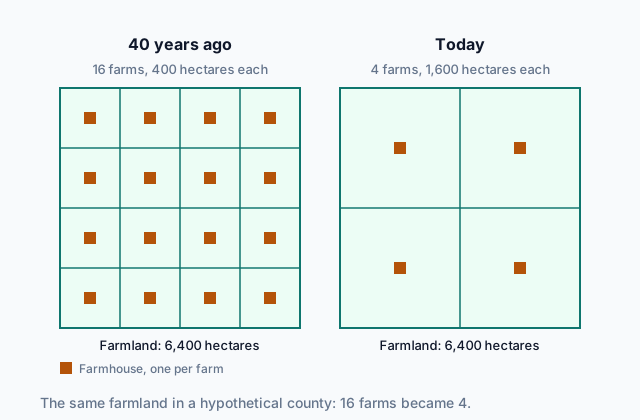
- Large-scale commercial operations are replacing small family farms: the number of farms falls and the average farm grows, often on the same farmland.
- Technology has increased economies of scale, because costly machines lower the cost of each tonne only when spread over a large harvest, and it has raised the carrying capacity of the land by raising how much food each hectare yields.
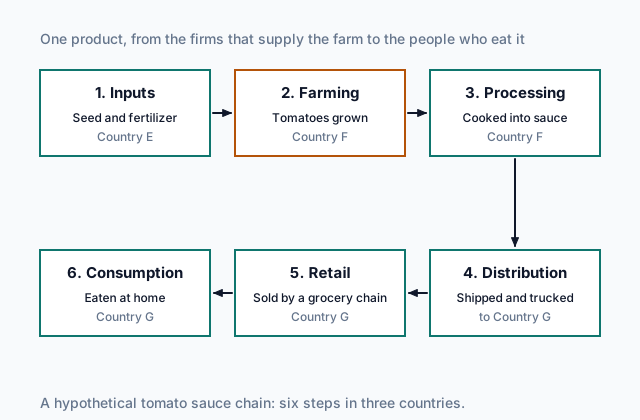
- A commodity chain is the series of firms and places a farm product passes through, from the suppliers of seed and fertilizer to the farm, the processor, the distributor, the store and the consumer.
Part 2 Learn it How economic forces organize farming
2a. Large operations replacing small family farms
In many farming regions, large-scale commercial agricultural operations are replacing small family farms. A small family farm is run mainly by one household, which does most of the work and makes the decisions. A large-scale commercial operation produces in large volume for sale, with hired workers and costly machines, on far more land or with far more animals than its neighbors once had. Some are owned by corporations, and many are family businesses run on a large scale.
The picture at the top of the page shows the pattern in a hypothetical county: the same farmland, held by fewer and larger farms. When a farmer retires or can no longer cover the bills, a neighbor with a bigger operation buys or rents the land. The number of farms falls, the average farm grows, and the farmland can stay the same.
In hypothetical County R, 1,800 farms shared 108,000 hectares a generation ago, an average of 60 hectares each. Today 600 farms share the same land, an average of 180 hectares.
Economic forces drive the change. The price a farmer gets for each tonne of grain or liter of milk is low, so a farm needs a large output to earn a living. Machines and buildings cost a great deal and pay for themselves only over many hectares. And processors and supermarket chains want large, steady deliveries of a uniform product, so they sign contracts with the farms big enough to supply them.
Quick check · Calculate
In a hypothetical farming county, 96,000 hectares of farmland were divided among 1,200 farms a generation ago. Today those 96,000 hectares are divided among 300 farms. By how many hectares has the average farm size grown?
2b. Technology and economies of scale
Economies of scale are the savings a larger operation gets as it produces more: its cost for each unit of output falls. Some of a farm's costs stay about the same however much it grows, such as a combine harvester, a grain dryer or a manager's time. Spread over more tonnes, each tonne carries less of them. A large farm also buys seed, fuel and fertilizer in bulk at lower prices, and sells in volumes that buyers reward.
Technology has increased economies of scale in agriculture. Wider combines, tractors that steer themselves by satellite positioning, computer-controlled irrigation and milking robots each cost a great deal, and each lets one worker handle far more land or animals. On a small farm such a machine sits idle much of the year, and its cost for each tonne is high. On a large farm it works every day of the season, and its cost for each tonne is low.
Land matters too. Wide machines work fastest on large, flat, open fields; on steep slopes or small fields broken up by woods they turn often and cover ground slowly, so size pays off less there.
So each new costly machine widens the advantage of size. A large farm that can afford it grows each tonne more cheaply than its small neighbors, and when crop prices are low, the farm with the higher cost per tonne is the one that runs out of money first.
Quick check · Fill the statement
Complete the description of how farm technology has changed the advantage of farm size.
A self-steering combine has a yearly cost to own and run. Its cost for each tonne of grain is therefore on a farm that harvests many hectares than on a farm that harvests few, so machines like it give farms a cost advantage.
2c. Technology and the carrying capacity of the land
The carrying capacity of land is the number of people it can support. For farmland, that comes down to how much food each hectare produces and how much food each person needs.
Technology has increased the carrying capacity of the land. Irrigation brings water to dry fields. Fertilizer and improved seed raise the harvest from each hectare. Machinery lets farmers plant and harvest at the right time, and better storage means less of the harvest rots or is eaten by pests before people eat it.
Take a hypothetical river valley with 5,000 hectares of cropland. Each hectare yields 2 tonnes of grain a year, and each person needs about 0.25 tonnes. The valley grows 10,000 tonnes, enough for 40,000 people. Irrigation raises the yield to 3 tonnes a hectare: 15,000 tonnes, enough for 60,000 people, on the same land.
Keep two ideas apart. Economies of scale are about cost: what it costs a farm to grow each tonne. Carrying capacity is about people: how many the land can feed. A technology can raise one without the other. A bigger combine can lower the cost of each tonne without adding a tonne to the harvest, and a better seed can raise the harvest on a farm of any size.
Quick check · Calculate
A hypothetical island has 1,500 hectares of cropland. Each hectare yields 2.4 tonnes of grain a year, and each person needs 0.3 tonnes of grain a year. New irrigation and improved seed raise the yield to 4.0 tonnes per hectare on that cropland. By how many people does the land's carrying capacity rise?
2d. Commodity chains
A commodity chain is the series of linked steps, firms and places that a farm product passes through between production and consumption. Today the two are often far apart, and the chain is what links them.
 Tap to open the picture full size
Follow the sauce. A seed and fertilizer firm in hypothetical Country E supplies a tomato farm in Country F. A cannery in Country F cooks the tomatoes into sauce. Ships and trucks carry it to Country G, a grocery chain sells it, and a household eats it.
The chain is complex: many firms, several countries, and storing, packing or moving between almost every step. Each step adds cost and value, so the farm receives only part of what the shopper pays. The large processors and retailers near the end of the chain decide how much they want, of what quality and when, and their demand for big, uniform deliveries is one more push toward farms large enough to supply it.
Quick check · Put it in order
A loaf of packaged bread is sold in a hypothetical town. Put the steps of its commodity chain in order, from first to last.
Part 3 Watch it done Which farm grows wheat more cheaply?
Watch each step, then do the last one yourself.
In a hypothetical wheat region, Farm A has 200 hectares and Farm B has 2,000 hectares, and both harvest 4 tonnes of wheat per hectare. Farm A's machinery costs $120,000 a year. Farm B's larger, self-steering machinery costs $400,000 a year. Each farm's other costs, such as seed, fuel and fertilizer, come to $150 for each tonne it grows. Compare what each farm pays to grow one tonne of wheat.
Predict first
Before the steps, which farm do you expect to grow each tonne of wheat more cheaply?
Step 1 · Find each farm's harvest
Both farms harvest 4 tonnes per hectare. Farm A: 200 × 4 = 800 tonnes. Farm B: 2,000 × 4 = 8,000 tonnes.
Step 2 · Work out Farm A's cost per tonne
Farm A's machinery, $120,000 a year, spread over 800 tonnes: $120,000 ÷ 800 = $150 a tonne. Add the other costs of $150 a tonne: Farm A pays $300 to grow each tonne.
Why this step?
Why divide each machinery bill by the harvest, instead of comparing the two bills?
Farm B's bill is bigger, but what decides whether a farm can compete is what each tonne costs it to grow. Economies of scale show up only in the cost per unit.
Your step · Calculate
Finish it. Farm B harvests 8,000 tonnes, pays $400,000 a year for its machinery, and has other costs of $150 for each tonne. What is Farm B's total cost to grow each tonne of wheat?
dollars per tonne
Part 4 Try it Follow the farms of a region
Try it · Decide and justify
A hypothetical frozen-food company is building a plant that needs 60,000 tonnes of potatoes a year, all of one variety and size. Nearby are 300 small family farms that each grow about 200 tonnes of potatoes, and 12 large commercial operations that each grow about 5,000 tonnes of potatoes. Which farms is the company more likely to sign supply contracts with?
Which reason supports your answer?
Try it · Multiple choice
Oats for a hypothetical breakfast cereal are grown in Country P, milled in Country Q, and packed and sold in Country R. Which change would make this commodity chain more complex?
Part 5 Explain it Explain how farming is being reorganized
Nothing you type leaves this page. Check your answer against the model and each scoring point.
Free response is 50% of the exam score. This one is shaped like Question 1, from free-response II.
Free-response practice · Question 1 style
Over the past several decades, farming in many developed countries has changed. There are fewer farms, the average farm is much larger, and food often travels a long way and through many firms between the farm and the table.
(A) Define economies of scale.
(B) Describe one technology that has increased economies of scale in agriculture.
(C) Explain how economies of scale lead large-scale commercial operations to replace small family farms.
(D) Describe two steps in an agricultural commodity chain that come after the farm.
(E) Explain one way that large processors or retailers in a commodity chain influence the size of the farms that supply them.
(F) Explain how technology has increased the carrying capacity of the land.
(G) Explain one reason small family farms remain common in some places despite this trend.
Model answer
(A) Economies of scale are the cost savings a larger operation gets: as it produces more, its cost for each unit of output falls.
(B) A tractor that steers itself by satellite positioning lets one worker plant far more hectares a day. It costs a great deal each year, so it lowers the cost of each tonne only when that cost is spread over a large harvest.
(C) A large operation spreads the cost of its machines, buildings and management over many more tonnes, and buys seed and fertilizer in bulk, so it grows each tonne more cheaply. When crop prices are low, a small farm with a higher cost per tonne earns too little to keep going. When its farmer retires or sells, a larger neighbor buys or rents the land, and farms become fewer and larger.
(D) After the harvest, a processor such as a mill or a cannery turns the crop into a food product. Then distributors ship it to stores, and retailers sell it to consumers.
(E) Processors and supermarket chains want large, steady deliveries of a uniform product, so they sign contracts with farms that can supply those volumes. That rewards large operations and leaves small farms without a buyer unless they grow or sell.
(F) Irrigation, fertilizer and improved seed raise the harvest from each hectare, and better storage cuts the share of the harvest that is lost, so the same land produces more food and can support more people.
(G) Where land is hilly or split into small fields, large machines cannot work efficiently, so size gives less of an advantage. Small farms also survive by selling specialty products, such as fresh vegetables or organic eggs, straight to nearby customers, a short commodity chain in which they keep more of the price.
Score your own answer. This is a self-check, not a grade. Tick each point your answer makes.
Part 6 Check yourself Two counties, two rates of change
The case questions use the table. The others mix the ideas from the whole lesson.
A farm agency in a hypothetical country compares two of its counties. Neither county gained or lost farmland in 40 years.
| County North | County South | |
|---|---|---|
| Land | Flat plain, large open fields | Steep hills, small fields between woods |
| Main products | Corn and soybeans | Apples and pasture for dairy cows |
| Farmland, both years | 160,000 hectares | 90,000 hectares |
| Farms, 40 years ago | 1,600 | 1,500 |
| Farms, today | 400 | 1,100 |
Case question 1 · Multiple choice
Which statement best explains why the number of farms fell much faster in County North than in County South?
Case question 2 · Select all
Which two conclusions does the table support? Select two.
Select 2 answers, then check.
Case question 3 · Multiple choice
A company that processes corn and soybeans opens a plant in County North and offers contracts only to farms that can deliver at least 5,000 tonnes a year. What is the most likely result over the next decade?
The rest stand on their own and do not use the case.
Check yourself · Spot the error
A student compares two hypothetical grain farms. Which line is the first to go wrong?
Check yourself · Match
Each observation comes from a hypothetical farming region. Match each idea to the observation that shows it.
Part 7 Keep it Bring back earlier ideas
This lesson stands on earlier Unit 5 topics on farming regions and on how agriculture changed.
From 5.6 Agricultural Production Regions · Decide and justify
Hypothetical Farm R plants all 800 of its hectares in corn, on the same fields every year, as it has for 20 years, and sells the whole harvest to a grain company. Does Farm R's practice reflect commercial agriculture?
Which reason supports your answer?
From 5.4 The Second Agricultural Revolution · Put it in order
Put these steps of the second agricultural revolution in order, from the first cause to the last effect.
In three lines
- Large-scale commercial operations are replacing small family farms: fewer, larger farms, often on the same farmland.
- Technology has increased economies of scale, lowering the cost of each unit on large farms, and raised the carrying capacity of the land.
- Complex commodity chains link production and consumption, from the farm's suppliers to the processor, the store and the consumer.
Exam strategy for this topic
- Section I, Multiple Choice: 60 questions in 60 minutes.
- Section II, Free Response: 3 questions in 75 minutes.
When a question asks why farms are getting fewer and larger, name the economic force, such as cost per unit, low prices or buyers' contracts, and the technology behind it, then say what happens to the land and the number of farms.
Questions students ask
Are small family farms disappearing?
Their number is falling in many farming regions as large-scale commercial operations take over their land, but they have not vanished. They hold on where the land does not suit big machines, and where they sell specialty products straight to nearby customers.
Is every large farm owned by a corporation?
No. What makes an operation large-scale and commercial is its size, its hired workers and machines, and that it produces for sale. Some large operations are corporations, and some are owned by a family that runs them as a large business.
What is the difference between economies of scale and carrying capacity?
Economies of scale are about cost: a larger operation pays less for each unit it produces. Carrying capacity is about people: how many the land can support. Technology has increased both, but a change can raise one without the other.
Is a commodity chain the same as a supply chain?
They are close. A commodity chain follows one product through every step and place between production and consumption. Topic 5.9 looks at food and other farm products as part of a global supply chain.
Are the farms, counties and countries in this lesson real?
No. Every farm, county, company and country here is hypothetical, with numbers chosen to show each idea clearly. Real farming regions show these patterns more unevenly.
Course alignment, for teachers
AP Human Geography topic 5.7, Unit 5: Agriculture and Rural Land-Use Patterns and Processes.
- Skill 2.D: Explain the significance of geographic similarities and differences among different locations and/or at different times.
This lesson maps all 3 essential knowledge statements of the topic to the part that teaches each one: 3 are checked by a scored question. The map is in the lesson file.