Unit 6 · Topic 6.2 · about 30 minutes · 7 parts · 12 scored checks, 3 of them multiple choice, plus 2 from earlier lessons
AP Human Geography 6.2: Cities Across the World
Unit 6: 12 to 17% of the multiple-choice section
What you'll be able to do
- Explain the processes that start and drive urbanization and suburbanization, from the growth of megacities and metacities in periphery and semiperiphery countries to the edge cities, exurbs and boomburbs that sprawl and decentralization create, and the challenges they bring.
Key vocabulary
| Term | What it means | The exam trap |
|---|---|---|
| Megacity | An urban area with more than 10 million people. | It names a size class, so check the population figure against the threshold before you use the term. |
| Metacity | An urban area with more than 20 million people, the largest size class. | A metacity has also passed the megacity mark, so when a question asks for the larger class, use this term. |
| Periphery | In world-system theory, the lower-income countries whose economies lean on farming and raw materials. | It describes a country's position in the world economy, not where the country sits on a map. |
| Semiperiphery | In world-system theory, the countries between the core and the periphery, with industrializing economies. | A country's place in the world economy can change, so a country can move into or out of the semiperiphery. |
| Suburbanization | The movement of people from a central city to the suburbs around it. | It describes where people live, so it is not by itself a measure of how much land the metro area covers. |
| Sprawl | Urban growth that spreads outward at low density across farmland and open space, with places reached mostly by car. | A larger built-up area alone is not evidence of it; compare the growth of land with the growth of people. |
| Decentralization | The spread of jobs, stores and services from the downtown to many centers across a metro area. | A downtown can keep many of its jobs and still lose its place as the only center. |
| Edge city | A large cluster of offices, malls, hotels and entertainment in the suburbs, outside the old central city, often at a highway interchange. | It is defined by what is there, not by a city government; many have none. |
| Exurb | A community beyond the suburbs, among farms or woods, with homes on large lots and residents who commute into the metro area. | It looks rural, but it is part of the metro area's growth, tied to it by commuting. |
| Boomburb | A suburb that has grown very fast into a large city, often of more than 100,000 people, while it is not the main city of its metro area. | Its population can rival an old central city's, but it usually lacks a traditional downtown. |
 Tap to open the picture full size
Part 1 Think first Which urban area will be bigger?
Commit to a guess first. Being wrong now makes the right idea stick better.
Predict first
Two hypothetical countries each have one very large urban area. Country F's has 12 million people and adds about 50,000 people a year. Country G's has 8 million people and adds about 450,000 people a year. If both keep growing by those amounts, which urban area will have more people in 30 years?
In short. Urbanization has produced megacities, urban areas of more than 10 million people, and metacities, of more than 20 million, increasingly in periphery and semiperiphery countries; inside metro areas, suburbanization, sprawl and decentralization have created edge cities, exurbs and boomburbs, and new challenges with them.
- A megacity has more than 10 million people and a metacity more than 20 million, counted across the whole built-up urban area. Most new ones are in periphery and semiperiphery countries, where rural-to-urban migration and natural increase drive fast growth.
- Suburbanization moves people from the central city to the suburbs, sprawl spreads growth outward as density falls, and decentralization spreads jobs and services out of the downtown into many centers.
- Edge cities, exurbs and boomburbs are the new land-use forms, and they bring longer commutes, costly roads and pipes, lost farmland and a shrinking tax base for the central city.
Part 2 Learn it How cities grow up and spread out
2a. Megacities and metacities
Urbanization is the growth in the share of a country's people who live in urban areas. Where it runs fast for decades, it produces urban areas larger than any the world had before, and geographers name two size classes for them:
- A megacity is an urban area of more than 10 million people.
- A metacity is an urban area of more than 20 million people. A metacity has passed the megacity mark too; the term names the largest of them.
Count the whole urban area: the central city plus the suburbs and settlements built up around it without a break. A city's legal limits often hold only part of it. Hypothetical City H has 6 million people inside its city limits, but 13 million live across its continuous built-up area, so City H is a megacity.
Megacities and metacities are distinct spatial outcomes of urbanization, not just bigger versions of ordinary cities. Their size brings problems of scale: commutes that take hours, water and sewer systems that fall behind, and wide informal settlements at the edges, where newcomers build their own housing faster than planned building can keep up.
Quick check · Sort it
Each card describes a hypothetical urban area. Tap a card, then its size class. A metacity has also passed the megacity mark, so put it only in the metacity bin.
Not a megacity
Megacity, not a metacity
Metacity
2b. Where megacities are growing
World-system theory sorts countries by their place in the world economy. The core is the wealthy countries with high-income, diverse economies. The periphery is the lower-income countries whose economies lean on farming and raw materials. The semiperiphery sits between them: countries whose economies are industrializing. Unit 7 returns to the theory.
Megacities and metacities are increasingly located in periphery and semiperiphery countries. Core countries urbanized early, during their industrial revolutions. Most of their people already live in cities, so their largest urban areas now grow slowly. Many periphery and semiperiphery countries are urbanizing now, and fast, driven by two processes at once:
- Rural-to-urban migration: people leave the countryside, where farm jobs and land are scarce, for city jobs, schools and services.
- Natural increase: a young city population has more births than deaths, so the city grows even without newcomers.
Take two hypothetical urban areas over the same 25 years. Urban area J, in a semiperiphery country, grew from 5 million people to 12 million and became a megacity. Urban area E, in a core country, grew from 11 million to 12 million. Both are megacities today, but most of the world's new ones are like J.
Quick check · Calculate
In a hypothetical count of the world's megacities, 12 of 20 were in periphery or semiperiphery countries in an earlier year. In a later year, 30 of 40 were. By how many percentage points did the periphery and semiperiphery share of the world's megacities rise?
2c. Suburbanization, sprawl and decentralization
Inside a metro area, growth has moved outward. Suburbanization is the movement of people from the central city, the older core around the downtown, to the suburbs around it. Cars and highways let people live far from work, cheaper land at the edge meant larger homes and yards, and government road building and home loans sped the move up in many countries.
Sprawl is urban growth that spreads outward at low density across farmland and open space, with homes, stores and offices far apart and reached mostly by car. A city that adds people has to add some land, so a bigger built-up area alone is not sprawl. The test is land growing faster than people, so density falls.
Decentralization is the spread of jobs, stores and services out of the downtown into many centers across the metro area. Businesses followed the people outward, and the downtown stopped being the one place where everyone worked and shopped.
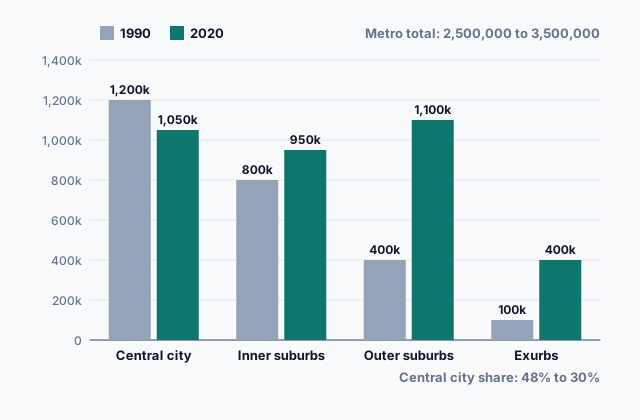
The chart at the top of the page shows hypothetical Metro Area R. From 1990 to 2020 the whole metro area grew by 1,000,000 people, yet its central city lost 150,000, and the central city's share of the metro fell from 48 percent to 30 percent. The outer suburbs and exurbs gained the most.
Quick check · Fill the statement
Name the process at work in each stage of a hypothetical metro area's growth.
In hypothetical Metro Area V, families left the central city for new neighborhoods outside it, an example of . The new neighborhoods spread across farmland with two or three homes to each acre and stores reached only by car, an example of . Later, banks and stores closed their downtown offices and opened new ones in several suburban centers, an example of .
2d. Edge cities, exurbs and boomburbs
Suburbanization, sprawl and decentralization have created new land-use forms.
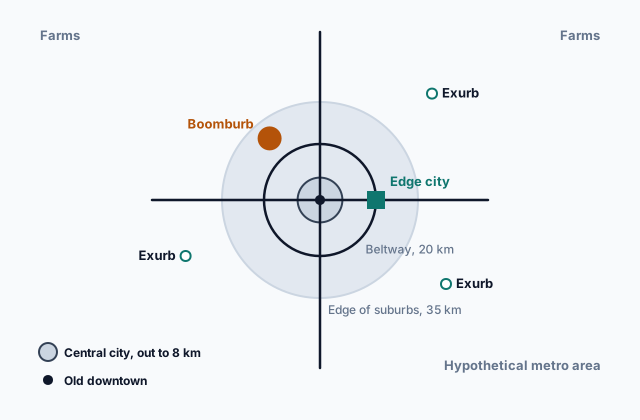
- An edge city is a large cluster of offices, malls, hotels and entertainment that grows up in the suburbs, outside the old central city, most often where a beltway meets a major highway. More people work there than live there, and it may have no city government of its own.
- An exurb is a community beyond the suburbs, among farms or woods, with homes on large lots. It looks rural, but most of its working residents commute long distances to jobs in the metro area.
- A boomburb is a suburb that has grown very fast into a large city of its own, often of more than 100,000 people, while it is still not the main city of its metro area. It is spread out and mostly residential, often with no traditional downtown.
 Tap to open the picture full size
These forms bring new challenges. Commutes grow longer, and traffic runs from suburb to suburb on roads and transit built to reach downtown. Roads, water lines, sewers and school buses must stretch across land with few homes per kilometer, which costs more for each household. Farmland and habitat disappear, and more car trips mean more air pollution. The central city's tax base shrinks as residents and jobs leave, while it still keeps up its old streets and services.
Quick check · Match
Match each place in a hypothetical metro area to the land-use term that fits it.
Part 3 Watch it done Has Metro Area W sprawled?
Watch each step, then do the last one yourself.
Hypothetical Metro Area W had 2,400,000 people on 600 square kilometers of built-up land in 2000. By 2025 it had 3,000,000 people on 1,000 square kilometers of built-up land. Use density, people per square kilometer of built-up land, to decide whether its growth was sprawl.
Predict first
Before the steps, what do you expect happened to Metro Area W's density from 2000 to 2025?
Step 1 · Compare the growth of people and of land
People: 3,000,000 minus 2,400,000 is 600,000 more, a rise of 25 percent. Built-up land: 1,000 minus 600 is 400 more square kilometers, a rise of about 67 percent. The land grew far faster than the population.
Step 2 · Work out the density in 2000
2,400,000 people ÷ 600 square kilometers = 4,000 people per square kilometer.
Why this step?
Why compare density, instead of only asking whether the built-up area grew?
A metro area that adds people has to use some more land, so more land alone does not show sprawl. Sprawl is land growing faster than population, and density shows it in one number: if density falls, the new growth is using more land per person than the city did before.
Your step · Calculate
Finish it. Work out Metro Area W's density in 2025, in people per square kilometer of built-up land.
people per square kilometer
Part 4 Try it Plan for a spreading metro area
Try it · Decide and justify
A hypothetical company will move its headquarters, with 6,000 office jobs, within hypothetical Metro Area T. Most of its workers live in suburbs spread all around the metro area and drive to work, and the company wants a large campus with room for parking. Where is it most likely to build?
Which reason supports your answer?
Try it · Multiple choice
In hypothetical County L, about 60 km beyond a metro area's suburbs, farms are being divided into home lots of several acres each. Most of the new residents drive to jobs in the metro area. Which challenge does this growth most directly create for the county government?
Part 5 Explain it Explain two urban areas' growth
Nothing you type leaves this page. Check your answer against the model and each scoring point.
Free response is 50% of the exam score. This one is shaped like Question 2, from free-response II.
Free-response practice · Question 2 style
Stimulus, hypothetical data on the largest urban area in each of two hypothetical countries:
- Urban area X, in a semiperiphery country: 7,500,000 people on 900 square kilometers of built-up land in 1995, and 16,000,000 people on 1,600 square kilometers in 2025.
- Urban area Y, in a core country: 11,000,000 people on 2,000 square kilometers of built-up land in 1995, and 12,500,000 people on 3,100 square kilometers in 2025.
(A) Identify the urban area that was a megacity in 1995.
(B) Describe how urban area X's size class changed between 1995 and 2025.
(C) Explain one reason urban areas in semiperiphery countries, such as X, are growing faster than urban areas in core countries, such as Y.
(D) Using the data, explain whether urban area Y's growth shows sprawl.
(E) Describe one new land-use form that decentralization could create in the suburbs of urban area Y.
(F) Explain one challenge that sprawl creates for local governments in urban area Y.
(G) Explain one limitation of the data for comparing the growth of the two urban areas.
Model answer
(A) Urban area Y. With 11,000,000 people in 1995, it had more than 10 million.
(B) Urban area X grew from 7,500,000 people, below the megacity mark, to 16,000,000, so it became a megacity. It is not a metacity, because it has not passed 20 million.
(C) X's country is still urbanizing. Many people move from the countryside to the city for jobs, schools and services, and its young city population has more births than deaths. Y's country urbanized long ago, so most of its people already live in cities and its largest urban area grows slowly.
(D) Yes. Y's built-up land grew by 55 percent, from 2,000 to 3,100 square kilometers, while its population grew by only about 14 percent. Its density fell from 5,500 people per square kilometer to about 4,000. Land growing faster than people, at falling density, is sprawl.
(E) An edge city: a cluster of offices, malls and hotels at a highway interchange in the suburbs, outside the old central city, where more people work than live, built as jobs leave the old downtown.
(F) Roads, water lines and sewers have to stretch across land with few homes per kilometer, so each household costs local governments more to serve, while the central city loses taxpayers who move out.
(G) The figures cover each urban area as a whole, so they cannot show where inside it the growth happened, such as in informal settlements or in new suburbs. The two countries may also draw the edge of an urban area differently, which changes both the people and the land counted.
Score your own answer. This is a self-check, not a grade. Tick each point your answer makes.
Part 6 Check yourself The places of Metro Area M
The case questions use the table. The others mix the ideas from the whole lesson.
Hypothetical Metro Area M's planning office publishes these figures for its central city and four other places in the metro area.
| Place | Distance from downtown | Residents, 2000 | Residents, 2020 | Jobs, 2020 |
|---|---|---|---|---|
| City M, the central city | 0 km | 900,000 | 860,000 | 520,000 |
| Place A | 22 km | 30,000 | 45,000 | 150,000 |
| Place B | 18 km | 60,000 | 210,000 | 70,000 |
| Place C | 55 km | 4,000 | 9,000 | 1,500 |
| Place D | 8 km | 120,000 | 118,000 | 40,000 |
Case question 1 · Multiple choice
Which place in the table best fits the definition of an edge city?
Case question 2 · Calculate
By what percent did Place B's residents grow from 2000 to 2020?
Case question 3 · Multiple choice
Every bus line in Metro Area M runs between a suburb and City M's downtown. Based on the table, which problem is this bus network most likely to face?
The rest stand on their own and do not use the case.
Check yourself · Spot the error
A student explains the growth of an urban area in a hypothetical country. Which line is the first to go wrong?
Check yourself · Rank it
Four hypothetical urban areas are growing by a steady number of people each year. If each keeps adding the same number every year, rank them by how soon each will become a megacity. Work out the years for each before you rank.
Soonest first
Give each one a place, 1 for first. Give two the same place if they are equal.
Your ranking: none yet
Part 7 Keep it Bring back earlier ideas
Two questions from Topic 6.1 come back here.
From 6.1 The Origin and Influences of Urbanization · Sort it
Each card describes hypothetical City R. Tap a card, then whether it describes City R's site or its situation.
Site
Situation
From 6.1 The Origin and Influences of Urbanization · Match
Each observation comes from a different hypothetical country whose cities are growing. Match each force that influences urbanization to the observation that shows it.
In three lines
- Megacities have more than 10 million people and metacities more than 20 million, and they are increasingly in periphery and semiperiphery countries.
- Suburbanization moves people out, sprawl spreads growth at falling density, and decentralization moves jobs and services into many centers.
- Edge cities, exurbs and boomburbs are the new land-use forms, with new challenges: long commutes, costly services, lost farmland and a shrinking central-city tax base.
Exam strategy for this topic
- Section I, Multiple Choice: 60 questions in 60 minutes.
- Section II, Free Response: 3 questions in 75 minutes.
When a question gives population figures, name each urban area's size class and the threshold it passes. When it asks about growth at the edge of a metro area, say what moved, people or jobs, and name the land-use form that resulted.
Questions students ask
What is the difference between a megacity and a metacity?
A megacity is an urban area of more than 10 million people, and a metacity is one of more than 20 million. Every metacity is past the megacity mark as well; the term names the largest class.
Why are most new megacities in periphery and semiperiphery countries?
Those countries are urbanizing now. People move from the countryside to cities for work and services, and young city populations have more births than deaths. Core countries urbanized earlier, so their largest urban areas grow slowly.
Is an edge city the same as a suburb?
No. A suburb is mainly where people live. An edge city is a center of offices, shopping and entertainment, usually at a highway interchange, where more people work than live. Decentralization builds edge cities inside the suburbs.
What is the difference between an exurb and a boomburb?
An exurb is a small, low-density community beyond the suburbs, among farms, whose residents commute into the metro area. A boomburb is a suburb that has grown very fast into a large city of its own, often of more than 100,000 people, without becoming the metro area's main city.
Are the places in this lesson real?
No. Every country, metro area, city, county and company in this lesson is hypothetical, and every number is invented to show an idea clearly. Real metro areas fit these patterns more loosely.
Course alignment, for teachers
AP Human Geography topic 6.2, Unit 6: Cities and Urban Land-Use Patterns and Processes.
- Skill 2.D: Explain the significance of geographic similarities and differences among different locations and/or at different times.
This lesson maps all 2 essential knowledge statements of the topic to the part that teaches each one: 2 are checked by a scored question. The map is in the lesson file.