Unit 6 · Topic 6.3 · about 30 minutes · 7 parts · 12 scored checks, 3 of them multiple choice, plus 2 from earlier lessons
AP Human Geography 6.3: Cities and Globalization
Unit 6: 12 to 17% of the multiple-choice section
What you'll be able to do
- Explain how cities show the processes of globalization at work: how world cities sit at the top of the world's urban hierarchy and drive globalization, and how networks and linkages connect cities so that they pass global processes along and shape them.
Key vocabulary
| Term | What it means | The exam trap |
|---|---|---|
| World city | A city at the top of the world's urban hierarchy, also called a global city: a center of the world economy whose decisions reach many countries. | The term names a role in the world economy, so test a city against that role before you use it. |
| Urban hierarchy | The ranking of settlements from a few at the top that serve the widest areas down to many small towns at the base that serve only nearby people. | A hierarchy can be drawn for one country or for the whole world, so say which scale you mean. |
| Globalization | The growing connection of places worldwide through flows of money, goods, people, information and ideas. | It works at the global scale but shows up in local places, so name the scale you are describing. |
| Network | A system of routes and connections that links many places at once, such as a set of airline routes or fiber-optic cables. | A network is the whole system; one connection in it is a linkage. |
| Linkage | A single connection between two places along which people, goods, money or information flow. | Name what flows along it, people, goods, money or information, when you describe one. |
| Mediate | To stand between a global process and the places it reaches, passing it along and changing it on the way. | A city mediates processes that start somewhere else, so look for where a process began and where it is going. |
 Tap to open the picture full size
Part 1 Think first Near or far?
Commit to a guess first. Being wrong now makes the right idea stick better.
Predict first
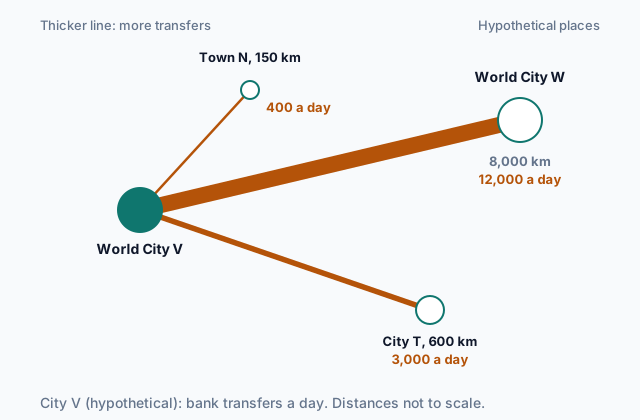
Hypothetical City V is a large financial center. Its banks deal every day with banks in Town N, a town 150 km away in the same country, and with banks in City W, another large financial center, 8,000 km away on another continent. With which place do City V's banks exchange more money transfers each day?
In short. Cities are where globalization happens: world cities sit at the top of the world's urban hierarchy and drive globalization, and networks and linkages tie cities together so that they pass global processes along to other places and shape them on the way.
- World cities rank at the top of the world's urban hierarchy for what they do, not for how many people they hold: headquarters of transnational corporations, banks and stock exchanges, producer services and nonstop routes to other world cities.
- Decisions made in world cities send investment, jobs, information and ideas around the world, which is how world cities drive globalization.
- Transport, communication, financial and corporate linkages tie cities into global networks, and cities mediate global processes, passing them from the global scale down to national and local places and changing them along the way.
Part 2 Learn it How cities carry globalization
2a. World cities at the top
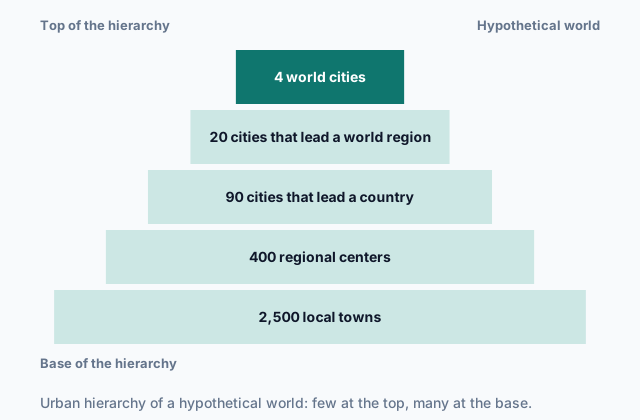
Topic 6.4 looks at the size and spacing of cities inside one country or region. Cities can also be ranked across the whole world. This urban hierarchy at the world scale has a few world cities at the top, more cities that lead a large world region below them, then cities that lead one country, and many regional centers and towns at the base.
What puts a city at the top is what it does for the world economy, not how many people live there. World cities hold:
- the headquarters of many transnational corporations, where decisions are made for offices and factories in many countries (command functions);
- banks, stock exchanges and investors that move money across borders;
- producer services, such as law, accounting, advertising and consulting firms, that serve companies on several continents;
- major airports with nonstop routes to other world cities, along with international media and organizations.
Compare two hypothetical cities. City F has 16 million people, but its firms mostly serve its own country, and few international flights land there. City G has 3 million people, yet 50 transnational corporations run their worldwide operations from it. City G sits higher in the world's urban hierarchy.
Some world cities are also very large, but size does not make one. A megacity can be weakly tied to the world economy, and a capital city can lead its own country without leading the world.
Quick check · Sort it
Each card states one fact about a hypothetical city. Tap a card, then say whether that fact, on its own, is a sign that the city sits at the top of the world's urban hierarchy.
A sign of a world city
Not a sign on its own
2b. How world cities drive globalization
Globalization is the growing connection of places around the world through flows of money, goods, people, information and ideas. World cities do more than take part in it. They drive it, because many of the decisions that start those flows are made there:
- A board meeting at a headquarters decides where a company builds its next factory, and jobs appear on another continent.
- Investors trading on a world city's stock exchange buy shares and bonds of firms and governments abroad, moving money across borders in seconds.
- Advertising and media firms spread brands, films and fashions to many countries.
- Universities and technology firms produce ideas and products that spread through the network of cities.
Take a hypothetical clothing company headquartered in world City H. Its designers choose next season's styles, its managers borrow money from City H's banks, and its buyers sign contracts with factories in three other countries. The decisions are made in one city, and the effects are felt in factories, shops and homes far away.
So many decisions start in so few places that a change in a world city travels fast. A banking crisis in one world city can slow lending, building and hiring in countries that never deal with it directly.
Quick check · Fill the statement
Complete the description of a hypothetical city.
Hypothetical City U holds the headquarters of 70 corporations and a stock exchange where investors from 40 countries trade. Decisions made there send money and jobs to other continents, so City U globalization and sits at the of the world's urban hierarchy.
2c. Networks and linkages
Cities are tied to one another by networks, systems of routes and connections that carry flows among many places. Each single connection between two places in a network is a linkage. Four kinds of linkage tie cities together:
- Transport linkages: airline routes and shipping lanes that carry people and goods.
- Communication linkages: undersea fiber-optic cables and data links that carry calls, messages and internet traffic.
- Financial linkages: loans, investments and trades that move money between banks and exchanges.
- Corporate linkages: offices of the same company in different cities, which pass staff, money and decisions among themselves.
In these networks, how strongly two places are linked depends on what they do as well as how far apart they are. The figure shows the hypothetical places from Think first, plus City T, a city 600 km from City V in its own country.
 Tap to open the picture full size
City V and City W both hold headquarters, banks and producer services that do business with each other every day, while Town N needs little from City V's offices. Distance still matters, but cities at the top of the hierarchy are often more tightly linked to each other than to towns nearby. The more linkages a city has, and the more world cities they reach, the more connected it is.
Quick check · Multiple choice
Suppose the stock exchange in hypothetical City Y, a world city, closes for a week. Through the networks and linkages that connect cities, which places will feel the closing most directly?
2d. Cities mediate global processes
A global process does not land on a whole country at once. It passes through cities, and the cities mediate it: they stand between the global scale and the places below, passing the process along and shaping it on the way.
Follow a hypothetical phone maker headquartered in a world city as it moves into hypothetical Country S:
- Global scale: the company's board, in the world city, decides to sell its phones in Country S.
- National scale: its office in Country S's capital follows Country S's laws, sets prices that its people can pay, and picks which cities get stores first.
- Local scale: a store opens in a provincial city of Country S, hires local staff, and advertises in the local language.
Each city changed the process. The capital set prices and followed national rules, and the provincial store made the product local. Another country's capital would have shaped it differently.
Cities mediate other global processes the same way. Foreign investment reaches farms through banks in national and regional cities, migrants arrive through a gateway city's airport, and a global fashion reaches a town through its stores and media. To explain a local change, trace it up the scales: which city made the decision, and which cities passed it along and changed it?
Quick check · Put it in order
Put these steps in the order a global process reaches the farmers near hypothetical Town E, in hypothetical Country P.
Part 3 Watch it done Which city is more connected?
Watch each step, then do the last one yourself.
A geographer measures how strongly four hypothetical cities, A, B, C and D, are linked through the offices of five hypothetical global service firms. Firm 1 has offices in Cities A, B and C. Firm 2 has offices in A and B. Firm 3 has offices in A, C and D. Firm 4 has offices in A, B and D. Firm 5 has offices in B and C. Count one linkage between two cities for each firm with offices in both, then add up each city's linkages with the other three cities. Which is more connected, City A or City B?
Predict first
Before the steps, which city do you expect to be more connected?
Step 1 · Count City A's linkages, pair by pair
Cities A and B share Firms 1, 2 and 4: 3 linkages. Cities A and C share Firms 1 and 3: 2 linkages. Cities A and D share Firms 3 and 4: 2 linkages.
Step 2 · Add them
City A's total is 3 + 2 + 2 = 7 linkages.
Why this step?
Why count the firms two cities share, instead of how many firms each city has?
A linkage is a connection between two places. A firm with offices in both cities moves staff, money and information between them, so shared firms measure how tightly each pair is tied. Counting each city's own firms would show how busy it is, not how connected.
Your step · Calculate
Finish it. City B shares 3 linkages with City A. Count its linkages with City C and with City D, then give City B's total.
linkages
Part 4 Try it Help City Z climb the hierarchy
Hypothetical City Z, with 2 million people, is the second-largest city of its country. Its leaders want it to play a bigger part in the world economy.
Try it · Decide and justify
City Z's leaders can pay for one of two plans. Which plan would do more to move City Z up the world's urban hierarchy?
Which reason supports your answer?
Try it · Match
City Z's leaders list four new connections between City Z and the rest of the world. Match each kind of linkage to the connection that shows it.
Part 5 Explain it Explain a world city's place and reach
Nothing you type leaves this page. Check your answer against the model and each scoring point.
Free response is 50% of the exam score. This one is shaped like Question 3, from free-response II.
Free-response practice · Question 3 style
Stimulus 1, a hypothetical table: - City X: population 15.5 million; 6 headquarters of transnational corporations; 40 nonstop international air routes. - City Y: population 3.8 million; 48 headquarters of transnational corporations; 190 nonstop international air routes.
Stimulus 2, a hypothetical map of City Y's busiest nonstop air routes: thick lines run from City Y to five world cities on four other continents, each with 20 or more flights a day; thin lines run to six cities in City Y's own country, each with 3 to 8 flights a day.
(A) Identify the city in Stimulus 1 that sits higher in the world's urban hierarchy.
(B) Using Stimulus 1, describe one characteristic that places that city higher.
(C) Explain why City X's larger population does not place it higher in the world's urban hierarchy.
(D) Using Stimulus 2, describe the pattern of City Y's linkages.
(E) A company headquartered in City Y decides to open a factory in a small town in another country. Explain how cities at the global, national and local scales carry this decision from City Y to the town.
(F) Explain one way, other than air travel, that a world city such as City Y drives globalization.
(G) Explain one limitation of using Stimulus 2 alone to measure how connected City Y is to the world.
Model answer
(A) City Y.
(B) City Y holds the headquarters of 48 transnational corporations, eight times as many as City X. Decisions about offices, factories and jobs in many countries are made there, a command function that world cities hold.
(C) A city's place in the world's urban hierarchy comes from its functions and linkages, not its size. City X has only 6 headquarters and 40 international routes, so far less of the world economy is run from it or passes through it.
(D) City Y's strongest linkages are with distant world cities on four other continents, with 20 or more flights a day each, while its links to cities in its own country are weaker, 3 to 8 flights a day. It is tied more closely to other world cities than to nearby places.
(E) At the global scale, the company's board in City Y makes the decision. At the national scale, its office in the other country's capital follows that country's laws and picks the town. At the local scale, the factory opens in the town and hires local workers. Each city along the way passes the decision on and shapes how it lands, so the cities mediate the global process.
(F) City Y's banks and stock exchange move investment across borders: when investors there buy shares in firms abroad or lend to them, money and jobs flow to other countries.
(G) Flights show only one kind of linkage. Stimulus 2 leaves out financial, communication and corporate linkages, such as money transfers, internet traffic and offices of the same firms, so City Y could be more or less connected than its air routes alone suggest.
Score your own answer. This is a self-check, not a grade. Tick each point your answer makes.
Part 6 Check yourself Four cities, four roles
The case questions use the table. The others mix the ideas from the whole lesson.
A geographer compares four hypothetical cities, each the largest city of its own hypothetical country. The table counts each city's people, the transnational corporations headquartered there, its nonstop international air routes, and the foreign banks with offices there.
| City | Population (millions) | Headquarters of transnational corporations | Nonstop international routes | Foreign banks with offices |
|---|---|---|---|---|
| City J | 18.0 | 4 | 35 | 12 |
| City K | 4.5 | 62 | 210 | 140 |
| City L | 9.0 | 21 | 120 | 55 |
| City M | 2.0 | 9 | 80 | 30 |
Case question 1 · Rank it
Using the table, rank the four cities by their likely place in the world's urban hierarchy.
Highest place first
Give each one a place, 1 for first. Give two the same place if they are equal.
Your ranking: none yet
Case question 2 · Multiple choice
Two foreign firms open sales offices in City L. In the same year, firms headquartered in City L decide to build factories in many other countries. Which statement best describes City L's role in globalization?
Case question 3 · Multiple choice
A transnational company headquartered in City K decides to build a factory in City M's country. The company's office in City M chooses the town where the factory will go, follows the country's labor laws and hires local managers. Which statement best describes City M's role?
The rest stand on their own and do not use the case.
Check yourself · Spot the error
A student explains how cities are linked in global networks. Which line is the first to go wrong?
Check yourself · Sort it
A hypothetical carmaker headquartered in a world city expands into hypothetical Country R. Tap each step, then the scale it happens at.
Global scale
National scale
Local scale
Part 7 Keep it Bring back earlier ideas
This lesson stands on Topics 6.2 and 6.1.
From 6.2 Cities Across the World · Calculate
In a hypothetical count of the world's megacities, 12 of 20 were in periphery or semiperiphery countries in an earlier year. In a later year, 30 of 40 were. By how many percentage points did the periphery and semiperiphery share of the world's megacities rise?
From 6.1 The Origin and Influences of Urbanization · Calculate
In a hypothetical city, workers will travel at most 45 minutes each way to downtown jobs. A new commuter rail line lets them travel at 30 km per hour instead of walking at 5 km per hour. At most, how many kilometers from downtown can a worker now live and still reach work in 45 minutes?
In three lines
- World cities sit at the top of the world's urban hierarchy because of their functions, such as headquarters, finance and producer services, not their size.
- Decisions made in world cities send investment, jobs and ideas around the world, so world cities drive globalization.
- Transport, communication, financial and corporate linkages tie cities into networks, and cities mediate global processes, passing them down to national and local places and shaping them.
Exam strategy for this topic
- Section I, Multiple Choice: 60 questions in 60 minutes.
- Section II, Free Response: 3 questions in 75 minutes.
When a question asks why a city ranks high in the world's urban hierarchy, point to a function or a linkage from the data, not to its population. When it asks how a global process reaches a place, name each scale the process passes through and what the city at that scale did to it.
Questions students ask
Is a world city the same as a megacity?
No. A megacity is defined by its population, as Topic 6.2 shows. A world city is defined by its role in the world economy. Some cities are both, but a megacity can be weakly tied to the world economy, and a world city can be far smaller than a megacity.
What makes a city a world city?
Its functions and linkages: headquarters of transnational corporations, banks and stock exchanges that serve investors from many countries, producer services such as law and advertising with clients worldwide, and nonstop routes and other linkages to other world cities.
What does it mean that cities mediate global processes?
A global process, such as foreign investment or a company's expansion, reaches a country's people through its cities. National and regional cities pass the process along and change it: they apply national laws, choose which places it reaches, and adapt it to local people.
Does distance still matter for linkages between cities?
Yes, but it is not the whole story. World cities do business with each other every day, so their linkages across oceans can be stronger than their links to nearby towns.
Are the cities and countries in this lesson real?
No. Every city, town, country, company and number here is hypothetical, chosen to show each idea clearly. Real world cities show the same patterns, but less neatly.
Course alignment, for teachers
AP Human Geography topic 6.3, Unit 6: Cities and Urban Land-Use Patterns and Processes.
- Skill 5.B: Explain spatial relationships across various geographic scales using geographic concepts, processes, models, or theories.
This lesson maps all 2 essential knowledge statements of the topic to the part that teaches each one: 2 are checked by a scored question. The map is in the lesson file.