Unit 7 · Topic 7.1 · about 30 minutes · 7 parts · 14 scored checks, 3 of them multiple choice
AP Human Geography 7.1: The Industrial Revolution
Unit 7: 12 to 17% of the multiple-choice section
What you'll be able to do
- Explain how new technologies and natural resources started industrialization, how its spread increased food supplies and populations, drew workers to industrial cities and changed class structures, and how investors' search for raw materials and markets contributed to colonialism and imperialism.
Key vocabulary
| Term | What it means | The exam trap |
|---|---|---|
| Industrial Revolution | The first great shift from making goods by hand to making them by machine in factories, driven by new technologies such as the steam engine. | It names the first wave of a long process, so do not treat it as one invention or one year. |
| Industrialization | The process by which a place's economy shifts toward making goods by machine in factories. | It changes farms, cities and classes as well as factories, so follow its effects past the factory gate. |
| Natural resources | Materials found in nature that people use, such as coal, iron ore and water. | A resource matters to industry only where people have the technology to use it. |
| Raw materials | Unprocessed materials, such as raw cotton or rubber, that factories turn into finished goods. | Whether something counts as a raw material depends on what a factory does with it next. |
| Class structure | The way a society is divided into groups by wealth, work and power. | It describes the groups of a whole society, so do not judge it from one person's job alone. |
| Colonialism | One country taking control of another territory and ruling it as a colony, often sending settlers there. | Give the economic motive as well as the political control when you explain it. |
| Imperialism | A country extending its power over other places, by conquest, by ruling through local leaders or by controlling their trade and money. | It is broader than colonialism, so do not use the two words as if they were the same. |
 Tap to open the picture full size
Part 1 Think first Where does the first mill go?
Commit to a guess first. Being wrong now makes the right idea stick better.
Predict first
A hypothetical country of farms and small towns gets a new invention: a steam engine that can drive a whole mill of spinning machines. Each engine burns several tons of coal a day. The country's coal comes from mines in its hilly north, roads are slow, and hauling coal by wagon costs more than the coal itself. Where are the first steam-powered mills most likely to be built?
In short. The Industrial Revolution was the shift from making goods by hand to making them by machine in factories. It began with new technologies, grew where natural resources such as coal and iron were at hand, and spread from its hearth to other countries.
- New machines and the steam engine made factories possible, and coal and iron ore decided where the first ones could run, so early industry clustered on coalfields and along cheap water routes.
- As industrialization spread, food supplies increased and populations grew; farms needed fewer hands, workers moved to industrial cities for factory jobs, and a new middle class and an industrial working class formed.
- Investors in industry sought raw materials and new markets overseas, a factor that contributed to the rise of colonialism and imperialism.
Part 2 Learn it How industry began and what it changed
2a. New machines, near coal and iron
Industrialization is the shift from making goods by hand, in homes and small workshops, to making them by machine in factories. Its first great wave is called the Industrial Revolution.
It began with new technologies. Machines that spun thread and wove cloth did the work of many hand workers. The steam engine powered them without a fast river, and new ways of making iron gave cheap, strong metal for machines, engines and, later, railroads.
Technology alone was not enough. A steam engine burns coal, and iron is made from iron ore in furnaces that burn coal. Before railroads, coal was slow and costly to haul, so the first factories grew up where the natural resources were: on coalfields, near iron ore, and along rivers and coasts that moved heavy loads cheaply.
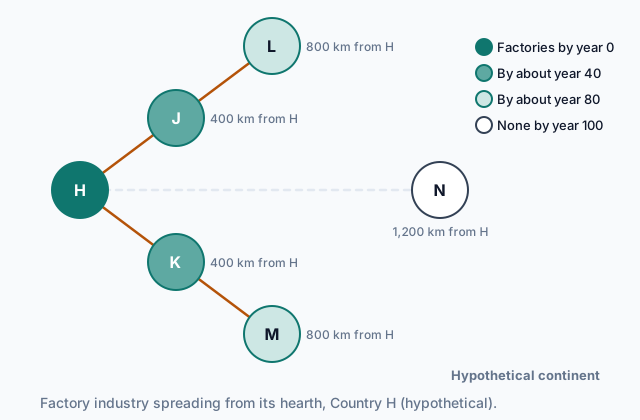
Then it spread. The map at the top of the page shows factories appearing first in hypothetical Country H, the hearth, then in nearer countries, then farther out. Real spread was less tidy: a distant country with coal, iron and investors could industrialize before a near one without them.
Quick check · Match
Match each technology or natural resource to the part it played as industrialization began in a hypothetical country.
2b. More food, more people, city jobs
As industrialization spread, it changed farming too. Factories turned out iron plows and, later, farm machines and chemical fertilizer, and railroads carried crops from farms to distant towns. Each farm worker could grow food for more people, so food supplies increased. With more food, and more reliable food, fewer people died young, and populations grew.
A farm that grows more with fewer hands needs fewer workers. Meanwhile, the growing villages held more young people than the farms could employ. At the same time, factories in the cities were hiring. Many rural people, the young above all, left to seek those industrial jobs, and the cities grew fast, often faster than their housing, clean water and sewers could keep up with.
Read it as a chain. Better tools and fertilizer raise farm output per worker. More food lets the population grow. The farms cannot use all the extra hands. The extra hands move to the factory cities.
Quick check · Put it in order
Put these changes in hypothetical Country D in the order in which each one leads to the next.
2c. New classes
Industrialization also changed class structure, the way a society is divided into groups by wealth, work and power. Before factories, most people farmed, many on land they rented from a small class of landowners whose wealth came from that land.
Factories built up two groups that grew with the cities. Owners of mills, mines and railroads, along with managers, engineers, clerks and other professionals, formed a growing middle class: people whose income came from industry and trade, not from land. Far larger was the industrial working class: wage workers in mills, mines and ironworks, paid by the hour or the day, who owned no machines and no land and often lived crowded near the factories.
What matters is where a person's income comes from and what they own, not the building they work in. A bookkeeper in a railroad's office is middle class; the laborer laying its track is working class. As wealth from industry began to rival wealth from land, the new classes pressed for a say in how their country was run, and workers later formed unions to bargain over pay and hours.
Quick check · Sort it
People in a hypothetical industrial country. Tap a card, then the class it belongs to.
Middle class of industry and trade
Industrial working class
Older landowning class
2d. Raw materials, markets and colonies
Factories ran into two limits at home. They needed raw materials the home country lacked or could not supply in bulk: cotton for its mills, rubber, and later oil and metals. And they made more goods than home buyers could purchase, so investors wanted new markets where the extra could be sold.
Investors in industry looked overseas for both, and their governments backed them. Colonialism is one country taking control of another territory and ruling it as a colony, often sending settlers. Imperialism is the wider practice of a country extending its power over other places, whether by conquest, by ruling through local leaders or by controlling their trade and money. The search for raw materials and markets was one factor that contributed to the rise of both.
The ties this built ran one way. A colony shipped out raw materials, such as raw cotton, and bought back factory goods, such as cloth, made from them. The profit from turning raw materials into finished goods stayed in the industrial country.
Quick check · Fill the statement
Complete the description of a hypothetical industrial country.
Country G's mills make far more cloth than its own people will buy, and it grows no cotton. Its investors want overseas territories that will supply and serve as new . When Country G takes control of such a territory and rules it from home, that is .
Part 3 Watch it done How fewer farmers fed more people
Watch each step, then do the last one yourself.
Before industry reached its farms, hypothetical Country F had 10,000,000 people, and each farm worker grew enough food for 2 people. About 80 years later, with iron tools, farm machines and fertilizer, it has 20,000,000 people, and each farm worker grows enough food for 5 people. Country F grows all its own food. How many farm workers does it need before and after, and what share of its people must work on farms after?
Predict first
Before the steps, will Country F need more farm workers after, fewer, or about the same number?
Step 1 · Farm workers needed before
10,000,000 people ÷ 2 people fed per farm worker = 5,000,000 farm workers. Half of all the people had to farm.
Step 2 · Farm workers needed after
20,000,000 people ÷ 5 people fed per farm worker = 4,000,000 farm workers. That is fewer than before, although there are twice as many people to feed.
Why this step?
Why does Country F need fewer farm workers when it has twice as many people to feed?
Each farm worker now feeds 2.5 times as many people, and that rise outpaces the doubling of the population. The people the farms no longer need are free to take factory jobs in the cities.
Your step · Calculate
Finish it. After 80 years, what percent of Country F's 20,000,000 people must work on farms?
percent
Part 4 Try it Read two maps of Country R
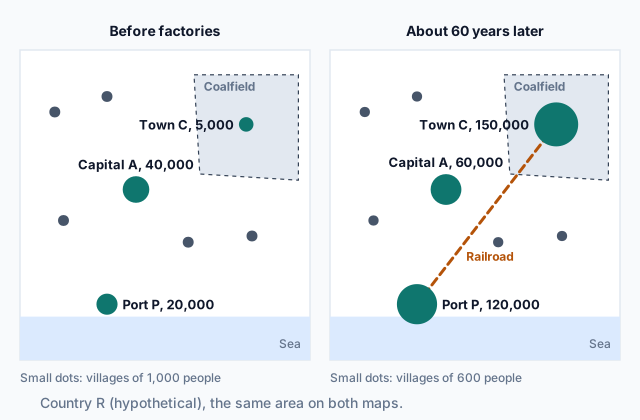
The two maps show the same area of hypothetical Country R, before its first factories and about 60 years later. A coalfield lies in the northeast, and the sea runs along the south.
 Tap to open the picture full size
Try it · Match
Compare the two maps. Match each change to the cause that best explains it.
Try it · Decide and justify
Compare the two maps again. Judging by how each place's population changed, did factory industry in Country R spread evenly across the area, or did it concentrate in a few places?
Which reading of the maps supports your answer?
Part 5 Explain it Explain how a country industrialized
Nothing you type leaves this page. Check your answer against the model and each scoring point.
Free response is 50% of the exam score. This one is shaped like Question 1, from free-response II.
Free-response practice · Question 1 style
Over about a century, a hypothetical country of farms and small towns becomes an industrial country.
(A) Identify one natural resource that helped industrialization begin in a place.
(B) Describe how a new technology, such as the steam engine, changed where factories could be built.
(C) Explain how industrialization led to larger food supplies and a growing population.
(D) Explain one reason many rural workers moved to industrial cities.
(E) Describe one change in class structure that industrialization brought.
(F) Explain how investors' search for raw materials or new markets contributed to colonialism or imperialism.
(G) Explain one reason industrialization reached some countries sooner than others as it spread from its hearth.
Model answer
(A) Coal, which fueled steam engines and the furnaces that made iron.
(B) Before the steam engine, mills ran on water power and had to sit beside fast rivers. A steam engine could drive machines anywhere its coal could reach, so factories could be built on coalfields, in towns and at ports.
(C) Factories made iron plows, farm machines and fertilizer, and railroads moved crops to distant towns, so each farm worker grew food for more people. With more and steadier food, fewer people died young, and the population grew.
(D) Farms that grew more with fewer hands needed fewer workers, while factories in the cities were hiring. Rural workers moved to the cities for those industrial jobs and their wages.
(E) A large industrial working class formed: wage workers in mills and mines who owned no machines or land. A middle class of owners, managers and professionals also grew, and its wealth from industry began to rival the wealth of landowners.
(F) Factories needed raw materials, such as cotton, that the home country lacked, and new buyers for the goods home markets could not absorb. Investors pressed their governments to take control of overseas territories that would supply the materials and buy the goods, which contributed to colonialism.
(G) A country with its own coal and iron, or a cheap way to bring them in, could run the new machines sooner. Countries near the hearth were also reached sooner in many cases, as engineers, machines and investors' money crossed borders.
Score your own answer. This is a self-check, not a grade. Tick each point your answer makes.
Part 6 Check yourself Country V over a century
The case questions use the table. The others mix the ideas from the whole lesson.
Hypothetical Country V built its first cotton mills just before its first census. Its census office has published three counts, 50 years apart, along with trade records for the same years. Country V grows no cotton.
| Census | Population | Share living in cities | Share of workers on farms | Raw cotton imported (thousand tons) | Cloth exported (million meters) |
|---|---|---|---|---|---|
| First | 8,000,000 | 15% | 75% | 10 | 20 |
| Second | 14,000,000 | 35% | 50% | 60 | 150 |
| Third | 24,000,000 | 60% | 20% | 200 | 500 |
Case question 1 · Multiple choice
Which conclusion does the table best support?
Case question 2 · Calculate
How many times as many people lived in Country V's cities at the third census as at the first?
Case question 3 · Multiple choice
By the third census, Country V's mill owners urge their government to take control of a hypothetical overseas territory where cotton grows well and few factories exist. Which reason for their push does the table best support?
The rest stand on their own and do not use the case.
Check yourself · Spot the error
A student explains how steam power changed a hypothetical country. Which line is the first to go wrong?
Check yourself · Select all
Which two drew investors in industry toward overseas colonies? Select two.
Select 2 answers, then check.
Part 7 Keep it Bring back earlier ideas
The factory cities in this lesson lead back to urban sustainability from Topic 6.11 and urban data from Topic 6.9.
Bring it back · Multiple choice
In a hypothetical city, a riverside district of closed factories sits empty, its soil polluted by a century of manufacturing. The city cleans the soil and builds housing and a park on the land. Which response to urban sustainability challenges is this?
Bring it back · Sort it
A planner studies how a hypothetical city's old mill district has changed since the mills closed. Tap a card, then the kind of data it gives.
Quantitative data
Qualitative data
In three lines
- Industrialization began with new technologies, such as the steam engine and new machines, and grew first where natural resources such as coal and iron were at hand.
- As it spread, food supplies increased and populations grew, workers moved to industrial cities for factory jobs, and a middle class and an industrial working class formed.
- Investors' search for raw materials and new markets contributed to the rise of colonialism and imperialism.
Exam strategy for this topic
- Section I, Multiple Choice: 60 questions in 60 minutes.
- Section II, Free Response: 3 questions in 75 minutes.
When a question asks why industry began or grew in a place, give a technology and the natural resource it depended on. When it asks about effects, follow the chain: more food, more people, fewer farm jobs, migration to factory cities, new classes, and investors looking overseas.
Questions students ask
Is industrialization the same thing as the Industrial Revolution?
Not quite. Industrialization is the process of shifting to factory production, and it is still happening in some places. The Industrial Revolution is the name for its first great wave, where the process began and from which it spread.
Why did the first factories need to be near coal?
Steam engines and iron furnaces burned great amounts of coal, and before railroads coal was slow and costly to haul. It was cheaper to build the factory at the coal and carry the finished goods away.
If people left the farms, how did industrial countries feed more people?
Industrial tools, fertilizer and railroads let each farm worker grow and ship food for more people. Food supplies rose even as the share of people farming fell.
What is the difference between colonialism and imperialism?
Colonialism is taking control of a territory and ruling it as a colony, often with settlers. Imperialism is the wider practice of extending power over other places, which can be done through trade and money as well as direct rule.
Are the countries and towns in this lesson real?
No. Every country, town and number here is hypothetical, chosen to show each idea clearly. Real countries industrialized in messier and more varied ways.
Course alignment, for teachers
AP Human Geography topic 7.1, Unit 7: Industrial and Economic Development Patterns and Processes.
- Skill 4.D: Compare patterns and trends in visual sources to draw conclusions.
This lesson maps all 3 essential knowledge statements of the topic to the part that teaches each one: 3 are checked by a scored question. The map is in the lesson file.