Unit 7 · Topic 7.2 · about 30 minutes · 7 parts · 14 scored checks, 3 of them multiple choice
AP Human Geography 7.2: Economic Sectors and Patterns
Unit 7: 12 to 17% of the multiple-choice section
What you'll be able to do
- Sort a job into one of the five economic sectors, and read a country's level of development from how its workers are divided among them.
- Explain where a factory locates using least cost theory, labor, transportation, shipping containers, break-of-bulk points, markets and resources, in core, semiperiphery and periphery countries.
Key vocabulary
| Term | What it means | The exam trap |
|---|---|---|
| Primary sector | The part of the economy that takes resources directly from the earth, such as farming, fishing, forestry and mining. | A plant that processes a raw material is not primary work, even when it sits next to the farm or the mine. |
| Secondary sector | The part of the economy that turns raw materials into goods, such as manufacturing, processing and construction. | Sort a job by what the worker does, not by what the company sells. |
| Tertiary sector | The part of the economy that provides services to people and businesses, such as retail, transportation and health care. | It is the largest sector by workers in many countries but not in all of them, so read the data before you say so. |
| Quaternary sector | The part of the economy that creates, processes and moves information and knowledge, such as software, research and finance. | Not every office job is quaternary; ask whether the work is mainly creating or handling information. |
| Quinary sector | The small group of people who make the highest-level decisions in companies, governments and research institutions. | It is the very top, so do not use it for every manager. |
| Least cost theory | Alfred Weber's theory that a factory locates where its total costs for transportation and labor are lowest; Weber also counted the savings from clustering near related firms. | Weight alone does not settle a location; labor costs can outweigh the shipping. |
| Break-of-bulk point | A place where cargo moves from one kind of carrier to another, such as a port where ships unload onto trains and trucks. | It is named for where the cargo changes carriers, not for the kind of cargo, so container ports count too. |
| Shipping container | A standard steel box that moves goods from ship to train to truck without being unpacked. | Its effect is on the cost of moving goods, so link it to where factories can locate, not only to trade. |
| Core, semiperiphery and periphery | Three groups of countries by their place in the world economy: wealthy core countries, industrializing semiperiphery countries and the least developed periphery countries. | The groups describe whole economies, so a core country still has farms and a periphery country still has some factories. |
 Tap to open the picture full size
Part 1 Think first Where should the plant go?
Commit to a guess first. Being wrong now makes the right idea stick better.
Predict first
A hypothetical mining company will build a plant that turns copper ore into copper metal. It takes 10 tons of ore to make 1 ton of copper. The mine is 300 km from the city where the copper is sold, and shipping costs the same per ton, per kilometer, for ore and for copper. Where should the plant go to keep shipping costs lowest?
In short. Economic activity falls into five sectors, from taking resources out of the earth to making the top decisions, and a country's mix of workers across them shifts as it develops. Where manufacturing locates depends on labor, transportation, break-of-bulk points, markets and resources, which least cost theory weighs against one another.
- The primary sector takes resources from the earth, the secondary sector makes goods from them, the tertiary sector provides services, the quaternary sector creates and handles information, and the quinary sector makes the highest-level decisions.
- Most workers in periphery countries are in the primary sector, semiperiphery countries have a large and growing secondary sector, and core countries employ most workers in the tertiary sector and hold most quaternary and quinary jobs.
- Least cost theory puts a factory where its transport and labor costs are lowest: near its resources when the product weighs less than its inputs, near the market when it weighs more, and at a break-of-bulk point when processing the cargo there saves a second round of handling.
Part 2 Learn it Economic sectors and where factories go
2a. Five economic sectors
Every job falls into one of five economic sectors, sorted by what the worker does.
- The primary sector takes resources directly from the earth: farming, fishing, forestry and mining.
- The secondary sector turns raw materials into goods: steel mills, food processing, factories and construction.
- The tertiary sector provides services to people and businesses: stores, restaurants, hospitals, repair shops and transportation.
- The quaternary sector creates, processes and moves information and knowledge: software, data analysis, research and finance.
- The quinary sector is the small group at the very top who make the highest-level decisions: the heads of large companies, governments and research institutions.
Sort a job by the work itself, not by what the company sells. A hypothetical juice company employs orchard pickers (primary), workers who press and bottle the juice (secondary), clerks who sell it in its shops (tertiary), analysts who study its sales data (quaternary) and a chief executive who decides which countries to sell in (quinary). Moving, selling and repairing goods are services, even when the goods came from a factory.
Quick check · Sort it
Each card describes one worker in a hypothetical country. Tap a card, then the sector the worker is in.
Primary
Secondary
Tertiary
Quaternary
Quinary
2b. Sectors and development
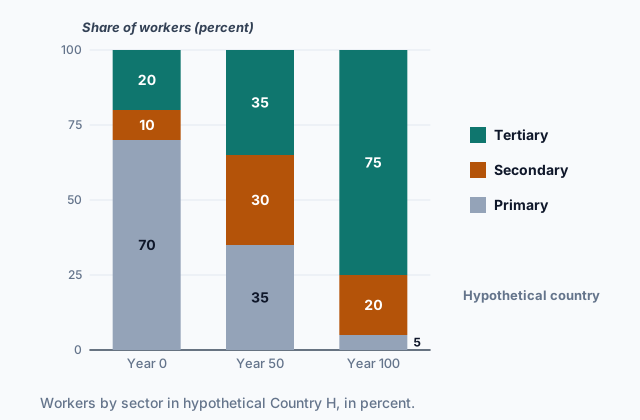
The share of a country's workers in each sector shifts as its economy develops, so each sector has its own development pattern. The chart at the top of the page follows hypothetical Country H over 100 years.
In a less developed country, most people work in the primary sector, many of them farming to feed their own families. As factories open, workers leave farms for factory jobs and the secondary sector grows. In a highly developed country, machines do most farm work, many factories are automated or have moved abroad, and most people work in services. That is why Country H's secondary share rises and then falls while its tertiary share keeps rising.
Geographers sort countries into three groups by their place in the world economy. Core countries are wealthy. Most of their workers are in the tertiary sector, and they hold most of the world's quaternary and quinary jobs: company headquarters, research labs and financial firms cluster in their large cities, which hold the highly educated workers, universities and money to invest that this work needs. Semiperiphery countries are industrializing, with a large and growing secondary sector. Periphery countries are the least developed, with most workers in the primary sector and few factories.
Read the pattern from the shares, not from one kind of job: every country has some farmers, some factory workers and some service workers.
Quick check · Rank it
Each hypothetical country lists the share of its workers in the primary, secondary and tertiary sectors. Rank the countries by their likely level of development.
Most developed first
Give each one a place, 1 for first. Give two the same place if they are equal.
Your ranking: none yet
2c. Least cost theory
Alfred Weber's least cost theory says a factory locates where its total costs for transportation and labor are lowest. Weber also counted savings from clustering near related firms.
Which costs more, shipping raw materials in or the product out, depends on weight. In a weight-losing (or bulk-reducing) industry, the product weighs less than the raw materials that go into it, as in smelting copper. Shipping the light product costs less than shipping the heavy raw materials, so the factory locates near its resources.
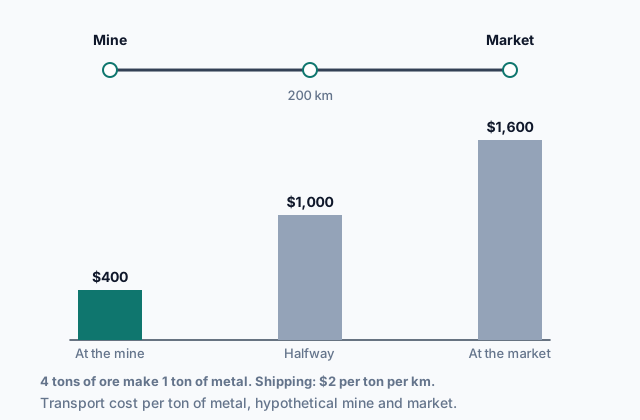
Take a hypothetical mine 200 km from a market, where 4 tons of ore make 1 ton of metal and shipping costs $2 per ton per kilometer. For each ton of metal, a plant at the mine ships 1 ton 200 km, for $400. A plant at the market ships 4 tons of ore 200 km, for $1,600. A plant halfway pays $800 for the ore and $200 for the metal, $1,000 in all.
 Tap to open the picture full size
In a weight-gaining (or bulk-gaining) industry, the product weighs more than what is shipped in, because the plant adds something found almost everywhere, such as water. Bottling drinks is the usual case, so these plants locate near their markets.
The theory assumes a company picks the cheapest site, but real companies also weigh government policies, such as taxes and trade rules, and their owners' preferences.
Quick check · Calculate
A hypothetical drink company mixes 1 ton of syrup with water to make 5 tons of bottled drinks. Water costs the same everywhere. The syrup plant is 300 km from the city where the drinks are sold, and shipping costs $1 per ton per kilometer. For each ton of syrup, how many dollars of shipping does the company save by bottling in the city instead of at the syrup plant?
2d. Labor, transportation and break-of-bulk points
Labor. Least cost theory counts wages along with shipping, and a site with much cheaper workers can beat the site with the lowest transport costs. Wages differ widely between countries. Assembly work that needs many workers but little training, such as sewing clothes or putting electronics together, has moved in large amounts to semiperiphery and periphery countries, where wages are lower. Manufacturing that needs highly skilled workers stays mostly in core countries, along with research and design.
Transportation and shipping containers. A shipping container is a standard steel box that moves from ship to train to truck without being unpacked. Containers made loading fast and cut the cost of shipping goods long distances, so a factory far from its buyers could compete, and lower wages abroad won out for many products.
Break-of-bulk points. A break-of-bulk point is a place where cargo moves from one kind of carrier to another, such as a port where ships unload onto trains and trucks. The cargo has to be unloaded there anyway, so processing it on the spot saves paying to unload and reload it a second time. Many factories cluster at ports for that reason.
Markets and resources. A factory near its buyers ships its product cheaply, and one near its raw materials ships them in cheaply. Weight decides between the two, as the last section showed.
Quick check · Fill the statement
Complete the description of where two kinds of factories locate.
A plant that turns heavy logs into much lighter paper is in a industry, so least cost theory places it near the . After cut the cost of moving goods across oceans, many assembly plants moved to periphery countries with lower wages.
Part 3 Watch it done Choose a site for a backpack factory
Watch each step, then do the last one yourself.
A hypothetical company makes backpacks for stores in core Country K. It can build its factory in Country K, near the stores, or in hypothetical periphery Country L, across an ocean. Materials cost the same at both sites. Labor costs $8.00 per backpack in Country K and $2.00 in Country L. Shipping each backpack to the stores costs $0.50 from Country K and $1.50 from Country L, in shipping containers. Using least cost theory, which site has the lower total cost, and by how much per backpack?
Predict first
Before the steps, which site do you expect to cost less?
Step 1 · Add the costs that differ
Materials cost the same at both sites, so leave them out. For each site, the cost per backpack is labor plus shipping.
Step 2 · Work out Country K
$8.00 for labor + $0.50 for shipping = $8.50 per backpack.
Why this step?
Why add labor and shipping together, instead of choosing the site with the cheaper shipping?
Least cost theory looks for the lowest total cost. A site that costs more to ship from can still win when its savings on labor are larger than the extra shipping.
Your step · Calculate
Finish it. Work out the total cost per backpack in Country L, then compare it with Country K's $8.50 to see which site is cheaper. What is the total cost per backpack in Country L?
dollars
Part 4 Try it Site a soybean plant
Try it · Match
Hypothetical Country R imports soybeans by ship. A company will build a plant that crushes them into cooking oil and animal feed, which go by rail to cities across the country. Crushing barely changes the weight of the cargo. Match each location factor to the fact about this plant that shows it.
Try it · Decide and justify
Hypothetical Country R imports soybeans by ship. A company will build a plant that crushes them into cooking oil and animal feed, which go by rail to cities across the country. Crushing barely changes the weight of the cargo. Every time cargo moves from one kind of carrier to another, it costs money to unload and reload it. The company can build at the port or at an inland rail town on the line from the port to the cities. Where should it build the plant?
Which reason supports your answer?
Part 5 Explain it Explain where a juice company works
Nothing you type leaves this page. Check your answer against the model and each scoring point.
Free response is 50% of the exam score. This one is shaped like Question 1, from free-response II.
Free-response practice · Question 1 style
A hypothetical company in core Country K makes fruit juice concentrate. It takes 6 tons of fruit to make 1 ton of concentrate. The company's orchards are 250 km from Port City P, where the concentrate is packed into shipping containers and loaded onto ships for buyers overseas. Shipping costs $2 per ton per kilometer for fruit or concentrate.
(A) Identify the economic sector of the workers who pick the fruit.
(B) Using least cost theory and the numbers given, explain why the company should build its concentrate plant near the orchards rather than in Port City P.
(C) Describe the role of Port City P as a break-of-bulk point.
(D) Explain how shipping containers make it cheaper for the company to sell to buyers overseas.
(E) Overseas buyers mix the concentrate with water to make bottled juice. Explain why they bottle it near the stores where it is sold.
(F) The company's research lab, which develops new flavors, is in Country K's capital. Explain why jobs like these are concentrated in core countries.
(G) Explain one limitation of least cost theory for explaining where companies build their plants.
Model answer
(A) The primary sector: picking fruit takes a resource directly from the land.
(B) Making concentrate is weight-losing: 6 tons of fruit become 1 ton. For each ton of concentrate, a plant near the orchards ships 1 ton 250 km to the port: 1 × 250 × $2 = $500. A plant in Port City P ships 6 tons of fruit the same 250 km: 6 × 250 × $2 = $3,000. Least cost theory places the plant where transport costs are lowest, near the orchards.
(C) Port City P is where the cargo moves from one kind of carrier to another, from trucks or trains onto ships. Goods are unloaded and reloaded there, so it is a natural place for storing, packing and processing them.
(D) A container moves from truck to ship to train without being unpacked, so loading is fast and handling costs are low. That lowers the cost of shipping each ton across the ocean, so the concentrate can be sold far away at a price buyers will pay.
(E) Bottling is weight-gaining: water, available almost everywhere, makes the juice much heavier than the concentrate. Shipping the light concentrate and adding the water near the stores keeps transport costs lowest.
(F) Research is quaternary work that needs highly educated workers, universities and money to invest. Core countries have more of each, so these jobs cluster in their large cities.
(G) Least cost theory assumes a company chooses the site with the lowest costs. Real companies also weigh government policies such as taxes and trade rules, and their owners' own preferences, so a plant can end up somewhere other than the cheapest site.
Score your own answer. This is a self-check, not a grade. Tick each point your answer makes.
Part 6 Check yourself Workers in four countries
The case questions use the table. The others mix the ideas from the whole lesson.
A hypothetical international agency reports how the workers of four hypothetical countries are divided among the economic sectors. Each row adds to 100 percent.
| Country | Primary | Secondary | Tertiary | Quaternary and quinary |
|---|---|---|---|---|
| X | 62 | 12 | 22 | 4 |
| Y | 20 | 38 | 35 | 7 |
| Z | 3 | 17 | 55 | 25 |
| W | 2 | 22 | 60 | 16 |
Case question 1 · Multiple choice
Which country in the table best fits the pattern of a semiperiphery country?
Case question 2 · Calculate
Country Y has 30,000,000 workers. How many of them work in the secondary sector?
Case question 3 · Multiple choice
Over the next few decades, companies based in Country Z move much of their electronics assembly, which puts together parts made elsewhere, to Country X, where wages are lower. They keep their research labs and headquarters in Country Z. Which change in Country X is most likely?
The rest stand on their own and do not use the case.
Check yourself · Spot the error
A student uses least cost theory to say where a plant should go. Which line is the first to go wrong?
Check yourself · Select all
Which two describe the pattern of work in a core country? Select two.
Select 2 answers, then check.
Part 7 Keep it Bring back earlier ideas
This lesson stands on the Industrial Revolution from Topic 7.1 and the challenges of urban change from Topic 6.10.
Bring it back · Multiple choice
In a hypothetical country, one region industrialized long before the rest. Which pair of conditions best explains why industrialization began there?
Bring it back · Fill the statement
A hypothetical city's old factory district changed over many decades.
Decades ago, banks refused to lend to home buyers in the district's mostly Black neighborhood, a practice called . Later the factories closed, owners left their buildings empty and people moved away, and the district became a .
In three lines
- Five sectors: primary takes resources, secondary makes goods, tertiary provides services, quaternary handles information and quinary makes the top decisions.
- As a country develops, workers move from the primary sector to the secondary and then the tertiary; core countries hold most quaternary and quinary jobs.
- Least cost theory: weight-losing plants go near resources, weight-gaining plants near markets, cheap labor and containers draw assembly abroad, and break-of-bulk points draw processing.
Exam strategy for this topic
- Section I, Multiple Choice: 60 questions in 60 minutes.
- Section II, Free Response: 3 questions in 75 minutes.
When a question asks where a factory will locate, name the factor that decides it (weight lost or gained, labor, a break-of-bulk point, the market) and say which way it pulls. When it gives the share of workers in each sector, read the primary and tertiary shares before you call a country core or periphery.
Questions students ask
What is the difference between the quaternary and quinary sectors?
Quaternary workers create, process and move information: software writers, researchers, data analysts and financial analysts. Quinary workers are the few at the very top who make the highest-level decisions, such as the heads of large companies, governments and research institutions.
Why do so many factories sit at ports?
A port is a break-of-bulk point, where cargo moves between ships and trains or trucks. The cargo must be unloaded there anyway, so processing it at the port saves the cost of unloading and reloading it a second time somewhere inland.
Does least cost theory still work now that shipping is cheap?
Yes, but the balance has changed. Once shipping containers made long-distance shipping cheap, transport costs mattered less and labor costs mattered more, which is one reason so much assembly work moved to semiperiphery and periphery countries.
Why does a wealthy country's share of factory workers fall?
Machines do more of the work in its factories, some factories move to countries with lower wages, and more people work in services, so the secondary sector's share of workers shrinks even when the country still makes many goods.
Are the countries and companies in this lesson real?
No. Every country, company and place here is hypothetical, with numbers chosen to show each idea clearly. Real countries and companies fit these patterns more loosely.
Course alignment, for teachers
AP Human Geography topic 7.2, Unit 7: Industrial and Economic Development Patterns and Processes.
- Skill 2.B: Explain spatial relationships in a specified context or region of the world, using geographic concepts, processes, models, or theories.
This lesson maps all 2 essential knowledge statements of the topic to the part that teaches each one: 2 are checked by a scored question. The map is in the lesson file.