Unit 7 · Topic 7.4 · about 30 minutes · 7 parts · 14 scored checks, 3 of them multiple choice
AP Human Geography 7.4: Women and Economic Development
Unit 7: 12 to 17% of the multiple-choice section
What you'll be able to do
- Explain how and to what extent changes in economic development have contributed to gender parity: how women's roles change as a country develops, whether gaps in wages and job opportunities remain, and what microloans have meant for women's small local businesses.
Key vocabulary
| Term | What it means | The exam trap |
|---|---|---|
| Gender parity | Equality between women and men in a measure such as pay, jobs, schooling or political power. | Name the measure you are judging, such as pay, jobs or schooling. |
| Wage gap | The difference between men's and women's average earnings, usually stated per 100 dollars men earn. | Check whether a figure is women's pay or the difference between women's and men's pay before you use it. |
| Collateral | Property, such as land or a house, that a borrower pledges to a lender and loses if the loan is not repaid. | It is property pledged before the loan is made, so do not confuse it with the payments made on the loan. |
| Informal sector | Work that is not registered, taxed or protected by labor laws, such as street selling or day labor. | Do not confuse informal work with unpaid work: an informal street seller earns money. |
| Microloan | A loan of a small amount, made to a person who cannot get an ordinary bank loan, to start or grow a business. | A microloan is a loan, not a grant, so it is repaid on a schedule. |
 Tap to open the picture full size
Part 1 Think first Guess the paycheck
Commit to a guess first. Being wrong now makes the right idea stick better.
Predict first
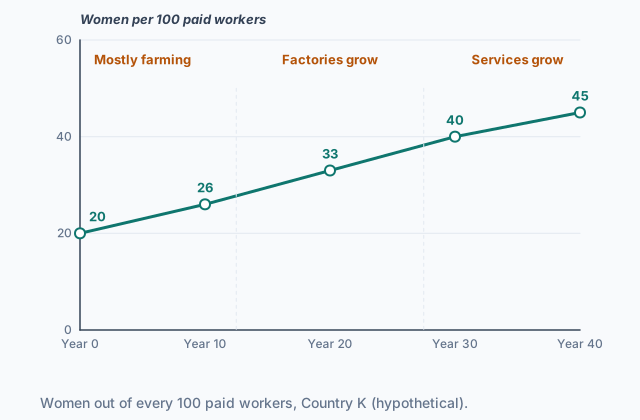
Look at the chart above. By year 40, women in hypothetical Country K hold 45 of every 100 paid jobs, up from 20. Picture a woman and a man who both work full time in Country K in year 40. On average, how does her pay compare with his?
In short. As a country develops economically, women's roles change and more women work for pay, but they still lack equity in wages and job opportunities, and microloans have helped many women start small local businesses that raise standards of living.
- Women's work moves from mostly unpaid farm and household work toward wage jobs in factories and then in services, helped by more schooling for girls and smaller families.
- More women in the workforce has not brought equal pay or equal access to senior posts: the wage gap can narrow as a country develops, but it has not closed.
- Microloans are small loans made without collateral; women have used them to start local businesses whose profits pay for food, schooling and health care.
Part 2 Learn it Development and women's work
2a. How women's roles change as a country develops
As a country's economy develops, the work women do changes, and so does where they do it.
In an economy of small family farms, women do much of the planting, weeding and harvesting. They also carry water and fuel, cook and care for children. Most of this work is unpaid, so it does not show up in income figures or in counts of paid jobs. It is real work that those numbers miss.
As factories open, many young women take wage jobs, for example in clothing and electronics assembly. A wage earned outside the home gives a woman income of her own and more say in how the household spends.
As the country develops further, girls stay in school longer and families have fewer children, so women spend more of their adult years in paid work. Service jobs grow in teaching, health care, banking and government. Women move into these jobs and, in time, into professions such as law and medicine and into public office.
The chart at the top of the page shows hypothetical Country K: women held 20 of every 100 paid jobs when it mostly farmed, and 45 of every 100 forty years later.
Quick check · Match
Match each change in a hypothetical country's economy to the change in women's roles that comes with it.
2b. More women at work, and still a pay gap
Development brings more women into paid work, but more jobs is not the same as equal pay. Equality between women and men in a measure is called gender parity, and a country can move toward it in one measure while falling short in another.
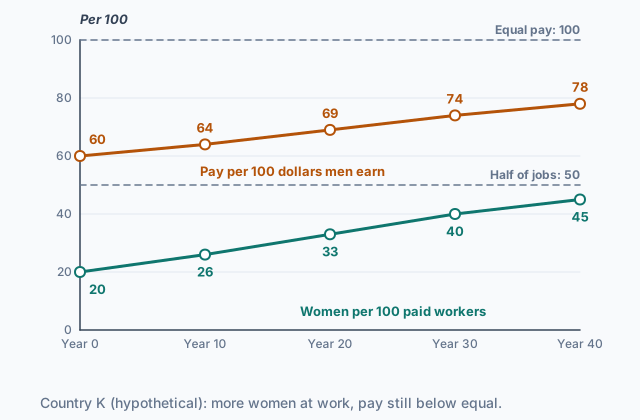
The wage gap is the difference between what men and women earn on average. It is usually worked out from women's earnings for every 100 dollars men earn: if women earn 78 dollars, the gap is 22 dollars per 100. In hypothetical Country K, women's earnings per 100 dollars rose from 60 to 78 over 40 years, so the gap narrowed from 40 dollars to 22 dollars per 100. It did not close.
 Tap to open the picture full size
Several things keep women's average pay below men's. More women than men work in lower-paid fields and in part-time or informal jobs. Many women leave paid work or cut their hours for years to care for children or older relatives, which is unpaid work, and they return to lower pay and slower promotion. And in many places women are still paid less than men for the same work.
Quick check · Calculate
In hypothetical Country M, men who work full time earn 60,000 dollars a year on average, and women who work full time earn 45,000 dollars. Women's average earnings are what percent of men's?
2c. Unequal opportunities at work
Pay is one side of equity at work. The other is which jobs women can get and how far they can rise.
In most countries, women and men are spread unevenly across fields of work. Women fill many of the jobs in fields that pay less than others needing the same training, and fewer of the jobs in the highest-paid fields.
Women are also fewer the higher you look in a company or a government. A firm can hire women for half its jobs and still have few women among its senior managers or on its board. The barriers include hiring and promotion decisions that favor men, long hours that clash with care work, and, in some countries, laws or customs that limit the jobs women may hold, the property they may own or the loans they may take.
So when you judge how far development has brought gender parity at work, look at how many women have paid jobs, what they earn, and how many reach senior posts. A rise in the first does not settle the other two.
Quick check · Sort it
A report on hypothetical Country P lists these facts. Tap a card, then what it shows.
Women's roles have changed
Women still lack equity at work
2d. Microloans and small local businesses
Starting even a small business takes money: a stock of goods for a market stall, or tools for a repair shop. Banks usually ask for collateral, property such as land or a house that the borrower would lose if the loan went unpaid. In many places women hold little property in their own name, so banks turn them down.
A microloan is a small loan, often a few hundred dollars or less, made to people who cannot get an ordinary bank loan. Many lenders lend to small groups of borrowers who know one another, and each member's on-time repayment lets the others borrow again, which takes the place of collateral. Loans are repaid in small, regular installments with interest or a fee, and a borrower who repays can take a larger loan next.
Many microloans have gone to women, who have used them to start small local businesses: market stalls, food stands, poultry farms, phone repair. The profits pay for food, school fees and health care, which raises the household's standard of living. The businesses stay small, though, and a microloan does not change the pay offered in the wider job market.
Quick check · Fill the statement
Complete the description of microloans.
Microloans are loans made to people who lack the that banks usually require. Many go to women, who use them to start businesses that sell mainly to .
Part 3 Watch it done What does the borrower keep?
Watch each step, then do the last one yourself.
A woman in hypothetical Village V runs a phone-charging kiosk. She takes a microloan of 200 dollars to buy a solar panel and a second charger, and she agrees to repay it with a flat fee of 20 dollars, in 20 equal weekly payments. Before the loan, her kiosk made 15 dollars of profit a week. With the new equipment it makes 35 dollars a week. While she is repaying, how many more dollars a week does she keep than before the loan?
Predict first
Before the steps: while she is still repaying, will she keep more each week than before the loan?
Step 1 · Find the total she repays
The loan plus the fee: 200 + 20 = 220 dollars.
Step 2 · Find each weekly payment
220 dollars over 20 weeks: 220 ÷ 20 = 11 dollars a week.
Why this step?
Why add the 20-dollar fee before dividing, instead of dividing only the 200 dollars she borrowed?
She repays the fee as well as the loan, over the same 20 weeks. Leaving it out makes each payment look like 10 dollars and overstates what she keeps.
Your step · Calculate
Finish it. Her weekly profit rose from 15 dollars to 35 dollars, and she pays 11 dollars a week on the loan. While she is repaying, how many more dollars a week does she keep than before the loan?
dollars
Part 4 Try it Judge a country's progress
Hypothetical Country R has developed quickly over 20 years. Its statistics office reports these changes in women's work.
| Measure | Year 0 | Year 20 |
|---|---|---|
| Women out of every 100 paid workers | 30 | 45 |
| Women's pay for every 100 dollars men earn | 65 | 75 |
| Women out of every 100 senior managers | 8 | 15 |
The report also notes that thousands of village women have opened market stalls with loans of about 100 dollars each, and that many of them now pay their children's school fees from the profits.
Try it · Match
Match each idea from this lesson to the fact about Country R that shows it.
Try it · Decide and justify
Using the Country R table, has Country R's development brought women gender parity at work?
Which reason supports your answer?
Part 5 Explain it Explain women's work in a developing country
Nothing you type leaves this page. Check your answer against the model and each scoring point.
Free response is 50% of the exam score. This one is shaped like Question 1, from free-response II.
Free-response practice · Question 1 style
Over 40 years, hypothetical Country T has changed from an economy of small family farms to one with many factories and a growing service sector. Women now hold far more of its paid jobs than before, though few of them hold senior posts.
(A) Identify one kind of work women in Country T did when its economy was mostly family farms.
(B) Describe one way women's work in Country T changed as factories opened.
(C) Explain one reason more women enter paid work as a country's economy develops further.
(D) Describe one way women in Country T can lack equity in wages even though more of them now work for pay.
(E) Explain one reason women in Country T hold fewer senior posts than men.
(F) Explain how microloans can give women in Country T's villages a way to start small local businesses.
(G) Explain one limit on how far microloans can bring women gender parity.
Model answer
(A) Unpaid work on the family farm, such as planting and harvesting, along with carrying water and fuel and caring for children.
(B) Many young women took wage jobs in factories, such as clothing or electronics assembly, which gave them income of their own outside the home.
(C) As girls stay in school longer, they qualify for jobs in teaching, health care and offices, which grow as the service sector grows. Families also have fewer children, so women spend more of their adult years in paid work.
(D) Women earn less than men on average, because more of them work in lower-paid fields and part-time jobs, and some are paid less than men for the same work.
(E) Many women leave paid work or cut their hours for years to care for children, and they return behind men in line for promotion. Hiring and promotion decisions that favor men also keep women out of top posts.
(F) Banks ask for collateral, which many women do not have. A microloan is a small loan made without collateral, often through a group of borrowers who stand behind one another, so a woman can buy stock or tools to open a market stall or a small shop.
(G) The loans and the businesses they fund are small, and borrowers must repay with interest or a fee. A microloan can raise a household's income without changing the wage gap or the shortage of women in senior posts in the wider economy.
Score your own answer. This is a self-check, not a grade. Tick each point your answer makes.
Part 6 Check yourself Women's work in three countries
The case questions use the table. The others mix the ideas from the whole lesson.
Hypothetical Countries W, X and Y are at different stages of economic development. The table compares women's work in each.
| Country | Largest sector of jobs | Women out of every 100 paid workers | Women's pay for every 100 dollars men earn | Women out of every 100 senior managers |
|---|---|---|---|---|
| W | Farming | 25 | 60 | 5 |
| X | Manufacturing | 38 | 70 | 12 |
| Y | Services | 46 | 80 | 25 |
Case question 1 · Multiple choice
Which conclusion do the data in the table best support?
Case question 2 · Calculate
In Country X, men earn 40,000 dollars a year on average. Using the table, how many dollars a year do women in Country X earn on average?
Case question 3 · Multiple choice
A student reads the table and says that women in Country W do little work. Which response best fits what the lesson taught?
The rest stand on their own and do not use the case.
Check yourself · Spot the error
A student judges how far hypothetical Country Z has come toward gender parity at work. Which line is the first to go wrong?
Check yourself · Select all
Which two describe how microloans have helped women? Select two.
Select 2 answers, then check.
Part 7 Keep it Bring back earlier ideas
This lesson stands on measures of development from Topic 7.3 and the Industrial Revolution from Topic 7.1.
Bring it back · Multiple choice
The Gender Inequality Index (GII) combines measures from which three areas?
Bring it back · Fill the statement
Complete the sentence about how industrialization began.
Industrialization began as a result of new , and it was helped along in places where were available.
In three lines
- As a country develops, women's work moves from mostly unpaid farm and household work toward wage jobs in factories and services.
- More women in paid work has not brought equity: women still earn less than men on average and hold fewer senior posts.
- Microloans, small loans made without collateral, have let many women start local businesses whose profits raise living standards.
Exam strategy for this topic
- Section I, Multiple Choice: 60 questions in 60 minutes.
- Section II, Free Response: 3 questions in 75 minutes.
When a question asks to what extent development has brought gender parity, give both sides: one change that moves women toward parity and one gap in pay or opportunity that remains, each tied to the data or the scenario.
Questions students ask
What is gender parity?
Equality between women and men in a given measure, such as pay, jobs, schooling or seats in government. A country can reach parity in one measure, such as girls' schooling, while falling short in another, such as pay.
Why has the wage gap not closed where many women work for pay?
More schooling for girls, more service jobs and smaller families have raised women's pay in many countries. But women still work more often in lower-paid fields and part-time jobs, take more time out of paid work for care, and reach senior posts less often, so the gap stays open.
How is a microloan repaid?
In small, regular installments, often weekly, with interest or a fee. Many lenders lend to small groups whose members know one another, and on-time repayment by each member lets the group borrow again.
Does development always improve women's position?
It has brought more women into paid work and more girls into school, but it has not by itself brought equal pay or equal access to senior posts. That is why the question is how far development has brought parity, not whether it has.
Are the countries and people in this lesson real?
No. Every country, village and person here is hypothetical, with round numbers chosen to show each idea clearly.
Course alignment, for teachers
AP Human Geography topic 7.4, Unit 7: Industrial and Economic Development Patterns and Processes.
- Skill 3.D: Compare patterns and trends in maps and in quantitative and geospatial data to draw conclusions.
This lesson maps all 3 essential knowledge statements of the topic to the part that teaches each one: 3 are checked by a scored question. The map is in the lesson file.