Unit 7 · Topic 7.5 · about 30 minutes · 7 parts · 14 scored checks, 3 of them multiple choice
AP Human Geography 7.5: Theories of Development
Unit 7: 12 to 17% of the multiple-choice section
What you'll be able to do
- Explain how Rostow's Stages of Economic Growth, Wallerstein's World System Theory, dependency theory and commodity dependence each account for differences in development between places, and say what a theory leaves out when applied to a particular country.
Key vocabulary
| Term | What it means | The exam trap |
|---|---|---|
| Rostow's Stages of Economic Growth | Walt Rostow's model of development as five stages a country passes through in order, from traditional society to high mass consumption. | Learn what changes at each stage, not only the names, so you can place a described economy. |
| Wallerstein's World System Theory | Immanuel Wallerstein's theory that the world is one linked economy whose countries play core, semiperiphery or periphery roles. | It places a country by the role it plays in trade, so read what a country sells and earns before you place it. |
| Core | In World System Theory, the countries with high wages, advanced technology and firms that own businesses and lend money around the world. | Size and population do not make a country core; look at its wages, products and firms. |
| Semiperiphery | In World System Theory, the countries between core and periphery, with growing industry and middle wages, that trade with both. | It is a tier with its own role, not a label for any country you are unsure about. |
| Periphery | In World System Theory, the countries with low wages that earn their income mostly from raw materials, crops and low-skill work. | Do not place a country by one industry it hosts; read the whole description. |
| Dependency theory | The theory that poor countries are kept poor by economic ties to richer countries, many of them set up under colonial rule, that keep them supplying raw goods. | Do not mix it up with World System Theory, which grew from it and adds a middle tier. |
| Commodity dependence | A country's reliance on one or a few raw or lightly processed goods for a large share of its export earnings. | It is about exports, so work from a country's export figures, not its whole economy. |
 Tap to open the picture full size
Part 1 Think first Who loses more when the price falls?
Commit to a guess first. Being wrong now makes the right idea stick better.
Predict first
Hypothetical Country A earns most of its export income by selling copper ore. Hypothetical Country B buys that ore, makes it into copper wire and electrical goods, and sells them around the world; the ore is a small part of the value of what B sells. One year the world price of copper ore falls by half. Whose export earnings fall by the larger share?
In short. Theories of development explain why some places are richer than others: Rostow's Stages of Economic Growth describes one path of stages a country climbs, while Wallerstein's World System Theory, dependency theory and commodity dependence explain poverty through a country's ties to the rest of the world economy.
- Rostow's five stages run from traditional society, through preconditions for take-off, take-off and the drive to maturity, to high mass consumption. Critics say the model assumes one path for every country and leaves out the ties between countries.
- World System Theory places countries in a core, a semiperiphery or a periphery of one linked world economy. Dependency theory says ties set up under colonial rule keep poor countries selling raw goods to richer ones, which keep most of the profit.
- Commodity dependence is earning a large share of export income from one or a few raw goods, which ties a country's earnings to world prices it does not control.
Part 2 Learn it Four theories of development
2a. Rostow's Stages of Economic Growth
The economist Walt Rostow described development as a climb through five stages, taken in the same order by every country. His Stages of Economic Growth are:
- Traditional society. Most people farm for their own food, with simple technology and little trade.
- Preconditions for take-off. Roads, ports, banks and schools are built, a class of business owners appears, and farmers start selling crops beyond their village.
- Take-off. A few leading industries, such as textiles, grow fast, and investment rises sharply.
- Drive to maturity. Industry spreads into many products, and new technology reaches most of the economy.
- High mass consumption. Most households can buy cars and appliances, and more workers have jobs in services.
The model gives a clear picture of how an economy's work changes over time, and it suggests a plan: build the groundwork, then invest.
Critics point to what it assumes. Rostow built it from the history of the countries that industrialized first, and it treats every other country as standing on a lower step of that same ladder, developing on its own. It leaves out colonial history and a country's ties to the rest of the world economy. The next three theories put those ties at the center.
Quick check · Put it in order
These events come from the history of hypothetical Country X. Put them in the order of Rostow's stages, earliest first.
2b. Wallerstein's World System Theory
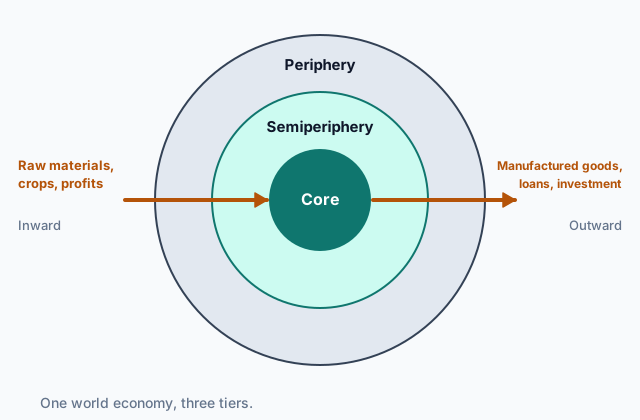
Immanuel Wallerstein's World System Theory starts somewhere else. Instead of studying each country alone, it treats the world as one economy, tied together by trade since the age of colonial empires. A country's development comes from the role it plays in that one system.
- Core countries have high wages, skilled workers and advanced technology. Their firms make high-value goods and services, own businesses abroad and lend money around the world.
- Periphery countries have low wages and earn their income from raw materials, crops and low-skill work. Much of the profit from that work flows out to firms in the core.
- Semiperiphery countries mix the two. They have growing factories and middle wages. The core profits from their factories, and they in turn buy cheap raw materials from the periphery.
 Tap to open the picture full size
Two features set the theory apart. The tiers are linked: the core's wealth and the periphery's poverty come from the same trade. And a country's place can change, up or down, as its economy changes. The theory's weakness is scale. It sorts whole countries into three groups, which hides a wealthy capital city and a poor countryside inside one country.
Quick check · Sort it
Each card describes a hypothetical country. Tap a card, then the tier of World System Theory it fits.
Core
Semiperiphery
Periphery
2c. Dependency theory
Dependency theory says poor countries are not simply on a lower step of Rostow's ladder. They are held back by the way their economies are tied to richer countries. Under colonial rule, many colonies were set up to grow crops and dig minerals for the ruling country, and to buy its manufactured goods. Those ties often lasted after independence.
Take a hypothetical former colony that sells raw tea leaves to firms in a richer country. The firms blend, pack and brand the tea and sell it for many times what they paid. Most of the value is added, and most of the profit kept, outside the former colony. Its own factories stay few, and it keeps relying on foreign buyers, foreign loans and foreign-owned firms. In dependency theory, the wealth of the rich country and the poverty of the poor one are two results of the same relationship.
World System Theory grew out of these ideas and added the semiperiphery as a middle tier. Critics of dependency theory point out that some poor countries became richer by trading more with wealthy countries, not less, and that a country's own government choices matter as well.
Quick check · Fill the statement
Complete the comparison of two theories.
Rostow's model sees a poor country as on the same path that richer countries took. Dependency theory sees it as by its ties to richer countries, whose firms buy its and keep most of the profit from turning them into finished products.
2d. Commodity dependence
A commodity is a raw or lightly processed good sold in bulk on world markets: crops such as coffee, minerals such as copper, and fuels such as oil. Commodity dependence describes a country that earns a large share of its export income from one or a few commodities. Measure it as a share:
share of export earnings = earnings from the commodity ÷ total export earnings × 100
Hypothetical Country K earns $20 billion a year from exports, $13 billion of it from natural gas: 13 ÷ 20 × 100 = 65%.
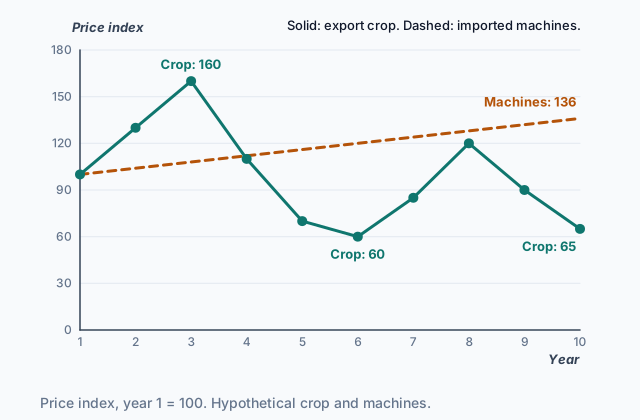
Commodity prices swing much more than the prices of manufactured goods. In the picture at the top of the page, a hypothetical crop climbs to 160, drops to 60 and ends at 65, while, as background, the machines the country imports rise steadily from 100 to 136, so by year 10 the crop buys about half the machinery it bought in year 1. The swings are the main point. A country that relies on such a crop sees its export earnings, government revenue and farm jobs rise and fall with a price it does not set, which makes loans hard to repay and roads hard to plan.
Selling raw goods while others process them is also the periphery's role, and dependency theory traces it to colonial times.
Quick check · Calculate
Hypothetical Country N earns $25 billion a year from exports: $18 billion from crude oil, $4 billion from machinery and $3 billion from other goods. What percent of Country N's export earnings comes from crude oil?
Part 3 Watch it done How much does a price fall cost?
Watch each step, then do the last one yourself.
Hypothetical Country V earns $50 billion a year from exports, $30 billion of it from cocoa beans and $20 billion from everything else. Next year the world price of cocoa beans falls by 40%. V sells the same amount of cocoa, and its other exports earn the same as before. By what percent do V's total export earnings fall?
Predict first
Before the steps, how much do you expect V's total export earnings to fall?
Step 1 · Find cocoa's share
30 ÷ 50 × 100 = 60%. Cocoa beans bring in 60% of V's export earnings, so V is commodity dependent.
Step 2 · Work out the loss on cocoa
The same amount of cocoa now sells for 40% less. 40% of $30 billion is $12 billion, so cocoa earns $18 billion instead of $30 billion.
Why this step?
Why does cocoa's share of V's exports matter to the size of the fall?
Only the cocoa earnings fall. The larger the share of export income one commodity brings in, the more of the total its price fall takes with it. A country earning 10% of its exports from cocoa would lose only 4% of its export earnings to the same price fall.
Your step · Calculate
Finish it. Cocoa now earns $18 billion, and V's other exports still earn $20 billion. By what percent have V's total export earnings fallen from $50 billion?
%
Part 4 Try it Read one country through four theories
Hypothetical Country W, a former colony, earns most of its export income from bananas sold to fruit firms based in wealthier countries. Wages on the plantations are low, and the firms that ship and sell the bananas keep most of the profit. W's government is building new roads and a port and hopes factories will follow.
Try it · Match
Match each theory to the statement about Country W that uses it.
Try it · Decide and justify
An adviser uses Rostow's model to forecast that once W's roads and port are finished, a few industries will take off and W will follow the path that richer countries took. Is the adviser's forecast well supported?
Which reason supports your answer?
Part 5 Explain it Explain a cotton exporter's development
Nothing you type leaves this page. Check your answer against the model and each scoring point.
Free response is 50% of the exam score. This one is shaped like Question 1, from free-response II.
Free-response practice · Question 1 style
Hypothetical Country Z, once a colony, earns most of its export income from raw cotton, which it sells to textile firms in wealthier countries. Most of its workers farm, and farm wages are low. Its government is now building roads, ports and banks and hopes factories will follow.
(A) Identify the stage of Rostow's Stages of Economic Growth that building roads, ports and banks belongs to.
(B) Identify the economic sector that growing raw cotton belongs to.
(C) Describe commodity dependence, using Country Z as the example.
(D) Explain how commodity dependence makes Country Z's export earnings unstable.
(E) Explain how dependency theory accounts for Country Z selling raw cotton rather than cloth.
(F) Describe where World System Theory would place Country Z, using one characteristic of Z.
(G) Explain one limitation of Rostow's model for predicting Country Z's future.
Model answer
(A) Preconditions for take-off.
(B) The primary sector.
(C) Commodity dependence is earning a large share of export income from one or a few raw or lightly processed goods. Country Z earns most of its export income from raw cotton, so it is commodity dependent.
(D) The world price of cotton rises and falls with harvests and demand around the world, and Z does not set it. Because most of Z's export income comes from cotton, a fall in its price cuts most of Z's earnings at once, along with the government's revenue and farm jobs, so Z's income swings from year to year.
(E) Dependency theory says Z's economy was shaped under colonial rule to supply raw materials to wealthier countries. Textile firms there turn the cotton into cloth and clothing and keep most of the value and profit, while Z buys finished goods back. Its own factories stay few, so it keeps depending on foreign buyers.
(F) In the periphery. Z sells a raw crop, its farm wages are low, and most of the profit from its cotton flows to firms in core countries.
(G) Rostow's model assumes Z will follow the path of the countries that industrialized first once it builds roads, ports and banks. It treats Z as developing on its own and leaves out its colonial past and its ties to wealthier countries, which shape what Z sells and who profits. So the take-off the model expects may not come.
Score your own answer. This is a self-check, not a grade. Tick each point your answer makes.
Part 6 Check yourself The exports of four countries
The case questions use the table. The others mix the ideas from the whole lesson.
Four hypothetical countries report their exports for one year. Country F ships most of its coffee beans unroasted to Country G, where firms roast, pack and sell coffee around the world. Country G's own firms also build and sell cars.
| Country | Total export earnings ($ billion) | Largest export | Earnings from largest export ($ billion) |
|---|---|---|---|
| F | 40 | Coffee beans | 30 |
| G | 200 | Cars | 50 |
| H | 120 | Iron ore | 48 |
| J | 8 | Rice | 4 |
Case question 1 · Multiple choice
Which country in the table is the most commodity dependent?
Case question 2 · Calculate
What percent of Country H's export earnings comes from iron ore?
Case question 3 · Multiple choice
A planner in Country F says that F only needs to save and invest, as Country G once did, to reach the take-off stage of Rostow's model. Which limitation of Rostow's model does dependency theory point to in this case?
The rest stand on their own and do not use the case.
Check yourself · Spot the error
A student uses World System Theory to describe three hypothetical countries. Which line is the first to go wrong?
Check yourself · Select all
Which two are criticisms of Rostow's Stages of Economic Growth? Select two.
Select 2 answers, then check.
Part 7 Keep it Bring back earlier ideas
This lesson stands on women and economic development from Topic 7.4 and economic sectors from Topic 7.2.
Bring it back · Multiple choice
As hypothetical Country P's economy grows, more women take paid jobs. Which outcome fits the pattern in the workforce as countries develop?
Bring it back · Fill the statement
Three jobs in one hypothetical mining town.
Workers who dig iron ore out of the ground work in the sector. Workers at the mill who turn the ore into steel work in the sector. Workers who sell steel tools in the town's hardware store work in the sector.
In three lines
- Rostow's Stages of Economic Growth: five stages from traditional society to high mass consumption, criticized for assuming one path and treating each country alone.
- World System Theory and dependency theory: a linked core, semiperiphery and periphery, with poor countries held back by ties that send raw goods and profits to richer ones.
- Commodity dependence: a large share of export earnings from one or a few raw goods, so a country's income rides on world prices.
Exam strategy for this topic
- Section I, Multiple Choice: 60 questions in 60 minutes.
- Section II, Free Response: 3 questions in 75 minutes.
When a question asks how a theory explains a place, name the theory, apply its key idea to the place in one sentence, and, if it asks for a limitation, say what the theory leaves out for that place. Give commodity dependence as a share of export earnings, not a dollar figure.
Questions students ask
Which theory of development is right?
None of them alone. Rostow's model describes how an economy's work changes over time; World System Theory and dependency theory explain how countries' places are linked; commodity dependence explains why some countries' incomes swing. Use the one that fits the question, and be ready to say what it leaves out.
What is the difference between dependency theory and World System Theory?
Both explain poverty through ties between countries. Dependency theory divides the world into richer countries and the poorer ones tied to them. World System Theory grew out of it and adds a third, middle tier, the semiperiphery.
Why is Rostow's third stage called take-off?
The name borrows from an airplane leaving the ground: after the groundwork of the second stage, a few leading industries grow fast enough to pull the rest of the economy into steady growth.
Does a commodity have to be a crop?
No. Crops such as coffee, minerals such as copper and iron ore, and fuels such as oil and natural gas are all commodities: raw or lightly processed goods sold in bulk on world markets.
Are the countries in this lesson real?
No. Every country, product figure and price here is hypothetical, with numbers chosen to show each theory clearly.
Course alignment, for teachers
AP Human Geography topic 7.5, Unit 7: Industrial and Economic Development Patterns and Processes.
- Skill 1.E: Explain the strengths, weaknesses, and limitations of different geographic models and theories in a specified context.
This lesson maps the one essential knowledge statement of the topic to the part that teaches each one: 1 is checked by a scored question. The map is in the lesson file.