Unit 7 · Topic 7.6 · about 30 minutes · 7 parts · 14 scored checks, 3 of them multiple choice
AP Human Geography 7.6: Trade and the World Economy
Unit 7: 12 to 17% of the multiple-choice section
What you'll be able to do
- Explain how complementarity and comparative advantage create trade, how neoliberal policies and organizations such as the EU, WTO, Mercosur and OPEC link places, how government initiatives such as tariffs affect development at every scale, and how debt crises, the IMF and microlending show economies becoming interdependent.
Key vocabulary
| Term | What it means | The exam trap |
|---|---|---|
| Complementarity | A condition in which one place has a surplus of something that another place lacks and wants, which gives them a reason to trade. | It needs both sides: a surplus in one place and a demand in the other. |
| Comparative advantage | A place's ability to make a good while giving up less of other goods than another place gives up to make it. | Work it out from a table as a rate, one good's output divided by the other's, for each country. |
| Neoliberal policies | Policies that shrink the government's role in the economy, such as cutting tariffs, selling state-owned companies and opening to foreign investment. | Free trade agreements are one kind of neoliberal policy, not the whole of it. |
| Free trade agreement | An agreement among countries to remove tariffs and other barriers on goods they trade with one another. | It lowers barriers among members only; goods from outside can still face tariffs. |
| European Union (EU) | A union of European countries with a single market, in which goods, services, money and people move between members with few barriers. | It is more than a trade agreement: many members also share a currency. |
| Mercosur | A trade bloc of South American countries that cut tariffs on trade among themselves. | Place it on the map: it is the South American example among the organizations in this topic. |
| OPEC | The Organization of the Petroleum Exporting Countries, a group of oil-exporting countries that coordinate how much oil they produce. | Its members are tied together by one export, not by a free trade agreement. |
| World Trade Organization (WTO) | A global organization whose member countries agree on rules for trade, negotiate lower trade barriers and settle trade disputes. | Easy to mix up with the other international bodies in this topic, so learn what each one does. |
| Tariff | A tax a government charges on imported goods. | Know who is charged it, where, and whose prices change. |
| Debt crisis | A crisis that starts when a country, or its banks and businesses, owe foreign lenders more than they can pay. | Follow the money: the losses land on lenders in other countries too. |
| International Monetary Fund (IMF) | An international lending agency that lends to governments in financial crisis, with conditions on how they run their economies. | Learn who it lends to and what it asks in return. |
| Microlending | Making very small loans to people who cannot borrow from ordinary banks, so they can start or grow a small business. | Learn who borrows, how much, and what the money is for. |
 Tap to open the picture full size
Part 1 Think first Can the faster country gain from trade?
Commit to a guess first. Being wrong now makes the right idea stick better.
Predict first
In hypothetical Country A, one worker in a day makes far more shirts and grows only a little more rice than one worker in hypothetical Country B. A trade official says that if the two countries trade, both could end up with more shirts and more rice than they have now. Is she right?
In short. Places trade because each has what others want and can make some goods at a lower cost, and trade and lending now tie economies so closely that a change in one country reaches many others.
- Complementarity means one place has a surplus of what another lacks and wants; comparative advantage means a place gives up less of other goods to make a good, so it specializes in that good and trades for the rest.
- Neoliberal policies such as free trade agreements built organizations and trade links, including the EU, the WTO, Mercosur and OPEC, while governments at every scale use tools such as tariffs, taxes on imports, to shape development.
- Debt crises spread from one country to its lenders and trade partners, the IMF lends to governments in crisis on conditions, and microlending makes small loans to people banks will not serve, so economies are interdependent.
Part 2 Learn it Why places trade, and what ties their economies together
2a. Complementarity and comparative advantage
Trade starts with complementarity: one place has a surplus of something that another place lacks and wants. A hypothetical tropical country grows bananas and needs trucks. A hypothetical cold country builds trucks and cannot grow bananas. Each has what the other wants, so goods move both ways.
Complementarity explains trade between places that make different things. Comparative advantage explains who should make what, even when one place is better at everything. A place has a comparative advantage in a good when it gives up less of other goods to make it than another place does. What a place gives up to make something is its opportunity cost.
| Country | Shirts | or sacks of rice |
|---|---|---|
| Country K | 40 | 20 |
| Country M | 10 | 10 |
Country K's workers make more of both goods. But each sack of rice a Country K worker grows costs 2 shirts (40 ÷ 20), while in Country M a sack costs only 1 shirt (10 ÷ 10). Country M gives up less to grow rice, so it has the comparative advantage in rice, and Country K has it in shirts. If Country M grows only rice, Country K puts most of its work into shirts and they trade, the two together can end up with more of both goods than if each made everything itself.
Quick check · Calculate
In hypothetical Country G, one worker can make 12 tables or 4 bicycles in a day. In hypothetical Country H, one worker can make 6 tables or 3 bicycles. What is Country G's opportunity cost of making one bicycle, in tables?
2b. Trade agreements and the organizations they built
Neoliberal policies shrink the government's role in the economy and let markets decide more: cutting tariffs, selling state-owned companies and opening the country to foreign investment. A free trade agreement is one such policy. Its member countries remove tariffs and other barriers on goods they trade with one another.
These policies built new organizations:
- The European Union (EU) joins European countries in a single market, where goods, services, money and people move between members with few barriers. Many members share one currency, the euro.
- The World Trade Organization (WTO) is a global organization whose members agree on rules for trade, negotiate lower barriers and settle trade disputes.
- Mercosur is a trade bloc of South American countries that cut tariffs on trade among themselves.
- OPEC, the Organization of the Petroleum Exporting Countries, is a group of oil-exporting countries that coordinate how much oil they produce, which moves world oil prices.
Each one creates new spatial connections, such as ports, highways, pipelines and supply chains that cross borders, and new trade relationships between places that once traded little. That is the globalization these organizations foster: places linked more tightly by flows of goods, money and people.
Quick check · Fill the statement
Complete the description of trade agreements and the organizations they built.
In a free trade agreement, member countries remove on goods they sell to one another. Members of the agree on rules for trade among most of the world's countries and settle trade disputes. The group called coordinates how much oil its member countries produce.
2c. Tariffs and government initiatives at every scale
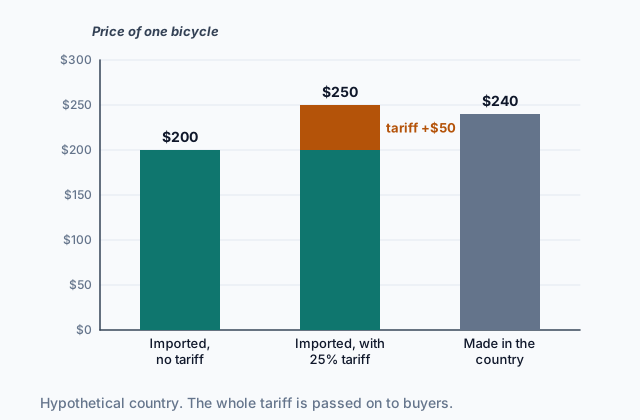
A tariff is a tax a government charges on imported goods. The importer pays it at the border and usually passes it on to buyers in a higher price. The picture at the top of the page shows a 25% tariff on a $200 imported bicycle: it adds $50, so the import now costs $250, more than the $240 bicycle made in the country.
That is why governments use tariffs. Producers at home gain sales and keep jobs, because their goods are now the cheaper choice. Everyone who buys the good pays more, including businesses that use it. Trading partners may answer with tariffs on the country's own exports. Whether a tariff helps a country develop depends on which of these effects is larger.
Governments at every scale try to shape their economies. A city may let a new factory skip property taxes for a few years. A state or province may pay for job training. A national government sets tariffs and pays subsidies to farmers. Groups of countries act above that: the EU and Mercosur each charge one shared tariff on goods from outside, and WTO members agree on rules for the world. Each can change where jobs and investment go.
Quick check · Sort it
Each card is a government initiative in a hypothetical place. Tap a card, then the scale of government that carries it out.
Local
National
Supranational or global
2d. Debt crises, the IMF and microlending
Lending ties economies through money, and a crisis can travel along those links. A debt crisis starts when a country, or its banks and businesses, owe foreign lenders more than they can pay. A shock often sets it off: the price of the country's main export falls, or interest rates rise. When the country stops paying, banks abroad lose money and lend less to everyone, and its trade partners sell less to it. A crisis that starts in one country can slow economies on other continents.
The International Monetary Fund (IMF) is an international lending agency. It lends to governments in financial crisis, with conditions attached: cut government spending, raise taxes, sell state-owned companies or open markets further. Supporters say the conditions restore stability; critics say cuts to schools, health care and food subsidies fall hardest on the poor.
Microlending works at the other end of the scale, as a strategy of development. It makes very small loans, often to women, to people in poor villages or city neighborhoods who cannot borrow from ordinary banks, to start or grow a small business such as a market stall. Lenders and donors in wealthy countries often fund microlenders in poorer ones, so even a village loan links economies far apart.
Quick check · Put it in order
Put the stages of a debt crisis in hypothetical Country V in order, from first to last.
Part 3 Watch it done When does a tariff make the import cost more?
Watch each step, then do the last one yourself.
In hypothetical Country T, an imported washing machine sells for $400 and a washing machine made in Country T sells for $450. Country T's government puts a 10% tariff on imported washing machines, and importers pass the whole tariff on to buyers. What does an imported machine cost now, and how does it compare with the machine made in Country T?
Predict first
Before the steps, which machine do you expect will be cheaper once the tariff is in place?
Step 1 · Find the tariff
The tariff is 10% of the import's price: 0.10 × $400 = $40.
Step 2 · Find the new price and compare
$400 + $40 = $440. The imported machine still costs $10 less than the $450 machine made in Country T, but the gap has shrunk from $50 to $10.
Why this step?
Why does the tariff help Country T's washing machine makers, even though the import is still cheaper?
Buyers compare prices. With the gap down from $50 to $10, some buyers decide the machine made at home is worth the small difference and switch to it. Its makers gain sales, while every buyer of an imported machine pays $40 more than before.
Your step · Calculate
Finish it. What is the smallest tariff rate, as a percent of the $400 import price, that makes an imported washing machine cost at least as much as the $450 machine made in Country T?
%
Part 4 Try it Trade between two neighbors
Try it · Match
Hypothetical Country Z has large iron ore mines but few factories. Its neighbor has many factories, including tractor plants, but no iron ore of its own. Match each idea to the observation that shows it.
Try it · Decide and justify
Country Z's farmers buy their tractors from the neighbor. A small factory in Country Z also makes tractors, at a higher price than the imports. Country Z's government now puts a 30% tariff on imported tractors, and importers pass the whole tariff on to buyers. Which group in Country Z is most likely to be hurt by the tariff?
Which reason supports your answer?
Part 5 Explain it Explain one country's trade and debt
Nothing you type leaves this page. Check your answer against the model and each scoring point.
Free response is 50% of the exam score. This one is shaped like Question 2, from free-response II.
Free-response practice · Question 2 style
Hypothetical Country W exports copper, which makes up 80% of its exports, and imports most of its factory machinery. It joined the World Trade Organization (WTO) in Year 2. In Year 11, the world price of copper fell by half. The data below describe Country W.
- Year 0: average tariff on imports 25%; exports $5 billion; foreign debt $4 billion
- Year 10: average tariff on imports 8%; exports $15 billion; foreign debt $12 billion
- Year 12: average tariff on imports 8%; exports $9 billion; foreign debt $14 billion
(A) Identify the change in Country W's average tariff on imports between Year 0 and Year 10.
(B) Using the data, describe the change in Country W's exports between Year 0 and Year 10.
(C) Explain how joining the WTO could have contributed to the change in exports you described in part (B).
(D) Explain how comparative advantage accounts for Country W exporting copper and importing machinery.
(E) Explain why Country W's exports fell between Year 10 and Year 12.
(F) Explain how Country W's foreign debt shows that economies in different countries are interdependent.
(G) In Year 12, Country W borrows from the International Monetary Fund (IMF). Explain one way the conditions attached to such a loan could affect people in Country W.
Model answer
(A) The average tariff fell, from 25% to 8%.
(B) Exports tripled, from $5 billion in Year 0 to $15 billion in Year 10.
(C) WTO members agree to lower tariffs and other barriers on one another's goods. Once Country W joined, its copper faced lower tariffs in many more markets, so it was cheaper for buyers abroad, and Country W could sell more of it.
(D) Compared with its trading partners, Country W gives up less of its other output to produce copper, and its partners give up less to produce machinery, so Country W's comparative advantage is in copper. It specializes in copper and trades it for machinery that its partners make at a lower opportunity cost.
(E) Copper is 80% of Country W's exports, $12 billion of the $15 billion in Year 10. When the world price halved, the same amount of copper earned $6 billion, so exports fell to $9 billion even though the other $3 billion held steady. An economy that depends on one export rises and falls with that export's world price.
(F) Country W's debt rose from $4 billion to $14 billion, owed to lenders in other countries. Its ability to repay depends on a copper price set by buyers around the world, and if it cannot pay, the banks and governments that lent to it lose money and lend less elsewhere. A fall in demand in one region can become a loss for lenders in another.
(G) The IMF attaches conditions such as cutting government spending. If Country W cuts spending on schools, health care or food subsidies, poorer families lose services they depend on, and public workers may lose their jobs.
Score your own answer. This is a self-check, not a grade. Tick each point your answer makes.
Part 6 Check yourself Country R joins a trade bloc
The case questions use the table. The others mix the ideas from the whole lesson.
Hypothetical Country R and four neighboring countries signed a free trade agreement in Year 0 and put it into effect in steps over twenty years. The table shows Country R's trade.
| Measure | Year 0 | Year 10 | Year 20 |
|---|---|---|---|
| Average tariff on goods from bloc partners | 20% | 10% | 0% |
| Total exports ($ billion) | 10 | 16 | 40 |
| Share of exports sold to bloc partners | 25% | 40% | 60% |
Case question 1 · Multiple choice
Which statement is best supported by the table?
Case question 2 · Calculate
By how many billion dollars did Country R's exports to its bloc partners grow from Year 0 to Year 20?
Case question 3 · Multiple choice
In Year 21, a financial crisis begins in the bloc's largest economy and spreads to Country R's other bloc partners, and their spending falls. Using the table, which outcome for Country R is most likely?
The rest stand on their own and do not use the case.
Check yourself · Spot the error
A student works out which country should specialize in which good. Which line is the first to go wrong?
Check yourself · Select all
Which two statements about international lending are accurate? Select two.
Select 2 answers, then check.
Part 7 Keep it Bring back earlier ideas
This lesson stands on theories of development from Topic 7.5 and measures of development from Topic 7.3.
Bring it back · Multiple choice
In Wallerstein's world system theory, which description fits the countries of the semi-periphery?
Bring it back · Fill the statement
Complete the description of the Human Development Index.
The Human Development Index combines life expectancy, years of schooling and income per person into one measure. Mapping it country by country shows variation in levels of development.
In three lines
- Complementarity and comparative advantage are the basis for trade: places make what they give up least to make and trade for the rest.
- Free trade agreements and organizations such as the EU, WTO, Mercosur and OPEC link places, and governments at every scale use tools such as tariffs.
- Debt crises, IMF loans and microlending show how closely economies in different countries are now tied together.
Exam strategy for this topic
- Section I, Multiple Choice: 60 questions in 60 minutes.
- Section II, Free Response: 3 questions in 75 minutes.
When a question names a trade organization, say what it does, not only what it is. When it gives a tariff, say which prices rise and which producers it protects, and name the scale the policy works at.
Questions students ask
What is the difference between complementarity and comparative advantage?
Complementarity is a reason two places trade at all: one has a surplus of what the other lacks and wants. Comparative advantage explains which place should make which good, even when one place could make all of them.
Is OPEC a free trade agreement?
No. OPEC is a group of oil-exporting countries that coordinate how much oil they produce. It does not remove tariffs on trade among its members, but it ties their economies to world energy trade.
Do tariffs always protect jobs?
No. A tariff can protect jobs in the industry it shields, but it raises costs for every business and family that buys the import, and trading partners may answer with tariffs on the country's own exports, which can cost jobs in other industries.
Why does a geography course study trade and lending?
Trade and lending are flows between places. They create spatial connections, change where jobs and investment go, and explain why a crisis in one region reaches people in another.
Are the countries and figures in this lesson real?
No. Every country, town and number here is hypothetical, chosen to show each idea clearly. The organizations named, the EU, the WTO, Mercosur, OPEC and the IMF, are real, and the lesson describes what they do without statistics.
Course alignment, for teachers
AP Human Geography topic 7.6, Unit 7: Industrial and Economic Development Patterns and Processes.
- Skill 5.B: Explain spatial relationships across various geographic scales using geographic concepts, processes, models, or theories.
This lesson maps all 4 essential knowledge statements of the topic to the part that teaches each one: 4 are checked by a scored question. The map is in the lesson file.