Unit 1 · Topic 1.4 · about 30 minutes · 7 parts · 11 scored checks, 1 of them multiple choice, plus 2 from earlier lessons
AP Microeconomics 1.4: Comparative Advantage and Trade
Unit 1: 12 to 15% of the multiple-choice section
What you'll be able to do
- Tell absolute advantage from comparative advantage, and pick out which producer holds each from a PPC or a table.
- Show how specializing in the lower-cost good and trading at a suitable rate gives both sides more, and calculate a rate of exchange that works for both.
Key vocabulary
| Term | What it means | The exam trap |
|---|---|---|
| Absolute advantage | Turning the same amount of resources into more of a good or service than another producer can. | Some tables give time per unit rather than output, so read the heading before you compare. |
| Comparative advantage | Making a good or service while giving up less of other things than another producer would: a lower opportunity cost. | Line up two producers' costs for one and the same good, never one producer's cost of one good against the other's cost of a different good. |
| Opportunity cost | The value of the best alternative given up. With two goods, it is the amount of the other good given up to make one more unit. | Write the units with every cost, such as 3 pies per cake, so the cost of one good is not mistaken for the cost of the other. |
| Specialization | Concentrating production on one good, or a few, instead of making a bit of everything. | Specializing means making less of some goods, so a producer that specializes relies on trade for the rest. |
| Terms of trade | The price of one good expressed in units of another, such as 2 shirts for each hat. | Express both producers' costs and the offered rate in units of the same good before judging whether the rate works. |
| Gains from trade | The extra goods each side ends up with by specializing and trading, compared with making everything itself. | A gain is measured against the producer's own PPC, not against zero. |
 Tap to open the picture full size
Part 1 Think first Who chops the onions?
Make a guess first. Even a wrong guess helps the answer stick.
Predict first
In a busy restaurant kitchen, the head chef chops onions faster than her assistant does, and she also cooks the dishes much faster than he does. During the dinner rush, with a pile of onions to chop and a line of orders to cook, who should chop the onions?
In short. When two producers face different opportunity costs, each does best making the good it gives up less to make; that edge is called comparative advantage, and trading on it leaves both sides with more of both goods than working alone would give them.
- Absolute advantage asks who turns the same resources into more output; comparative advantage asks whose opportunity cost per unit is lower.
- One producer can lead in output of both goods, but its two costs are reciprocals, so it is the low-cost maker of one good at most.
- A price for a good that sits between the seller's cost and the buyer's cost leaves both better off.
Part 2 Learn it Four ideas, with a check after each
2a. Absolute advantage: who makes more
Absolute advantage is about raw productivity. Give two producers the same resources (two people, two firms or two whole countries), and the one that turns out more of a good holds the absolute advantage in it.
Watch which way the numbers in a table point.
- Units made in a set time, such as 40 shirts a day: more is better, so the larger figure wins.
- Time or inputs used per unit, such as 2 hours per shirt: less is better, so the smaller figure wins. Two hours a shirt gets more shirts out of a day than three.
Look for words like per day or hours per in the heading before you read a single number.
Nothing stops one producer from leading in both goods. The head chef in Think first is quicker at chopping and at cooking, and that alone did not settle who should chop.
Quick check · Decide and justify
Two tile setters work with the same tools. Sam needs 5 hours to tile a bathroom floor, and Dev needs 3 hours to tile the same floor. Who has the absolute advantage in tiling bathroom floors?
Which reason supports your choice?
2b. Comparative advantage: who gives up less
A comparative advantage belongs to whichever producer gives up less to make one unit of a good, that is, the producer with the lower opportunity cost.
Take Ines and Theo. In a day, Ines can sew 40 shirts or 20 hats, and Theo 30 shirts or 10 hats. Ines leads in output of both. Divide what each gives up by what each gains:
| Producer | Cost of a hat | Cost of a shirt |
|---|---|---|
| Ines | 40 ÷ 20 = 2 shirts | 20 ÷ 40 = 0.5 hat |
| Theo | 30 ÷ 10 = 3 shirts | 10 ÷ 30 = 1/3 hat |
Read down each column, so you compare one good at a time. Ines pays 2 shirts for a hat and Theo pays 3, so hats are Ines's comparative advantage. Theo pays 1/3 hat for a shirt and Ines pays 1/2, so shirts are Theo's.
Each producer's two costs flip into each other: 2 and 1/2 for Ines. Being the cheaper maker of one good makes you the costlier maker of the other, which is why nobody holds the comparative advantage in both.
Quick check · Calculate
In a day, Rosa can bake 24 pies or 8 cakes, at a constant opportunity cost. What is Rosa's opportunity cost of baking one cake, in pies?
2c. Specialize, then trade
Say Ines and Theo each split the day: Ines sews 10 shirts and 15 hats, and Theo sews 18 shirts and 4 hats. Together that is 28 shirts and 19 hats.
Now each specializes, making only the good it produces more cheaply. Ines sews only hats, 20 of them, and Theo sews only shirts, 30 of them. Together that is 30 shirts and 20 hats: 2 more shirts and 1 more hat from the same workers and machines.
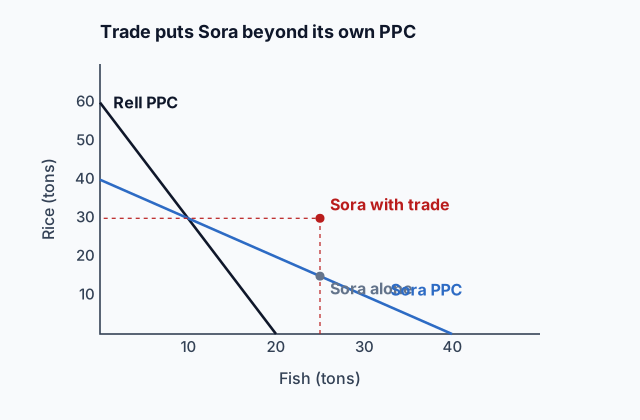
When they then trade, each can end up with a combination outside its own PPC: more of both goods than it could make alone. That is the gain from trade, and it comes from comparative advantage, not absolute advantage. Ines is better at both goods, and she still gains by leaving shirts to Theo.
Quick check · Put it in order
Put the steps for setting up a trade between two producers in order. Tap them from first to last.
2d. A price both sides accept
The terms of trade are the exchange rate between two goods, say 2.5 shirts for one hat.
In the hat and shirt example, Ines sells hats to Theo. Making a hat costs her 2 shirts, so she will not sell for fewer than 2. Making one himself would cost Theo 3 shirts, so he will not pay more than 3. Anything between those limits leaves both ahead: at 2.5, Ines collects half a shirt more than her hat cost, and Theo keeps half a shirt he would have spent.
Outside the limits, someone walks away. At 1.5 shirts a hat, Ines does better sewing her own shirts. At 3.5, Theo does better sewing his own hats.
The working rule: state both producers' costs of the good being traded, in the same units, and check that the price falls inside them.
Quick check · Decide and justify
One hat costs Mara 4 scarves to knit, and it costs Jon 6 scarves. Mara specializes in hats and offers to sell Jon each hat for 5 scarves. Would this trade benefit both of them?
Which reason supports your choice?
Part 3 Watch it done Two countries, one trade
Follow each step, then finish the last one yourself.
Kesh and Lorin have equal resources, and each faces a constant opportunity cost. A year's work can give Kesh 60 tons of coffee or 30 tons of cocoa, and Lorin 24 tons of coffee or 24 tons of cocoa. Decide who should specialize in what, and check whether a trade of 1 ton of cocoa for 1.5 tons of coffee helps both.
Step 1 · Opportunity costs
Kesh gives up 60 coffee for 30 cocoa, so 1 ton of cocoa costs 2 tons of coffee and 1 ton of coffee costs 0.5 ton of cocoa. Lorin gives up 24 for 24, so each good costs 1 ton of the other.
Step 2 · Comparative advantage
Coffee costs Kesh 0.5 ton of cocoa and Lorin 1 ton, so Kesh has the comparative advantage in coffee. Cocoa costs Lorin 1 ton of coffee and Kesh 2, so Lorin has it in cocoa. Kesh is ahead in output of both goods.
Why this step?
Why does Lorin get a good to specialize in when Kesh makes more of both?
Specializing depends on what each country gives up, not on how much it makes. Every ton of cocoa Kesh grows costs it 2 tons of coffee, while Lorin gives up only 1. Leaving cocoa to Lorin frees Kesh to make coffee, where its cost is lowest.
Step 3 · Terms of trade
A ton of cocoa costs Lorin 1 ton of coffee and Kesh 2 tons. A price of 1.5 tons of coffee per ton of cocoa lies between them, so both can gain. Lorin makes 24 tons of cocoa and sells 8 of them to Kesh for 8 × 1.5 = 12 tons of coffee.
Your step · Calculate
Once the trade is done, Lorin holds 16 tons of cocoa and 12 tons of coffee. Working alone, Lorin can make 24 tons of coffee or 24 tons of cocoa, at a constant opportunity cost. Compared with the most coffee Lorin could make by itself while keeping 16 tons of cocoa, how many extra tons of coffee does the trade give it?
tons
Part 4 Try it New tables, your turn
Try it · Decide and justify
A tailor needs 3 hours to sew a shirt and 9 hours to sew a jacket. Her assistant needs 2 hours for a shirt and 8 hours for a jacket. Who has the comparative advantage in sewing jackets?
Which reason supports your choice?
Part 5 Explain it Answer a short free-response question
Nothing you type leaves this page. Draw the graph on paper, then compare it with the model.
Free response is 33.35% of the exam score. This one is shaped like Question 3, Short.
Free-response practice · Question 3 style
Ardo and Belm have equal resources, and each faces a constant opportunity cost. In a year, Ardo can catch 90 tons of fish or grow 30 tons of grain, and Belm can catch 40 tons of fish or grow 20 tons of grain. (a) Draw a correctly labeled production possibilities curve for Belm, with fish on the horizontal axis, and label where it meets each axis. (b) Which country has an absolute advantage in producing grain? Explain. (c) Calculate Belm's opportunity cost of one ton of fish. Show your work. (d) The countries specialize according to comparative advantage. Is an exchange of 1 ton of grain for 2.5 tons of fish good for both? Explain.
Model answer
(a) Fish on the horizontal axis and grain on the vertical axis, with a straight line from 20 tons of grain to 40 tons of fish. (b) Ardo: from the same resources it grows 30 tons of grain to Belm's 20. (c) Catching 40 tons of fish costs Belm its 20 tons of grain, so each ton of fish costs 20 ÷ 40 = 0.5 ton of grain. (d) Yes. A ton of grain costs Belm 40 ÷ 20 = 2 tons of fish and Ardo 90 ÷ 30 = 3, so Belm grows the grain. At 2.5 tons of fish, Belm is paid more than its grain cost it, and Ardo pays less than growing the grain would cost.
Belm's production possibilities curve
A constant opportunity cost draws a straight line from 20 tons of grain to 40 tons of fish.
Score your own answer. This is a self-check, not a grade. Tick each point your answer makes.
Part 6 Check yourself Read two shops' output
The case questions can all be answered from this table.
Inkwell and Paperjam are print shops with equal staff and presses. Each row gives the most a shop can print in an 8-hour day spent on only that item, at a constant opportunity cost.
| Shop | Posters | Banners |
|---|---|---|
| Inkwell | 80 | 20 |
| Paperjam | 30 | 10 |
Case question 1 · Calculate
What is Inkwell's opportunity cost of printing one banner, measured in posters?
Case question 2 · Multiple choice
The two shops specialize according to comparative advantage and trade with each other. Which price for one banner would benefit both shops?
Case question 3 · Fill the statement
Tap a blank, then tap a word or phrase.
Inkwell has the absolute advantage in , and Paperjam has the comparative advantage in .
The rest stand on their own and do not use the case.
Check yourself · Sort it
Tap a statement, then tap the idea it describes.
Absolute advantage
Comparative advantage
Check yourself · Spot the error
In an hour, Mei can pick 30 pounds of berries or 10 pounds of beans, and Leo can pick 12 pounds of berries or 6 pounds of beans. A student planned their picking. Tap the first line with a mistake.
Part 7 Keep it Keep it
From 1.3 Production Possibilities Curve · Calculate
A school print shop, using every press and worker, can turn out 150 yearbooks and 20 banners in a month (point J) or 120 yearbooks and 30 banners (point K). Going from J to K, how many yearbooks does each extra banner cost?
From 1.1 Scarcity · Match
Tap each resource, then tap how an economist classifies it.
In three lines
- Absolute advantage is more output from equal resources; comparative advantage is the lower cost per unit.
- Each side specializing where its cost is lower, then trading, gets both past their own PPCs.
- A rate of exchange works for both only if it sits between their costs of the traded good.
Exam strategy for this topic
- Section I, Multiple Choice: 60 questions in 70 minutes.
- Section II, Free Response: 3 questions in 60 minutes.
- This lesson's Explain it is shaped like free-response question 3, Short.
- A four-function calculator is allowed on both sections of the exam.
Show each cost as a division with units, such as 80 ÷ 20 = 4 posters per banner, and compare one good at a time. For a proposed exchange rate, write both producers' costs of that good and say whether the rate falls inside them.
Questions students ask
Can a producer lead in output of both goods?
Yes. If one producer turns out more of each good from the same resources, it leads in both, as Kesh does in the worked example.
Can a producer have the lower cost of both goods?
No. A producer's two costs are reciprocals, so if it gives up less for one good it gives up more for the other. If the two producers' costs are identical, neither has a comparative advantage.
How do I read an input table?
It lists the time or inputs one unit uses. Fewer hours per unit means more output, so the smaller figure marks the absolute advantage. For costs, compare hours: a 6-hour table against a 2-hour chair means one table costs 3 chairs.
How do I pick a rate of exchange both sides accept?
Find what one unit of the traded good costs each producer. A price strictly inside those two costs pays the seller more than the good cost it and charges the buyer less than making it would.
Why does the producer that is worse at both goods still gain from trade?
Its cost is still the lower one for one of the two goods. Making that good and swapping it gets the other good for less than producing it would cost, so it can consume past its own PPC.
Course alignment, for teachers
AP Microeconomics topic 1.4, Unit 1: Basic Economic Concepts.
- Skill 1.C: Identify an economic concept, principle, or model using quantitative data or calculations.
This lesson maps all 4 essential knowledge statements of the topic to the part that teaches each one: 4 are checked by a scored question. The map is in the lesson file.