Unit 1 · Topic 1.5 · about 28 minutes · 7 parts · 10 scored checks, 1 of them multiple choice, plus 2 from earlier lessons
AP Microeconomics 1.5: Cost-Benefit Analysis
Unit 1: 12 to 15% of the multiple-choice section
What you'll be able to do
- Define opportunity cost, and explain and calculate the opportunity cost of a choice, counting both explicit and implicit costs.
- Explain a decision by comparing total benefits with total costs, and calculate those totals, from a table or a graph.
Key vocabulary
| Term | What it means | The exam trap |
|---|---|---|
| Opportunity cost | The value of the best alternative given up when a choice is made. | Opportunity cost is the value of the single best alternative, not the sum of every alternative you could have picked. |
| Explicit cost | A cost paid out in money, such as rent, wages or tuition. | An explicit cost is paid in money, whether in cash, by card or by a bill paid later. |
| Implicit cost | A cost of a choice that involves no payment of money: the value of the best use given up for a resource you already own or control. | An implicit cost is measured by the best use given up, not by every use the resource could have had. |
| Rational agent | A person or firm that weighs costs and benefits to make the choice that serves its goal best. | Rational in economics means weighing costs and benefits toward a goal, not being unemotional or always choosing the cheapest option. |
| Total benefit | Everything a choice brings in: total utility for a consumer, total revenue for a firm. | Total benefit is everything the choice brings in, not the gain from one more unit. |
| Utility | The satisfaction or usefulness a consumer gets from a good, service or choice, often counted in utils. | When a problem states utility in dollars, it means the most the person would pay, which is not the price they actually paid. |
| Total revenue | The money a firm takes in from selling its output, price times quantity sold. | Total revenue is money coming in before any costs, so it is not the same as profit. |
| Net benefit | Total benefit minus total cost. | Net benefit belongs to each whole option, so a table of options has one net benefit on every row. |
 Tap to open the picture full size
Part 1 Think first One more night at the stall
Make a guess first. Even a wrong guess helps the answer stick.
Predict first
Priya runs a dumpling stall at a night market. If she opens on Thursday too, she expects $400 in sales and will pay $150 for ingredients and a helper. If she stays closed, she will spend Thursday evening tutoring, which pays her $300. Is opening on Thursday a good choice for Priya?
In short. Cost-benefit analysis means adding up everything a choice gives you and everything it costs you, including what you give up, and choosing the option with the largest net benefit.
- The cost of a choice is its opportunity cost: the money you pay (explicit) plus the value of the best thing you give up without paying for it (implicit).
- Total benefit is measured as utility for a consumer and as total revenue for a firm.
- The best choice makes net benefit, total benefit minus total cost, as large as it can be.
Part 2 Learn it Four ideas, with a check after each
2a. The full cost: explicit plus implicit
The opportunity cost of a choice is the value of the best alternative you give up to make it. Economists count every cost of a choice this way, and it has two parts.
- An explicit cost is money you actually pay out: tuition, rent, wages, ingredients.
- An implicit cost is the value of something you already have that the choice uses up, with no payment changing hands: the pay you would have earned with that time, the rent your own building could have brought in.
A rational decision maker, one who weighs costs and benefits to do as well as possible, counts both. Priya's $150 of ingredients is explicit. The $300 of tutoring pay she gives up is implicit. Her full cost of opening is $450, not $150.
One test keeps the list honest: a cost belongs only if the choice causes it. If Priya pays her phone bill whether or not she opens, the phone bill is not a cost of opening.
Quick check · Calculate
Dev is deciding whether to take a summer coding course. The course charges $1,200 in tuition. Its classes fill his weekdays, so he would have to give up a summer job that pays $2,800. What is Dev's total opportunity cost of taking the course, in dollars?
2b. Total benefit: utility or revenue
The other side of the ledger is total benefit, everything the choice brings in. What it measures depends on who is choosing.
For a consumer, total benefit is utility, the satisfaction or usefulness the choice gives. A season pass to a climbing gym gives Amara a year of climbing, and its total benefit is the total utility of all that climbing. Utility is often counted in made-up units called utils. To set a benefit beside a dollar cost, a problem may instead state it as the most the person would pay, in dollars.
For a firm, total benefit is total revenue, the money it takes in from selling its output: price times quantity sold. A food truck that sells 200 burritos at $9 each has total revenue of $1,800.
Once both sides are in the same units, the comparison is direct: total benefit on one side, total cost (explicit plus implicit) on the other.
Quick check · Match
Tap a situation, then tap what it measures.
2c. Net benefit picks the best option
Net benefit is total benefit minus total cost. A rational decision maker chooses the option where net benefit is largest. That is the optimal choice.
The Robotics Club can run a booth at the school fair for 1, 2 or 3 hours. Each hour takes members away from other fundraising, so total cost rises with time:
| Hours | Total benefit | Total cost | Net benefit |
|---|---|---|---|
| 1 | $110 | $50 | $60 |
| 2 | $180 | $100 | $80 |
| 3 | $220 | $170 | $50 |
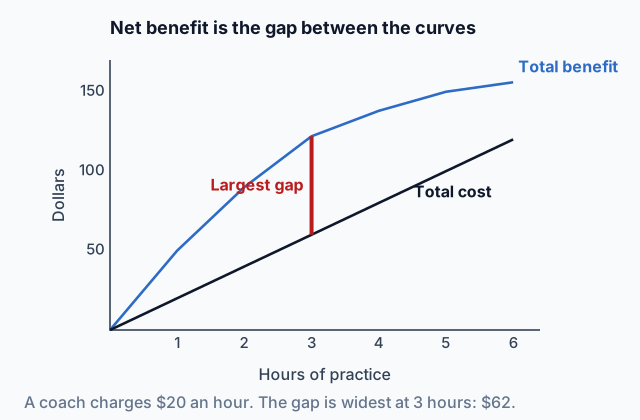
The best choice is 2 hours. It is not the option with the biggest total benefit (3 hours brings in the most but costs far more), and it is not the cheapest option either. Only the difference between the two columns decides. The graph near the top of the page shows the same idea for hours of practice: net benefit is the vertical gap between the total benefit and total cost curves, and the best number of hours is where that gap is widest.
Quick check · Fill the statement
Tap a blank, then tap a word or number.
A school's chess club can run a car wash for 1, 2 or 3 hours. Total benefits are $90, $150 and $180, and total costs are $40, $80 and $130. Net benefit is largest at hours, where it equals . Choosing 3 hours would be a mistake: 3 hours brings in the most , but it does not give the most net benefit.
2d. Bit by bit, or all at once
Some choices come in increments: how many hours to practice, how many loaves to bake. You can ask about each extra unit on its own: does one more hour add more benefit than it costs? That extra benefit and extra cost are called marginal benefit and marginal cost, and the next lesson works with them.
Other choices cannot be broken into pieces. Half a bridge is useless, and you cannot take 30% of a job offer. For these all-or-nothing choices, there is no extra unit to judge. You compare the total benefit of doing it with the total cost of doing it, implicit costs included, and do it only if the benefit is bigger.
In either kind of choice the goal is the same: the largest net benefit.
Quick check · Sort it
Tap a decision, then tap how it has to be judged.
One unit at a time
All or nothing: totals only
Part 3 Watch it done How many tours should Jo run?
Follow each step, then finish the last one yourself.
Jo leads kayak tours on a lake and can run 0 to 5 tours a day. Total benefit is her total revenue from tours. Total cost includes her rental fees and the pay she gives up at her part-time job for each tour she leads.
- 1 tour: total revenue $120, total cost $60
- 2 tours: total revenue $230, total cost $130
- 3 tours: total revenue $330, total cost $220
- 4 tours: total revenue $420, total cost $330
- 5 tours: total revenue $500, total cost $460
How many tours a day give Jo the largest net benefit?
Step 1 · Name the two sides
Jo is a business, so her total benefit is total revenue. Her total cost already counts the job pay she gives up, an implicit cost, so it is her full opportunity cost.
Step 2 · Net benefit, row by row
Subtract total cost from total revenue. 1 tour: $120 − $60 = $60. 2 tours: $230 − $130 = $100. Keep going down the table the same way.
Why this step?
Why not simply run 5 tours, where revenue is highest?
Each extra tour adds less revenue and more cost than the one before. Past some point a tour costs Jo more than it brings in, so net benefit falls even while revenue keeps rising.
Your step · Calculate
Jo can run 0 to 5 kayak tours a day. Her total revenue for 1 to 5 tours is $120, $230, $330, $420 and $500, and her total cost, including the job pay she gives up, is $60, $130, $220, $330 and $460. How many tours a day give Jo the largest net benefit?
tours
Part 4 Try it A county's yes-or-no choice
A new situation. Decide, then pick the reason that supports your decision.
Try it · Decide and justify
Ferris County is deciding whether to build a library branch. It can build the branch as planned or not at all. Over its life, the branch would give residents benefits worth $8 million. The county would pay builders $5 million. The branch would go on a county lot that the county now leases to a car dealer, and it would lose $4 million of lease payments over the same years. Should the county build the branch?
Which reason supports your choice?
Part 5 Explain it Answer a short free-response question
Nothing you type leaves this page.
Free response is 33.35% of the exam score. This one is shaped like Question 3, Short.
Free-response practice · Question 3 style
Carmen owns a food truck. A couple offers her $700 to cater their wedding on Saturday. Food and staff for the wedding would cost her $300. If she turns the wedding down, she will spend Saturday at the farmers market, where she clears $350 after all her costs. (a) Define opportunity cost. (b) Calculate Carmen's total cost of catering the wedding, counting explicit and implicit costs. Show your work. (c) Should Carmen cater the wedding? Explain using total benefit and total cost.
Model answer
(a) Opportunity cost is the value of the best alternative given up when a choice is made. (b) The explicit cost is the $300 of food and staff. The implicit cost is the $350 she would clear at the farmers market. Total cost = $300 + $350 = $650. (c) Yes. Her total benefit from catering is the $700 she is paid, which is more than the $650 total cost, so catering gives her a net benefit of $50.
Score your own answer. This is a self-check, not a grade. Tick each point your answer makes.
Part 6 Check yourself Read Elena's streaming choices
Read the table first, then answer the questions from it.
Elena is deciding how many streaming services to subscribe to. She has measured her total benefit, the utility she gets, as the most she would be willing to pay each month for that many services. Each service costs $12 a month.
| Services | Total benefit | Total cost |
|---|---|---|
| 0 | $0 | $0 |
| 1 | $25 | $12 |
| 2 | $44 | $24 |
| 3 | $54 | $36 |
| 4 | $60 | $48 |
Case question 1 · Calculate
What is Elena's net benefit from subscribing to 3 services, in dollars per month?
Case question 2 · Multiple choice
How many streaming services should Elena subscribe to?
The rest stand on their own and do not use the case.
Check yourself · Spot the error
Lucia is deciding whether to spend next year at a college or keep working full time. Whatever she does, she will rent the same apartment for $8,000 a year. A student added up her cost of a year at college. Tap the first line with a mistake.
Check yourself · Select all
Jada quits her job as a lawyer to open a bakery, which she pays for with her own savings. Which two are implicit costs of running the bakery? Select two.
Select 2 answers, then check.
Part 7 Keep it Keep it
From 1.4 Comparative Advantage and Trade · Calculate
In a day, Rosa can bake 24 pies or 8 cakes, at a constant opportunity cost. What is Rosa's opportunity cost of baking one cake, in pies?
From 1.2 Resource Allocation and Economic Systems · Decide and justify
In the country of Halvard, private firms own most factories and stores, and prices set by buyers and sellers decide what most firms make. The government runs the public schools, owns the national railway and sets safety rules for food. What kind of economic system does Halvard have?
Which reason supports your choice?
In three lines
- Opportunity cost counts explicit costs (money paid) and implicit costs (value given up).
- Total benefit is utility for a consumer and total revenue for a firm.
- The optimal choice has the largest net benefit; all-or-nothing choices are judged on totals.
Exam strategy for this topic
- Section I, Multiple Choice: 60 questions in 70 minutes.
- Section II, Free Response: 3 questions in 60 minutes.
- This lesson's Explain it is shaped like free-response question 3, Short.
- A four-function calculator is allowed on both sections of the exam.
When a question gives you costs, sort them into money paid and value given up before you add anything, and write the subtraction for net benefit out in full. For a choice that comes in units, show the net benefit of each option so a reader can see where it peaks.
Questions students ask
What is the difference between explicit and implicit costs?
An explicit cost is money you pay out, such as rent or tuition. An implicit cost is value you give up with no payment, such as the wages you could have earned with the same time. The opportunity cost of a choice counts both.
Is opportunity cost the same as the price?
No. The price is only the explicit part. A concert ticket that costs $60 and makes you skip a $90 shift has an opportunity cost of $150.
Why not choose the option with the most total benefit?
Because it can also have the most cost. The best option is the one where total benefit beats total cost by the widest margin, which is the largest net benefit.
When should I compare totals instead of looking one unit at a time?
When the choice cannot be split into pieces, such as whether to take a job, buy a particular car or build a bridge. Then you compare the total benefit of doing it with its total cost.
How is utility measured?
Usually in made-up units called utils. When a problem needs to compare a benefit with a dollar cost, it may state utility in dollars instead, as the most the person would be willing to pay.
Course alignment, for teachers
AP Microeconomics topic 1.5, Unit 1: Basic Economic Concepts.
- Skill 1.C: Identify an economic concept, principle, or model using quantitative data or calculations.
This lesson maps all 4 essential knowledge statements of the topic to the part that teaches each one: 4 are checked by a scored question. The map is in the lesson file.