Unit 1 · Topic 1.6 · about 30 minutes · 7 parts · 10 scored checks, 1 of them multiple choice, plus 2 from earlier lessons
AP Microeconomics 1.6: Marginal Analysis and Consumer Choice
Unit 1: 12 to 15% of the multiple-choice section
What you'll be able to do
- Define the assumptions of consumer choice, and explain and calculate how a rational consumer uses marginal benefit and marginal cost to decide, from a table or graph.
- Define marginal analysis and its terms, and explain a decision using marginal analysis, from a table or graph.
Key vocabulary
| Term | What it means | The exam trap |
|---|---|---|
| Utility | The satisfaction a consumer gets from consuming a good or service, often counted in utils. | Utility measures satisfaction, not price paid or usefulness to anyone else. |
| Total utility | The satisfaction from all the units of a good a consumer has. | Total utility and marginal utility are different columns, so check which one a question names before you read a number off a table. |
| Marginal utility | The change in total utility from consuming one more unit of a good. | Marginal utility can be small while total utility is large, so a big total says little about the next unit. |
| Diminishing marginal utility | The pattern in which each extra unit of a good adds less satisfaction than the one before. | Diminishing marginal utility means the extra shrinks, not that total utility falls. |
| Marginal utility per dollar | Marginal utility divided by price: the satisfaction the next dollar buys. | Marginal utility per dollar changes as you buy more of a good, because each unit usually adds less than the one before. |
| Marginal benefit | The extra benefit from one more unit of an activity. | Marginal benefit belongs to the next unit only, never to all the units together. |
| Marginal cost | The extra cost of one more unit of an activity. | Marginal cost is the cost of the next unit alone, not the average cost of all the units so far. |
| Sunk cost | A cost already paid that cannot be recovered. | Sunk is about whether money can be recovered, not about how much was paid. |
| Fixed benefit | A benefit already determined by a past choice, such as a bonus already received. | A fixed benefit can be large and still be settled, so ask whether it is already in hand. |
 Tap to open the picture full size
Part 1 Think first The all-you-can-eat buffet
Make a guess first. Even a wrong guess helps the answer stick.
Predict first
Marcus pays $18 for an all-you-can-eat lunch buffet, and the money cannot be refunded. He has finished two plates. How should he decide whether to go back for a third plate?
In short. Marginal analysis compares what one more unit of something adds (its marginal benefit) with what it costs (its marginal cost), and a rational consumer keeps going only while the extra benefit is worth the extra cost.
- Consumers have limited income and time, and in this model they choose to make their total utility as large as possible.
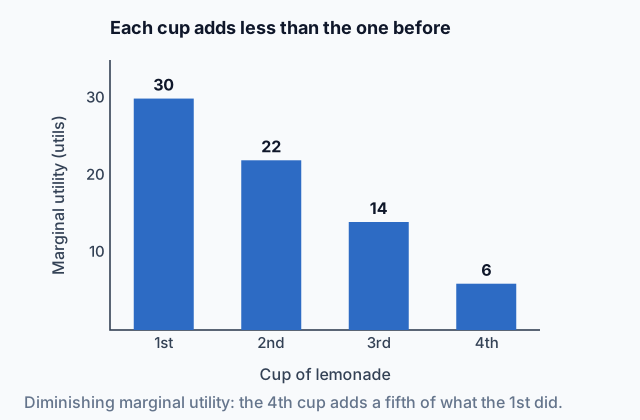
- Each extra unit of a good usually adds less satisfaction than the one before: diminishing marginal utility.
- With a limited budget, spend each dollar where it adds the most utility, until the marginal utility per dollar is equal across goods.
Part 2 Learn it Four ideas, with a check after each
2a. Limited means, one goal
The model of consumer choice starts from two assumptions.
First, consumers face constraints. Income is limited, and there are only so many hours in a week. A student with $30 for the weekend cannot buy everything at the mall.
Second, consumers are rational: within those constraints, they choose the combination of goods and services that makes their total utility, their total satisfaction, as large as possible. The model does not say what anyone should like. It takes each person's tastes as given and asks how that person gets the most out of a limited budget.
Put the two together and every purchase becomes a choice between uses of the same scarce dollars. A dollar spent on snacks is a dollar not spent on a movie, so the consumer has to decide where each dollar does the most good.
Quick check · Fill the statement
Tap a blank, then tap a word or phrase.
Rosa has $40 and one free Saturday. In the model of consumer choice, her $40 and her one Saturday are , and she spends them on the combination of things that makes her as large as it can be.
2b. Each one adds less: diminishing marginal utility
Marginal utility is the extra utility from one more unit of a good: the change in total utility. Economists often count it in made-up units called utils.
Think about water on a long hike. The first bottle is a relief. The second is welcome. By the fifth you are carrying it, not drinking it. Each bottle still adds something, but less than the one before. That pattern is diminishing marginal utility, and consumers experience it with almost every good.
To find marginal utility from a table of total utility, subtract: the total with this unit minus the total without it. If 1 bottle gives 40 utils and 2 bottles give 65, the second bottle's marginal utility is 65 − 40 = 25 utils.
Total utility can still be rising while marginal utility falls. Total utility is the height you have climbed, and marginal utility is the size of the next step.
Quick check · Calculate
Leo's total utility from slices of pizza at lunch is 20 utils for 1 slice, 36 utils for 2 slices, 48 utils for 3 slices and 56 utils for 4 slices. What is the marginal utility of the third slice, in utils?
2c. Marginal utility per dollar
Goods have different prices, so comparing marginal utility alone can mislead. A concert ticket might add more utility than a sandwich, but it also costs ten times as much.
The fair comparison is marginal utility per dollar: marginal utility divided by price. It says how much satisfaction the next dollar buys.
- A $3 sandwich adding 24 utils: 24 ÷ 3 = 8 utils per dollar.
- A $30 ticket adding 150 utils: 150 ÷ 30 = 5 utils per dollar.
The sandwich is the better use of the next dollar.
A consumer with limited income keeps spending the next dollar wherever its marginal utility per dollar is highest. Because of diminishing marginal utility, the good being bought keeps adding less, so the numbers come together. When income runs out and the marginal utility per dollar of the last unit of each good is equal, no switch of a dollar from one good to another can raise total utility. That combination maximizes utility.
In symbols: MU of good A ÷ price of A = MU of good B ÷ price of B.
Quick check · Rank it
Bea has a little money left and is choosing her next purchase. A paperback costs $10 and would add 70 utils. A movie ticket costs $12 and would add 72 utils. A smoothie costs $2 and would add 18 utils. Rank the three by marginal utility per dollar.
Highest marginal utility per dollar first
Give each one a place, 1 for first. Give two the same place if they are equal.
Your ranking: none yet
2d. Marginal benefit, marginal cost, and what to ignore
Marginal analysis compares the marginal benefit (MB) of one more unit of an activity with its marginal cost (MC), the extra cost of that unit.
- If MB > MC, the next unit adds more than it costs: increase.
- If MB < MC, the last unit cost more than it added: decrease.
- If MB = MC, you are at the best amount: maintain.
The optimal quantity is where marginal benefit equals marginal cost, which is also where total benefit minus total cost is as large as it can be. In a table that moves in whole units, keep adding units while MB is at least MC, and stop before the first unit whose MB falls below its MC.
Costs already paid and benefits already locked in do not matter. A sunk cost, such as a nonrefundable ticket or a fixed fee already paid, is the same whichever way you choose next, so it changes neither MB nor MC of the next unit. The same goes for a fixed benefit already settled by a past choice, such as a signing bonus already received: it does not change whether one more shift is worth working.
Quick check · Decide and justify
Omar paid a $60 nonrefundable fee for a month at a climbing gym. He is deciding whether to climb one more evening this week. That evening of climbing is worth $15 to him. If he climbs, he gives up an evening of tutoring that pays $20. Should Omar climb the extra evening?
Which reason supports your choice?
Part 3 Watch it done Spending $12 on tacos and smoothies
Follow each step, then finish the last one yourself.
Ana has $12 to spend at a food stand. Tacos cost $2 each and smoothies cost $4 each. Her marginal utility from each one is:
- Tacos, 1st to 6th: 16, 12, 8, 6, 4 and 2 utils
- Smoothies, 1st to 4th: 32, 24, 16 and 8 utils
Which combination spends her $12 and gives her the most total utility?
Step 1 · Marginal utility per dollar
Divide each marginal utility by the price. Tacos ($2): 8, 6, 4, 3, 2, 1 utils per dollar. Smoothies ($4): 8, 6, 4, 2 utils per dollar.
Step 2 · Spend the next dollars where they do the most
The first taco and the first smoothie both give 8 per dollar, the highest, so Ana buys both: $2 + $4 = $6 spent, $6 left. Now compare the next taco with the next smoothie the same way.
Why this step?
Why compare utility per dollar, not just marginal utility?
A smoothie adds more utils than a taco but costs twice as much. Dividing by price shows what each dollar buys, which is what Ana has a limited number of.
Your step · Calculate
Ana has $12. Tacos cost $2 and smoothies cost $4. Her marginal utilities from the 1st to 6th taco are 16, 12, 8, 6, 4 and 2 utils, and from the 1st to 4th smoothie 32, 24, 16 and 8 utils. How many tacos are in the combination that spends her $12 and maximizes her total utility?
tacos
Part 4 Try it New tables, same rule
A new situation each time. Every question draws a new table of the marginal utility of two goods and a budget. Some ask how many of each to buy, and some ask for the total utility of the best combination.
One more decision, from marginal benefit and marginal cost. This one has no budget and no second good: compare what each extra hour adds with what it costs.
Try it · Calculate
Sami can buy guitar lessons at $9 an hour. Sami's marginal benefit from the 1st to the 5th hour of lessons each month is $18, $14, $11, $7 and $3. How many hours of lessons a month maximize Sami's net benefit?
Part 5 Explain it Answer a short free-response question
Nothing you type leaves this page.
Free response is 33.35% of the exam score. This one is shaped like Question 2, Short.
Free-response practice · Question 2 style
Lena pays $10 an hour to use a batting cage. Her marginal benefit from the 1st to the 5th hour each week is $20, $16, $12, $8 and $4. She has already paid a $25 membership fee that cannot be refunded. (a) Identify the number of hours a week that maximizes Lena's net benefit. Explain using marginal analysis. (b) The price of an hour falls to $6. Will Lena use the cage more hours, fewer hours or the same number? Explain. (c) Does the $25 membership fee change the number of hours that maximizes Lena's net benefit? Explain.
Model answer
(a) 3 hours. The 1st, 2nd and 3rd hours each add more benefit ($20, $16, $12) than their $10 marginal cost, but the 4th hour adds only $8, less than $10, so a 4th hour would lower her net benefit. (b) More hours. At $6 an hour, the 4th hour's marginal benefit of $8 is now greater than its marginal cost, so she uses the cage 4 hours. The 5th hour's $4 is still below $6. (c) No. The fee is already paid and cannot be recovered, so it is the same whatever she does next. It changes neither the marginal benefit nor the marginal cost of any hour.
Score your own answer. This is a self-check, not a grade. Tick each point your answer makes.
Part 6 Check yourself Read Mira's day at the fair
Read the table first, then answer the questions from it.
Mira has $12 to spend on rides at a county fair. A roller coaster ride costs $4 and a bumper car ride costs $2, and the fair limits each rider to 4 rides of each kind. The table shows her total utility from each number of rides.
| Rides | Roller coaster ($4) | Bumper cars ($2) |
|---|---|---|
| 1 | 40 | 18 |
| 2 | 72 | 34 |
| 3 | 92 | 46 |
| 4 | 104 | 52 |
Case question 1 · Calculate
What is the marginal utility per dollar of Mira's second roller coaster ride, in utils per dollar?
Case question 2 · Multiple choice
Which combination of rides that Mira can afford with $12 maximizes her total utility?
The rest stand on their own and do not use the case.
Check yourself · Spot the error
A bagel shop has already paid $500 for this month's oven lease, which it cannot get back. One more batch of bagels would add $30 to revenue and $24 to the cost of flour, labor and power. A student wrote this analysis. Tap the first line with a mistake.
Check yourself · Match
Tap a situation, then tap the idea it shows.
Part 7 Keep it Keep it
From 1.5 Cost-Benefit Analysis · Fill the statement
Tap a blank, then tap a word or number.
A school's chess club can run a car wash for 1, 2 or 3 hours. Total benefits are $90, $150 and $180, and total costs are $40, $80 and $130. Net benefit is largest at hours, where it equals . Choosing 3 hours would be a mistake: 3 hours brings in the most , but it does not give the most net benefit.
From 1.3 Production Possibilities Curve · Decide and justify
Kirin makes only smartphones and rice. A new chip design lets each factory worker assemble twice as many phones a day. Rice farming does not change, and neither do Kirin's resources. What happens to Kirin's PPC?
Which reason supports your choice?
In three lines
- Consumers face limited income and time, and choose to maximize total utility.
- Marginal utility usually diminishes; compare goods by marginal utility per dollar until it is equal.
- Do more while marginal benefit is at least marginal cost, and ignore sunk costs.
Exam strategy for this topic
- Section I, Multiple Choice: 60 questions in 70 minutes.
- Section II, Free Response: 3 questions in 60 minutes.
- This lesson's Explain it is shaped like free-response question 2, Short.
- A four-function calculator is allowed on both sections of the exam.
In a utility table, add a column for marginal utility and one for marginal utility per dollar before you answer anything; most mistakes come from reading the wrong column. When you explain a decision, name both numbers being compared, such as "the 4th hour adds $8 of benefit and costs $10".
Questions students ask
What is the difference between total utility and marginal utility?
Total utility is the satisfaction from all the units you have. Marginal utility is what the last unit added, the change in total utility. Total utility can rise while marginal utility falls.
Why divide marginal utility by price?
Because goods cost different amounts. Dividing by price tells you how much satisfaction each dollar buys, so you can compare a $2 snack with a $12 ticket fairly.
What does it mean that marginal utility per dollar is equal across goods?
It means the last dollar spent on each good adds the same satisfaction. With the budget spent, moving a dollar from one good to another cannot raise total utility, so the consumer is at the best combination.
Why should sunk costs be ignored?
A sunk cost is already paid and stays the same whatever you decide next, so it cannot change the benefit or cost of one more unit. Only what changes with the decision matters.
What if two choices give the same marginal utility per dollar?
Then the last dollar does equally well on either one, so it makes no difference which you buy next. What matters is that you never stop while a dollar moved from one good to the other would buy more utility.
Beyond the AP Exam
College Board sets this limit on what the AP Exam asks about this topic. Anything past it is not on the exam.
Indifference curves are beyond the scope of the course and the AP Exam, but equating the ratios of marginal utility to price is within the scope.
Course alignment, for teachers
AP Microeconomics topic 1.6, Unit 1: Basic Economic Concepts.
- Skill 2.C: Interpret a specific economic outcome using quantitative data or calculations.
This lesson maps all 7 essential knowledge statements of the topic to the part that teaches each one: 7 are checked by a scored question. The map is in the lesson file.